-
-
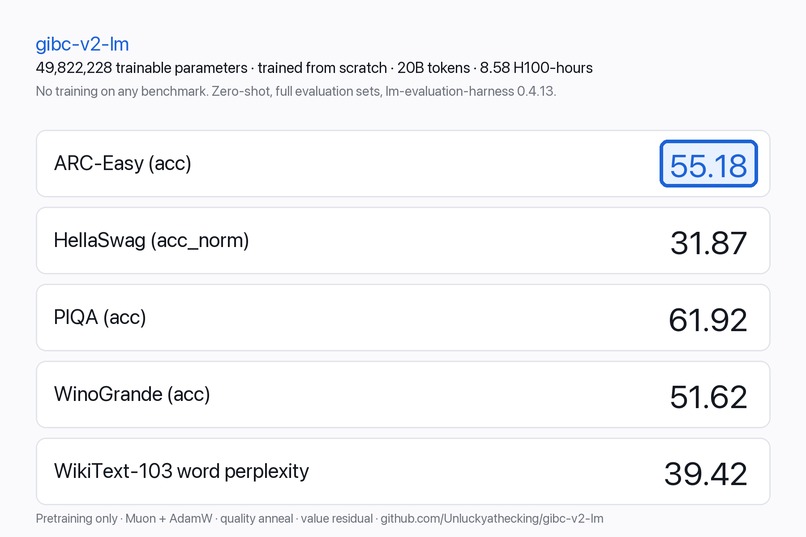
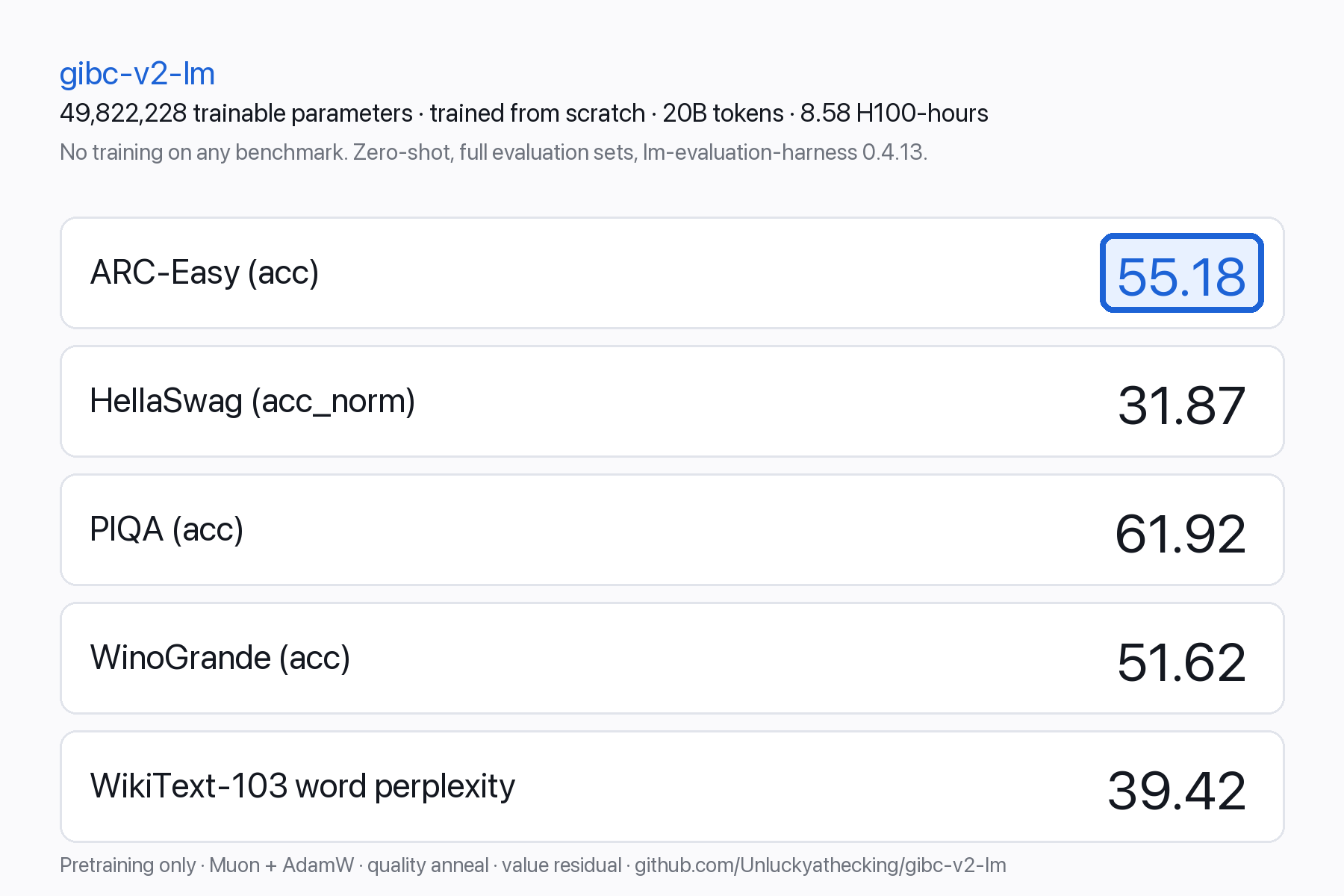
Headline scores of the submitted model (pretraining only, zero-shot); ARC-Easy highlighted
-
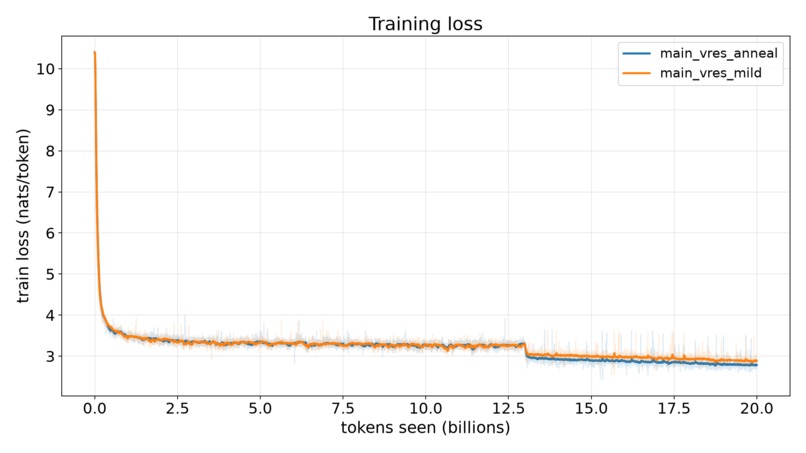
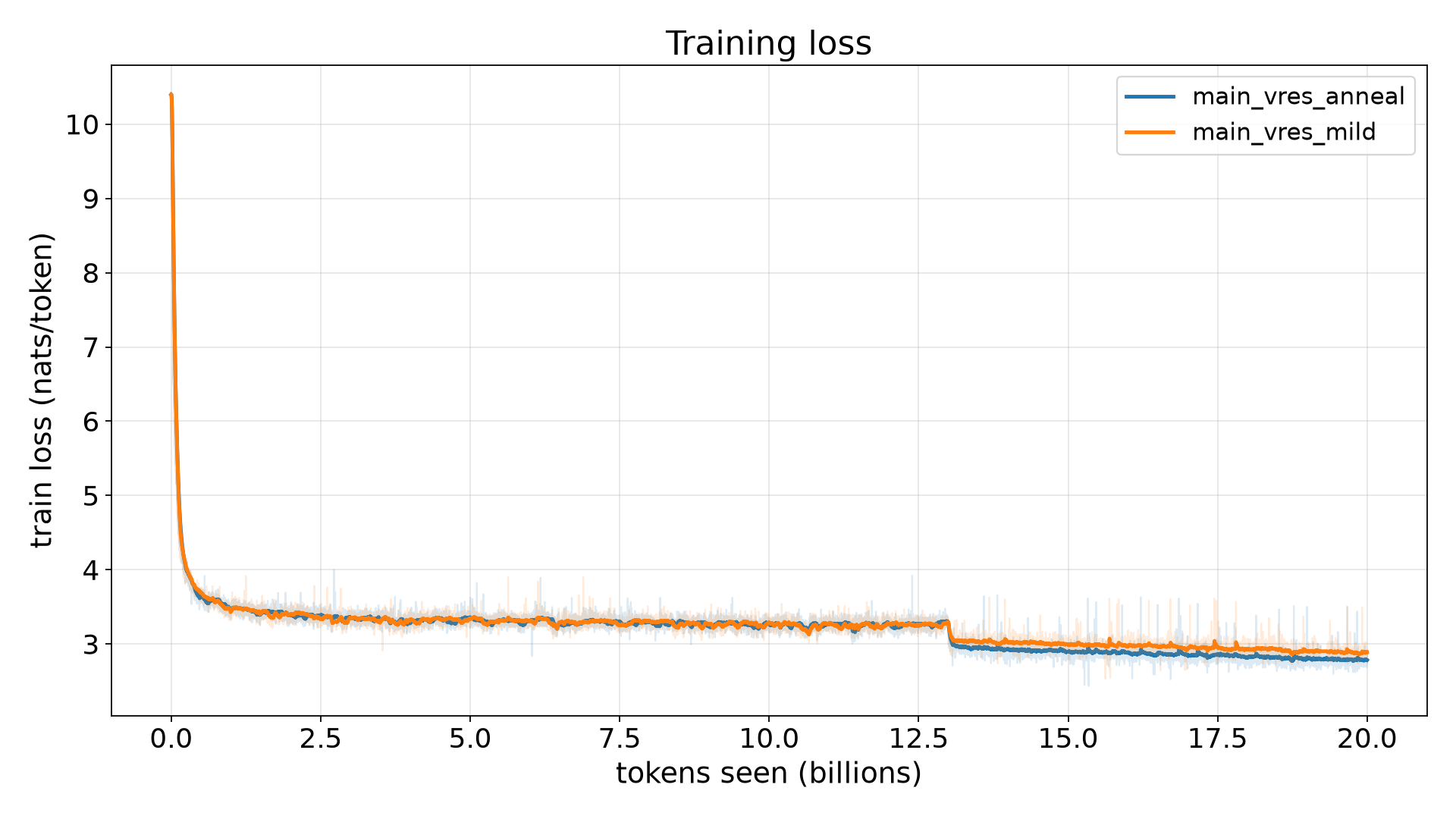
Training loss for the two main runs; the anneal mix starts at step 24,795
-
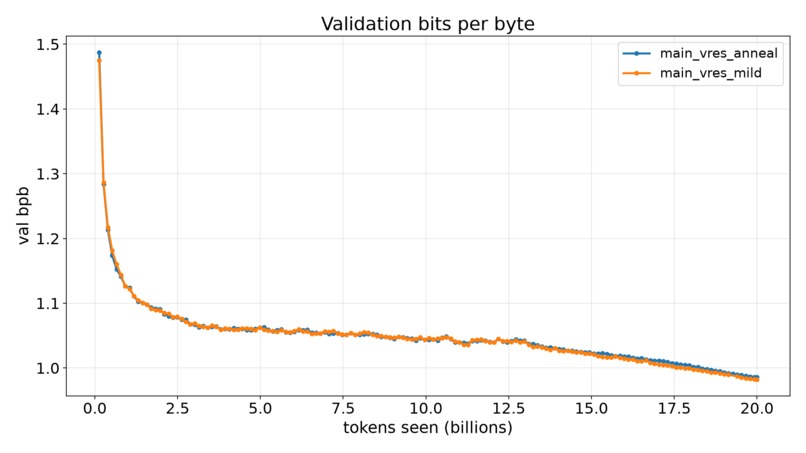
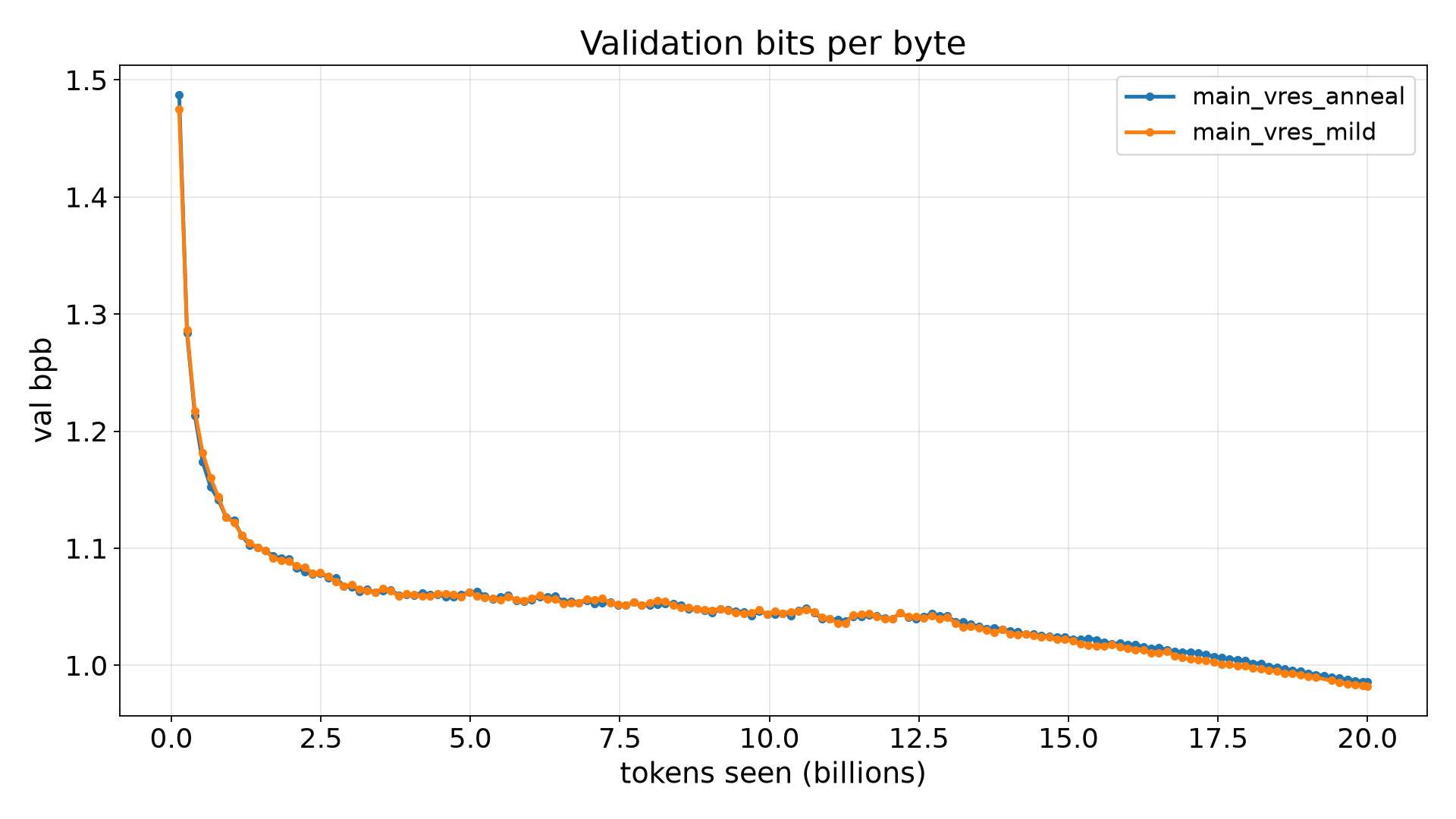
Validation bits per byte for the two 20B-token main runs
-
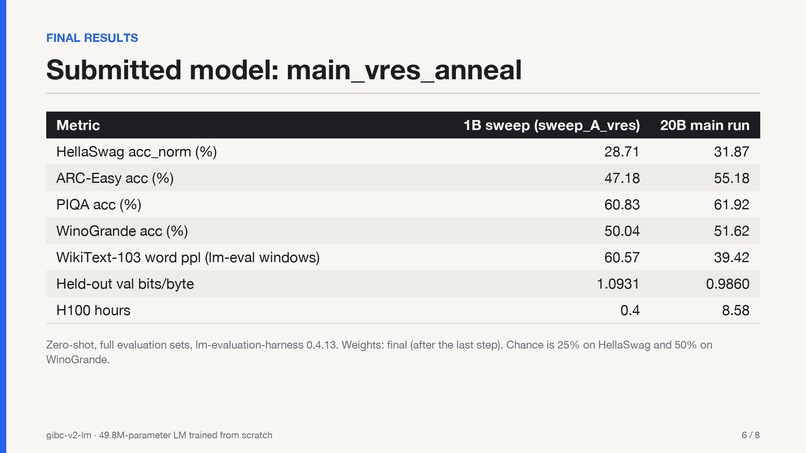
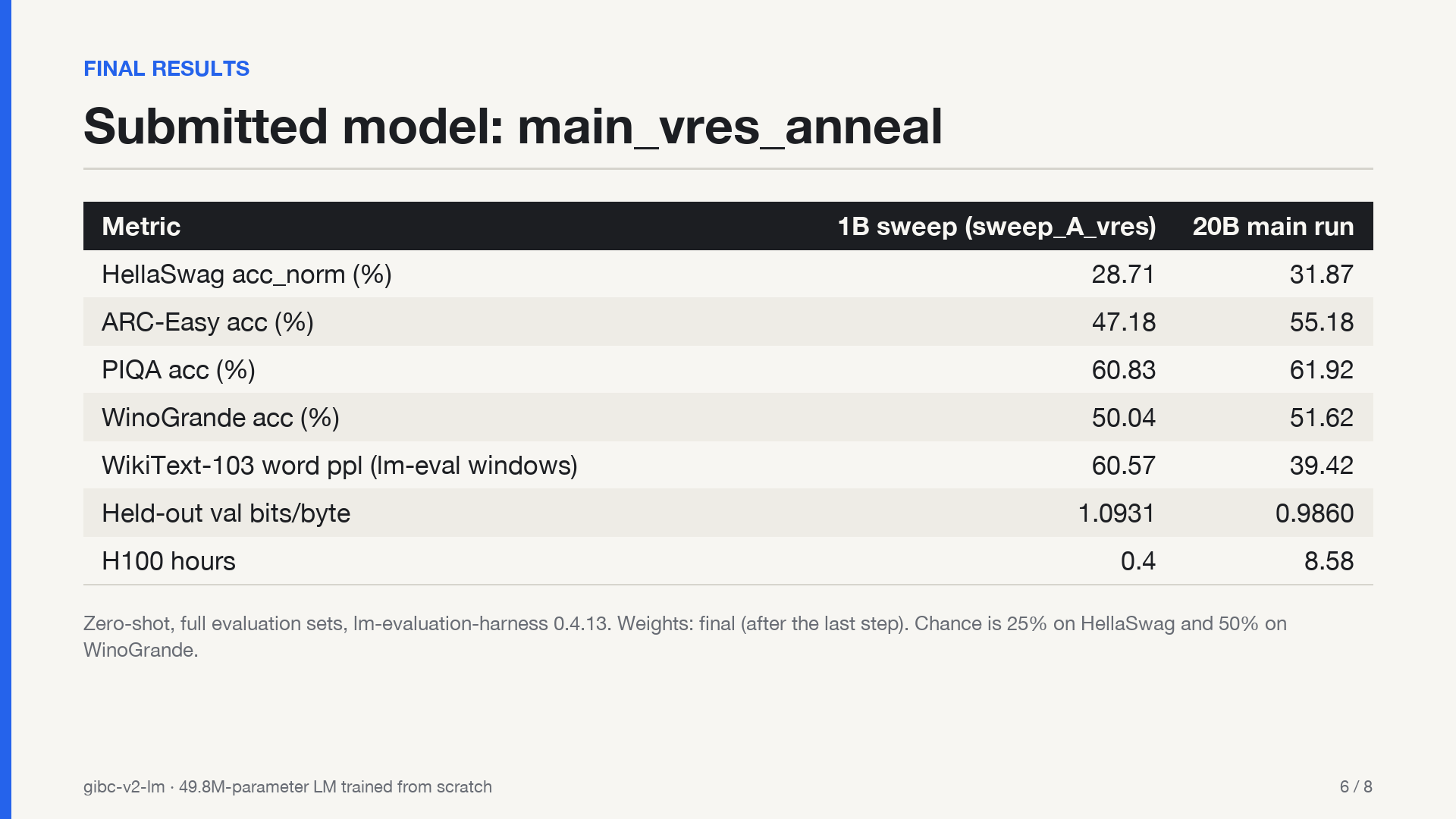
Final results of the submitted model vs the 1B-token sweep
-
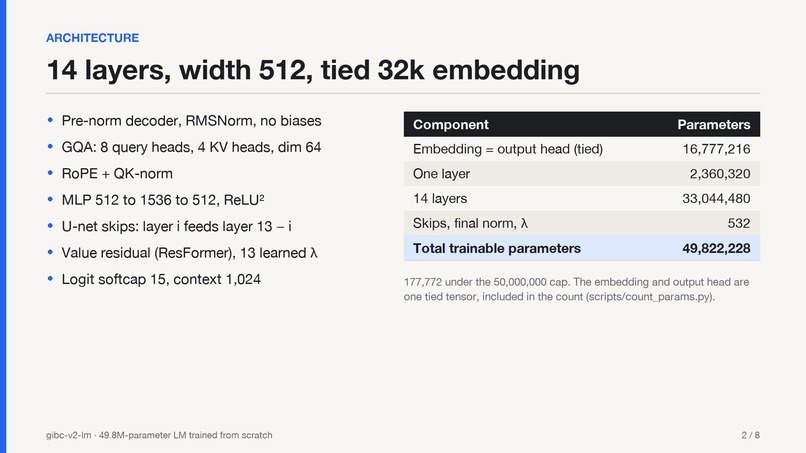
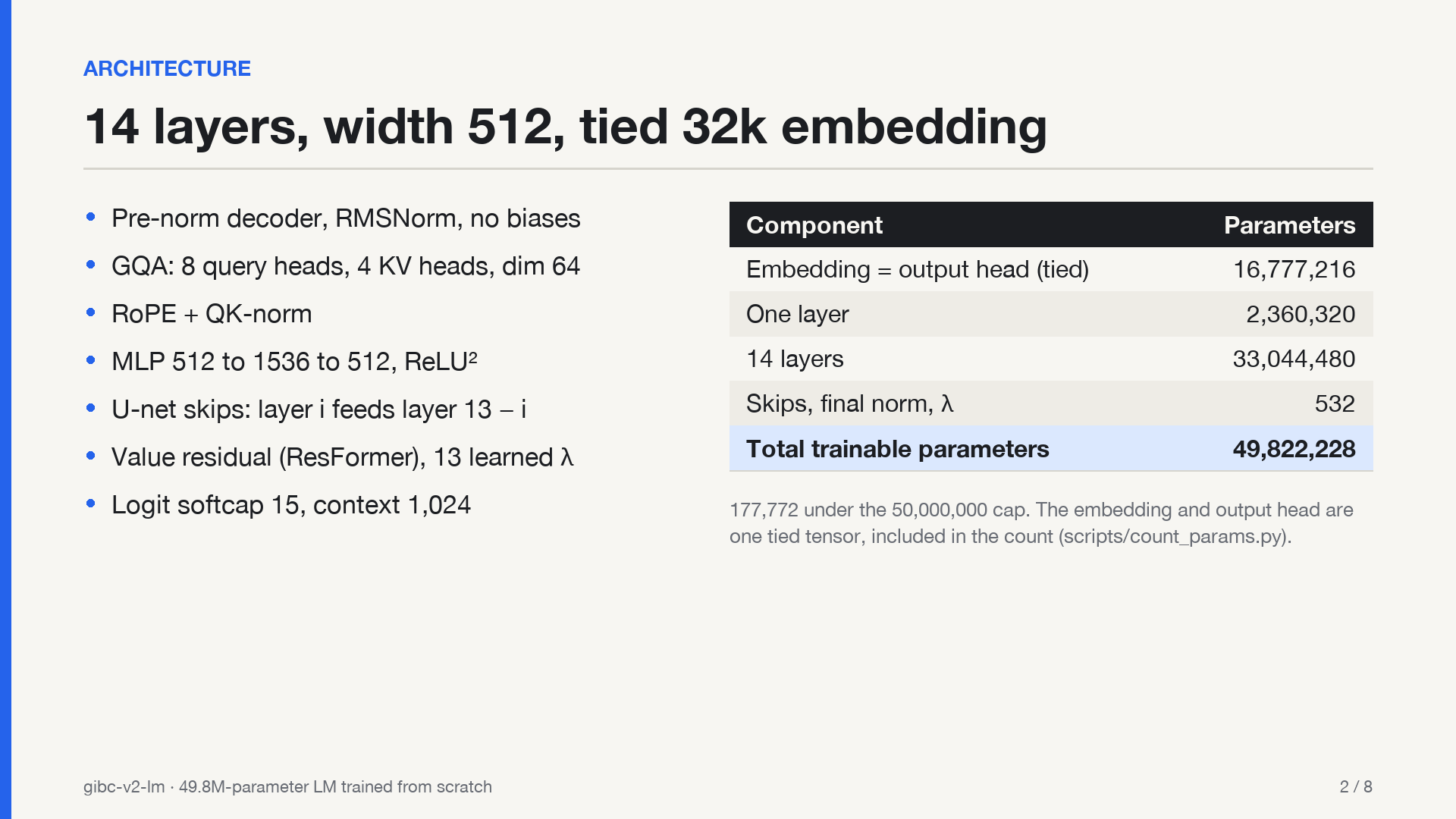
Architecture and parameter count: 49,822,228 trainable parameters
-
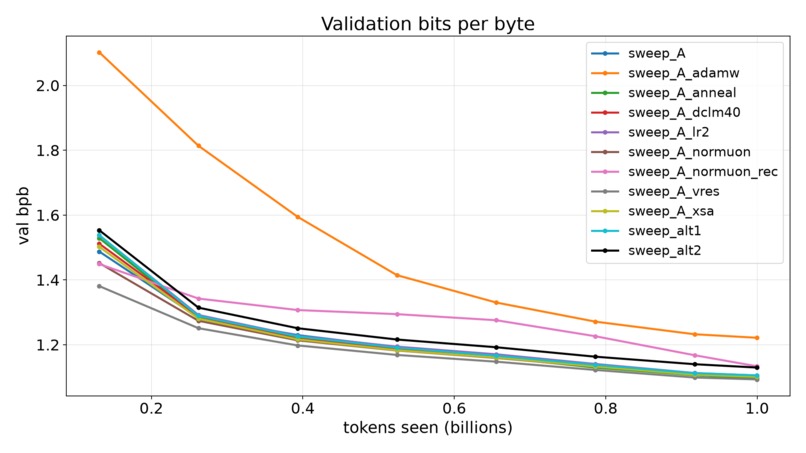
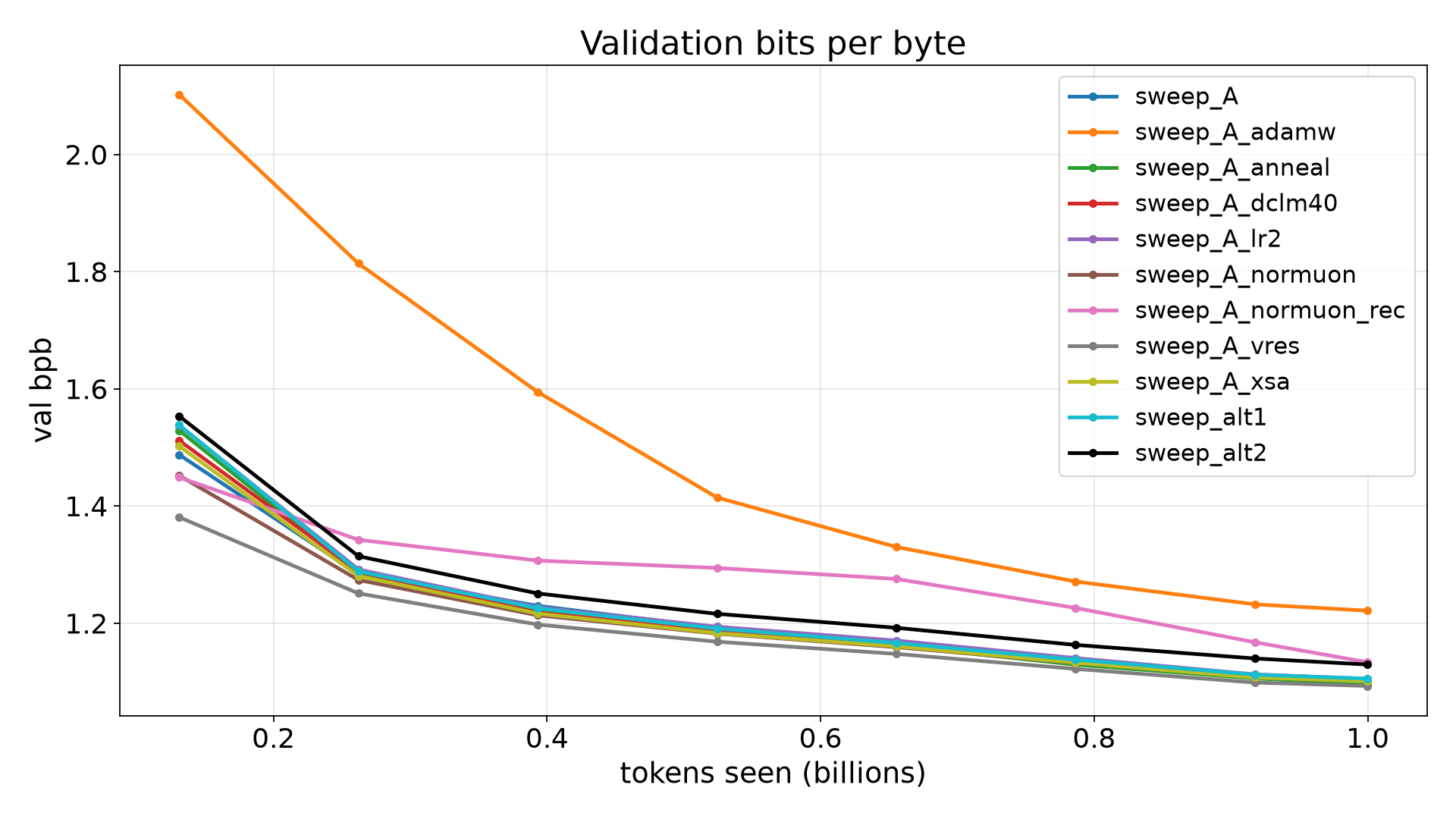
Validation bits per byte for the 12-arm, 1B-token ablation sweep
Headline results
No training on any benchmark. HellaSwag, ARC, PIQA and WinoGrande data (train, validation or test) never entered training, and there is no fine-tuning stage of any kind. Every score below is zero-shot on the full evaluation set, lm-evaluation-harness 0.4.13.
Submitted model: main_vres_anneal, 49,822,228 trainable parameters, trained from scratch on 20B tokens, one NVIDIA H100, 8.58 GPU-hours.
| Benchmark | Score |
|---|---|
| HellaSwag (acc_norm) | 31.87 |
| ARC-Easy (acc) | 55.18 |
| PIQA (acc) | 61.92 |
| WinoGrande (acc) | 51.62 |
| WikiText-103 test word perplexity (lm-eval-style windows) | 39.42 |
| WikiText-103 test word perplexity (stride-512 sliding window) | 35.21 |
Reference: Pythia-70M (300B tokens) reports HellaSwag 26.6, ARC-Easy 36.9, PIQA 60.0.
Methods: Muon + AdamW, warmup-stable-decay, quality anneal on curated data for the last 35%, ResFormer value residual, grouped-query attention, RoPE, QK-norm, ReLU², U-net skips, logit softcap, tied 32k BPE embedding. Every choice tested first in a 12-arm, 1B-token ablation sweep. Training data decontaminated against WikiText-103 (4,969 documents dropped); benchmark overlap measured and reported.
Code and full write-up: https://github.com/Unluckyathecking/gibc-v2-lm
Demo video: https://youtu.be/rbA6RGoDeYU
Inspiration
Track 01 caps the model at 50 million trainable parameters, embeddings and output head included. With a 32k vocabulary the embedding alone costs 16.8M, a third of the budget. We wanted to see how much a single rented H100 and the modded-nanogpt speedrun techniques could get out of the remaining two thirds, and to report every number plainly, including the ones that argue against our choices.
What it does
gibc-v2-lm is a 14-layer decoder-only transformer, width 512, with 49,822,228 trainable parameters, under the 50,000,000 cap. It is trained from random initialisation on 20B tokens with our own 32k byte-level BPE tokenizer, pretraining only: no fine-tuning stage and no benchmark data of any kind in training. All scores are zero-shot.
The submitted model is main_vres_anneal (final weights). Zero-shot on the full sets it scores HellaSwag 31.87 (acc_norm), ARC-Easy 55.18 (acc), PIQA 61.92 (acc), WinoGrande 51.62 and WikiText-103 test word perplexity 39.42 with lm-eval-style windows (35.21 with a stride-512 sliding window). The second main run, main_vres_mild, which uses a milder anneal, scores 32.15, 53.24, 61.97, 51.46 and 38.76. We submit the anneal run for its 1.9-point ARC-Easy lead at equal PIQA and WinoGrande. A third 20B run, main_alt2_vres_anneal, is a vocabulary-size ablation: the same recipe with a 16k tokenizer and 41,433,620 trainable parameters. It scores 31.61, 53.75, 61.43, 50.67 and 42.46. For scale, Pythia-70M reports HellaSwag 26.6, ARC-Easy 36.9 and PIQA 60.0 after 300B tokens, with a different recipe and data.
How we built it
The recipe is Muon on the block matrices and AdamW on the embedding and scalars, with QK-norm, ReLU², U-net skips and a logit softcap from modded-nanogpt, plus a ResFormer value residual. Training uses a warmup-stable-decay schedule; for the last 35% the loader switches to a quality anneal mix of high-scoring FineWeb-Edu, FineMath and 5% decontaminated Wikipedia. The two main runs differ only in how hard the anneal leans on curated data. The submitted run took 8.58 H100-hours; the 1B-token sweep that chose its recipe took 5.23.
Before committing to a 20B run we ran a 12-run, 1B-token ablation sweep: a baseline plus 11 single-change arms, each about half an H100-hour.
The data is all public: FineWeb-Edu, DCLM-baseline, FineMath, FinePDFs and Wikipedia, under ODC-By, CC-BY-4.0 and CC-BY-SA/GFDL. No intentionally synthetic or LLM-generated dataset, no teacher model, no distillation data, no pretrained weights and no pretrained tokenizer; the web-derived corpora may incidentally contain AI-generated pages, which no public crawl can rule out. Every document sharing a 13-gram with WikiText-103 validation or test is dropped, 4,969 in total, plus 16 Wikipedia articles by title. We measured but did not filter the multiple-choice benchmarks: 3 HellaSwag, 1 ARC-Easy, 2 PIQA and 0 WinoGrande items overlap a 300M-token sample of the training data.
Evaluation uses lm-evaluation-harness 0.4.13 and our own WikiText-103 script, which follows lm-eval's normalisation. Everything runs on Modal.
This project was built with Claude Code agents (Claude Opus 5.5 and Claude Fable 5.1), which wrote the code and docs under the direction and review of Mohammed Alibhai, who set the goals, made the decisions and can explain every component.
Challenges we ran into
WikiText-103 is made of Wikipedia articles, and the web copies them. Before filtering, a 250M-token sample of our shards contained 4.96% of WikiText-103 test 13-grams, from 6 web documents. The cap was the other constraint: the tied embedding alone takes a third of the 50M budget. One seed at 1B tokens gives standard errors of 0.45 to 1.4 benchmark points, so most decisions rest on perplexity and bits per byte. Near the end, the main runs were stopped by our Modal spend limit and resumed from checkpoints with model, optimizer, RNG and data cursors restored; the README describes this, including 218 training-log lines lost from one run when two trainers briefly ran at once.
Accomplishments that we're proud of
Every change in the main runs was tested first. A 20B-token 16k-vocabulary ablation confirmed the sweep's choice of 32k, which leads by 0.3 to 1.4 benchmark points and 7% WikiText perplexity. Value residual cut 1B WikiText perplexity from 57.2 to 54.0 for 13 parameters, and Muon beat AdamW-only 57.2 to 89.0. The whole pipeline reproduces from public data with documented commands, and the README reports the unflattering results too.
What we learned
At this size the embedding decides the architecture. Perplexity is a far steadier signal than the benchmarks. The quality anneal traded PIQA for ARC-Easy at 1B, which we could not resolve, so both strengths became main runs. The Wikipedia anneal arm finished after the main runs started: ARC-Easy 48.74 and WikiText perplexity 54.70, against 47.98 and 58.51 without Wikipedia. At 20B tokens the trade-off mostly went away: the strong anneal kept its ARC-Easy gain and the PIQA drop seen at 1B did not appear (61.92 vs 61.97). Averaging the last four checkpoints gave nothing, because after a decay to zero they are nearly identical.
What's next
Multiple seeds for the close sweep results, a stacked run with Exclusive Self Attention and NorMuon, which each gave about 1.2 perplexity at 1B, and longer context than 1,024 tokens.

Log in or sign up for Devpost to join the conversation.