Inspiration
Technical storytelling requires a rare combination of skills: subject-matter expertise, editorial judgment, and filmmaking craft. The people closest to a breakthrough understand its nuance but may struggle to make it compelling. Creative teams know how to capture attention but can unintentionally flatten the science or overstate the claims.
The result is often accurate content nobody watches—or polished content technical audiences do not trust. We built Ghostwriter to eliminate that tradeoff and turn important technical work into stories that are both faithful and unforgettable.
What it does
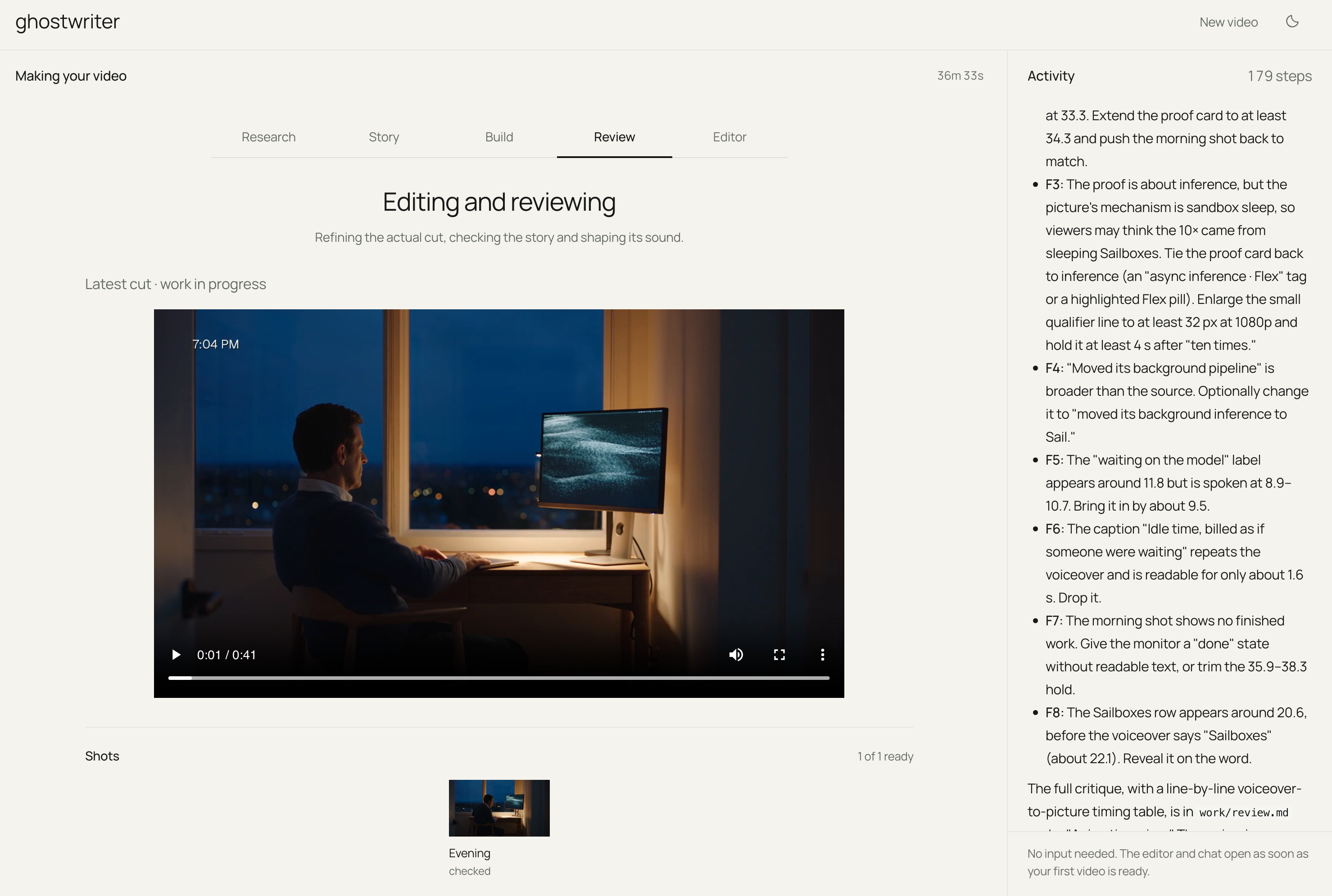
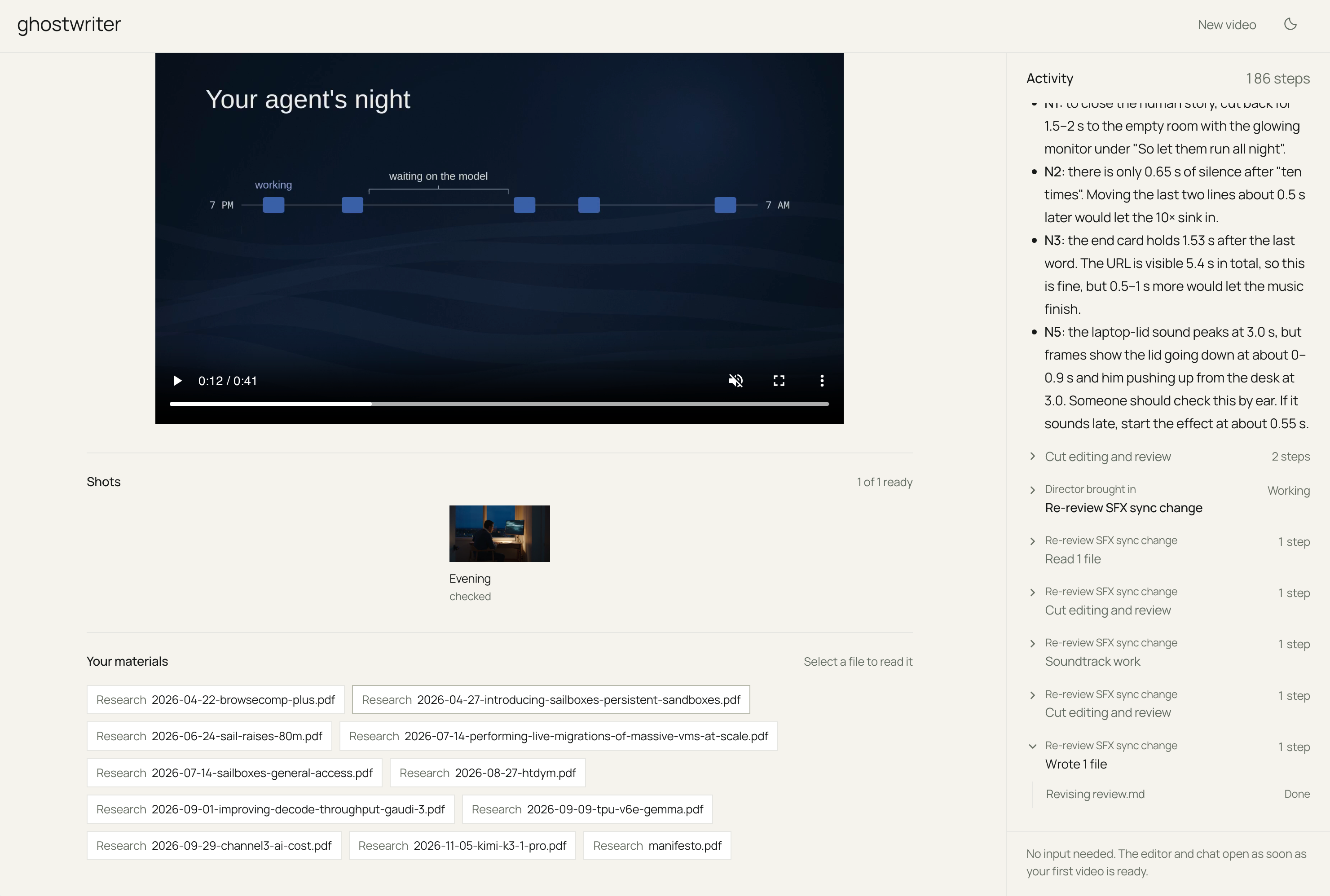
Ghostwriter turns research and company context into a short, technically faithful launch film.
Teams can provide research papers, product documents, brand guidance, audience insights, performance data, creative examples, and selected read-only Slack or Notion context. Ghostwriter identifies the one idea that matters most, then develops the hook, narrative, visual language, shots, and soundtrack around it.
An autonomous Director assembles specialist agents for research, story strategy, shot design, and independent review. It renders and inspects every shot, fixes weak outputs, assembles the film, and delivers an editable MP4. Teams can then edit manually or ask the editing agent to tighten the hook, add captions, change the format, or refine the soundtrack.
How we built it
Ghostwriter combines a Next.js and React interface with a Python FastAPI worker, connected through live server-sent events.
A Director built with the Claude Agent SDK orchestrates specialist agents and bounded tools. Universal Constructor helps search, classify, and extract evidence from large document sets, while original sources remain the authority for technical claims. Slack and Notion are exposed through scoped, read-only snapshots.
Seedance 2.5 and Grok Imagine generate video shots, ElevenLabs creates editable music and sound effects, and FFmpeg handles inspection, composition, mixing, and export. A persistent Pi-based editing agent works through a typed, versioned timeline API, making every agent edit reviewable, reversible, and safe from stale changes.
Challenges we ran into
The hardest problem was not generating video—it was deciding what the video was allowed to say.
Research papers, brand documents, performance data, Slack conversations, and Notion pages all carry different kinds of authority and can contradict one another. We had to separate factual evidence from creative context, preserve source provenance, resolve stale versus approved decisions, and treat retrieved content as untrusted evidence rather than agent instructions.
Media generation created another challenge: jobs are slow, nondeterministic, and sometimes costly. We needed to detect visual defects, preserve successful work through partial failures, prevent accidental duplicate requests, and keep manual edits, agent edits, audio, previews, and exports synchronized. Accomplishments that we're proud of We built the complete journey from raw technical material to an editable launch film.
Technical fidelity is part of the workflow—not merely a line in a prompt. Ghostwriter records claims and caveats, checks them against original sources, requires an independent review, and inspects every generated shot before publishing.
We are also proud of the balance between autonomy and control. Ghostwriter can make end-to-end creative decisions, while users can inspect its reasoning, edit the timeline themselves, undo changes, or switch the agent into a propose-first mode. The output is not a disposable generation; it is a project the team can continue shaping.
What we learned
We learned that great technical media does not come from one larger prompt. It comes from a disciplined creative process: research, interpretation, one sharp idea, a coherent visual device, independent review, inspection, and iteration.
We also learned that context should shape the story—not the facts. Research determines what is true; company context determines who cares, why it matters now, and how it should be communicated.
Finally, autonomous creative systems become more trustworthy when their decisions are visible, editable, and reversible.
What's next for Ghostwriter
Next, we want to make every on-screen claim traceable to its exact source passage, support richer brand assets and reference imagery, and generate platform-specific versions from one verified story.
We also plan to add collaborative reviews and approvals, more enterprise and media integrations, stronger automated evaluations, and a feedback loop that learns from real content performance without sacrificing factual fidelity.
Our goal is for Ghostwriter to become the creative system of record for technical launches: one grounded story, adapted everywhere, without losing the truth along the way.
