-
-

GhostWriter Logo
-
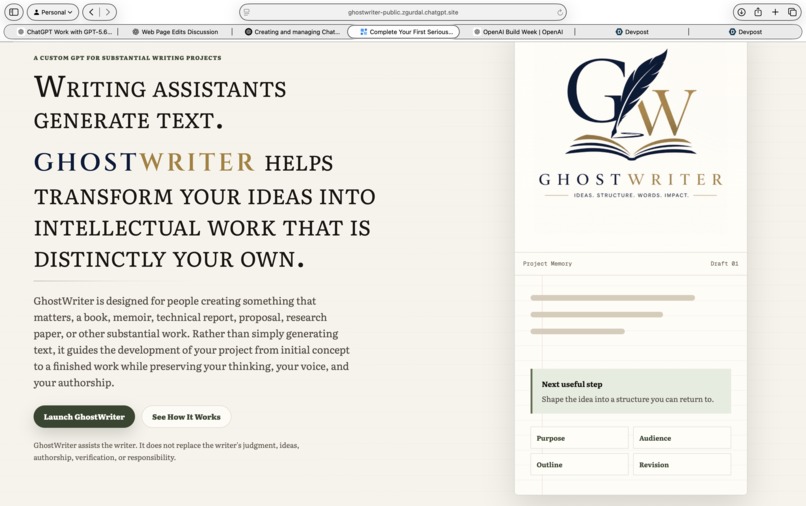
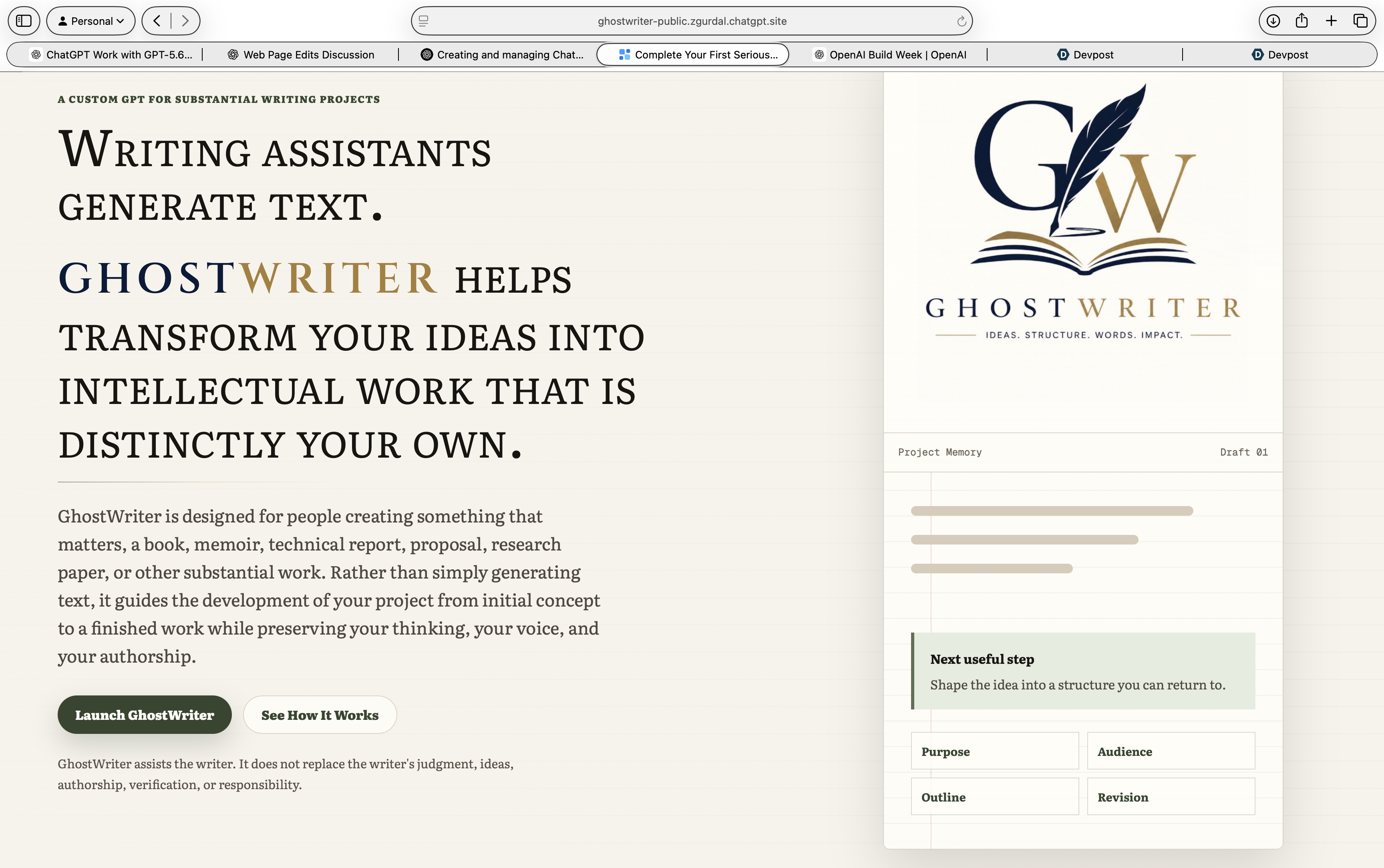
GhostWriter "Hero" page
-
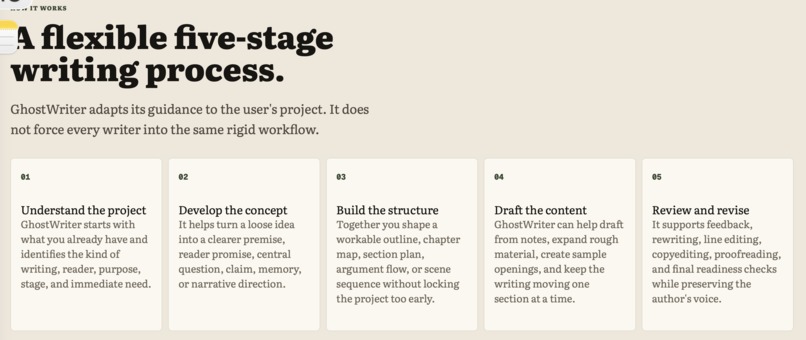
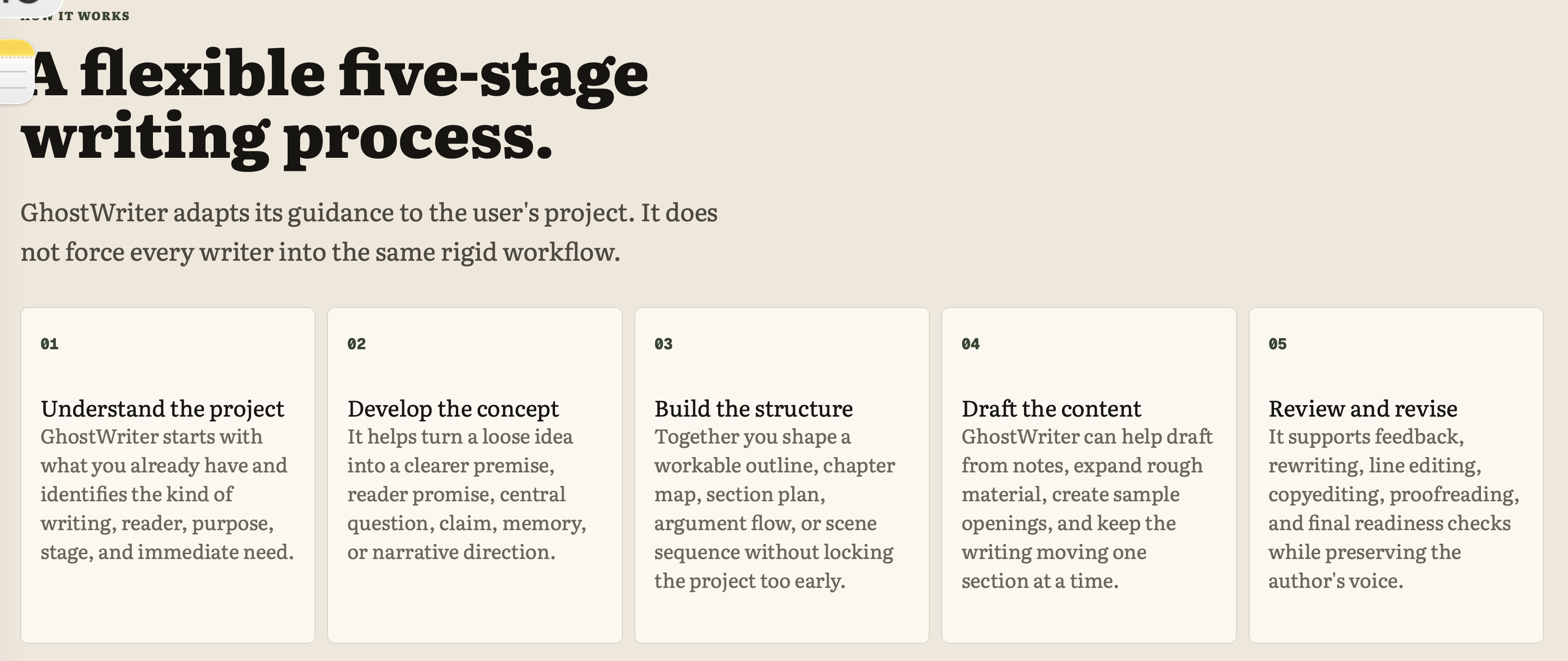
GhostWriter "How It Work"

Inspiration
As an educator, I have spent the last several years observing how students, colleagues, and people outside technical fields use GPTs. The responses are often impressive enough to make it clear that large language models will become an important part of how we learn, work, and communicate.
But I also became concerned about a less visible danger. Many users accept AI-generated language almost exactly as it is presented and begin to treat it as their own. The result may be polished, but it may not reflect the user’s judgment, experience, reasoning, or voice.
What makes a piece of writing genuinely yours is not simply that you requested it. The ideas, decisions, language, and character of the work must remain recognizably your own.
My first response was to build specialized GPTs for engineering education. These systems were intended to improve technical accuracy and work within the terminology and reasoning of particular engineering fields. Over time, I realized that technical accuracy addressed only part of the problem.
There was a broader need: a system that could help people develop substantial written work without replacing the intellectual contribution of the author.
That realization inspired GhostWriter.
What it does
GhostWriter guides substantial writing projects from early idea to finished work. It can support books, memoirs, reports, proposals, academic manuscripts, technical documents, and other long-form projects.
Rather than treating writing as a one-step prompt-and-response task, GhostWriter uses a five-stage process:
- understand the project;
- develop the concept;
- build the structure;
- draft the content;
- review and revise.
Users can begin with an idea, title, paragraph, collection of notes, partial draft, or complete manuscript. GhostWriter identifies the next useful step and adapts its guidance to the project type, stage of development, and level of support required.
Its central purpose is not merely to generate better text. It is to help users produce intellectual work that remains distinctly their own.
How I built it
GhostWriter grew out of several years of developing specialized custom GPTs for aerospace engineering, optimization, composite materials, robotics, quantum computing, and broader knowledge-work applications.
A parallel influence has been my work on a proposed computational engineering book series currently under review by Wolfram Media. That effort explores how expert-authored technical knowledge, structured discourse, and executable notebooks can be combined into a more interactive publishing environment. GhostWriter extends part of that thinking beyond engineering by asking how a writing system can preserve not only domain knowledge, but also the author’s reasoning, decisions, and distinctive voice.
These projects taught me that a useful GPT needs more than a strong prompt. It needs structured knowledge, consistent terminology, clear operating principles, and a practical way to preserve continuity.
I applied those lessons to writing by developing a system of method and knowledge files for onboarding, concept development, outlining, drafting, revision, and project continuity. The architecture includes an author profile, writing DNA, project memory, editorial state, collaboration state, and session records.
Together, these elements create an evolving model of the author’s voice, reasoning, preferences, terminology, and confirmed decisions. The goal is not to imitate the author mechanically, but to help the system collaborate without replacing the author’s judgment.
I refined the prototype through repeated writing experiments, architectural reviews, and website development. I simplified the visible workflow so that a first-time user can begin without needing to understand the underlying system.
The current project includes a functioning custom GPT, a structured internal methodology, a five-stage writing process, project-memory guidance, and a public website explaining its purpose, operation, and responsible use.
ChatGPT and Codex supported the project through architectural reasoning, editorial development, testing, and implementation assistance.
Challenges I ran into
The first major challenge was that prompt engineering quickly became inefficient. Longer instructions could improve an individual response, but they could not reliably preserve an author’s style, reasoning, terminology, and intentions across a complete project.
My earlier exploration of ideas inspired by Stephen Wolfram’s work on symbolic discourse led me toward using taxonomies and ontologies in engineering. Instead of relying entirely on prose instructions, important concepts could be defined more explicitly, together with their roles and relationships.
Applying this idea to writing proved difficult. Terms such as author, project, voice, memory, evidence, intent, decision, editorial state, and collaboration state seem simple in ordinary conversation, but they become ambiguous when they must guide a GPT consistently.
A second challenge was continuity. A substantial project cannot be treated as a sequence of unrelated prompts. GhostWriter needs to preserve important decisions, structure, terminology, unresolved questions, and next steps without pretending to possess perfect or unlimited memory.
A third challenge was balancing internal sophistication with user simplicity. The architecture may be detailed, but a first-time author should still be able to begin with a paragraph or a folder of notes.
I also had to resist a common tendency of language models: producing polished prose too early. Fluent language can create the appearance of progress before the purpose, audience, argument, or authorial intent has been understood.
The central challenge was therefore not how to make the GPT write more. It was how to make it collaborate more carefully.
Accomplishments that I am proud of
I am proud that GhostWriter has evolved beyond a prompt for generating polished prose. It is now a structured framework for developing a substantial writing project while keeping the author’s ideas and decisions at the center.
The project brings together structured knowledge, author modeling, project memory, editorial guidance, collaboration states, and session continuity in a form that remains approachable for a general user.
I am also proud that GhostWriter does not define success simply as producing fluent text. It can pause, ask questions, organize the project, preserve confirmed decisions, and identify the next useful step before drafting.
The deepest accomplishment may take time to demonstrate. A short evaluation can show the quality of an individual response. The more important test is whether, over the course of a complete project, the work increasingly reflects the author’s own intellectual and stylistic DNA.
What I learned
I learned that producing good language is not the hardest problem. Modern language models can generate impressive prose from relatively simple instructions.
The harder problem is preserving authorship, continuity, intent, and individuality across many decisions and many sessions.
I also learned that writing DNA is not limited to vocabulary or sentence style. It may include:
- Preferred terminology
- Rhythm and degree of formality
- Patterns of reasoning
- Use of examples
- Attitudes toward uncertainty
- Recurring themes
- Editorial choices the author accepts or rejects
Some of these characteristics can be stated explicitly. Others emerge only through continued collaboration.
GhostWriter therefore needs evaluation methods that go beyond fluency. Useful measures may include consistency of terminology and voice, preservation of confirmed decisions, reduction of generic language, the number of corrections required from the author, and the degree to which the user feels represented by the evolving manuscript.
The most important lesson is that preserving authorship is not a single feature. It is an ongoing process of observation, confirmation, memory, revision, and trust.
A short evaluation can measure the quality of GhostWriter’s responses; its deeper success must be measured by whether a complete project gradually becomes more distinctly the author’s own.
What's next for GhostWriter
GhostWriter has been developed primarily from my experience as an educator, engineering researcher, proposal writer, and author of technical books and educational materials. I am not a professional software engineer or data scientist. The current system has been built through experimentation with custom GPT instructions, structured knowledge files, writing methods, project memory, and repeated testing.
That is both a limitation and part of the project’s strength. GhostWriter was designed first from the perspective of someone who understands how substantial writing projects actually develop: ideas change, outlines evolve, terminology must remain consistent, and authors repeatedly revise their own thinking.
The immediate priority is to test GhostWriter with real users working on books, memoirs, reports, proposals, and academic manuscripts. These projects will show where the workflow succeeds, where it becomes too complicated, and where the system needs better methods for recognizing voice and preserving decisions.
The next technical stage is to combine the present writing methodology with stronger software and computational expertise. Future development may include structured project storage, improved document management, external tool integration, API-based capabilities, progress tracking, and systematic evaluation of writing DNA.
Support from OpenAI Build Week would help move GhostWriter from a carefully developed custom-GPT prototype toward a professional and technically robust writing environment. It would support software development, architecture refinement, user testing, and meaningful evaluation methods.
GhostWriter may not be the right writing environment for everyone. Its value will be clearest to authors who want substantial AI assistance without surrendering their intellectual identity. One measure of its long-term success would be that writers feel comfortable acknowledging its use—perhaps even stating that a work was developed with GhostWriter—because the name has come to represent careful collaboration, preserved authorship, and responsible use rather than undisclosed text generation.
The long-term goal is not simply to make GhostWriter generate more text. It is to build a reliable, responsible, and accepted collaborator that combines the strengths of advanced language models with the experience, judgment, and individuality of the human author. The long-term goal is not simply to make GhostWriter generate more text. It is to build a reliable, responsible, and accepted collaborator that combines the strengths of advanced language models with the experience, judgment, and individuality of the human author—and whose use authors can acknowledge openly and with confidence.
Built With
- custom-gpts
- markdown
- openai
- openai-codex
- sites


Log in or sign up for Devpost to join the conversation.