Inspiration
Most automation platforms start with workflows companies already know and have documented. But a huge amount of enterprise work happens outside formal SOPs.
Employees repeatedly move between support tools, CRM systems, billing platforms, knowledge bases, and communication apps to complete tasks that nobody has formally defined as workflows.
We asked:
What if AI could discover repetitive work automatically instead of waiting for humans to document it first?
That became GhostWork — an AI-native platform for finding the work nobody documented and turning it into safe AI automation.
What it does
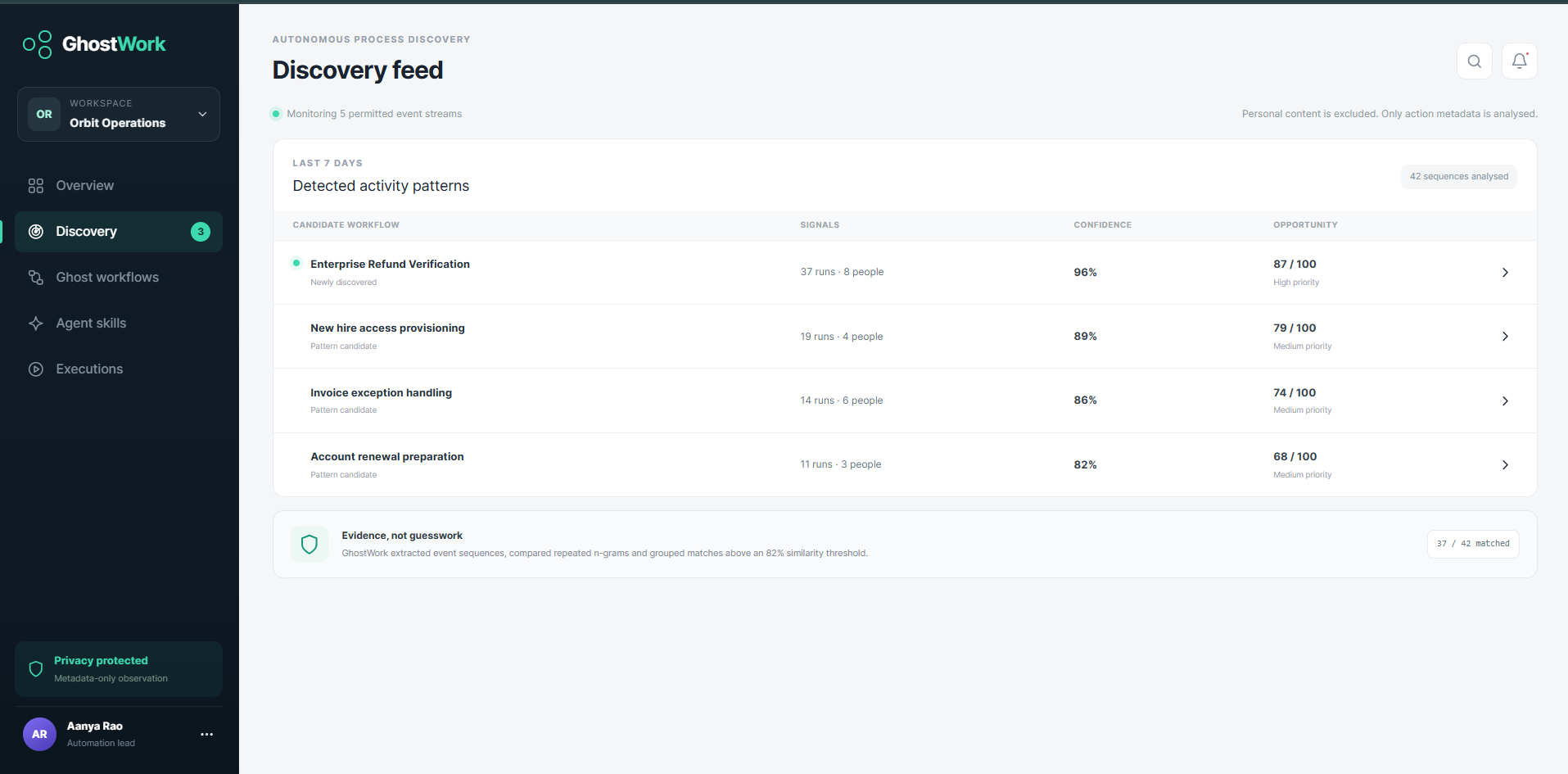
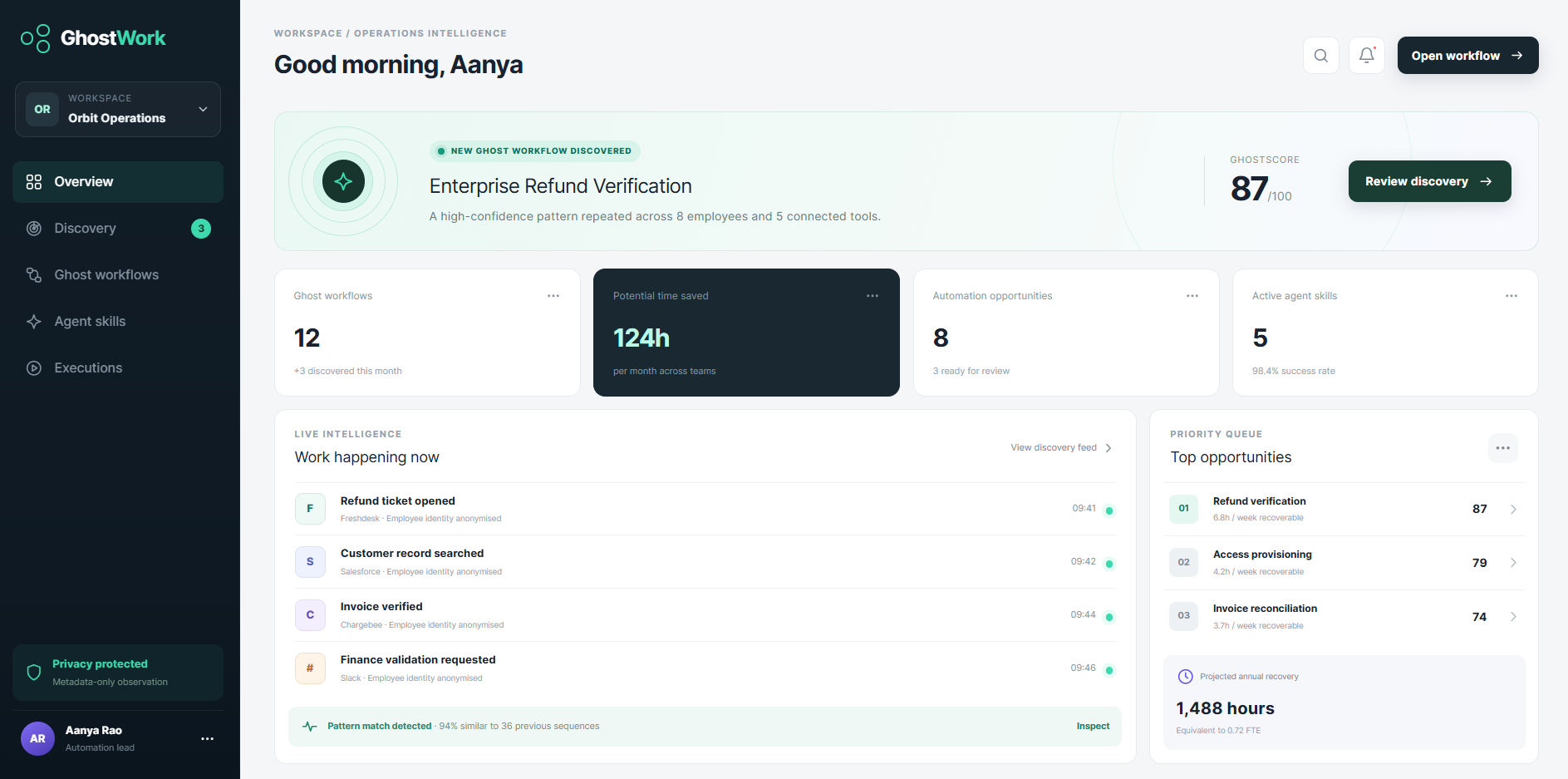
GhostWork discovers repetitive, undocumented enterprise workflows from privacy-safe activity metadata and identifies opportunities for AI-agent automation.
It follows a simple lifecycle:
Observe → Discover → Understand → Evaluate → Automate → Approve → Execute → Verify
Specialised agents detect recurring patterns, reconstruct the underlying business process, analyse which steps can be automated, evaluate risk, and convert approved workflows into reusable GhostSkills.
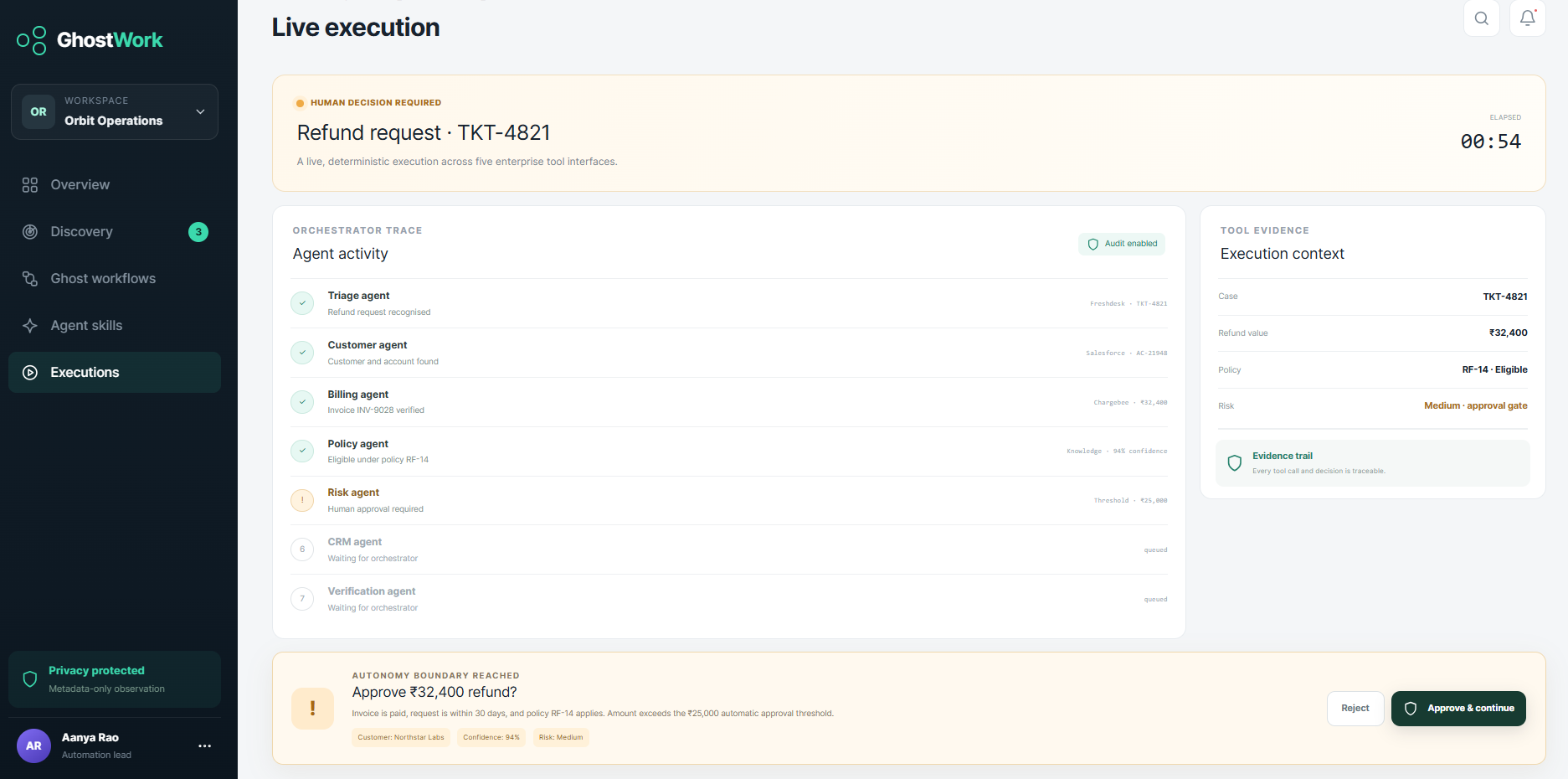
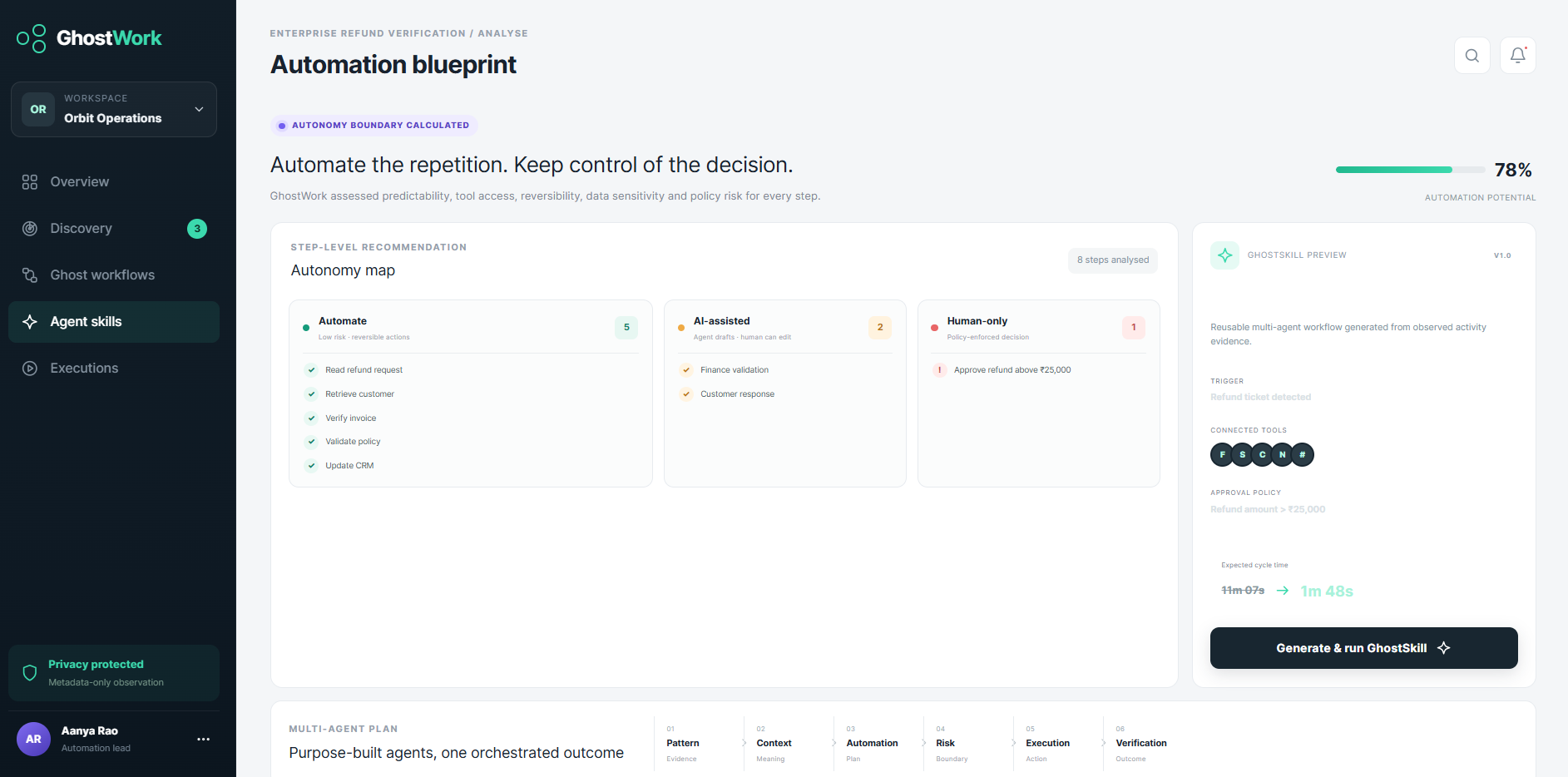
GhostWork introduces an Autonomy Boundary that separates actions AI can perform independently from sensitive decisions that require human approval.
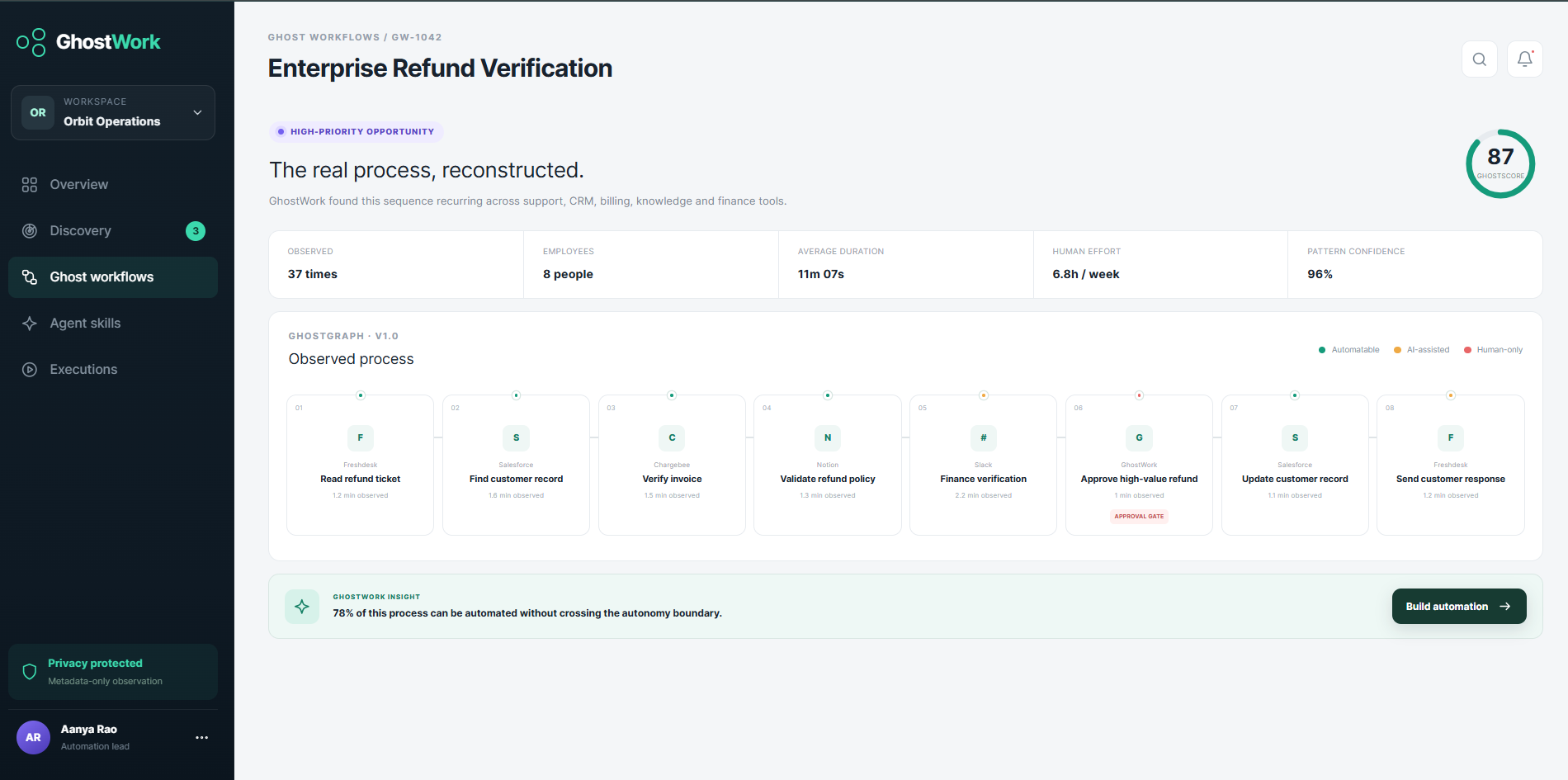
In our demo, GhostWork discovers an Enterprise Refund Verification process repeated 37 times. It identifies approximately 78% automation potential and converts the process into an agent workflow.
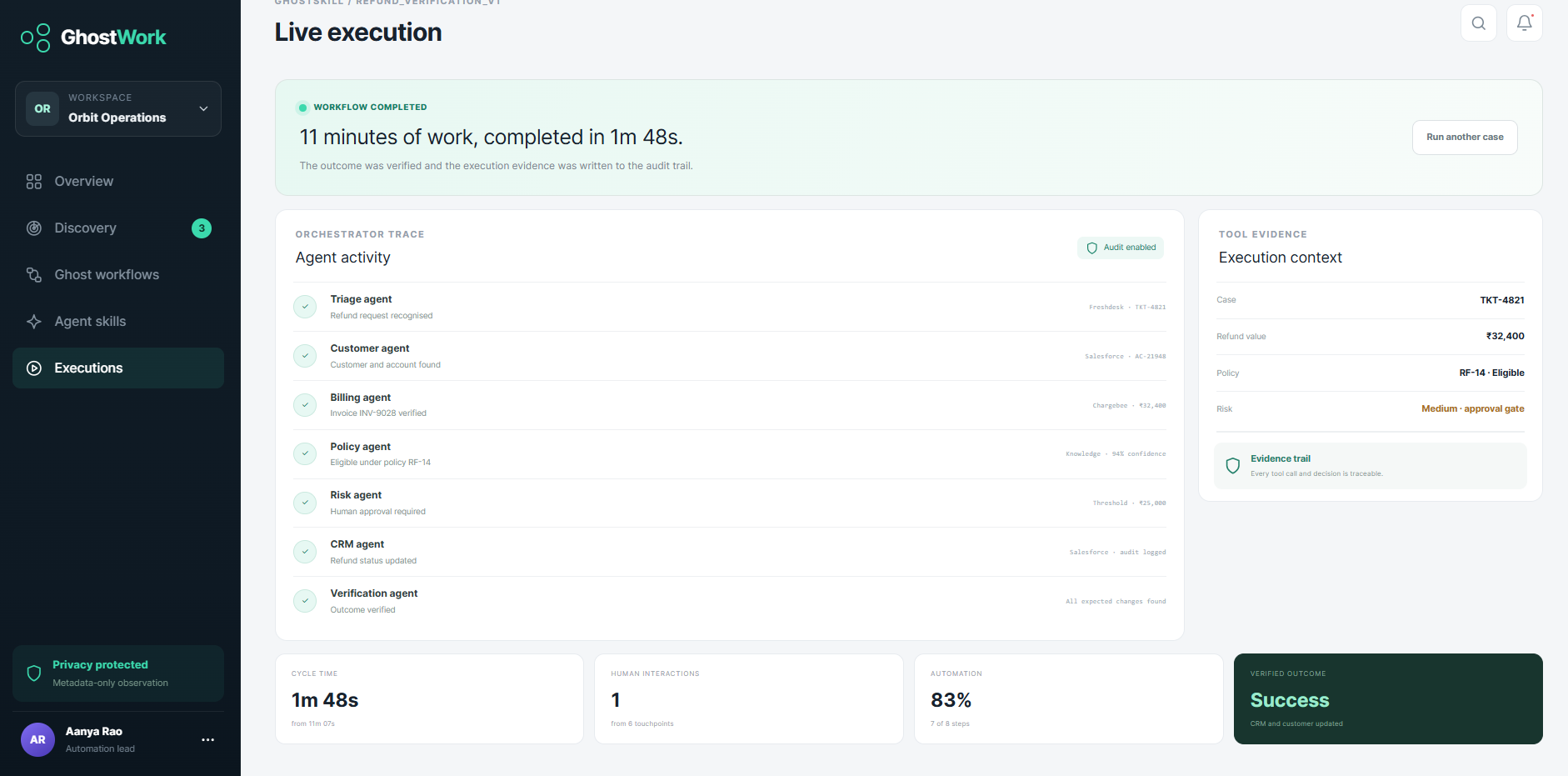
When a ₹32,000 refund exceeds the ₹25,000 autonomous threshold, the Risk Agent pauses execution and requests human approval. Once approved, the agents continue the workflow, update the required systems, notify the customer, and verify completion.
The result: a process taking approximately 11m 07s is reduced to 1m 48s, with human interactions reduced from 6 to 1.
How we built it
For the qualification round, we built an interactive product prototype focused on demonstrating the complete GhostWork experience.
We designed the system around a multi-agent architecture consisting of specialised agents for:
- pattern detection
- contextual understanding
- workflow reconstruction
- automation analysis
- risk evaluation
- skill generation
- execution
- verification
The prototype demonstrates the complete journey:
Enterprise Activity → Ghost Workflow → GhostGraph → Automation Analysis → GhostSkill → Agent Execution → Human Approval → Verification
We built a clean enterprise-style interface with deterministic demo data so judges can experience the complete workflow consistently.
The architecture is designed to later connect with enterprise systems such as Freshworks, CRM, billing platforms, knowledge bases, and communication tools through APIs and MCP-compatible integrations.
Challenges we ran into
Our biggest challenge was differentiating GhostWork from traditional process mining and RPA.
Process mining helps organisations discover and visualise processes. RPA automates processes that humans have already identified and configured.
GhostWork connects both ends:
Discover → Understand → Prioritise → Generate → Execute → Verify
Another challenge was deciding how much autonomy an enterprise AI agent should have. Maximum automation is not always desirable, especially for financial, security, or compliance-sensitive actions.
This led us to design the Autonomy Boundary, allowing routine work to remain autonomous while high-risk decisions stay human-controlled.
We also had to make a broad enterprise concept understandable in a short demo. We solved this by focusing on one complete refund-verification workflow rather than demonstrating many disconnected features.
Accomplishments that we're proud of
We are proud that GhostWork goes beyond simply suggesting automation opportunities. It demonstrates a complete path from discovering hidden work to creating and executing governed agent workflows.
We developed several core concepts that make the system understandable:
Ghost Workflow — a repetitive process discovered from enterprise activity.
GhostGraph — a visual reconstruction of the hidden workflow.
GhostScore — a score used to prioritise automation opportunities.
GhostSkill — a reusable agent workflow generated from a discovered process.
Autonomy Boundary — the point where AI must stop and request human judgement.
Most importantly, our prototype demonstrates the entire transformation:
Hidden Work → Discovered Workflow → Agent Automation → Human Governance → Verified Outcome
What we learned
We learned that agentic AI becomes much more valuable when it is connected to real operational workflows rather than being limited to conversational assistants.
We also learned that multi-agent systems work best when every agent has a clearly defined responsibility. Pattern discovery, contextual reasoning, risk assessment, execution, and verification are fundamentally different tasks and benefit from specialised agents.
Another major learning was that good enterprise AI must know when not to act. Human-in-the-loop control is not a limitation; it is essential for building trustworthy automation.
Finally, we learned that explainability matters as much as automation. Users should understand why a workflow was discovered, why an action can be automated, why approval is required, and whether execution succeeded.
What's next for GhostWork
The next step is transforming GhostWork from an interactive prototype into a functional enterprise agent platform.
We plan to add real enterprise integrations, MCP-connected tools, live workflow-event ingestion, process clustering, agent orchestration, and persistent workflow storage.
Future capabilities could include process-drift detection, compliance agents, workflow simulation, automated ROI analysis, reusable GhostSkill libraries, and learning from previous agent failures.
Our long-term vision is for GhostWork to become an Enterprise Self-Automation Layer that continuously:
Observes work → Discovers repetition → Evaluates automation → Deploys governed agents → Measures outcomes → Improves
Most automation tools automate workflows companies already know.
GhostWork discovers the ones they don't.
Built With
- agents
- ai
- chatgpt
- css3
- html5
- javascript
- multi-agent


Log in or sign up for Devpost to join the conversation.