
Inspiration
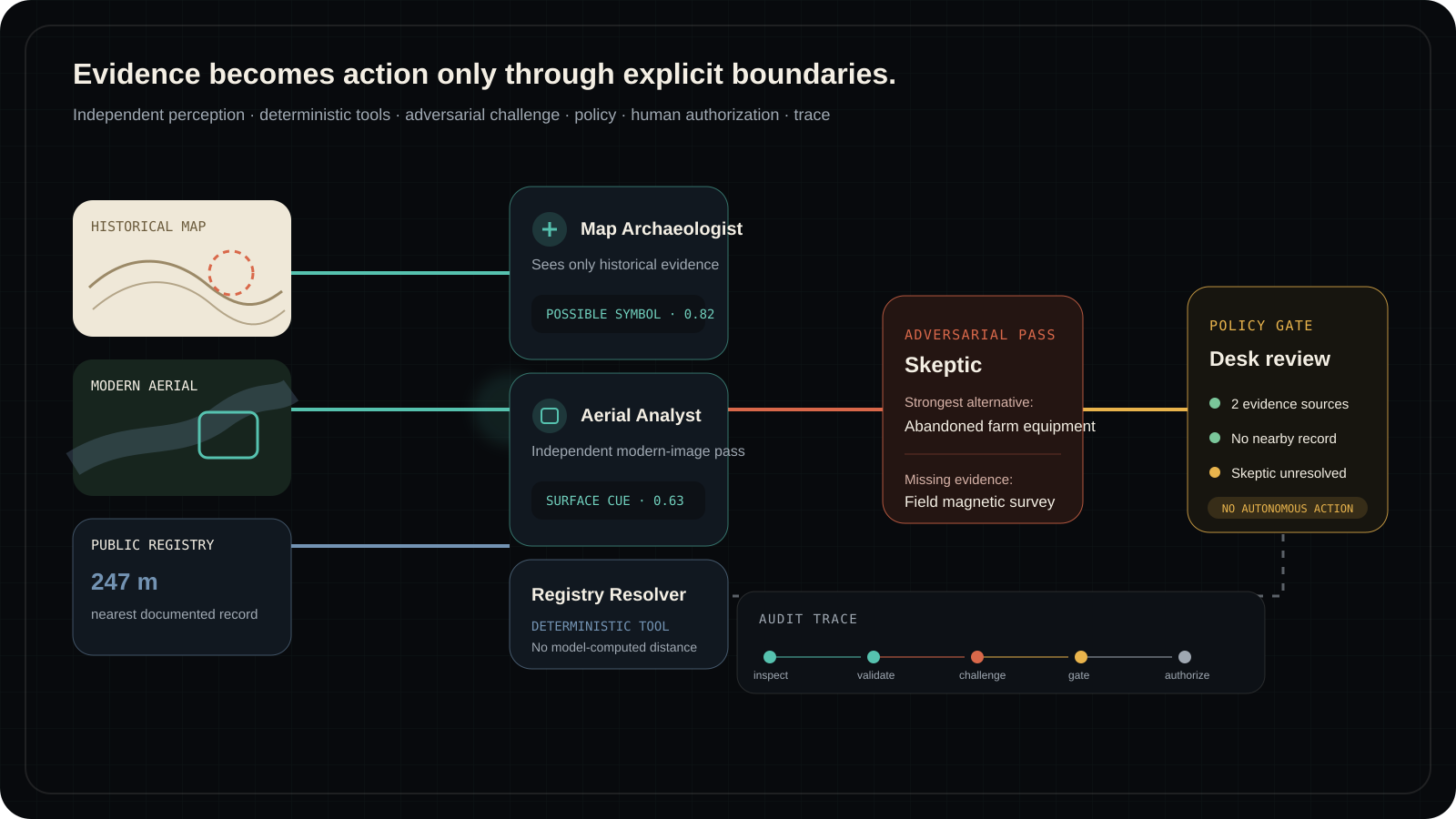
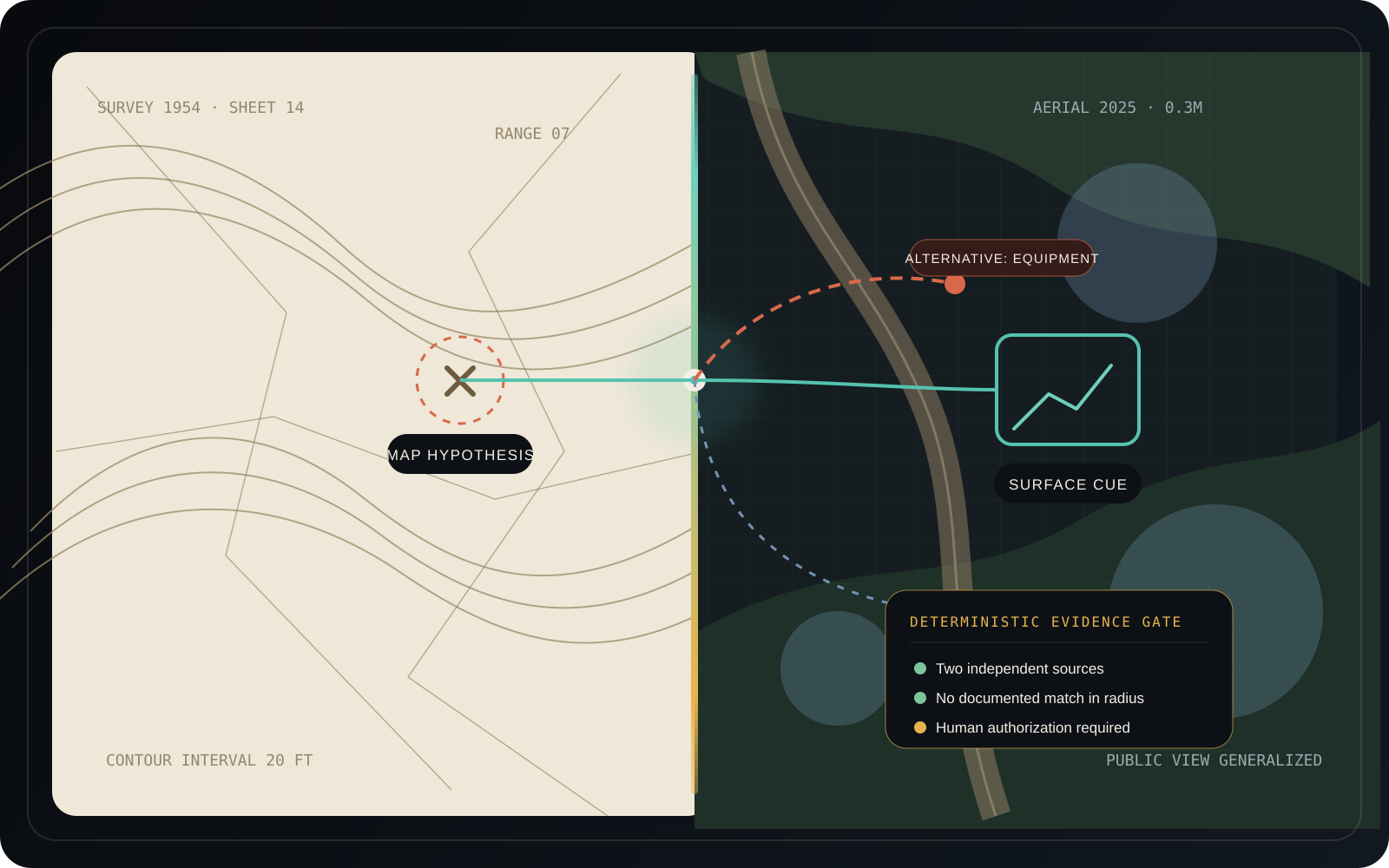
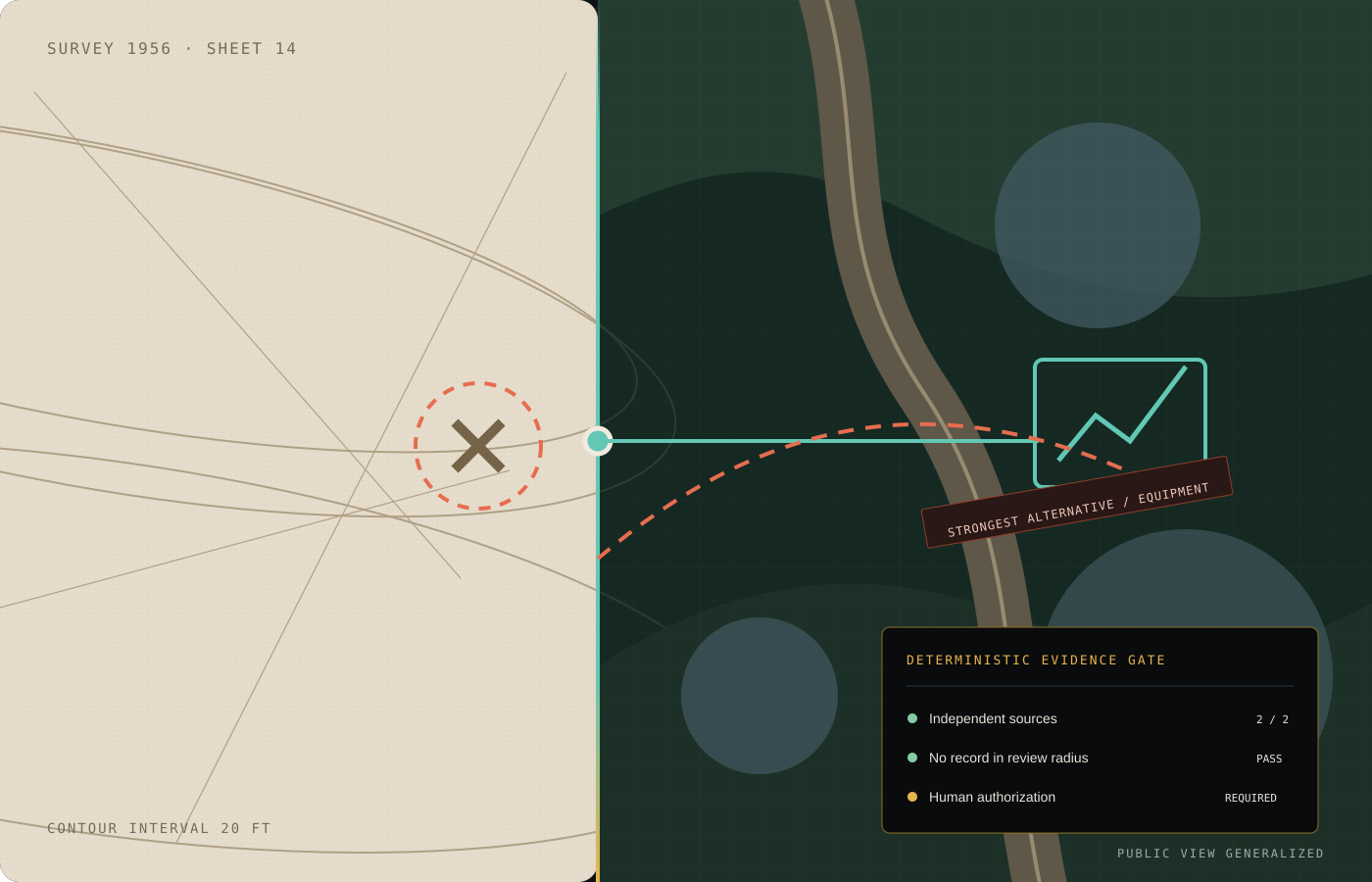
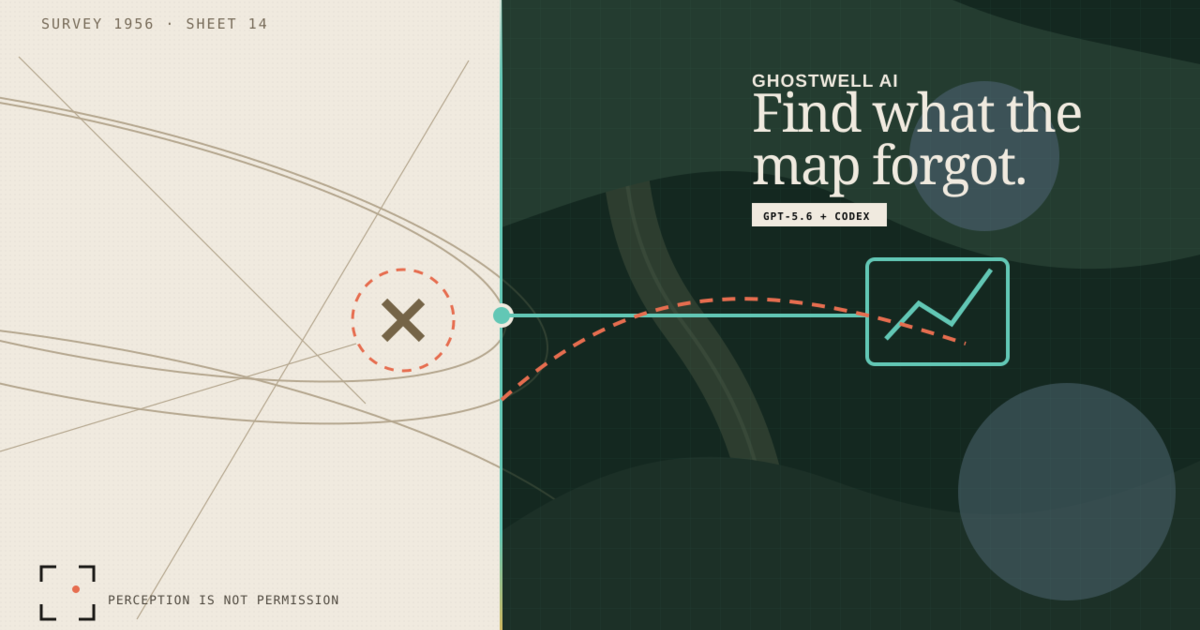
Important infrastructure decisions often depend on evidence created across different eras, systems, and institutions. A symbol on an old map, a shape in modern aerial imagery, and the absence of a nearby registry record may each be weak signals on their own—but together they may justify further investigation.
I wanted to explore a deeper question than whether an AI model can recognize an object:
How can AI turn uncertain physical-world evidence into a governed recommendation without confusing capability with permission?
GhostWell begins with abandoned oil and gas well review, but the larger idea is a reusable evidence and governance layer for physical infrastructure.
What GhostWell does
GhostWell helps an authorized infrastructure reviewer reconcile:
historical map evidence; modern aerial imagery; public well records; alternative explanations; explicit policy thresholds; human authorization; and a replayable evidence trace.
The workflow separates each responsibility.
A Map Archaeologist examines only the historical map. An Aerial Analyst independently reviews modern imagery. A deterministic TypeScript registry resolver calculates relationships to documented records. A Skeptic Agent then searches for the strongest alternative explanation, contradictions, and missing evidence.
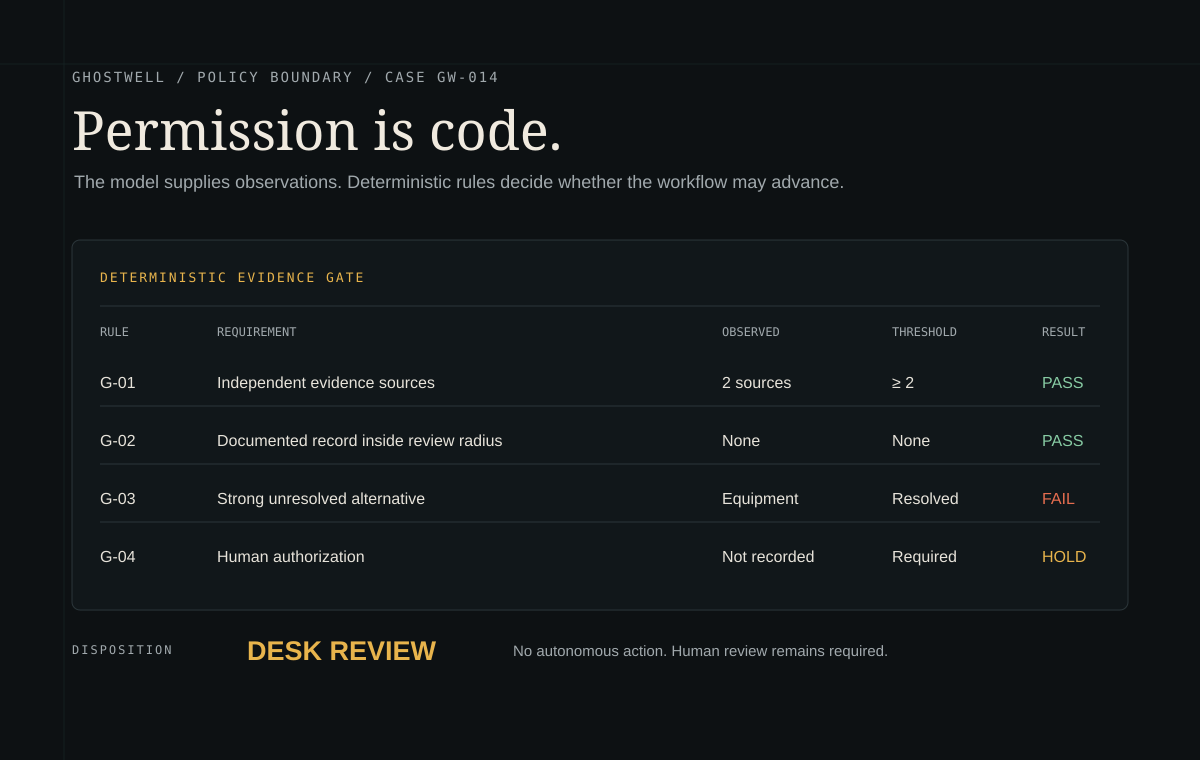
A deterministic six-rule policy gate returns only:
REJECTED DESK_REVIEW FIELD_VERIFICATION_RECOMMENDED
Even the strongest machine conclusion is not confirmation of a well and is not authorization to visit or act at a site. Human authorization remains a separate server-enforced event.
The core principle is:
$$
\text{Permitted action}
\text{verified evidence} \land \text{policy pass} \land \text{human authorization} $$
How I built it
I built GhostWell with GPT-5.6 and Codex.
GPT-5.6 provides bounded multimodal interpretation for the historical-map, aerial-imagery, and Skeptic roles. Each model output is constrained by typed schemas, validation, timeouts, one repair attempt, and explicit abstention. The model does not calculate authoritative registry distances, evaluate final policy, reveal protected locations, or authorize action.
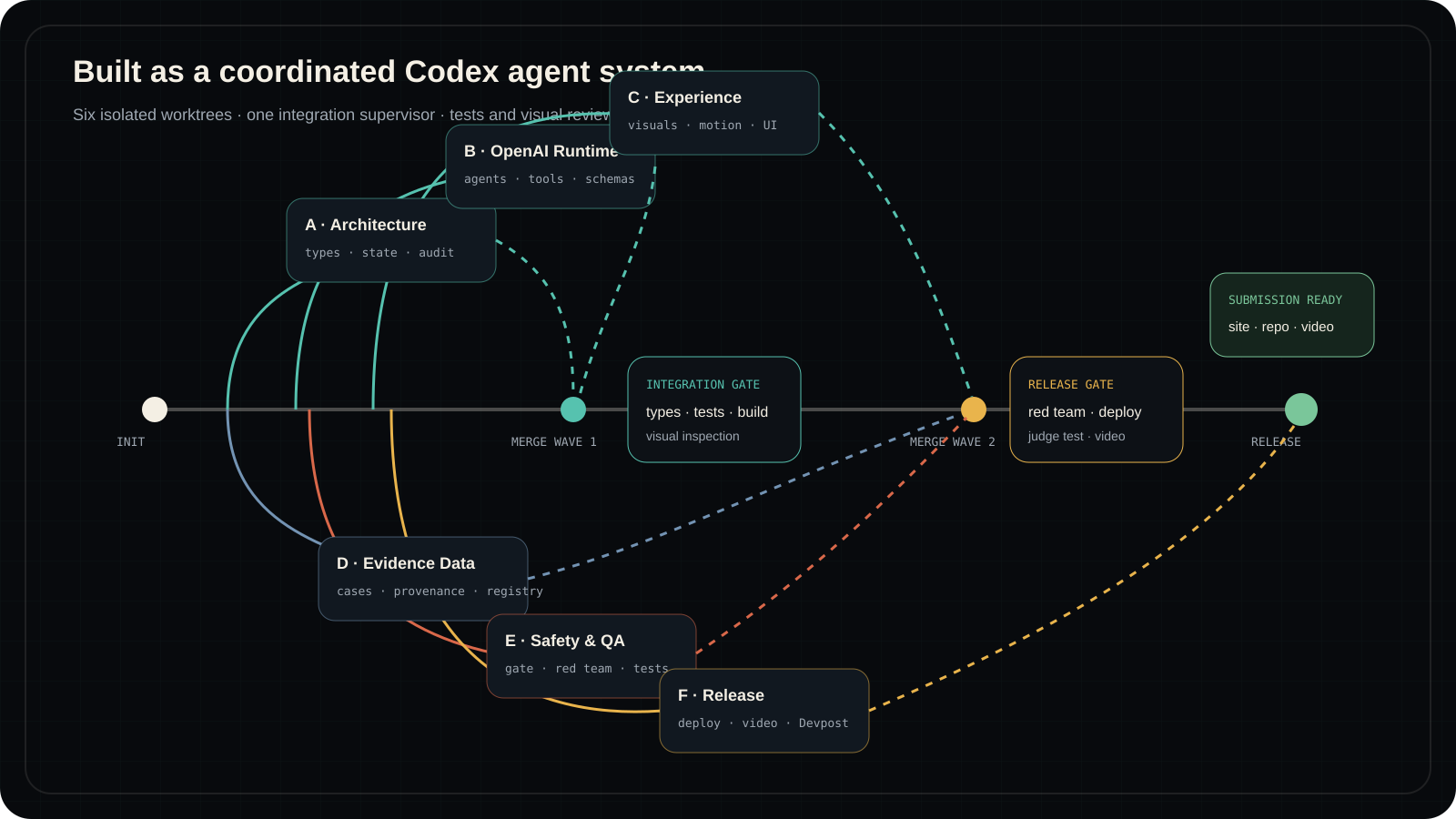
Codex operated as an integration supervisor and a parallel engineering team. The work was divided into isolated streams for:
domain architecture and state contracts; Recorded Demo and Live GPT-5.6 orchestration; the responsive product experience; demonstration data and provenance; safety, authorization, redaction, and testing; release and submission artifacts; and independent rendered-design critique.
Codex accelerated implementation, test generation, policy-drift detection, responsive visual iteration, deployment verification, and release documentation. The product decisions remained explicit: capability is not permission, locations must remain generalized, the Skeptic must challenge before policy, Recorded Demo must be reliable without credentials, and every consequential decision must leave evidence.
Recorded Demo and Live GPT-5.6
The default judging experience is a deterministic, credential-free Recorded Demo. It replays validated typed outputs through the same state, policy, authorization, and dossier contracts used by the application.
A separate Live GPT-5.6 path is implemented behind server-only configuration. It supports image and text inputs, strict structured outputs, timeout handling, schema repair, and typed abstention. The current submission does not claim a credential-backed Live validation run; the Recorded Demo is the verified judge path.
Challenges I faced Preventing multi-agent “theater”
Simply giving several agents different names would not create genuine independence. I had to isolate their evidence boundaries so the Aerial Analyst could not anchor on the Map Archaeologist’s conclusion during its initial pass.
Separating belief from permission
A visually plausible candidate is not the same as authorization to act. The policy gate and approval system had to remain deterministic and server-enforced rather than relying on model confidence or persuasive language.
Making the demo reliable
Judges should not need an API key, a rebuild, or a working external model endpoint. The Recorded Demo therefore had to exercise the complete workflow without any code path capable of calling OpenAI.
Preserving provenance without exposing risk
The public demonstration cases are synthetic and generalized. Every scene is labeled, actionable coordinates are removed, and the product never presents demonstration imagery as documentary field evidence.
Balancing depth with comprehension
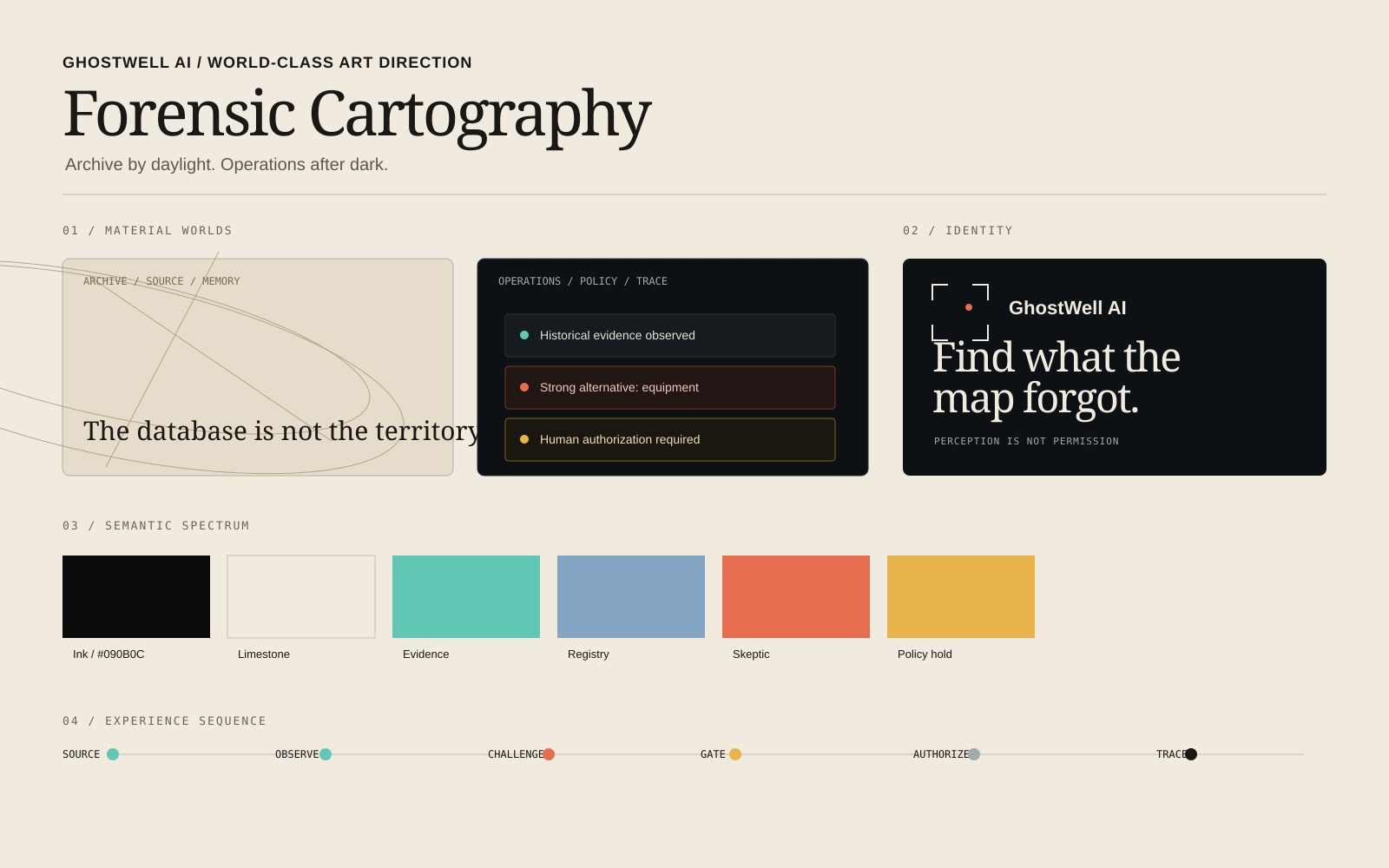
The underlying system includes multiple agents, deterministic tools, policy, authorization, trace, and failure states. The visual design had to make these boundaries understandable without becoming another dense AI dashboard.
What I learned
The biggest lesson was that faster model and coding capability creates more value when it is invested in verification—not merely faster answers.
Codex made it possible to build and test several workstreams in parallel, but speed alone was not enough. The work became trustworthy only after turning product principles into executable invariants, regression tests, structured contracts, and visible release gates.
I also learned that an AI system should clearly distinguish:
what it observed; what it inferred; what deterministic tools established; what policy permits; what a human authorized; and what evidence proves afterward. What comes next
The next stage would be a controlled pilot with orphan-well program analysts, GIS specialists, environmental reviewers, and field-operation leads.
Before operational use, GhostWell would need:
trusted server-side identity and program-scoped permissions; durable access-controlled storage; real program data agreements; credential-backed Live evaluations; drift and incident monitoring; formal threat modeling; policy validation with domain owners; and measured evidence that the workflow improves review quality or analyst time.
The long-term opportunity is a Civic Field Intelligence Layer for other fragmented physical-infrastructure problems—while keeping the same invariant:
Model proposes. Specialists verify. Policy decides. Humans authorize. Trace proves.
Built With
- agents
- codex
- css
- eslint
- github
- gpt-5.6
- html
- javascript
- motion
- next.js
- node.js
- openai
- playwright
- prettier
- react
- typescript
- vinext
- vite
- vitest

Log in or sign up for Devpost to join the conversation.