-
-
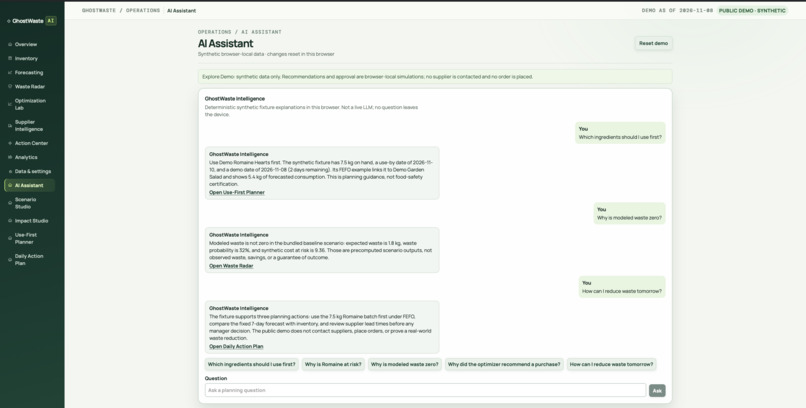
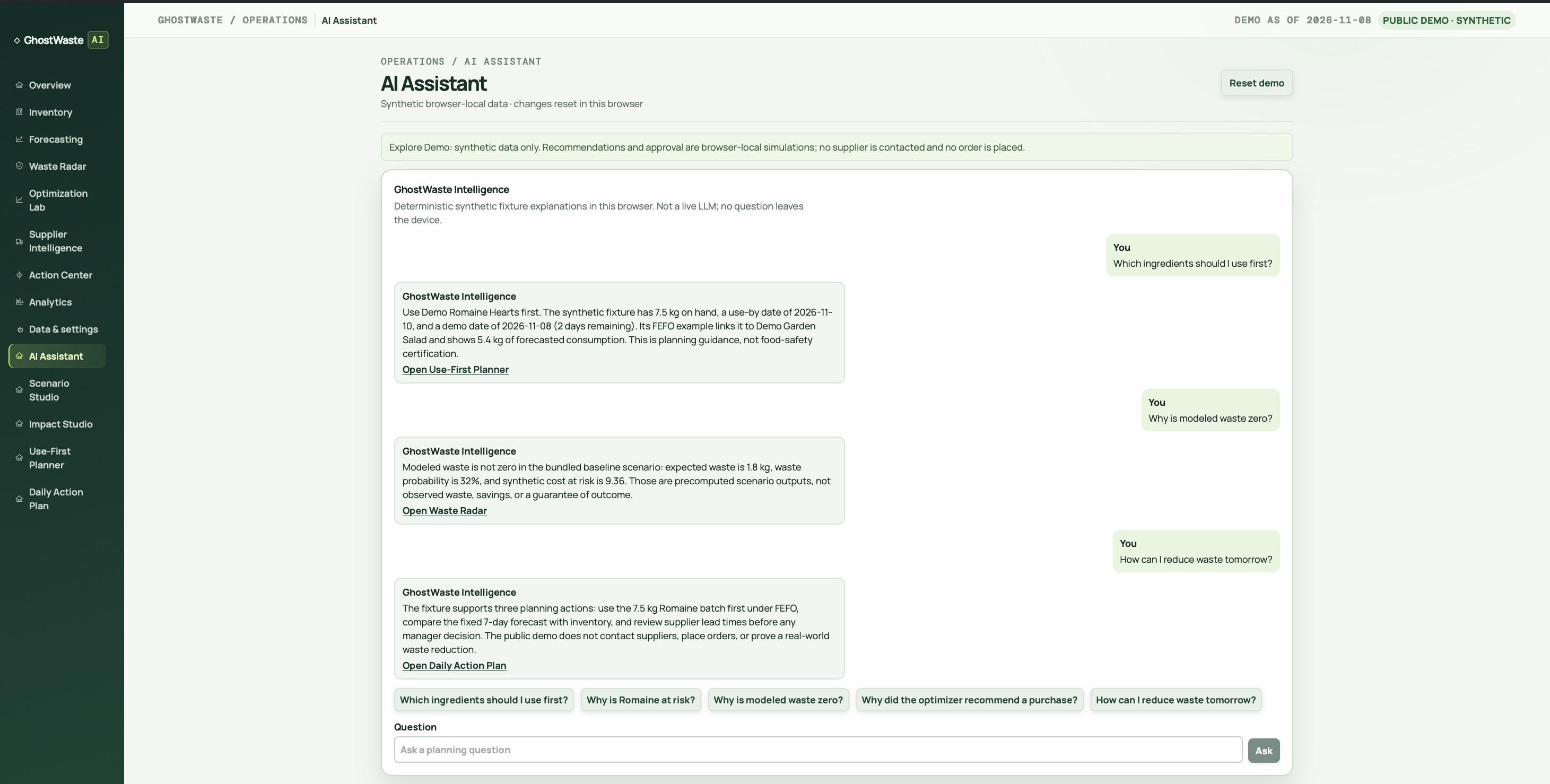
Context-aware planning guidance explains ingredient risks, waste estimates, and recommended actions using synthetic data.
-
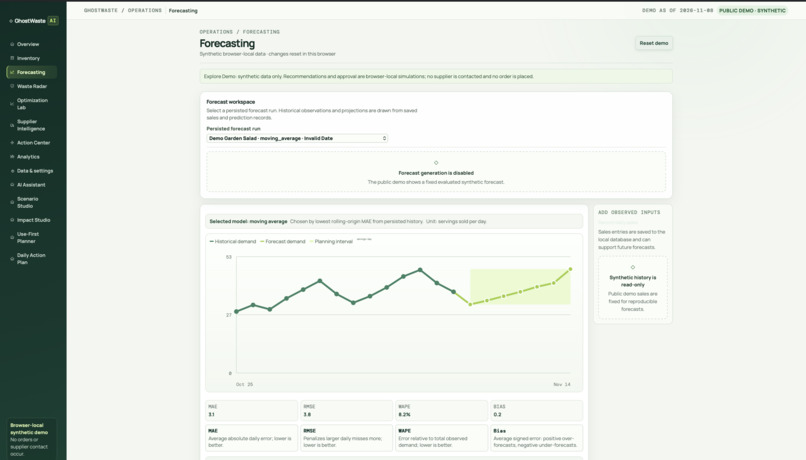
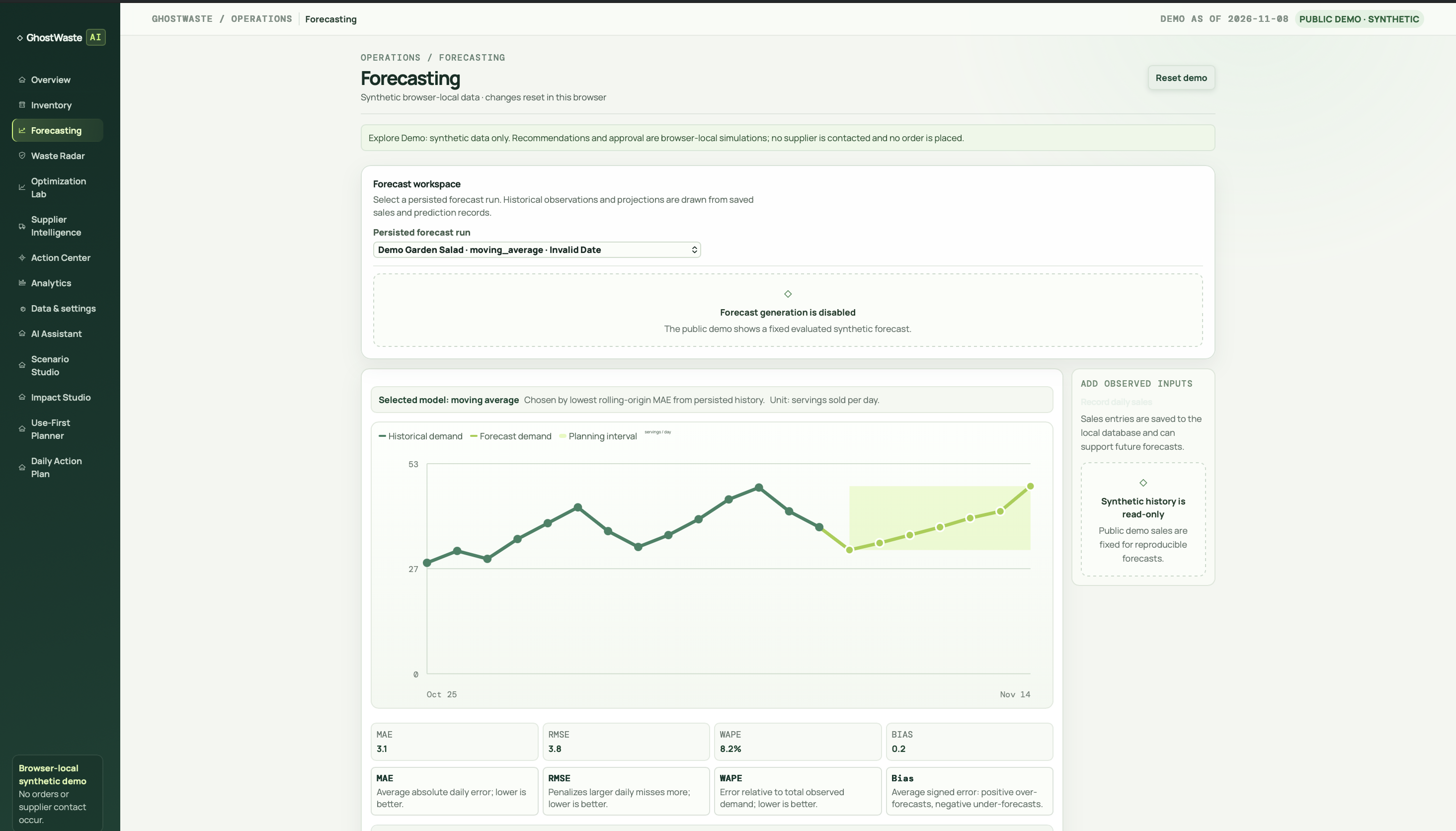
Visualize historical demand, forecast future ingredient needs, and evaluate prediction accuracy to support smarter purchasing.
-
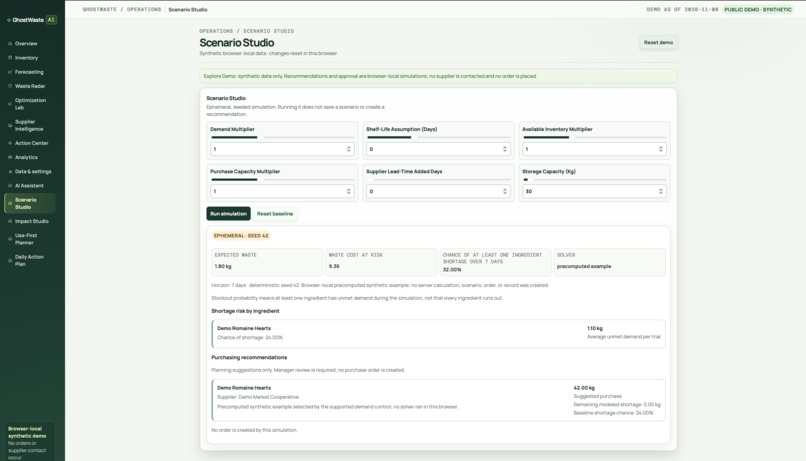
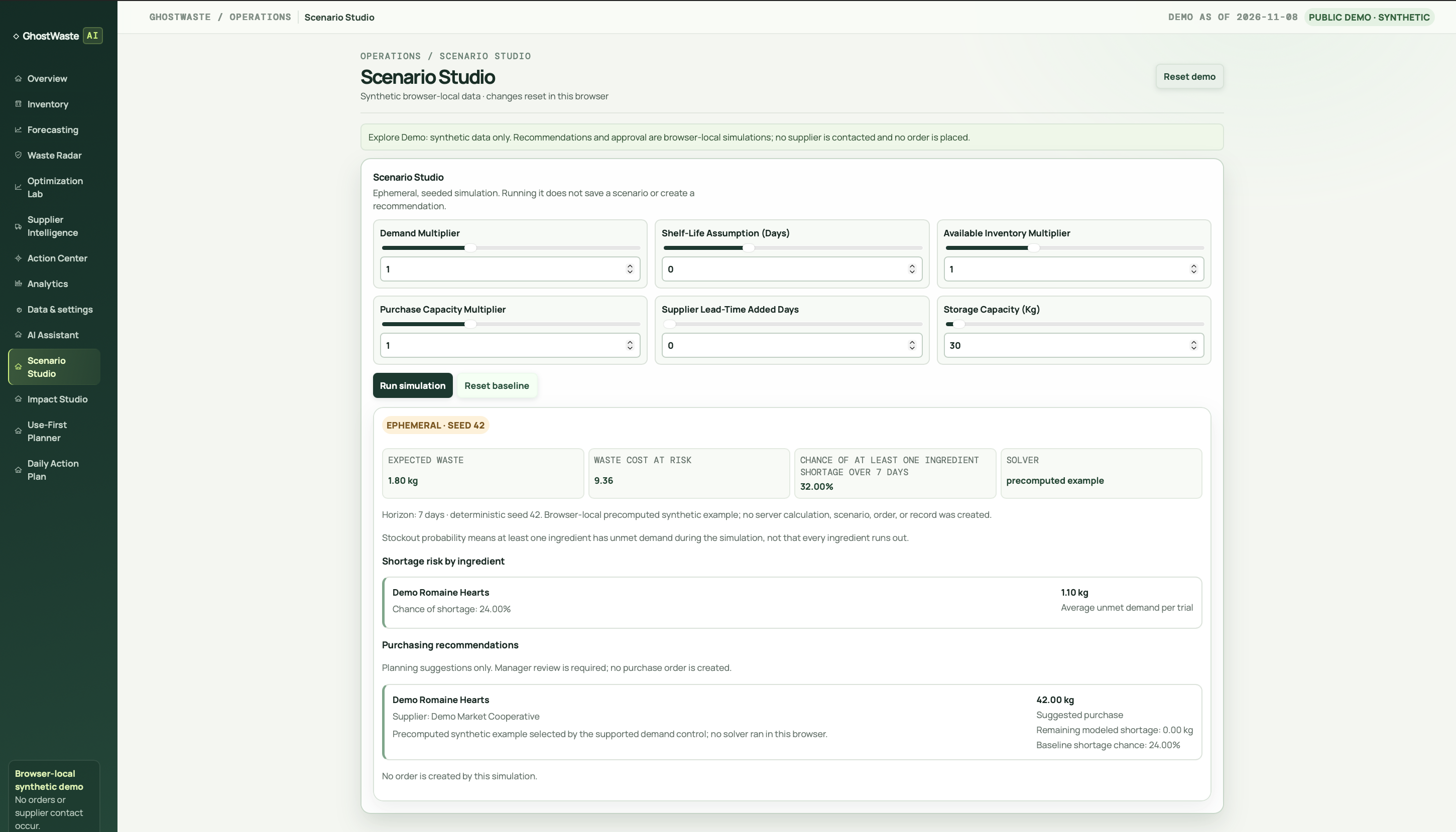
Explore what-if scenarios for demand, shelf life, and inventory while comparing modeled waste risks and purchasing decisions.
-
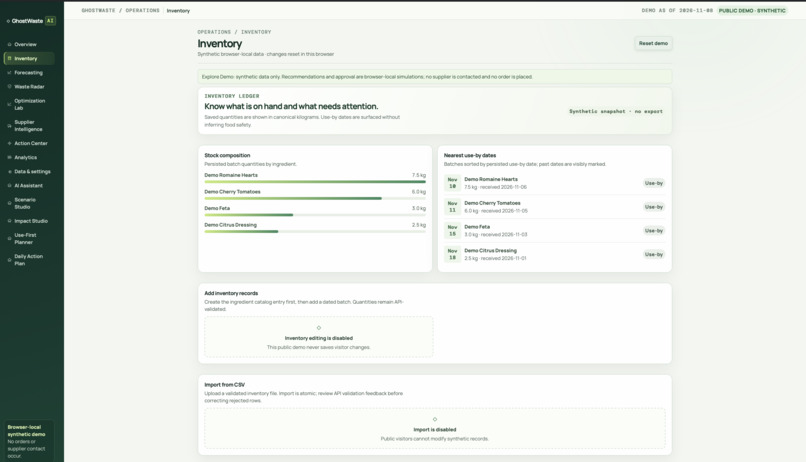
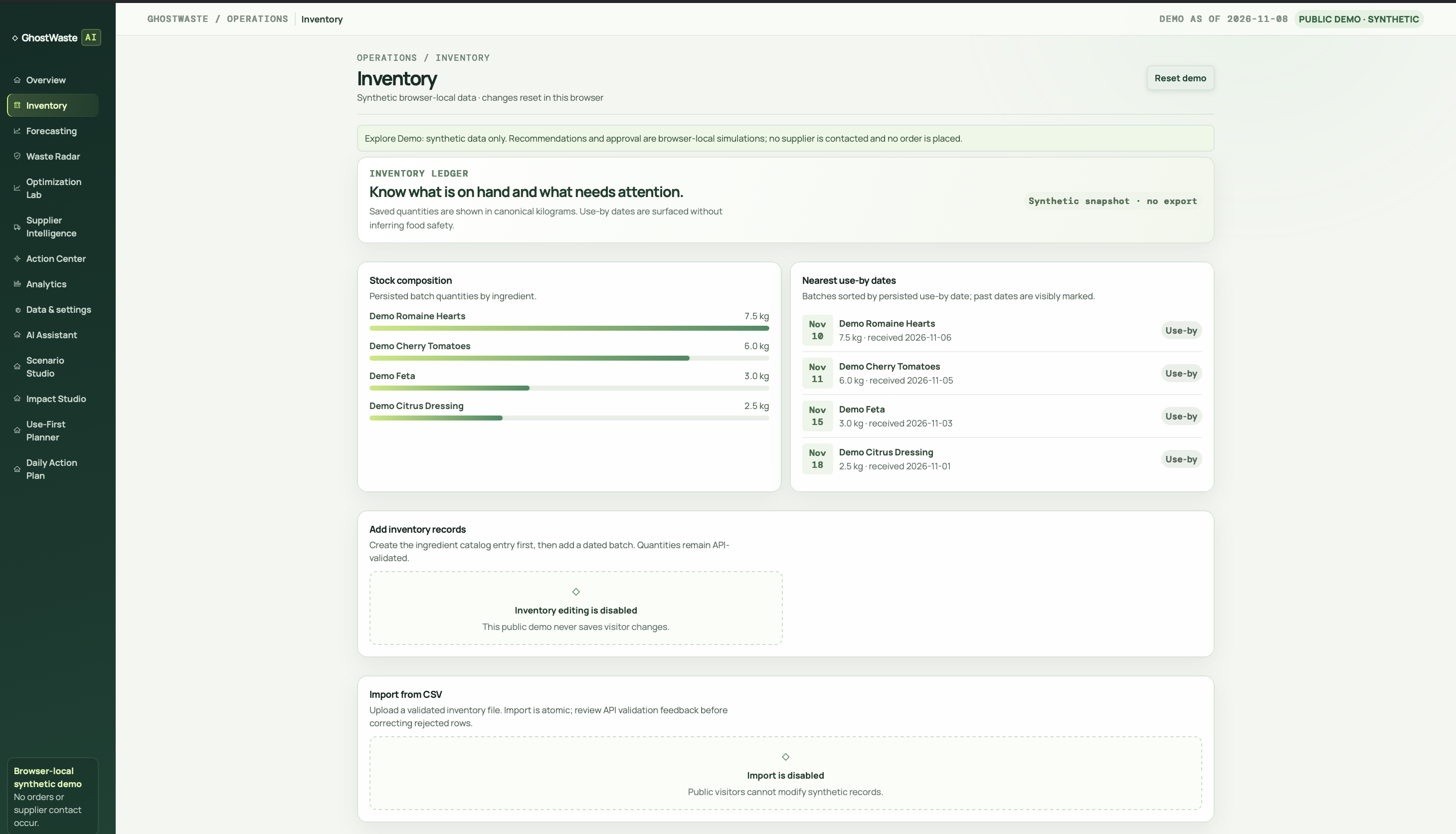
Track ingredient quantities, inventory batches, and use-by dates to identify stock that needs attention before it expires.
-
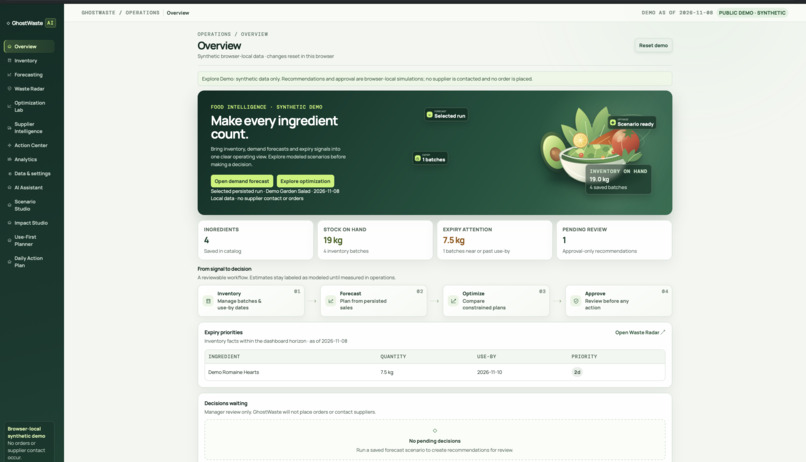
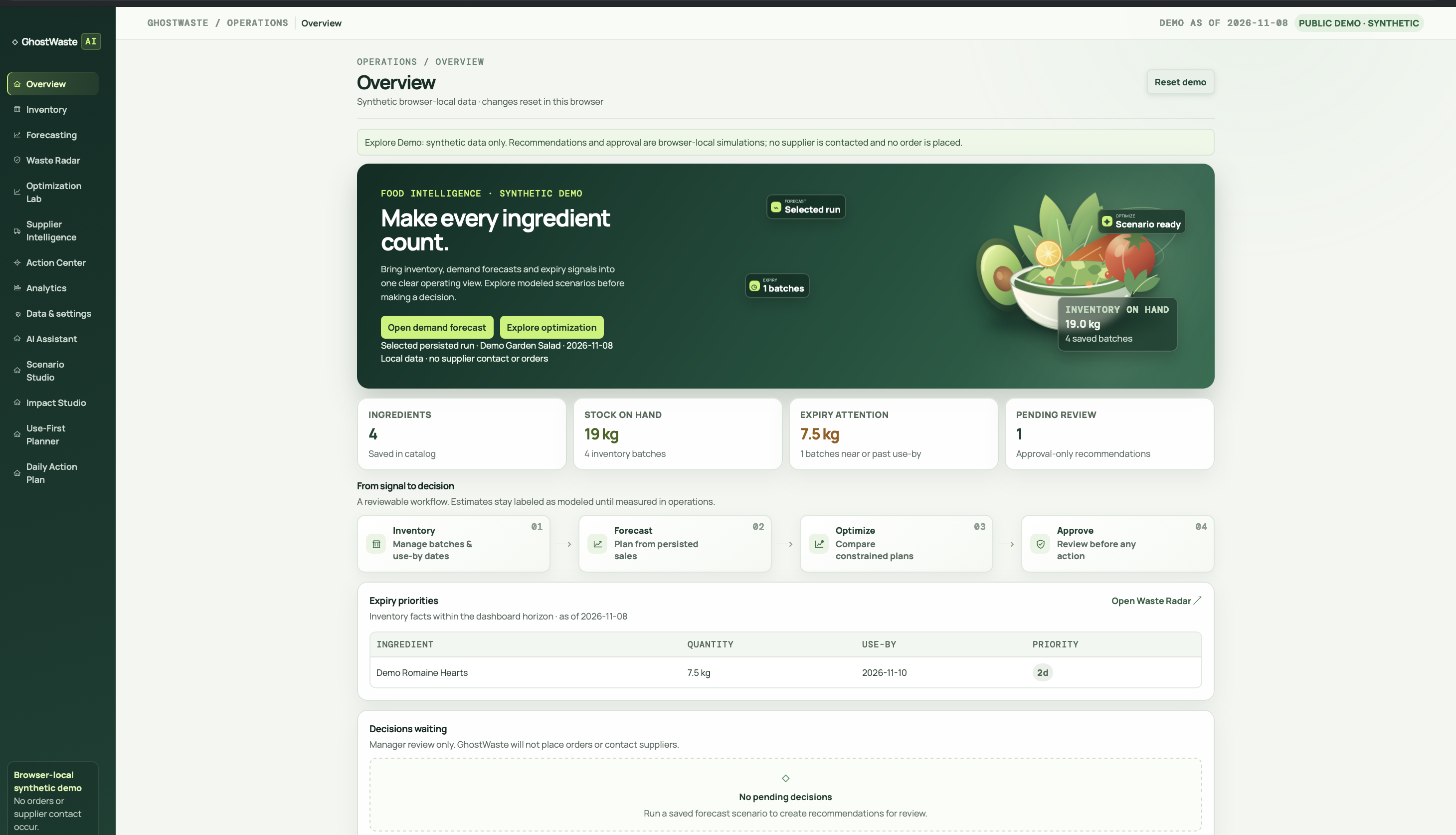
One dashboard connects inventory, demand forecasting, expiry alerts, and human-reviewed purchasing recommendations.
Inspiration
Every day, restaurants face a difficult balancing act: purchasing enough ingredients to meet customer demand while avoiding excess inventory that may expire before it can be used.
Food waste is not just an environmental issue. It also represents lost purchasing costs, inefficient operations, and missed opportunities to make better decisions.
We built GhostWaste AI around one question:
What if restaurants could identify potential food waste before it happens—and use that information to make smarter decisions?
Our goal was to turn disconnected inventory records, demand forecasts, and expiration dates into an understandable, actionable decision-support workflow.
What it does
GhostWaste AI is a restaurant food-waste intelligence and procurement planning platform.
It helps restaurant operators understand their inventory, anticipate demand, identify ingredients at risk of waste, compare purchasing decisions, and review recommended actions before taking them.
The platform brings together 14 connected workspaces, including:
- Overview: A unified dashboard showing inventory, expiry priorities, and pending decisions.
- Inventory: Ingredient quantities, inventory batches, and use-by dates.
- Forecasting: Historical demand, demand projections, and forecast accuracy metrics.
- Waste Radar: Identification and explanation of ingredients at risk of waste.
- Optimization Lab: Constrained purchasing and inventory-planning analysis.
- Supplier Intelligence: Supplier information for evaluating procurement choices.
- Action Center: Human review of proposed decisions.
- Analytics: Operational metrics and insights.
- Data & Settings: Data-management and configuration workflows.
- AI Assistant: Contextual explanations and practical planning guidance.
- Scenario Studio: What-if analysis for changes in demand, shelf life, available inventory, supplier lead times, and capacity.
- Impact Studio: Modeled impact exploration.
- Use-First Planner: Ingredient prioritization based on available inventory and use-by dates.
- Daily Action Plan: Practical next-step recommendations for restaurant operators.
Instead of only reporting what has already been wasted, GhostWaste AI focuses on helping people make better decisions before waste occurs.
How we built it
GhostWaste AI combines a modern web interface with a Python-based analytical backend.
Frontend
- Next.js, React, and TypeScript
- Responsive operational dashboards
- Interactive forecasting charts and scenario controls
- Browser-local synthetic demonstration mode
Backend and decision support
- Python and FastAPI
- SQLite for local persistence
- Demand-forecasting and evaluation workflows
- Constraint-based optimization using OR-Tools
- Inventory, expiry, supplier, and recommendation logic
Testing and deployment
- Playwright for browser-level testing
- Pytest for backend verification
- GitHub for source control
- Vercel for the publicly accessible demonstration
The architecture supports a local full-stack application and a separate public demonstration.
The public demo uses deterministic synthetic data and precomputed scenario examples. This allows judges to explore the product without requiring paid AI APIs, a production database, real restaurant information, or supplier integrations.
The public AI Assistant provides fixture-grounded explanations rather than claiming to be a live large language model. Its recommendations and simulated approvals remain local to the browser.
Challenges we ran into
Connecting predictions to decisions
Forecasting demand is useful, but a forecast alone does not tell a restaurant what to do. We had to connect demand estimates with ingredient quantities, shelf-life information, procurement constraints, and operational recommendations.
Building trustworthy scenario analysis
A scenario can legitimately produce no shortages or an infeasible result. We worked to distinguish meaningful model outputs from incorrect assumptions in our tests.
Creating a safe public demonstration
We wanted judges to explore the product without accidentally modifying shared data, contacting suppliers, or creating real purchase orders.
We developed a browser-local synthetic demonstration with explicit restrictions on persistent server-side operations.
Maintaining reliability across the application
Testing multiple interconnected workspaces required isolated browser environments, deterministic fixtures, and careful handling of test processes.
Accomplishments that we're proud of
- Built an integrated application with 14 operational workspaces.
- Connected inventory, forecasting, waste risk, procurement planning, and human review into one decision-support experience.
- Implemented a local optimization workflow with explicit constraints.
- Developed an interactive Scenario Studio for exploring operational changes.
- Created a public demonstration that requires no account or paid API credentials.
- Added an explanatory AI Assistant for synthetic demonstration data.
- Preserved clear distinctions between modeled outcomes, simulations, and actual operational results.
- Passed 50 backend tests, eight isolated local browser tests, and two public-demo browser tests during release verification.
- Published a live demonstration and source-code repository.
What we learned
Building GhostWaste AI reinforced that useful AI-driven software requires more than producing predictions.
A valuable system must explain its assumptions, connect analysis to practical decisions, handle uncertainty, and keep people in control.
We also learned the importance of deterministic testing, transparent model limitations, and safe demonstration environments—especially when software makes recommendations that could affect real business operations.
What's next for GhostWaste AI
Our next goal is to evolve GhostWaste AI from a validated prototype into a platform that can be evaluated with real restaurant partners.
Potential future improvements include:
- Integrations with restaurant point-of-sale and inventory systems.
- Forecasting based on real sales, seasonality, and operational patterns.
- Supplier catalog and price integrations.
- More advanced forecasting and optimization models.
- Mobile-friendly daily workflows for kitchen managers.
- Pilot studies measuring actual food-waste reduction and financial impact.
- Multi-location restaurant support.
Our vision: Help restaurants move from reactive waste reporting to proactive, explainable, human-controlled food-waste prevention.
GhostWaste AI's public demonstration uses synthetic data and simulated decisions. Its modeled estimates are not measured real-world waste reductions or guaranteed savings.
Built With
- css
- fastapi
- github
- google-or-tools
- javascript
- next.js
- playwright
- pytest
- python
- react
- sqlite
- typescript
- vercel
