-
-
-
-
vultr
-

Vultr
-
Backboard

Inspiration
Your crypto wallet knows more about your habits than you might think. Every swap, NFT mint, failed transaction, and late-night trading spree leaves a footprint on the blockchain.
But most wallet analytics tools focus on balances, charts, and transaction histories. We wanted to build something different: a way to turn on-chain activity into entertainment.
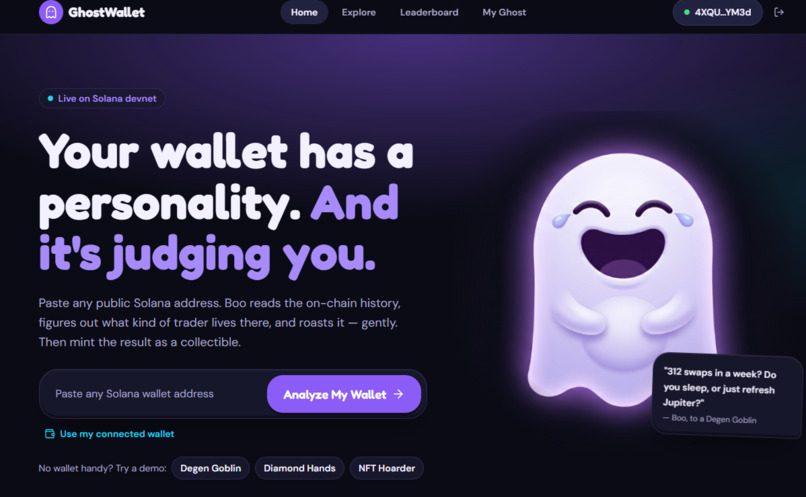
What if your Solana wallet had a personality? What if a mischievous little ghost could examine your transaction history and roast your financial decisions?
That's how GhostWallet was born.
Inspired by personality quizzes, collectible NFTs, and the chaotic culture of crypto, we created Boo, a playful ghost who turns wallet analytics into a personalized, shareable experience.
What it does
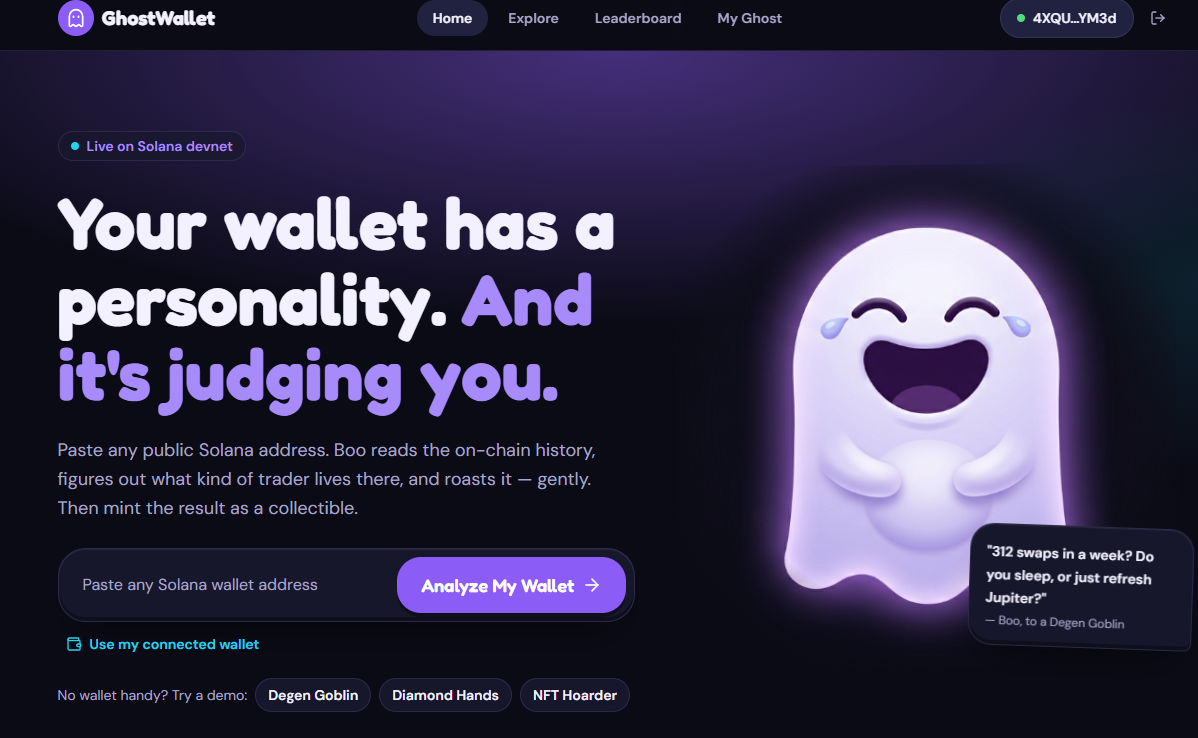
GhostWallet is an AI-powered Solana wallet personality analyzer.
Users enter a Solana wallet address, and Boo examines their on-chain activity to reveal which ghost personality best represents their behavior.
GhostWallet analyzes transaction patterns, including trading frequency, token diversity, swaps, NFT activity, transaction failures, and network fees.
Based on those metrics, users receive:
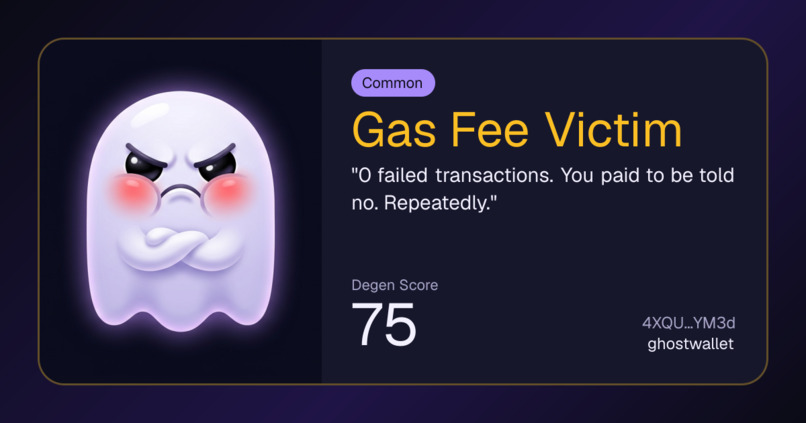
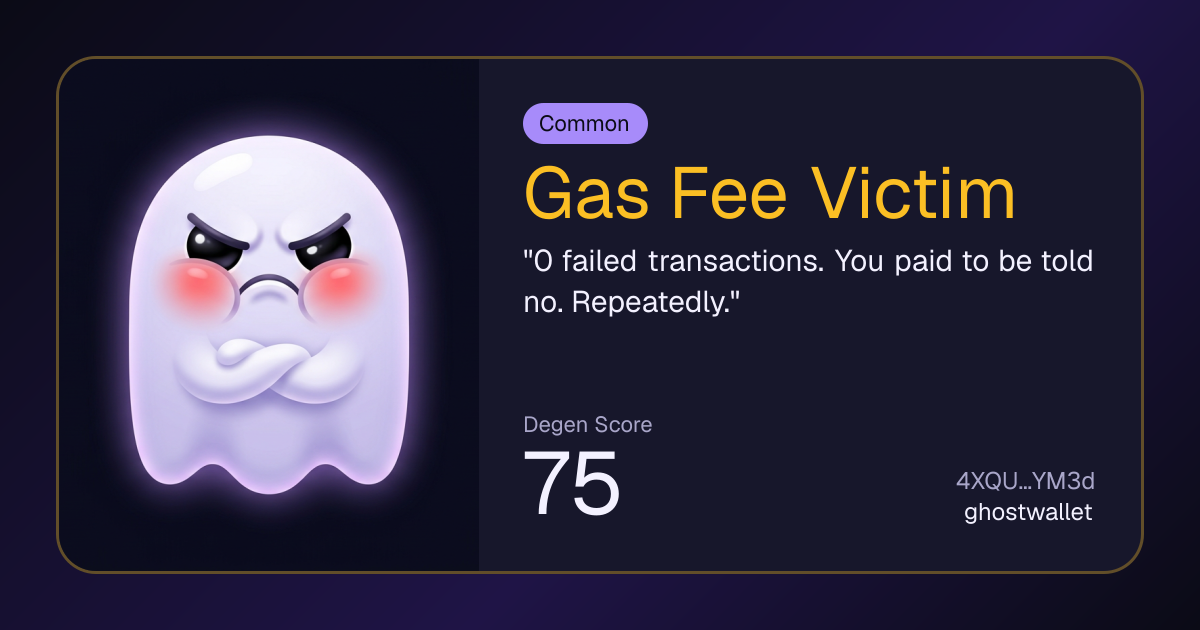
- One of eight ghost personalities, including Diamond Hands, Paper Hands, Degen Goblin, NFT Hoarder, Whale Wannabe, Gas Fee Victim, Ghost Town, and Solana Speedrunner.
- A Degen Score from 0–100 measuring how chaotic their on-chain behavior appears.
- AI-generated roasts personalized to their actual wallet activity.
- Achievements and rarity levels based on their transaction history.
- A collectible Solana NFT representing their ghost personality.
Boo doesn't just show numbers. Boo turns them into a story.
A wallet with hundreds of swaps might become a Degen Goblin. A wallet with barely any activity might become a Ghost Town. And someone who constantly sends transactions might discover that they're secretly a Solana Speedrunner.
The result is part blockchain analytics, part personality quiz, and part comedy.
How we built it
GhostWallet combines Solana blockchain data, deterministic analytics, generative AI, and NFT technology.
Frontend and backend — Next.js and TypeScript
We built GhostWallet using Next.js and TypeScript, with a responsive interface centered around Boo, our ghost mascot. Next.js API routes handle wallet analysis, AI inference, and NFT preparation.
Blockchain analytics — Solana and Helius
We use the Helius API to retrieve and interpret Solana transaction history. When enhanced transaction data is unavailable, our system can fall back to Solana RPC data.
We extract behavioral metrics such as transaction counts, swap activity, token diversity, NFT purchases and mints, failed transactions, fees, and wallet activity patterns.
Personality classification — TypeScript
Our classification engine evaluates wallet behavior across eight ghost archetypes.
We calculate a deterministic Degen Score and evaluate personality candidates using weighted behavioral signals. This gives the system a consistent baseline even when AI inference is unavailable.
AI personality analysis — Vultr Serverless Inference
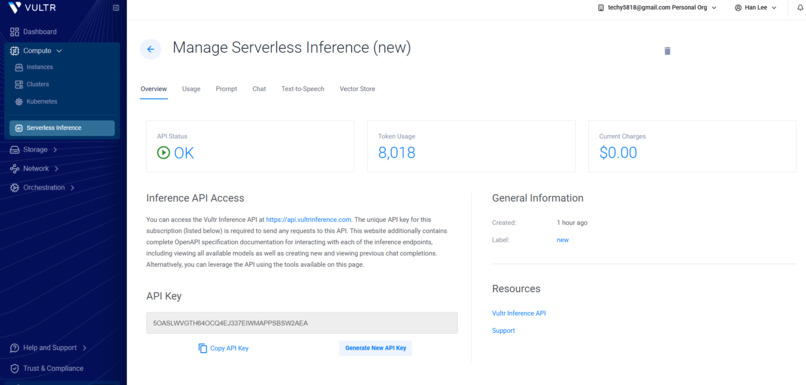
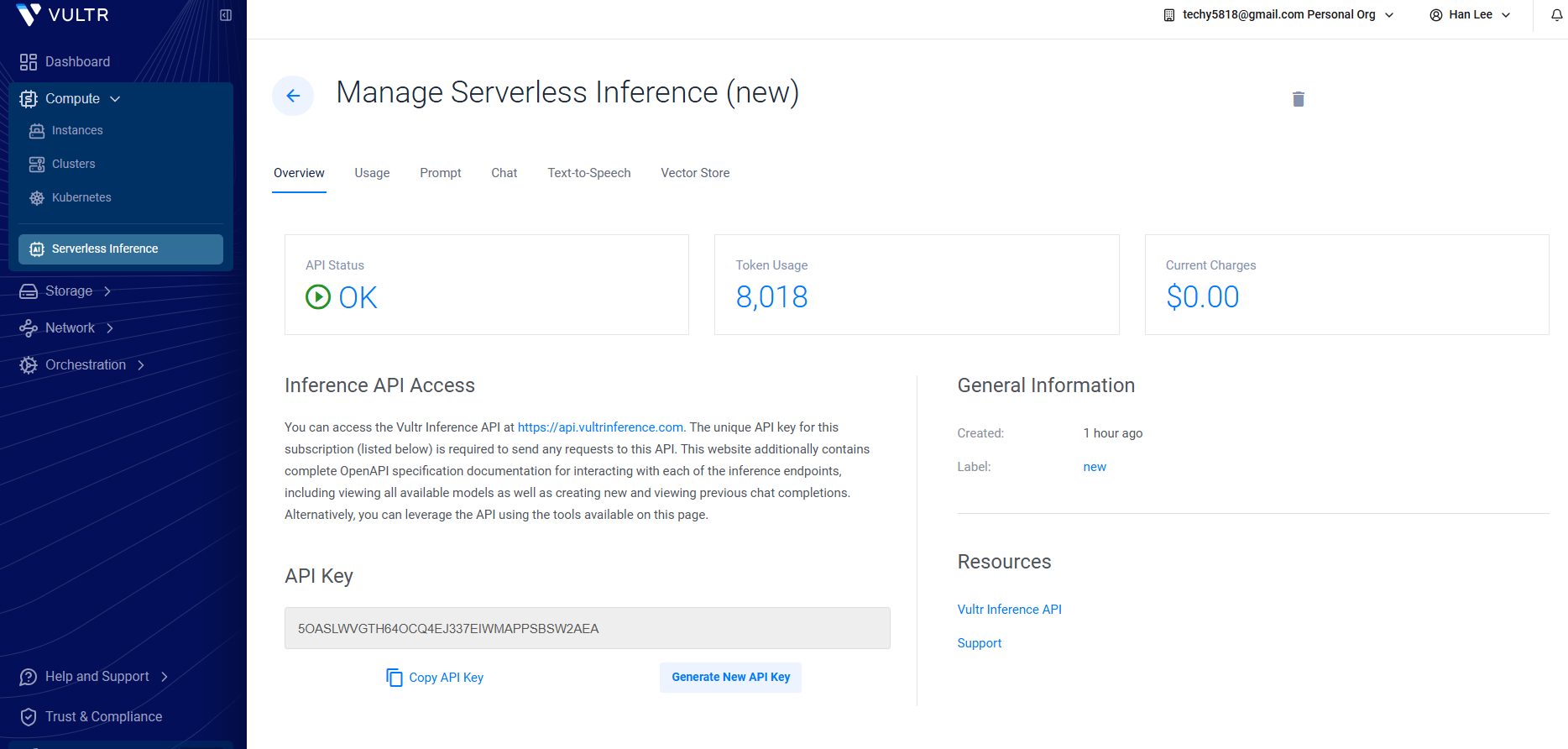
We integrated Vultr Serverless Inference using the DeepSeek model through an OpenAI-compatible API.
Vultr receives structured wallet metrics and personality candidates, then generates a personalized interpretation of the wallet's behavior, humorous roasts, and a shareable quote.
We use structured JSON responses and Zod validation to ensure AI-generated results match our application's expected format.
We also enforce guardrails to prevent the AI from inventing transaction amounts, profits, losses, or unsupported wallet activity.
NFT minting — Solana and Metaplex Core
Users can turn their ghost personality into a collectible NFT on Solana.
We use Metaplex Core to create the NFT asset, Pinata and IPFS to store its artwork and metadata, and wallet-based transaction signing to complete the minting process.
The NFT represents a personalized snapshot of the user's on-chain identity.
Deployment — Vercel and Vultr
GhostWallet's web application runs on Vercel, while Vultr provides the AI inference layer. This separates the web experience from model execution and allows us to use hosted AI without managing GPU infrastructure.
MLH Best Use of Backboard.io
We integrated Backboard.io into GhostWallet to give our mischievous ghost mascot, Boo 👻, a memory-powered conversational experience.
While GhostWallet uses blockchain data and AI to turn Solana wallet activity into entertaining ghost personalities, we wanted users to have a friendly companion who could explain the product, answer questions, and make the experience more approachable.
That's where Backboard comes in.
We built Chat with Boo, an AI product assistant that helps users understand GhostWallet's eight personality archetypes, Degen Score, AI-generated roasts, and collectible NFTs on Solana devnet.
Our architecture separates AI inference from conversational memory:
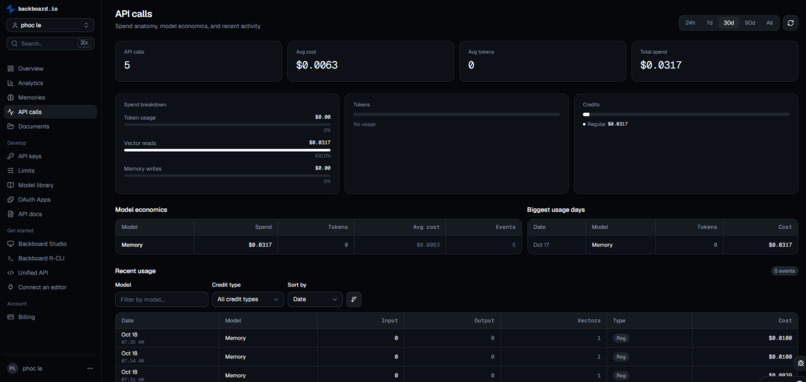
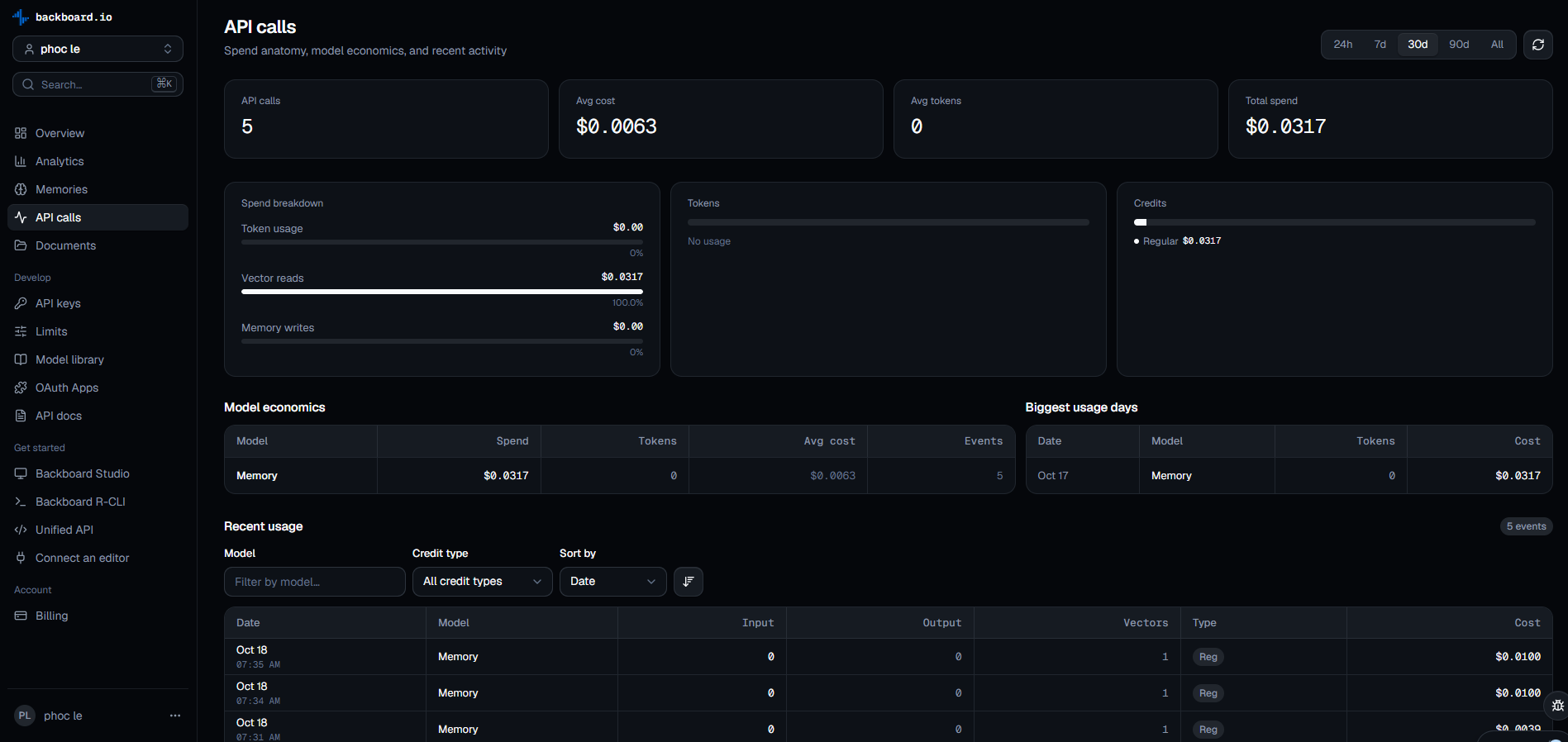
Backboard.io provides semantic memory storage and retrieval, allowing Boo to reference relevant previous conversations.
Vultr Serverless Inference generates Boo's conversational responses.
Next.js API routes connect both services while keeping API credentials secure on the server.
When a user asks Boo a question, GhostWallet retrieves relevant conversational memories from Backboard and provides that context to Vultr's language model. After generating a response, the application can save the conversation back to Backboard for future retrieval.
This design allows us to use Backboard's memory capabilities independently of the underlying language model.
One of our biggest challenges was discovering that Backboard's message endpoint could successfully accept a message while returning a failed inference status. Rather than abandoning the integration, we separated memory from response generation, keeping Backboard responsible for conversational context and Vultr responsible for generating replies.
What makes our Backboard integration special is that Boo is more than a generic chatbot. Boo has a distinct personality, understands GhostWallet's features, and uses conversational memory to make product support feel like interacting with a character rather than reading documentation.
Our goal is to turn a one-time wallet personality experience into a more engaging product where users can return, ask questions, and interact with a ghost that remembers their conversations.
Backboard gives Boo the memory. Vultr gives Boo the voice. GhostWallet gives Boo the personality.
MLH Best Use of Solana
GhostWallet uses Solana as both the source of its personality analysis and the destination for its collectible results.
Rather than simply connecting a wallet or transferring tokens, we use real on-chain transaction history as the foundation of an interactive experience.
Solana's high-throughput, low-cost ecosystem makes it especially interesting for behavioral analysis. Users can accumulate rich transaction histories involving swaps, NFT mints, and other on-chain interactions.
GhostWallet transforms that activity into something users can understand and share.
Our Solana integration includes transaction history analysis, behavioral classification, wallet interaction, and NFT creation using Metaplex Core.
What makes GhostWallet unique is the connection between on-chain behavior and on-chain identity.
Your transaction history determines your ghost personality, and that personality can become an NFT on the same blockchain.
We're making blockchain data more approachable, entertaining, and personal.
MLH Best Use of Vultr
Vultr powers GhostWallet's AI personality and roasting experience.
We integrated Vultr Serverless Inference to access DeepSeek through an API, allowing us to add generative AI without provisioning or managing our own GPU servers.
Instead of asking an AI model to invent a personality from scratch, we built a hybrid architecture.
First, our TypeScript analytics engine extracts factual wallet metrics and ranks potential ghost archetypes. Then Vultr's AI interprets those signals, selects an appropriate personality, and generates humorous explanations and roasts grounded in actual blockchain data.
For example, rather than producing a generic joke about crypto trading, Boo can reference a wallet's real swap count, active days, or transaction failures.
We also built reliability into the integration. When Vultr inference fails, returns invalid JSON, or exceeds its generation limits, GhostWallet falls back to deterministic personality classification and prewritten roasts.
This approach lets us combine the creativity of generative AI with the reliability of traditional application logic.
Vultr makes Boo feel less like a static personality quiz and more like a character who actually understands your wallet.
Challenges we ran into
Interpreting raw blockchain activity
Solana transactions contain complex instructions and token movements. Converting that information into meaningful behavioral metrics required careful parsing and normalization.
We also had to distinguish between enhanced transaction data and limited RPC data to avoid drawing conclusions from missing information.
Making AI outputs reliable
One of our biggest challenges was integrating DeepSeek through Vultr Serverless Inference.
During testing, we discovered that the model could consume its entire completion-token budget on internal reasoning, returning an empty response instead of the JSON our application expected.
We investigated the token usage, increased the completion-token budget, added response diagnostics, and strengthened JSON validation and fallback handling.
Preventing AI hallucinations
We wanted Boo to be funny without inventing financial information.
We designed prompts and validation rules around actual wallet metrics, restricted the available personalities, and kept numerical scoring outside the AI model.
Minting personalized NFTs
Connecting generated artwork, IPFS metadata, Metaplex Core assets, and wallet transaction signing required coordinating multiple services.
We also had to ensure the NFT metadata and image URLs were publicly accessible.
Balancing creativity with consistency
A purely rule-based personality quiz can feel repetitive, while a purely AI-based classifier can produce inconsistent results.
Our solution was a hybrid system that combines deterministic scoring with AI-generated personality interpretations.
Accomplishments that we're proud of
We're proud that GhostWallet transforms technical blockchain data into a playful experience that doesn't require users to understand transaction explorers or analytics dashboards.
We built a complete flow from entering a Solana wallet address to receiving a personalized ghost identity and minting it as an NFT.
We're especially proud of:
- Creating eight distinct ghost personalities with unique visual identities, traits, and humor.
- Integrating Vultr Serverless Inference for personalized AI analysis.
- Implementing fallback logic so the application remains functional when AI inference fails.
- Using Metaplex Core to turn personality results into collectible Solana NFTs.
- Bringing Boo to life as a memorable mascot who makes blockchain analytics entertaining.
Most importantly, we created something that makes people curious about their own on-chain history.
What we learned
Building GhostWallet taught us that blockchain analytics and generative AI complement each other when each is responsible for what it does best.
Traditional code is better suited for counting transactions, calculating ratios, enforcing constraints, and producing consistent scores.
Generative AI is better suited for interpreting patterns, creating personality-driven explanations, and turning structured data into entertaining language.
We also learned that working with reasoning models requires careful attention to token budgets, response validation, latency, and error handling.
On the blockchain side, we gained experience with Solana transaction analysis, Helius enhanced APIs, Metaplex Core, wallet signing, and decentralized NFT metadata storage.
Perhaps our biggest takeaway was that making Web3 fun can be just as valuable as making it technically powerful.
What's next for GhostWallet
We see GhostWallet growing beyond a one-time personality quiz into a living on-chain identity experience.
Our next steps include:
- Personality evolution: Track how a wallet's ghost personality changes as its on-chain behavior evolves.
- Ghost battles: Let friends compare Degen Scores, achievements, and personalities.
- More AI-powered commentary: Give Boo new jokes, reactions, and insights based on recent wallet activity.
- Dynamic NFT evolution: Allow ghost collectibles to reflect updated wallet personalities and achievements.
- Social sharing: Make it easier to share personalized ghost cards and roasts.
- Improved analytics: Expand transaction coverage and refine how we distinguish human activity from automated trading.
- Production-ready minting: Extend the NFT experience beyond development-network testing.
Our long-term vision is to make GhostWallet a fun, recognizable identity layer for Solana users.
Because every wallet has a history.
And every history deserves a ghost. 👻
Built With
- backboard.io
- deepseek
- metaplex
- next.js
- nft
- pinata
- solana
- typescript
- vultr


Log in or sign up for Devpost to join the conversation.