-
-
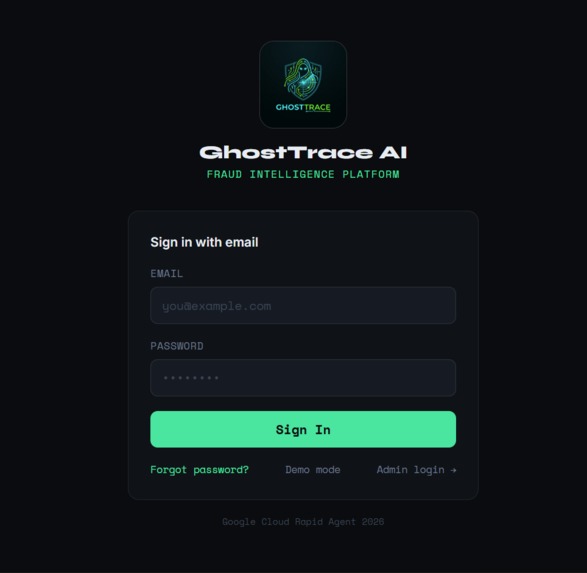
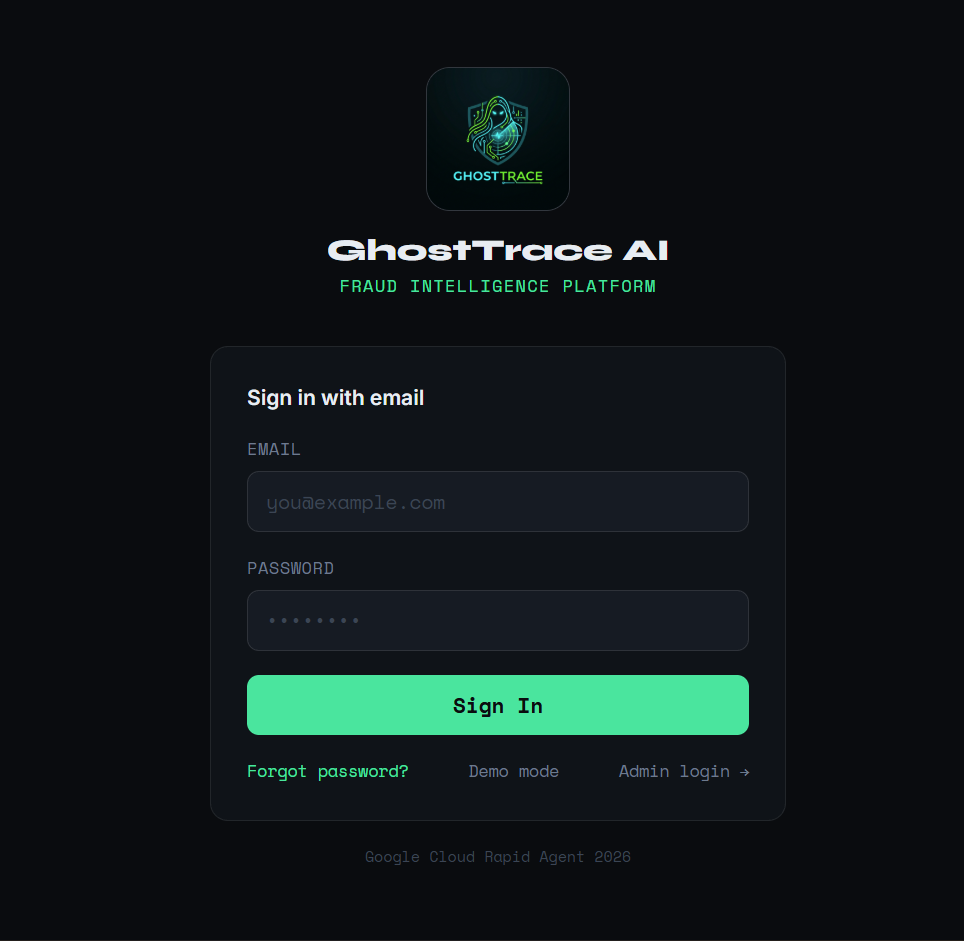
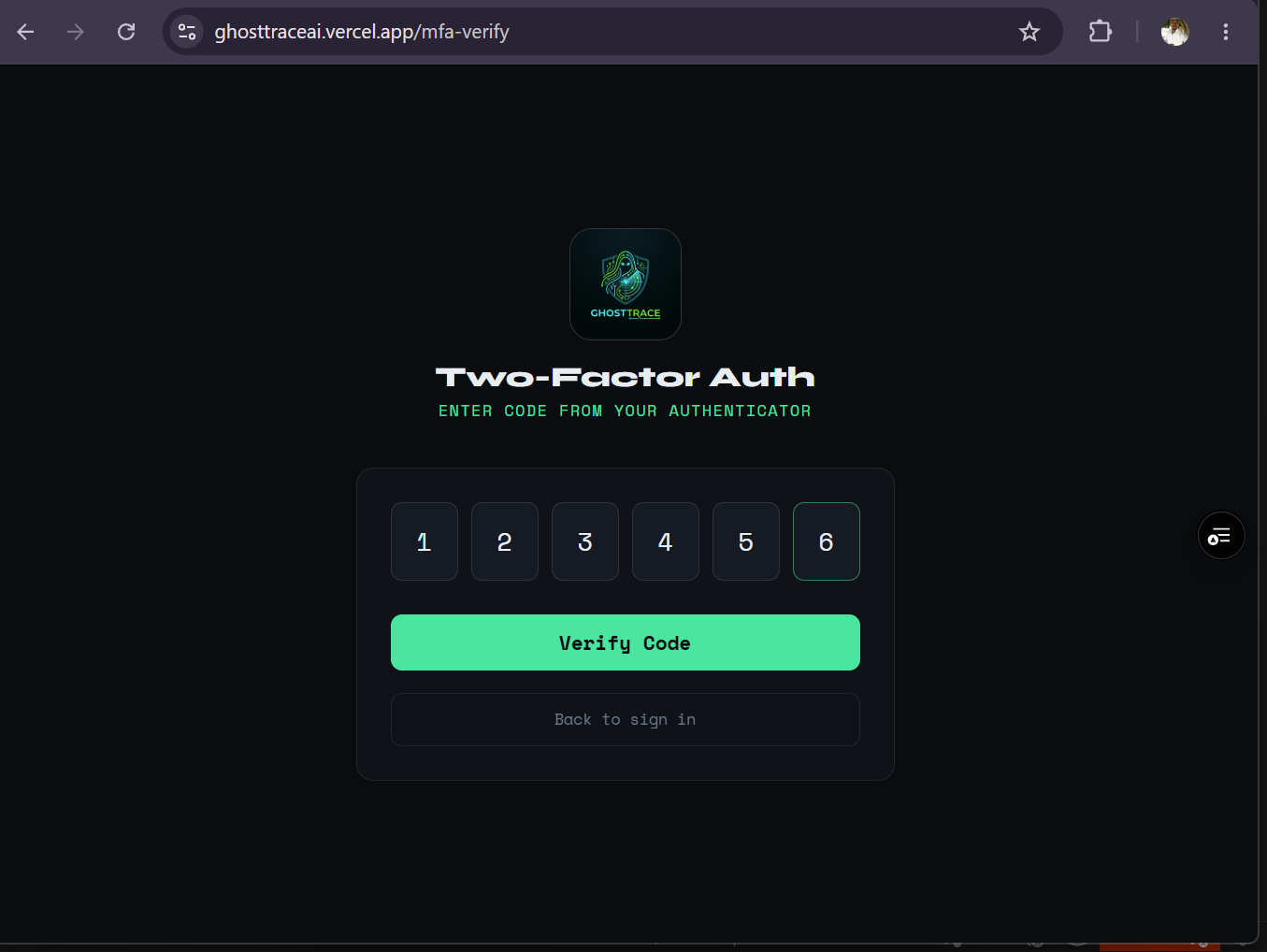
Demo/User Login page
-
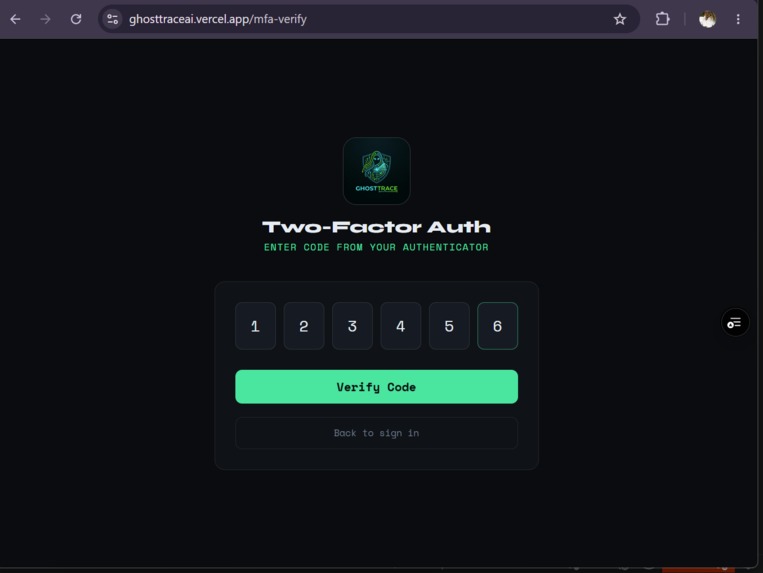
auth
-
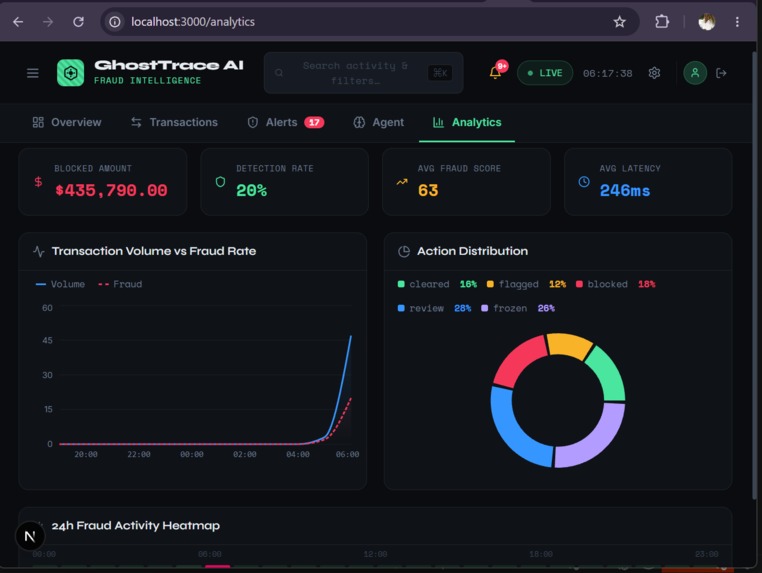
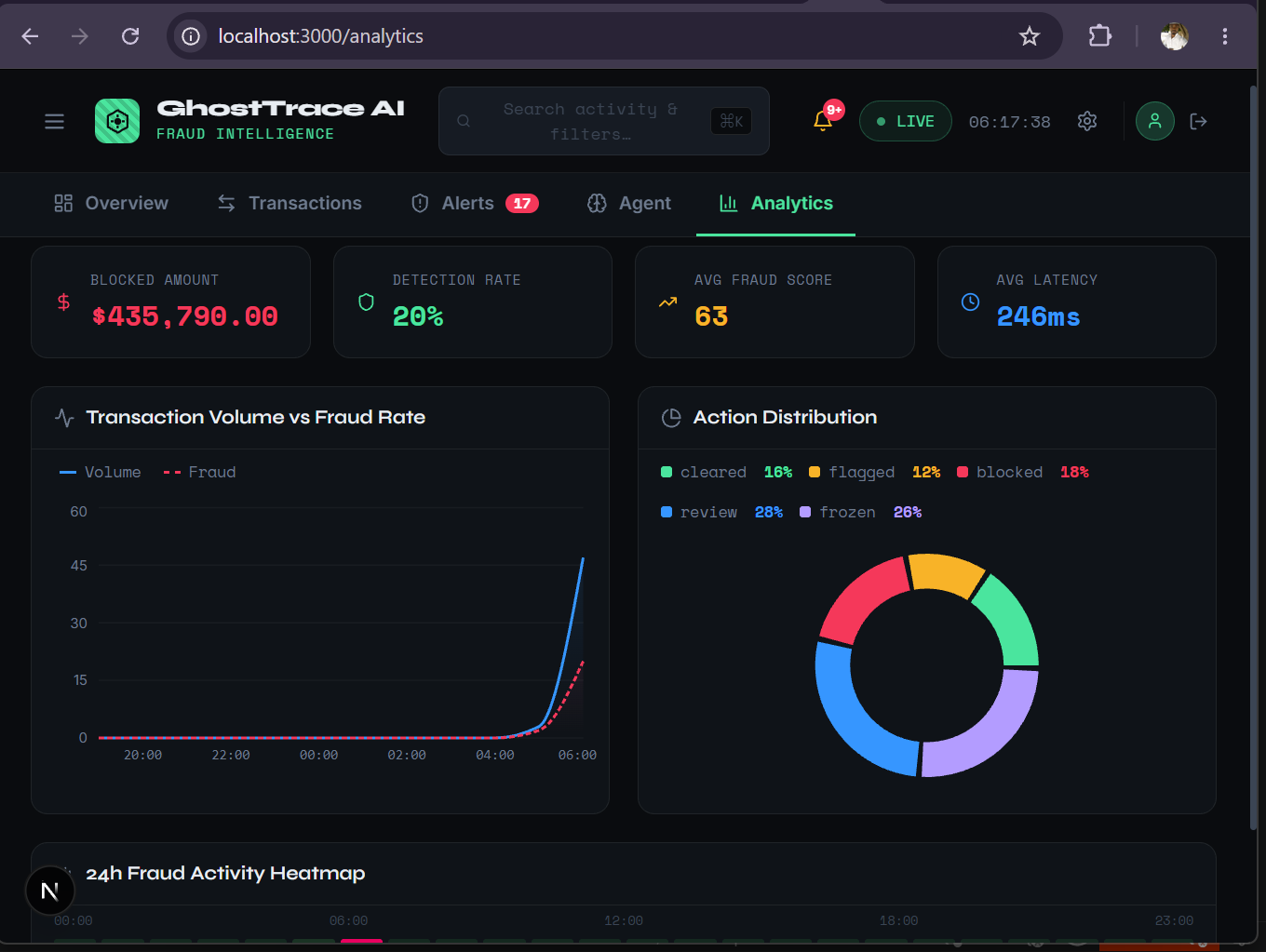
analysis
-
-
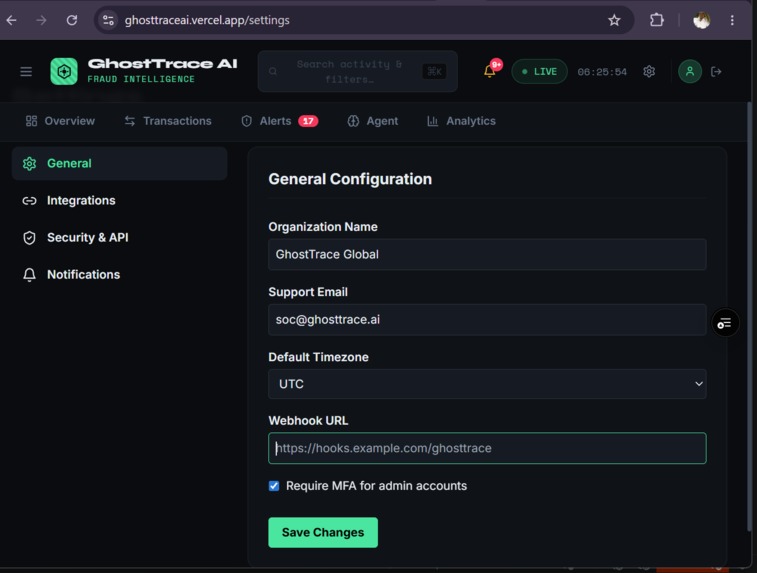
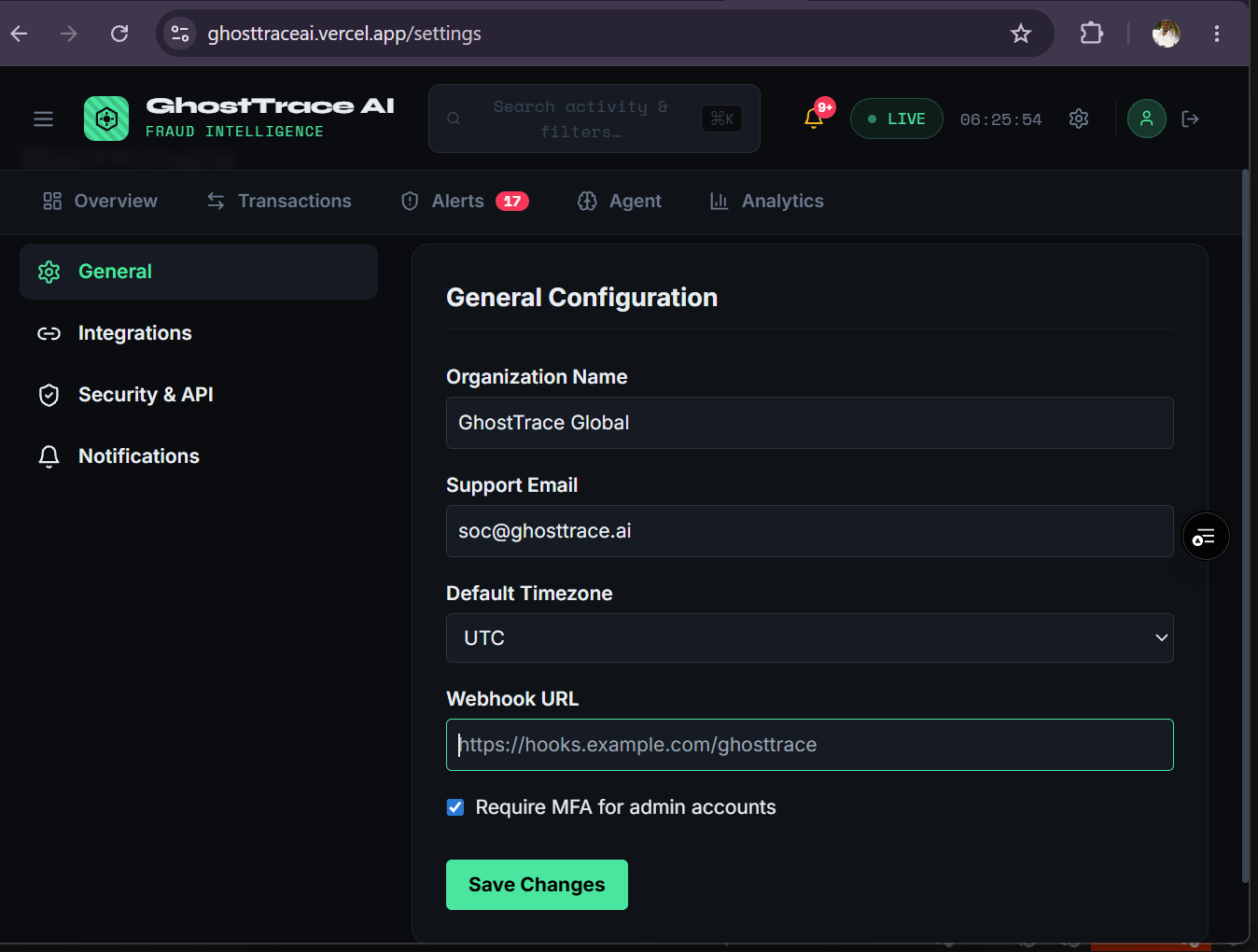
general webhook setup
-
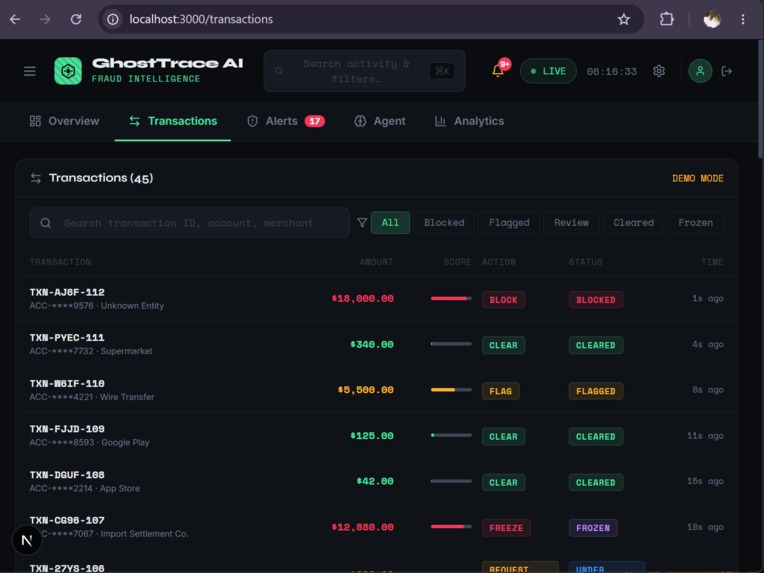
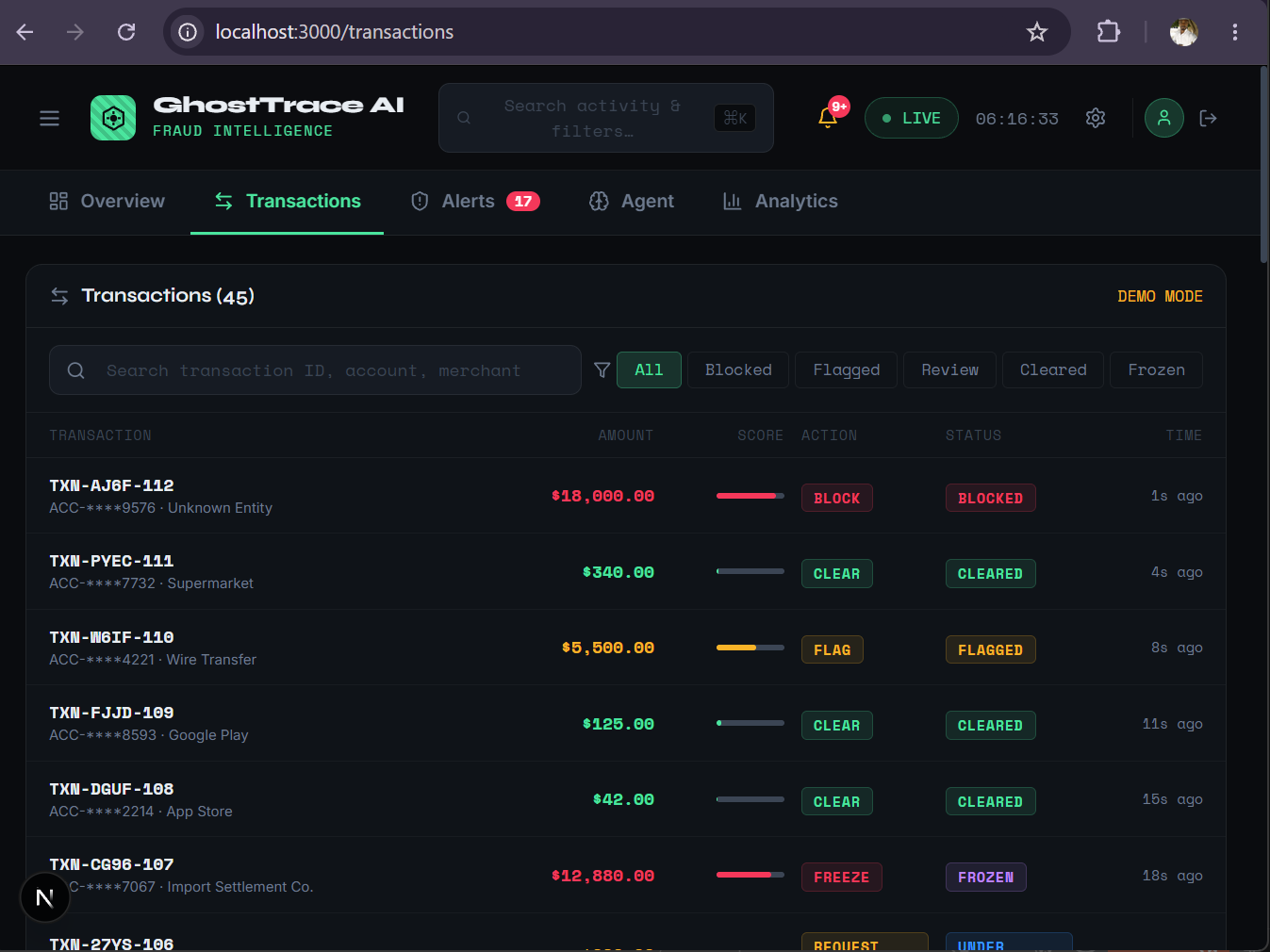
Transaction Viewer
-
Logo
-
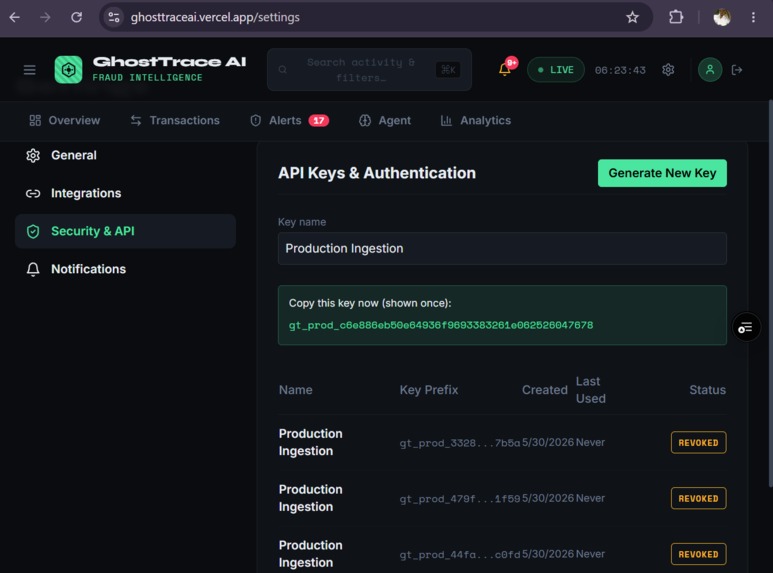
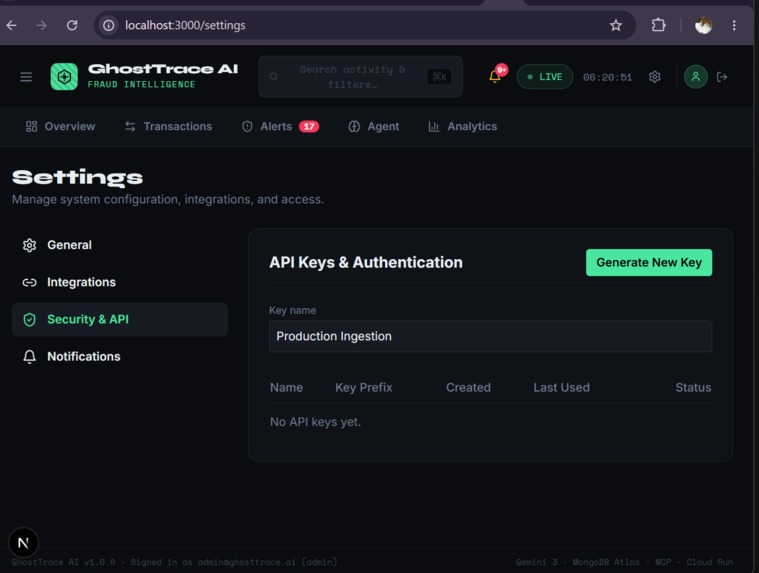
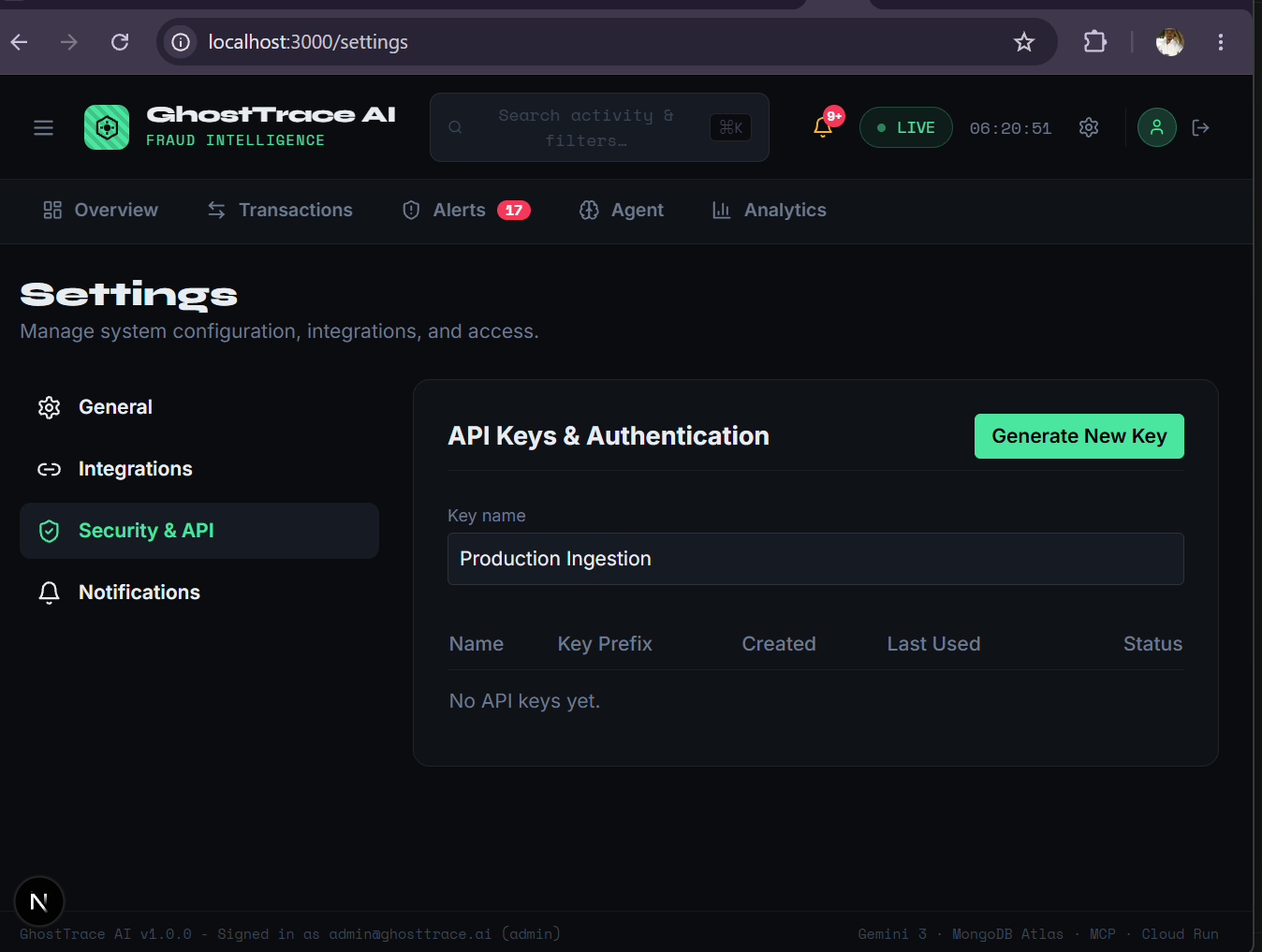
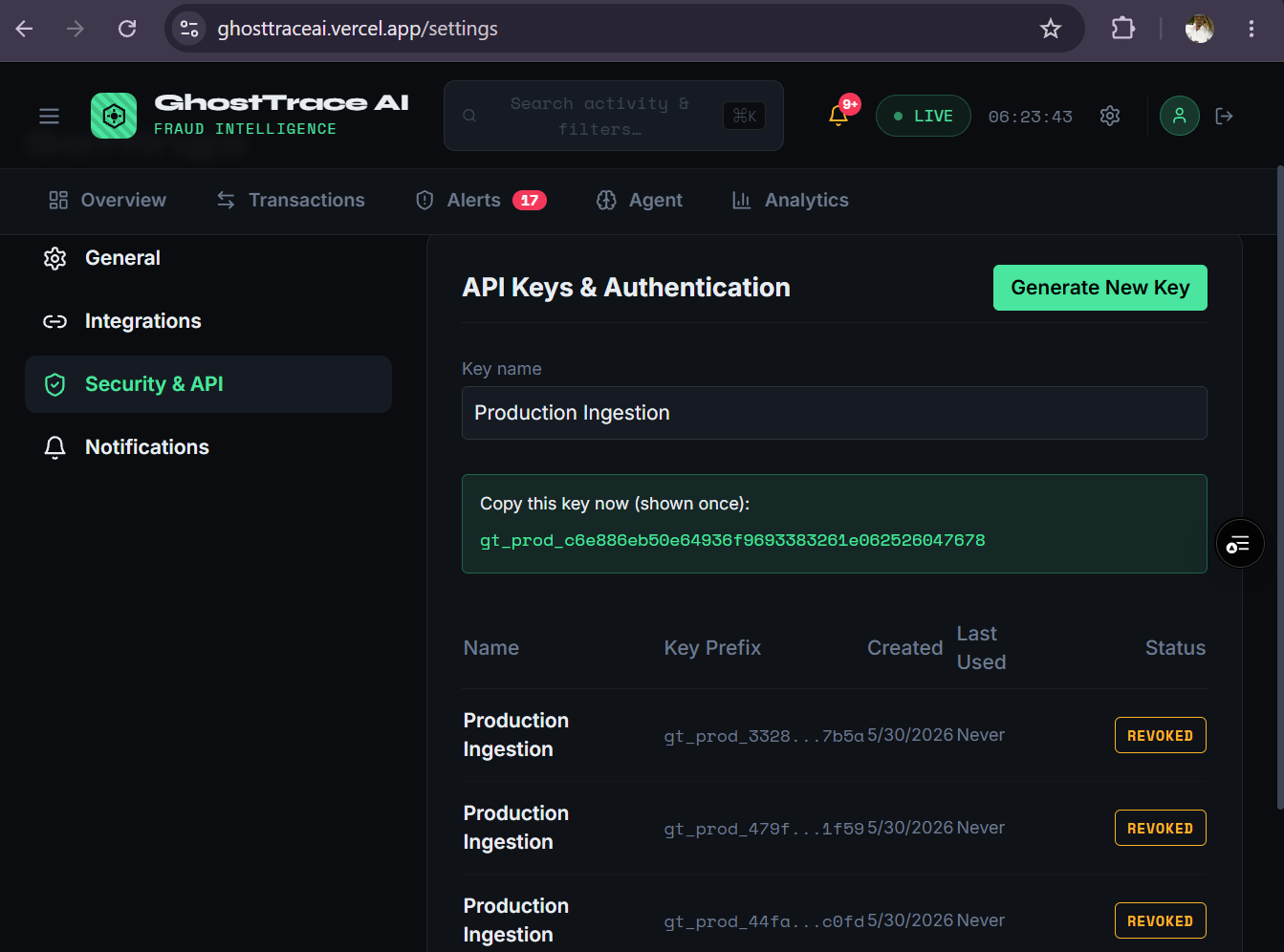
API Keys & Authentication
-
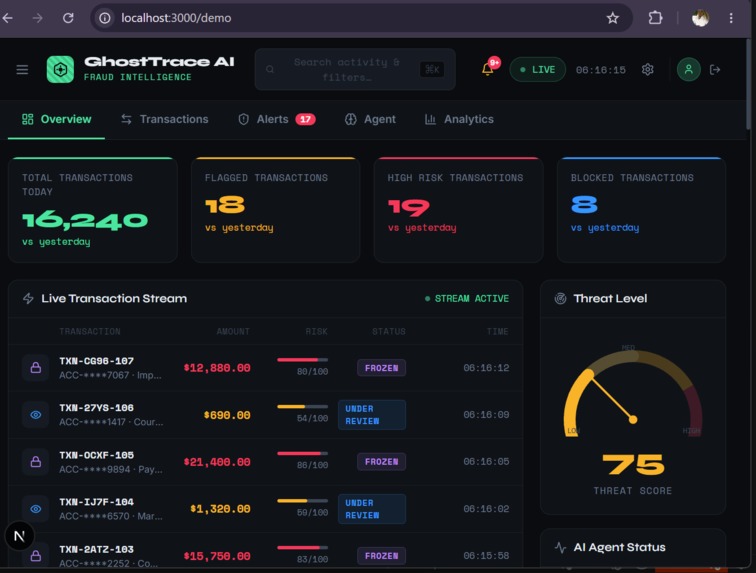
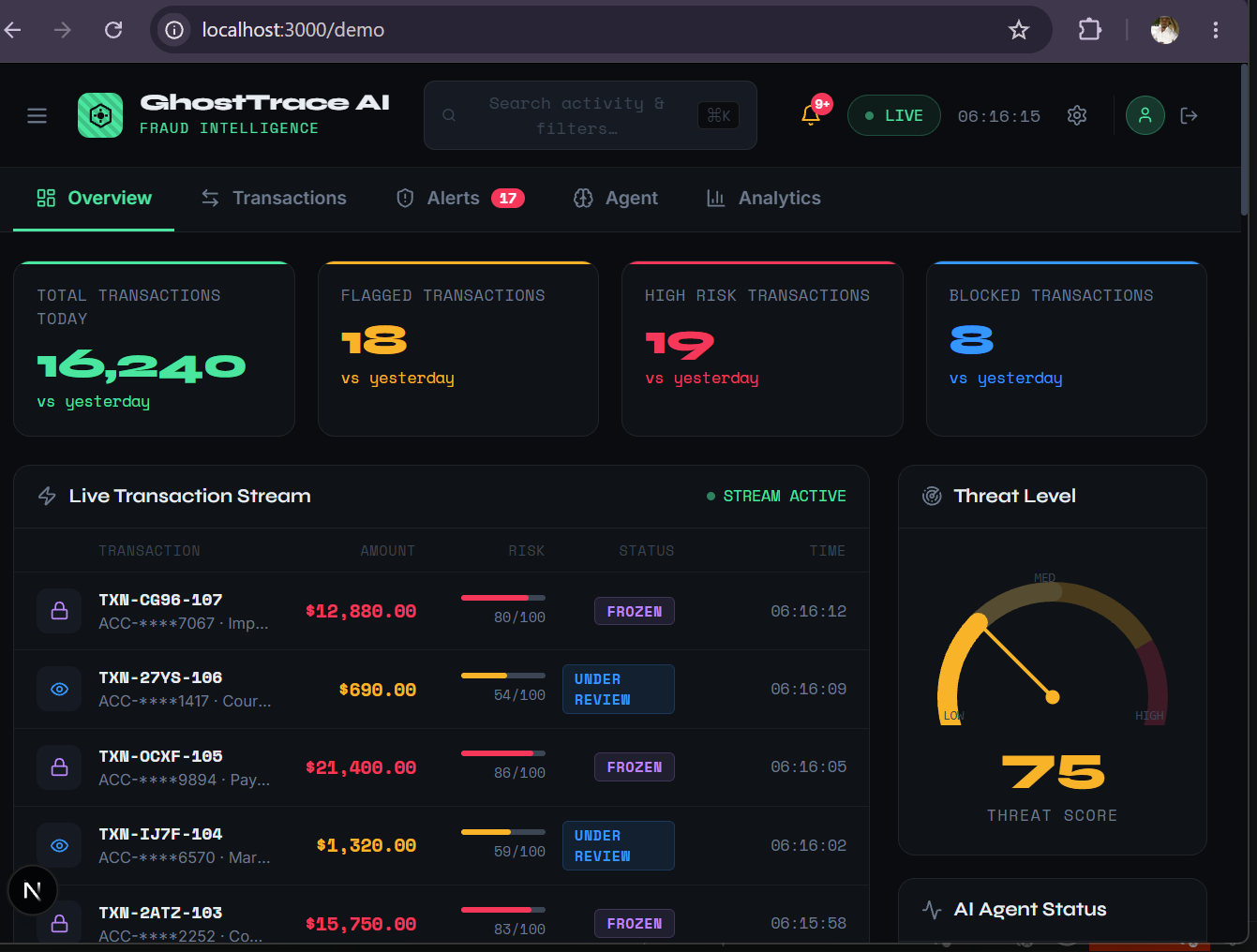
Dashboard/Overview page
-
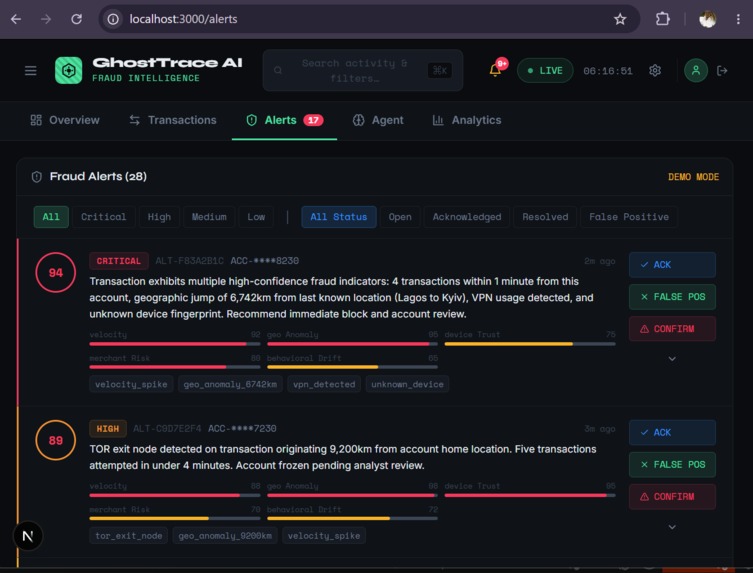
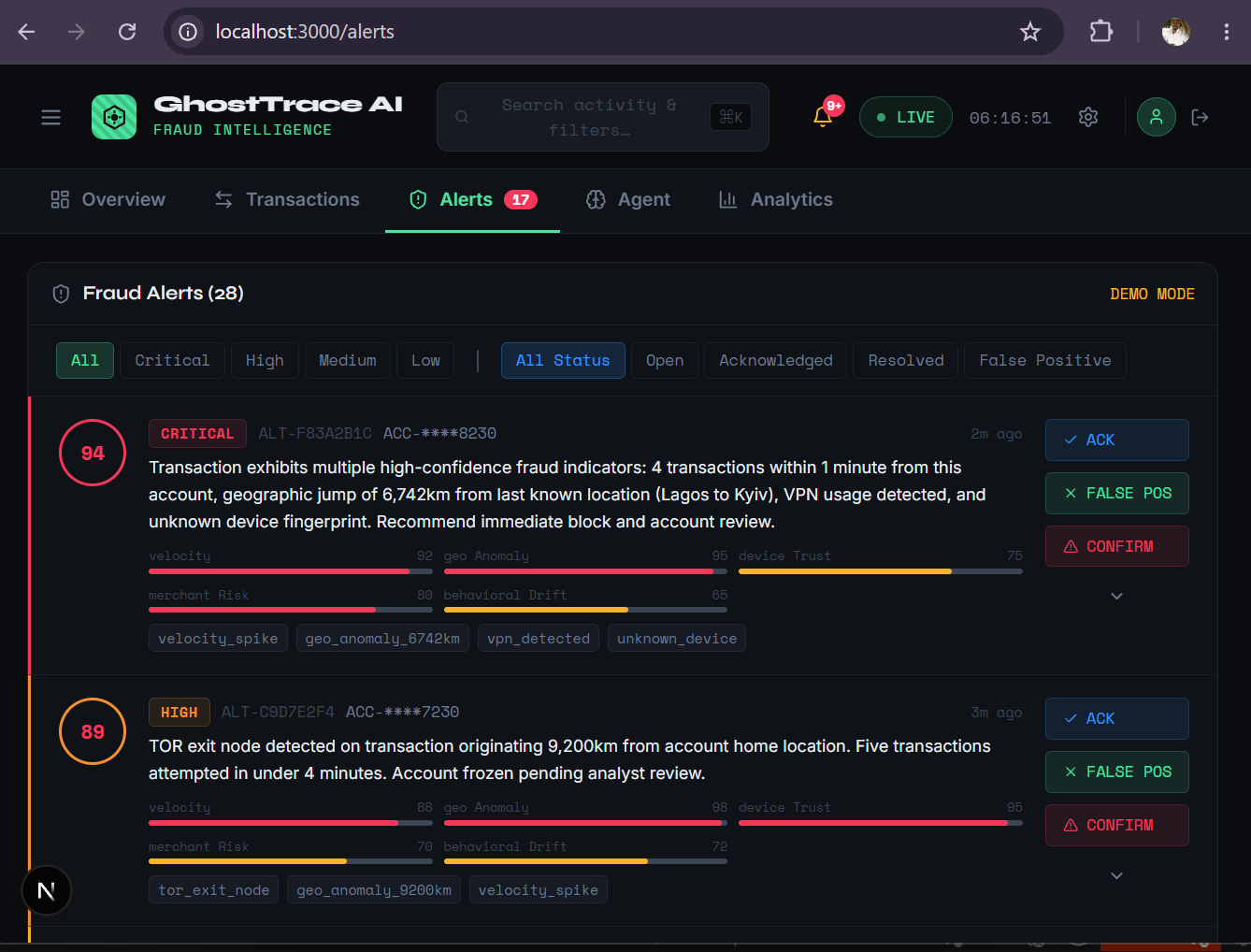
Alart
-
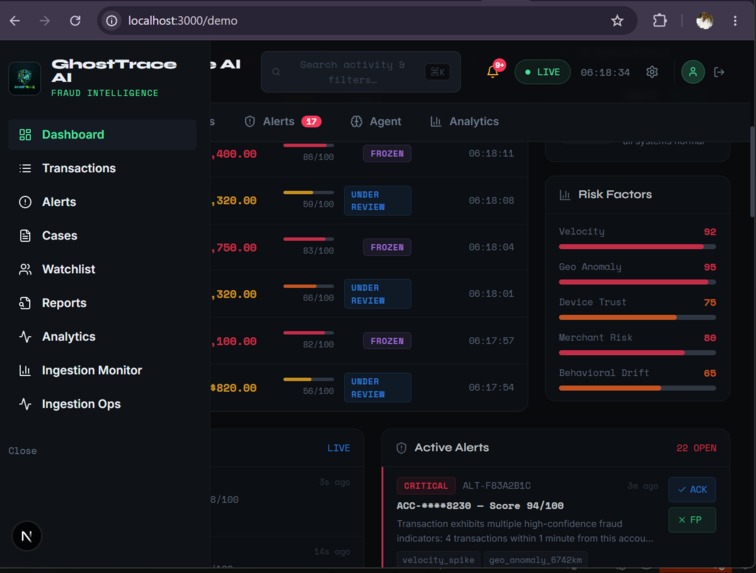
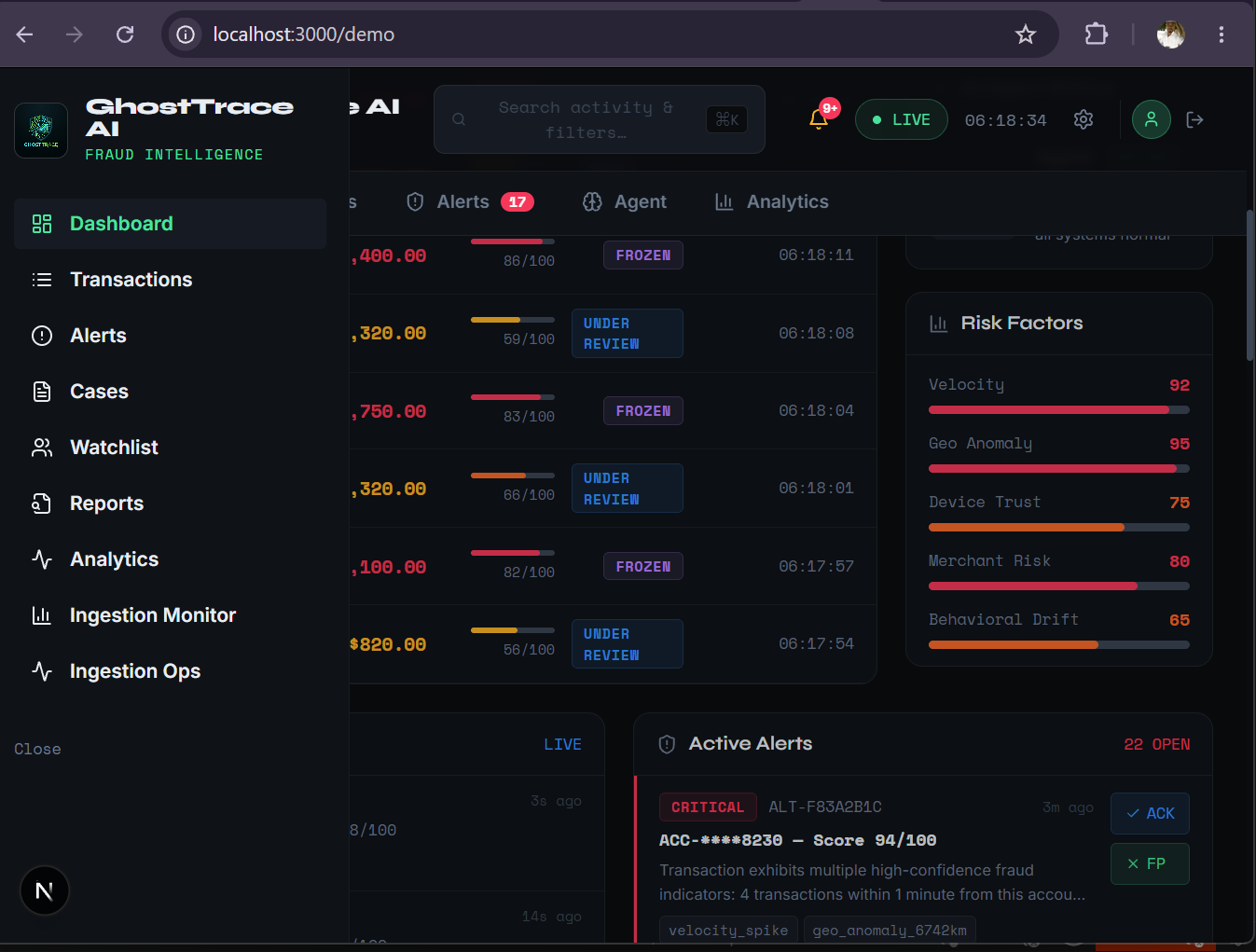
demo/user sidebar list items
-
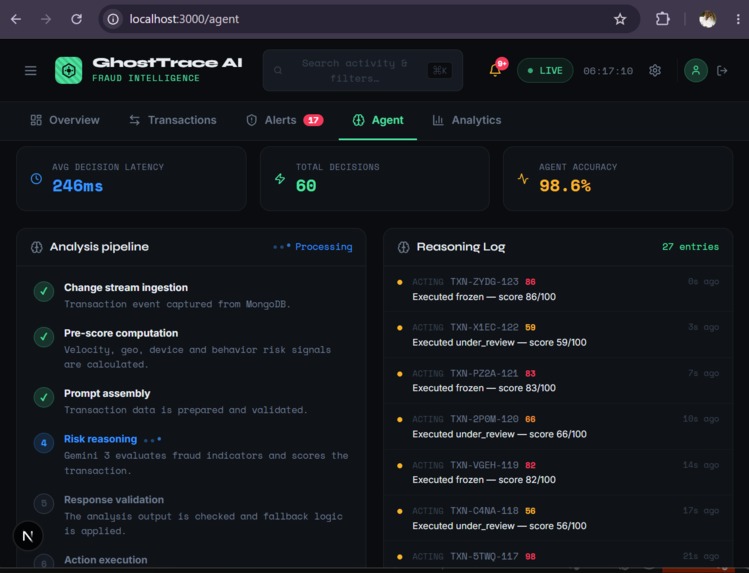
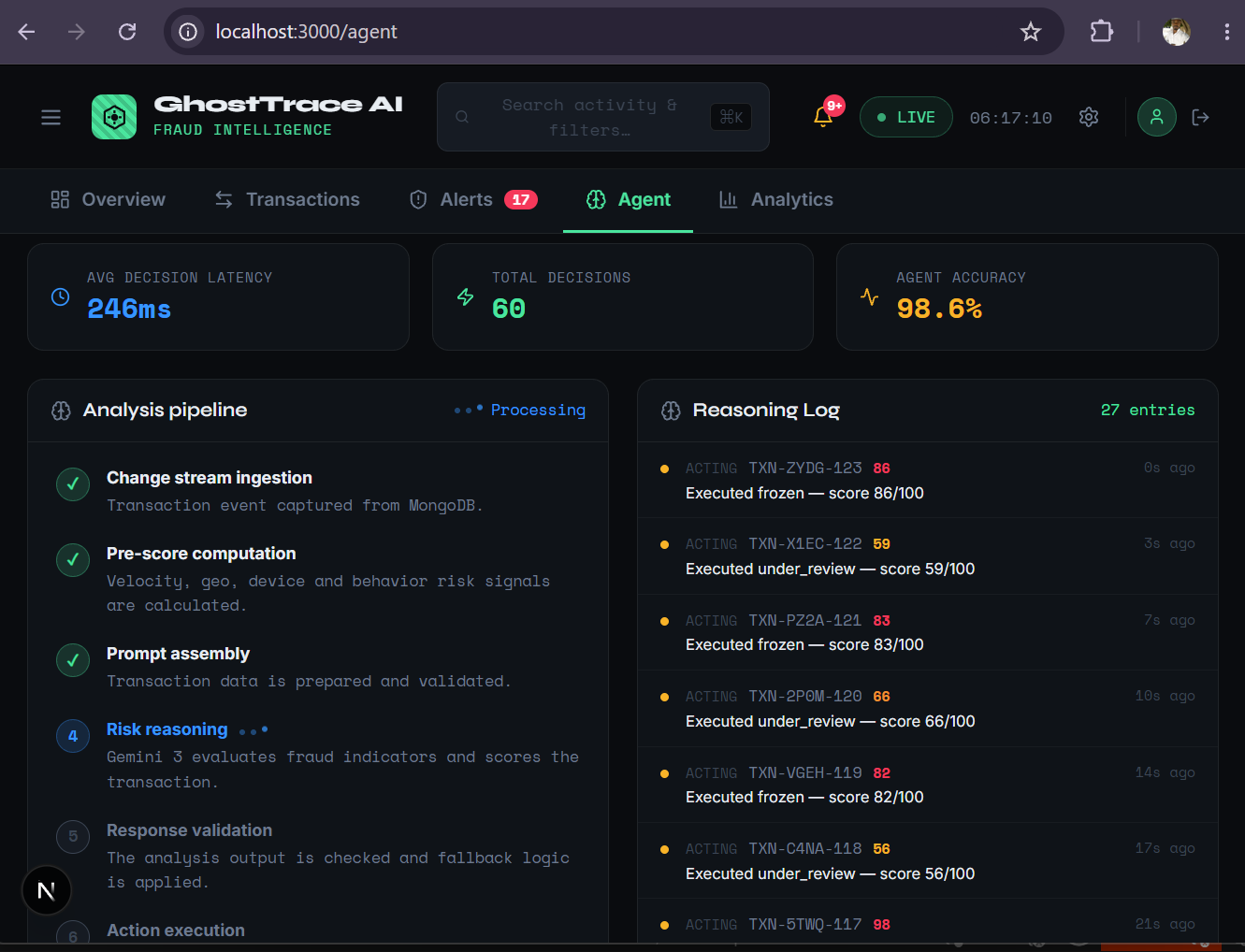
Agent overview
-
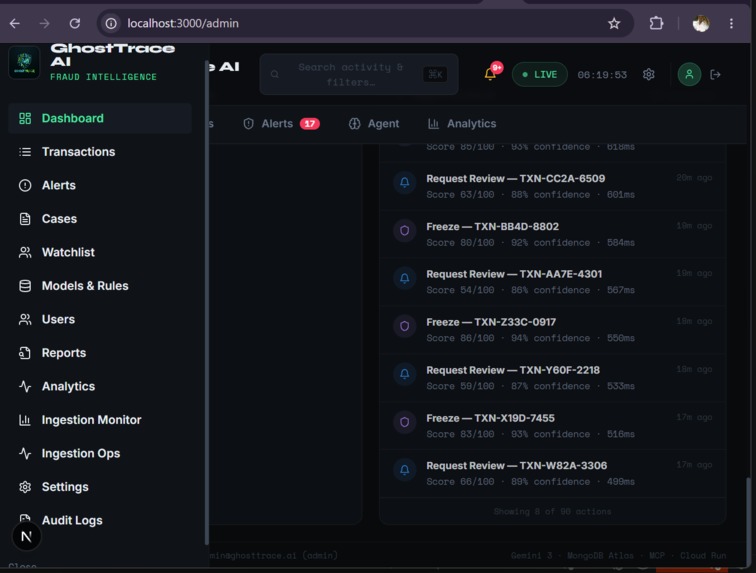
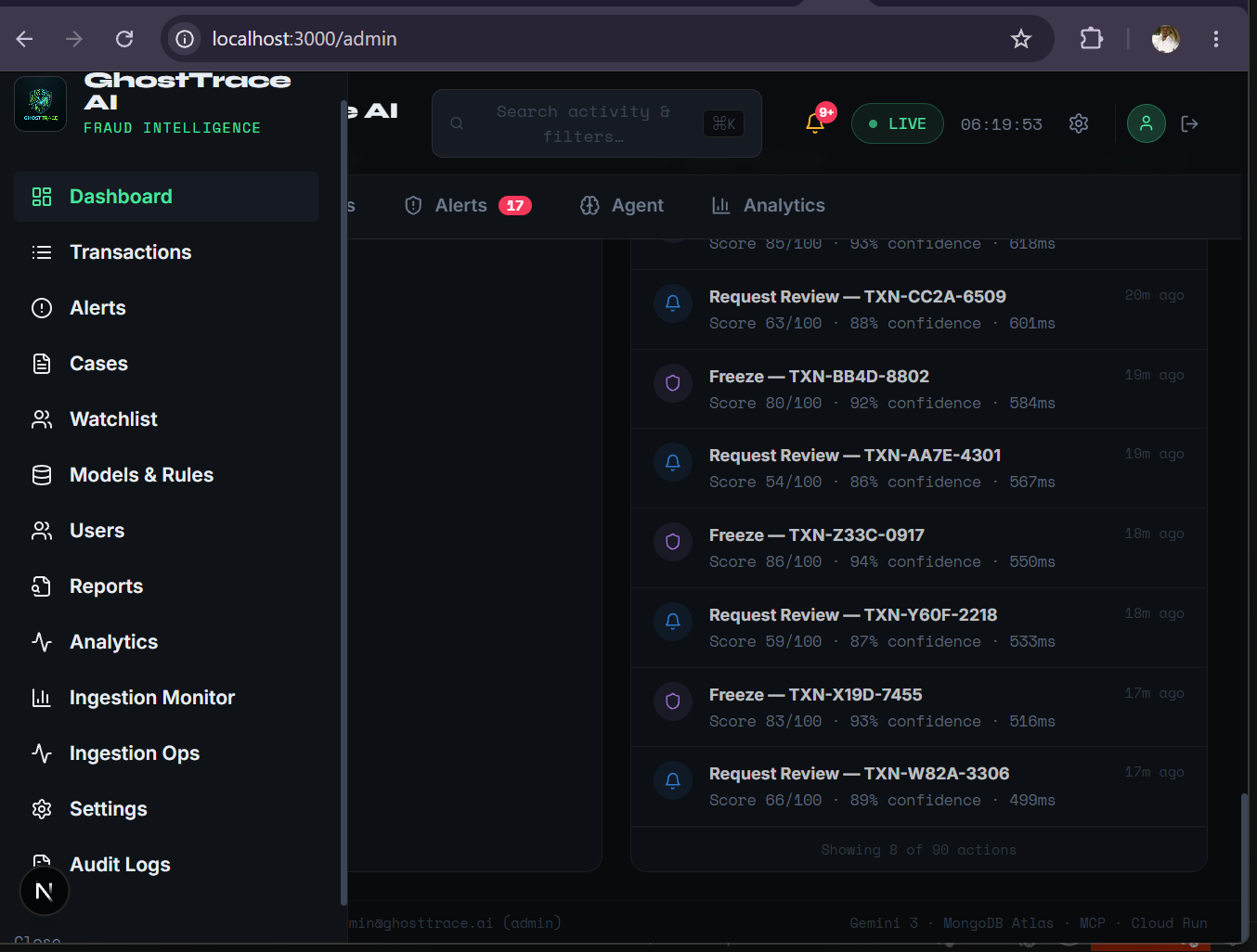
admin sidebar detail
-
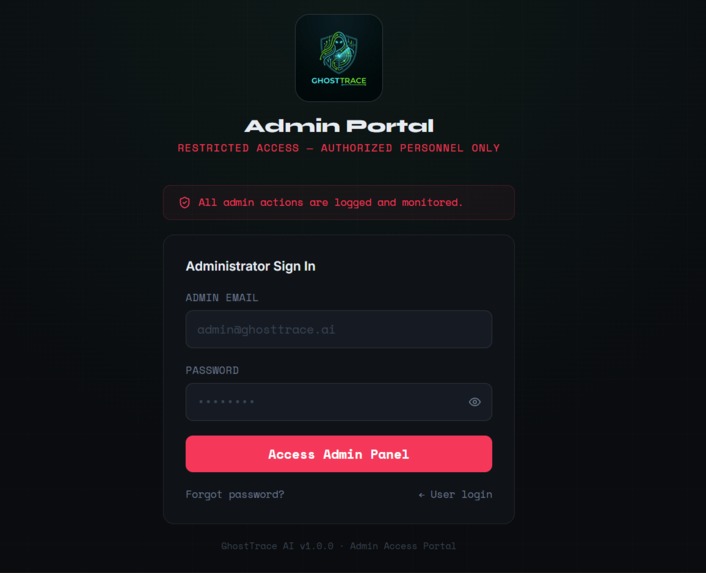
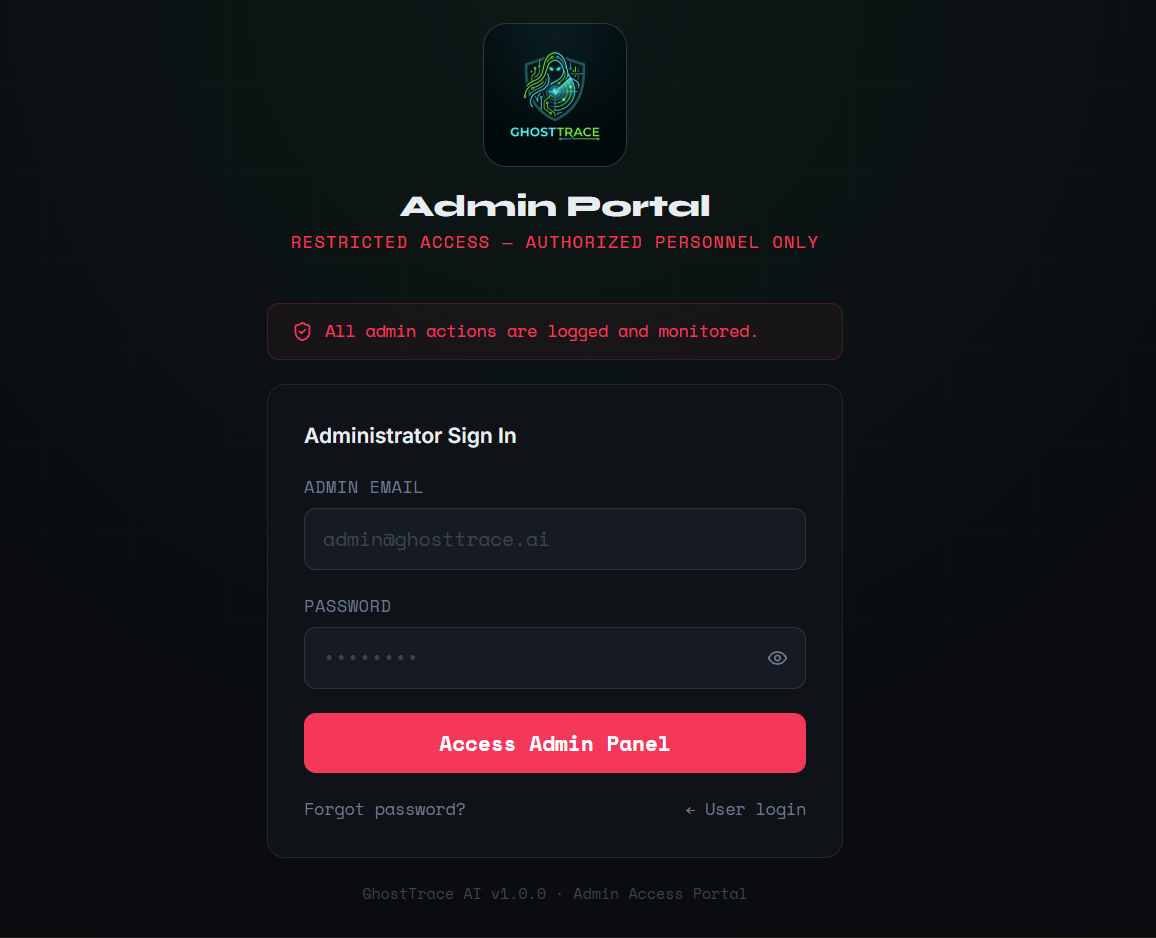
Admin Login Page
-
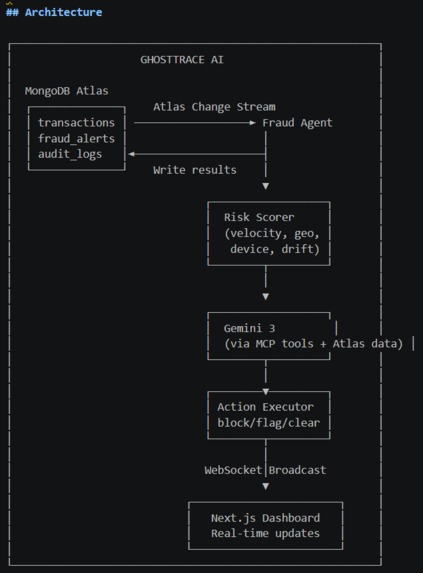
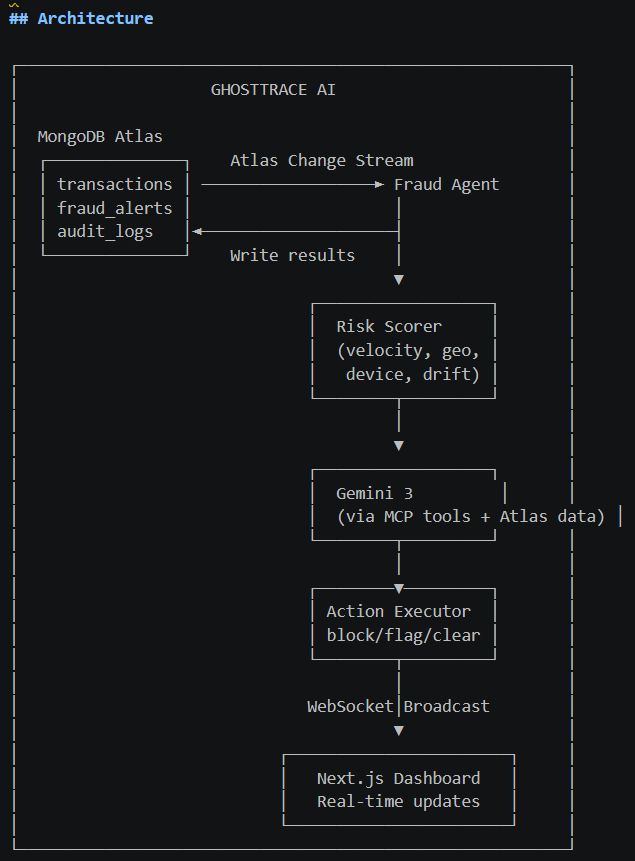
Architectural plan
About the project GhostTrace AI is an automated fraud detection system built to analyze transaction behavior, assign risk scores, and generate alerts in real time. It was designed as a data-driven security layer for financial systems, with a focus on scalability and automated decision support.
Inspiration Financial fraud systems today are often reactive, rule-heavy, and slow to adapt to evolving attack patterns. Many institutions still depend on static detection logic that struggles against sophisticated real-time threats such as account takeovers, transaction velocity attacks, device spoofing, and behavioral anomalies. We wanted to explore what fraud defense would look like if it were designed as an autonomous AI agent instead of a traditional monitoring dashboard. The idea behind GhostTrace AI was inspired by modern security operation centers, real-time threat intelligence systems, and the growing need for explainable AI in financial security. Our goal was to build a system capable of not only detecting suspicious activity in real time, but also reasoning about risk, explaining decisions, and autonomously responding to threats with minimal human intervention.
What it does GhostTrace AI is an autonomous real-time fraud detection and response platform powered by Gemini, Google Cloud, and MongoDB. The system continuously monitors live transaction streams and analyzes incoming events using AI-driven fraud reasoning. When suspicious behavior is detected, GhostTrace AI calculates a fraud risk score, generates a human-readable explanation, and automatically decides how to respond. Core capabilities include: 1 Real-time transaction monitoring 2 AI-powered fraud reasoning 3 Behavioral anomaly detection 4 Dynamic fraud risk scoring 5 Autonomous fraud response actions 6 Live investigation dashboard 7 Human-in-the-loop review workflows 8 Real-time alerting and escalation 9 Explainable AI decision analysis 10 Audit and investigation logging
It performs continuous evaluation where each transaction ( x ) is mapped to a risk vector ( \mathbf{v}(x) ), and risk is estimated with a score function such as: [ R(x) = \sigma(\mathbf{w} \cdot \mathbf{v}(x) + b)] Alerts are generated when ( R(x) > \tau ), where ( \tau ) is a configured threshold. GhostTrace AI can: 1 approve legitimate activity, 2 flag suspicious behavior, 3 escalate high-risk incidents, 4 or trigger manual review workflows automatically. The platform behaves as a true AI agent by reasoning, planning, and executing actions rather than functioning as a simple chatbot.
How we built it We designed GhostTrace AI as an event-driven architecture optimized for low-latency fraud analysis and autonomous response. Backend & AI Layer We built the core fraud agent using: Node.js Google Gemini Google Cloud Agent infrastructure MCP (Model Context Protocol)
The AI agent receives transaction events, analyzes fraud indicators, reasons over contextual data, generates risk scores, and selects the appropriate response action. Database & Streaming MongoDB Atlas was used as the primary operational database. We leveraged: MongoDB Change Streams, real-time event subscriptions, aggregation pipelines, structured audit collections
Change Streams allowed GhostTrace AI to react instantly whenever a new transaction entered the system. Frontend Dashboard I developed a modern real-time dashboard using: Next.js TailwindCSS live WebSocket updates interactive analytics visualizations The dashboard provides analysts with: live transaction feeds, fraud alerts, risk analytics, AI explanations, and investigation workflows. Fraud Simulation Engine Since production banking data is not publicly accessible, we built a simulated transaction engine capable of generating realistic banking activity and injecting fraud scenarios such as: velocity attacks, abnormal transfer spikes, location anomalies, and suspicious device activity.
Challenges we ran into One of the biggest challenges was designing the system to behave like a true autonomous agent instead of a static fraud classifier. I had to carefully architect: real-time event handling, AI reasoning orchestration, streaming workflows, and action execution pipelines. Another major challenge was balancing: detection sensitivity, false positives, and response speed. Building explainable AI outputs was also difficult because fraud systems must provide transparent reasoning rather than black-box decisions. I additionally faced challenges around: real-time synchronization, WebSocket stability, event deduplication, MongoDB stream reliability, and maintaining low-latency processing across the stack. Designing the dashboard UX for live fraud operations while keeping the interface clean and intuitive was another significant engineering and design challenge.
Accomplishments that we're proud of I'm proud that GhostTrace AI evolved beyond a traditional fraud dashboard into a fully autonomous fraud intelligence agent. Some accomplishments we are especially proud of include: Building a real-time AI-driven fraud response workflow, successfully integrating MongoDB streaming with autonomous AI reasoning, designing explainable fraud analysis outputs, creating a live operational dashboard with real-time updates, implementing autonomous action selection logic, building an enterprise-style fraud operations interface, simulating realistic fraud attack scenarios, architecting the platform with scalability and production-readiness in mind. Most importantly, I built a system that demonstrates how AI agents can actively participate in financial security operations instead of simply generating predictions.
What we learned This project taught me a great deal about: event-driven architectures, AI orchestration, real-time data systems, and operational security workflows. I learned that building autonomous AI systems requires much more than integrating an LLM. Reliable AI agents require: contextual memory, structured decision pipelines, fallback handling, explainability, and operational observability. I also gained deeper experience working with: MongoDB Change Streams, streaming event systems, WebSockets, Google Cloud services, and AI-driven workflow automation. Another important lesson was understanding the tradeoff between aggressive fraud detection and maintaining a low false-positive rate.
What's next for GhostTrace AI my next goal is to evolve GhostTrace AI into a multi-agent fraud intelligence platform capable of operating across larger financial ecosystems. Future plans include: multi-bank fraud intelligence sharing, advanced behavioral biometrics, federated anomaly detection, predictive fraud prevention, adaptive self-learning fraud models, blockchain and crypto fraud monitoring, analyst copilot features, advanced case management workflows, voice and identity fraud detection, SIEM/SOC integrations, and enterprise-scale deployment infrastructure
I also plan to integrate more advanced AI memory systems and build deeper autonomous investigation capabilities that can proactively trace coordinated fraud networks in real time.
Built With
- apis
- axios
- docker
- express.js
- framer-motion
- google-cloud-platform(gcp)
- google-gemini-api
- javascript
- jwt
- mongodb
- next.js
- node.js
- recharts
- rest
- sdk
- supertest
- swr
- websockets
- zustand

Log in or sign up for Devpost to join the conversation.