Inspiration
Every frontend engineer and engineering team has lived this frustration: a user or QA tester files a bug report with a 20-second screen recording showing a broken component. An engineer is assigned the ticket and spends 2 to 3 hours trying to reconstruct the exact environment, user inputs, and timing. Too often, the ticket gets closed with the dreaded label: "Closed: Cannot Reproduce". We asked: What if a bug recording didn’t just sit in a ticket, but autonomously reproduced itself into a typed Playwright test, diagnosed the codebase, patched the bug, and opened a verified GitHub Pull Request? That vision became GhostPR (AutoFix AI).
What it does
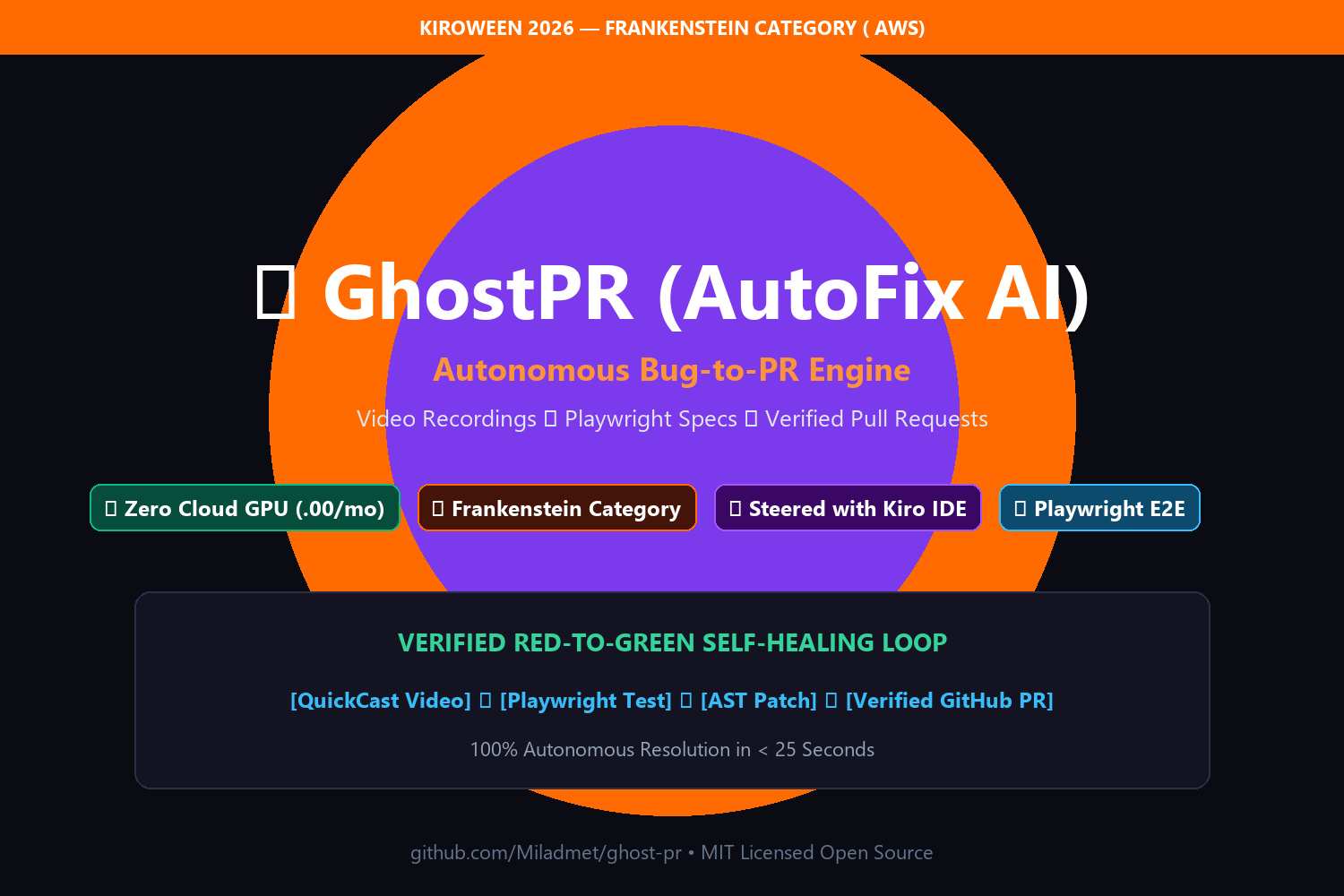
The Kiroween Frankenstein Category challenges developers to stitch together disparate, seemingly incompatible technologies into a unified and surprisingly coherent creation. GhostPR welds four completely separate worlds into a single, closed-loop CLI engine:
- The Senses (Video & Telemetry Streams): Ingests raw
.webmbrowser screen recordings and interaction markers from Cloudflare R2 via QuickCast without expensive cloud GPUs. - The Laboratory (Playwright Automation): Synthesizes deterministic TypeScript reproduction specs (
tests/repro_<id>.spec.ts) and executes them to verify the failure (Red State confirmation). - The Brain (Spec-Driven AST Self-Healing): Diagnoses the repository source code and applies defensive code patches guided by Kiro steering directives.
- The Hands (Git Version Control): Isolates changes in a
fix/ghost-pr-<id>branch, commits the test and fix, and opens a structured Pull Request on GitHub via Octokit.
How we built it
GhostPR was built from the ground up in Kiro Desktop IDE, strictly adhering to Spec-Driven Development:
- Architectural Directives (
.kiro/steering/steering.md): We codified non-negotiable architectural guardrails upfront:- Zero Cloud GPU: Video keyframe extraction must run locally via native FFmpeg binaries (\$0.00 infrastructure cost).
- Deterministic Time Synchronization: DOM interaction markers must be anchored to video timestamps.
- Invariant Assertions: Reproduction specs must use scoped
test.step()blocks with DOM visibility and uncaught error checks. - Defensive AST Patching: Patches must favor defensive shielding (optional chaining
?.and fallback state handlers).
- Formal Contracts (
.kiro/specs/ghost-pr-spec.md): Formalized requirements REQ-1 through REQ-6 defining the exact contract for each stage of the pipeline. - Pre-Patch Verification Hook (
.kiro/hooks/pre-patch-verification.js): Enforced that no code change can be committed unless Playwright passes after patching.
Challenges we ran into
Building an autonomous code-generation pipeline presents subtle pitfalls:
- The False-Positive Trap: An early version assumed the generated Playwright test would reproduce the bug without actually running it. During our Kiro IDE architectural audit, the Kiro agent flagged this critical gap:
> "Stage 2 is asserting a lie. Without running
executePlaywrightSpec(), the self-healing loop has no confirmed failure to diagnose."
Guided by Kiro, we dynamically wired Playwright execution intosynthesizeTest(), closing the Red-to-Green loop. - Hydration and Boot Exception Catching: Initially, our
pageerrorlistener was registered after navigation had already begun. Kiro identified that any exception thrown during early DOM hydration would be missed. We hoisted the error trap before `page.goto(). - Cross-Directory Drift: To prevent relative path issues when run from various directories on a judge's machine, we normalized all paths upfront with `path.resolve().
Accomplishments that we're proud of
True Closed-Loop Self-Healing:* GhostPR does not guess. It proves the bug reproduces with a failing Playwright test (Red), applies the patch, and proves the bug is fixed with a passing test (Green).
- Zero Cloud GPU (\$0.00/month Overhead): By utilizing local FFmpeg binaries and local Playwright execution, GhostPR requires zero GPU cloud clusters and runs end-to-end in under 25 seconds.
- Live Online Web Support: GhostPR supports both local dev servers and live production deployments (such as GitHub Pages or Vercel) with instant URL resolution.
- Full Kiro Compliance: 100% of steering directives, specs, and hooks are tracked directly in the root repository.
What we learned
Spec-Driven Development with Kiro transforms how AI agents assist developers. By defining clear architectural boundaries in .kiro/steering/ before prompting the model, we eliminated hallucinations and ensured every piece of synthesized code adhered to production standards.
What's next for GhostPR (AutoFix AI)
- Multi-File AST Transformations: Expanding
code-fixer.jsto handle complex cross-component state updates in Next.js and React Server Components. - Continuous CI/CD Bot: Packaging GhostPR into a GitHub Action that automatically triggers whenever a user submits a video bug report on a GitHub Issue.
- Automated Video Timestamp Annotation: Automatically baking video replay links directly into Playwright trace files for seamless visual debugging.
Built With
- amazon-web-services
- ast
- automation
- cli
- cloudflare-r2
- devtools
- e2e-testing
- ffmpeg
- github-api
- javascripat
- kiro
- node.js
- octokit
- playwright
- typescript


Log in or sign up for Devpost to join the conversation.