Real World Impact
Every organisation has a database that is quietly rotting — provider directories, CRM contacts, supplier records, service listings. The facts that go stale fastest — "is this office still here", "do they still accept this plan", "is this still the contact" — don't live in any API. They live in a person's head and decay constantly.
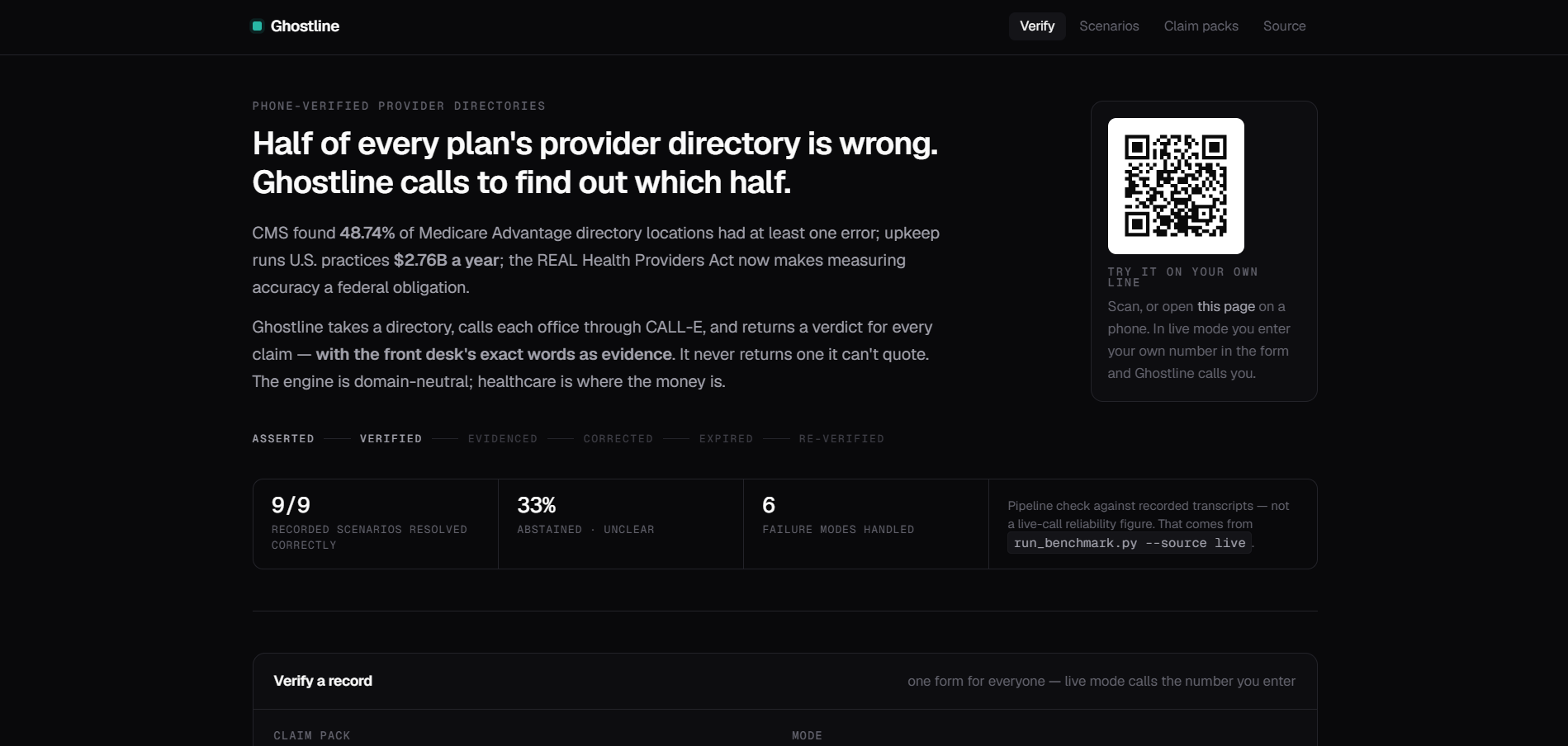
The numbers are not small. CMS's own national review found 48.74% of Medicare Advantage provider-directory locations had at least one inaccuracy. A Senate Finance Committee secret-shopper study found an 18% appointment-booking success rate. AJMC found 40.3% of already-known directory errors persisted an average of 540 days against a 90-day federal standard. CAQH puts directory maintenance at $2.76B/year for U.S. practices. And the REAL Health Providers Act (signed Feb 2026) makes measuring directory accuracy a federal statutory obligation for the first time.
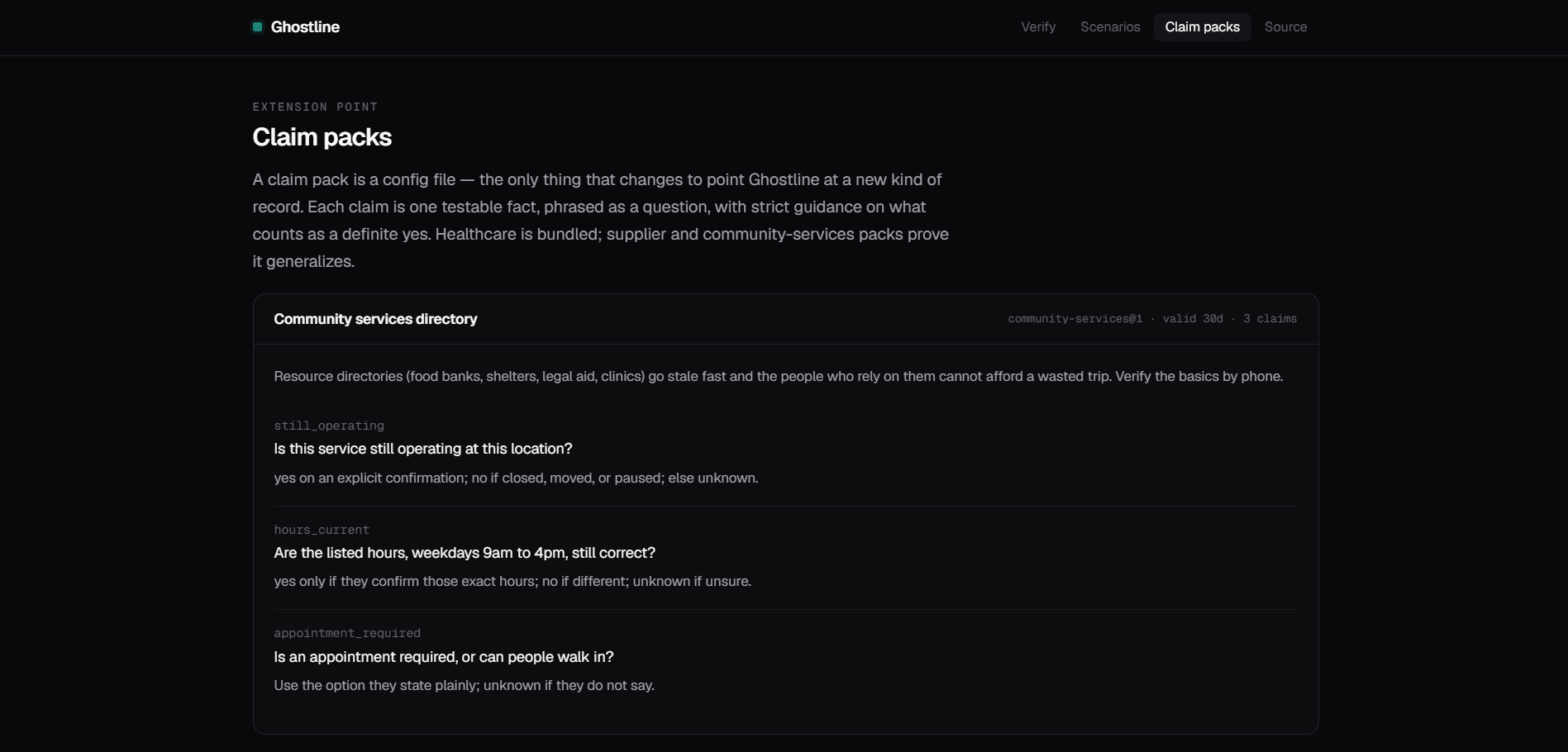
Healthcare is the flagship evidence case, not the product's identity. The same problem — a phone-reachable record that has to stay accurate — is a supplier-contact database, a 211-style community-services directory, any B2B record with a number attached. Ghostline's engine is domain-neutral; a new domain is a ten-line claim pack.
Who buys it: a health-plan network team, a procurement team, a sales-ops team, a 211
operator — anyone who today pays staff to make these calls by hand, or (worse) doesn't make
them and eats the error rate. What changes Monday: an evidence-backed corrections.csv
instead of a guess.
Quality of the Idea
The non-obvious move is what Ghostline refuses to do. Most "AI that calls people" demos place one happy-path call and report success. Ghostline's core primitive is evidence-span-or-abstain: a MATCH or MISMATCH verdict is impossible to produce unless the extractor identifies a verbatim quoted span from a recipient's turn that supports it. No span → forced UNCLEAR, stated as intellectual honesty, not an error.
This flips the usual demo. In our recorded scenarios, CALL-E's own extractor reads "we take
most commercial plans" as accepts_plan = yes with high confidence. Ghostline abstains —
because no quote named the plan. A skeptical judge can watch the system decline where a
confident model would commit.
Around that sit: an attestation-not-truth data model (a timestamped record of what a specific source said, with a source-role that caps confidence — an answering service can never reach "high"); expiry (every attestation has a re-verification clock); derived calls ("the answer wrote the next call" — a transcript lead becomes a proposed follow-up, human-approved, re-entering the same safety gate); and claim packs — the whole reusability story is "add a config file", provable live by generating one from a sentence.
Technical Implementation
CALL-E is used at runtime through two surfaces, deliberately:
- Python SDK (
calle-ai) powers the hosted console and CLI engine. The flow:PolicyGate.plan()builds ataskstring and a JSON-Schemaresult_schemafrom the claim pack →client.calls.create(task, recipients=[{phones,region,locale}], result_schema, idempotency_key)→ on a persistent host, pollwait_for_result; on serverless (Vercel), pass awebhook_urland resolve atPOST /calle/webhook→ normalizerecipients[].attempts[].transcript_turns[]into our ownTranscript. - MCP (
plan_call→run_call→get_call_run) powers the reusable Agent Skill (skills/phone-claim-verifier/), where the confirm-token split is the "don't dial until a human approves" gate.
Ghostline runs its own extraction over the transcript (verbatim span required, and a span
the model invents is dropped in code before it can matter); CALL-E's structured_result and
completion_confidence are stored only as a secondary signal.
Engineering: a hard VerdictError invariant guard, a dial allowlist with an explicit
prompt-injection test (a transcript saying "call our other office at +1…" cannot change the
dial target), retries and every terminal-state mapping, an append-only SQLite attestation
ledger, a fixture replay harness that runs the whole pipeline with zero live calls, 65
tests, ruff clean, CI on every push, and a benchmark script whose output the UI reads
from disk — so it is structurally impossible to display a number that wasn't measured.
We also filed detailed CALL-E feedback (see the repo's Docs/research/CALL_E_FEEDBACK.md):
no cancel endpoint, undocumented webhook signature headers, one-shot vs. goal result-shape
divergence, and more.
Product Experience & Demo
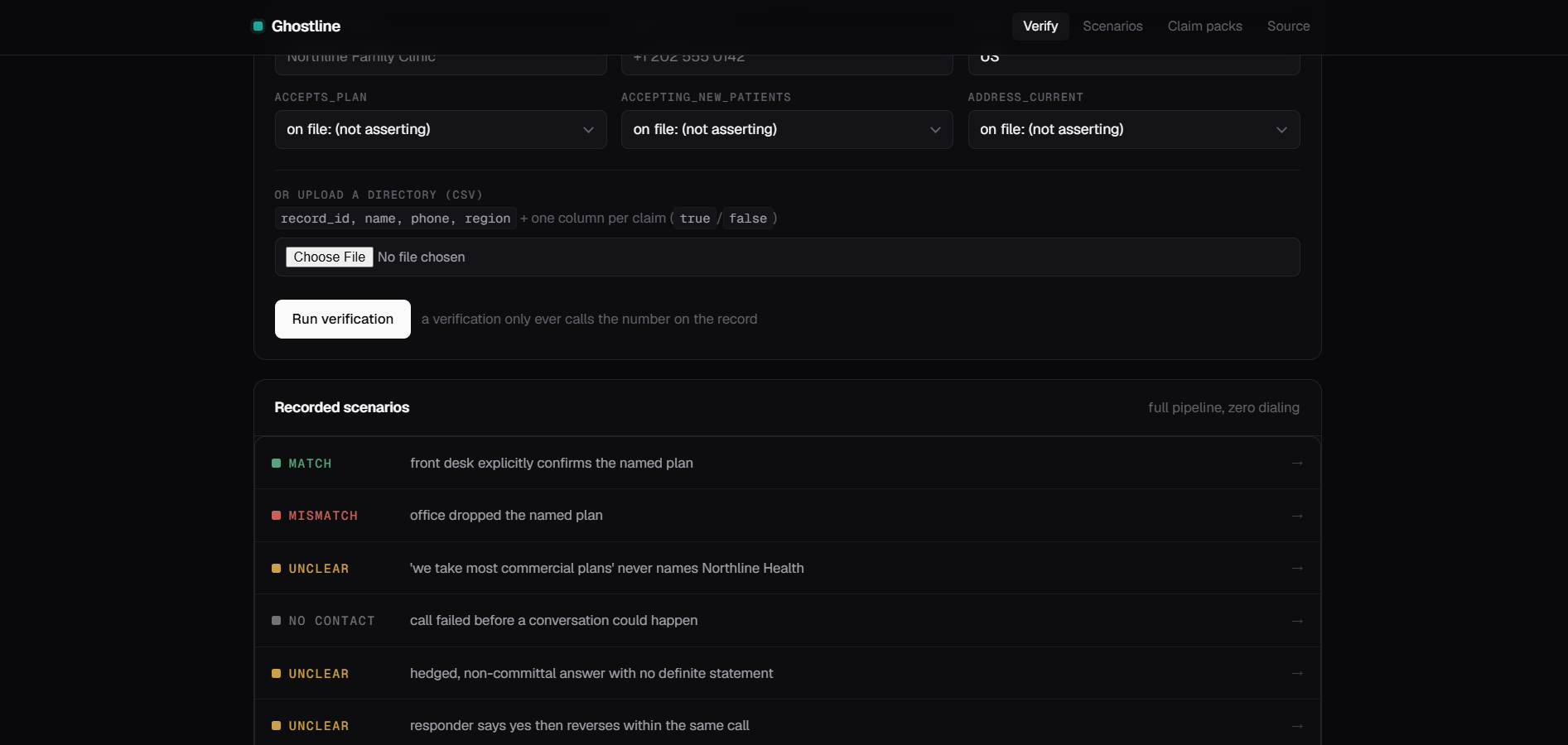
One screen. Type a record — or upload a CSV — pick a claim pack, choose Replay (explore 9
recorded calls, no dialing) or Live (Ghostline calls the number you typed). Anyone, including
a judge, tries the real product by typing their own name and number into the same form every
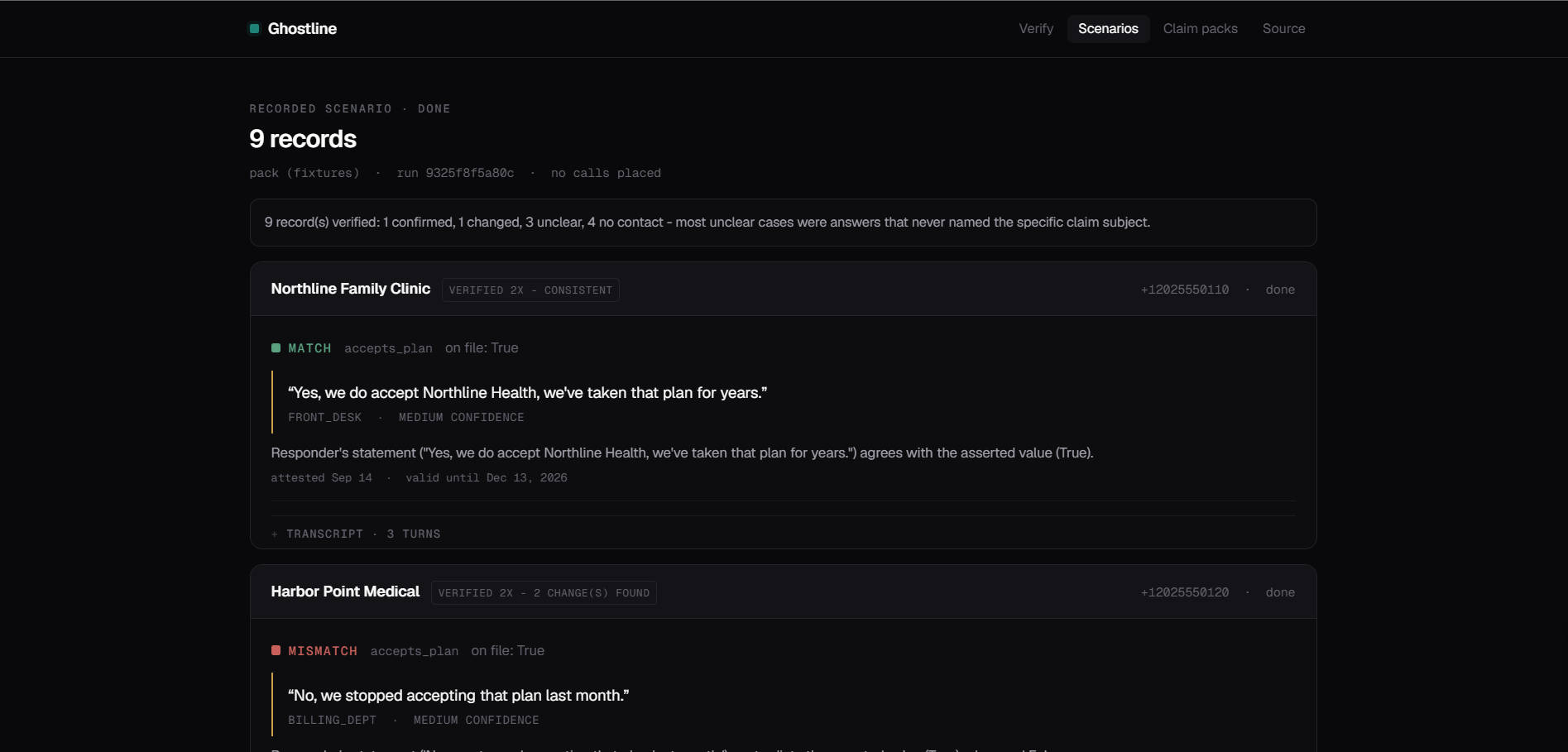
other user uses — there is no separate "demo mode". The result page shows a chat-style
transcript with the evidence span highlighted, the verdict with its provenance and expiry, a
plain-English batch summary, and — when a call surfaces a lead — a one-click derived-call
proposal. corrections.csv downloads from the same page.
Safety is visible: a verification only ever calls the number on the record you added or uploaded, never any other number; dry-run is the default; a hard credit floor falls back to Replay Mode.
What's next
Live-call reliability numbers from a labelled batch (the harness is built; it needs real
calls). A published CALL-E Goal for the healthcare pack so goals.run is demoed alongside
calls.create. Multi-language callee detection. A shareable per-report link. Slack/email
alerting on MISMATCH.

Log in or sign up for Devpost to join the conversation.