-
-
Banner
-
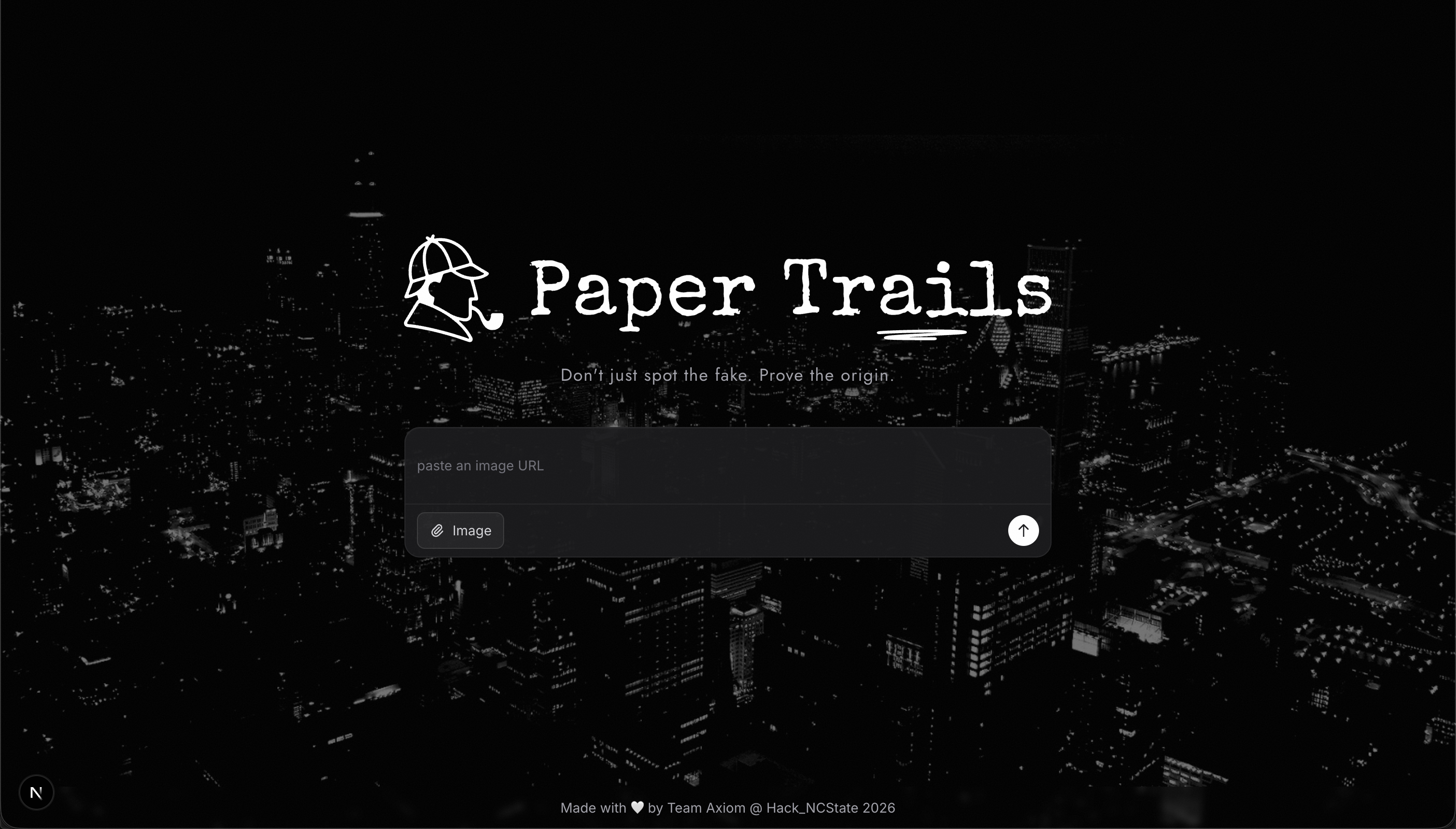
Screenshot of Home Page
-
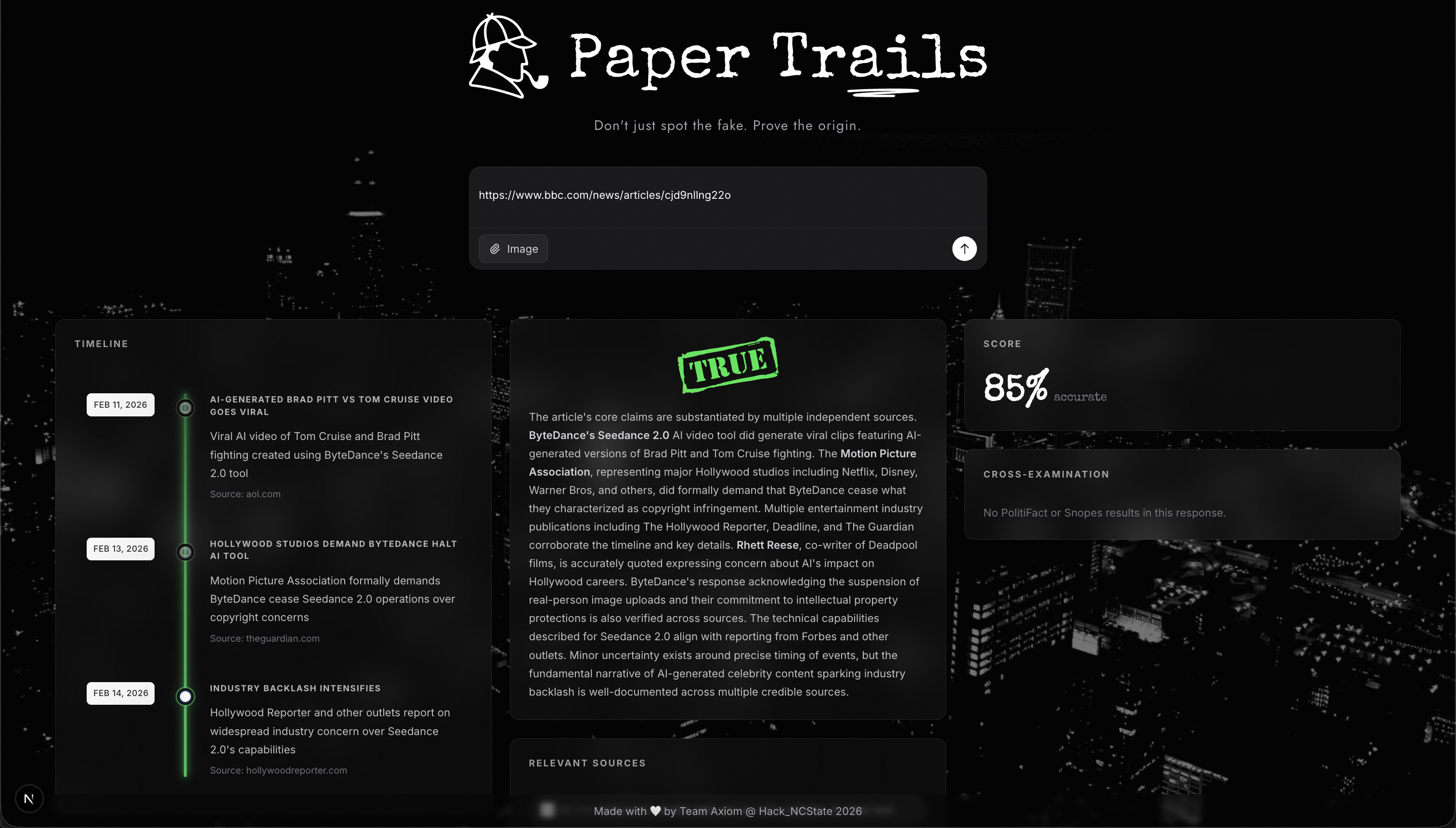
Screenshot of Test 1
-
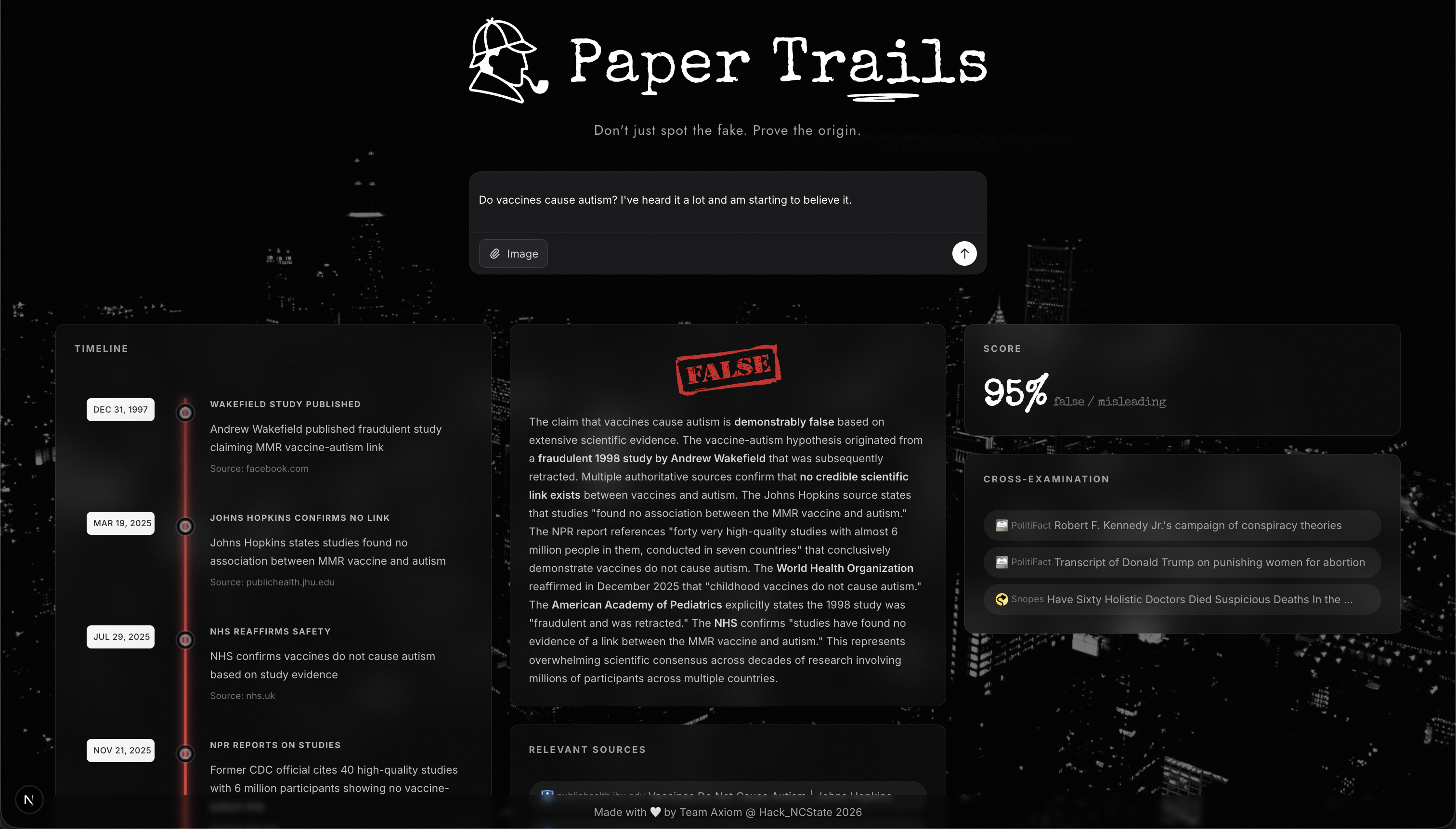
Screenshot of Test 2
What it does
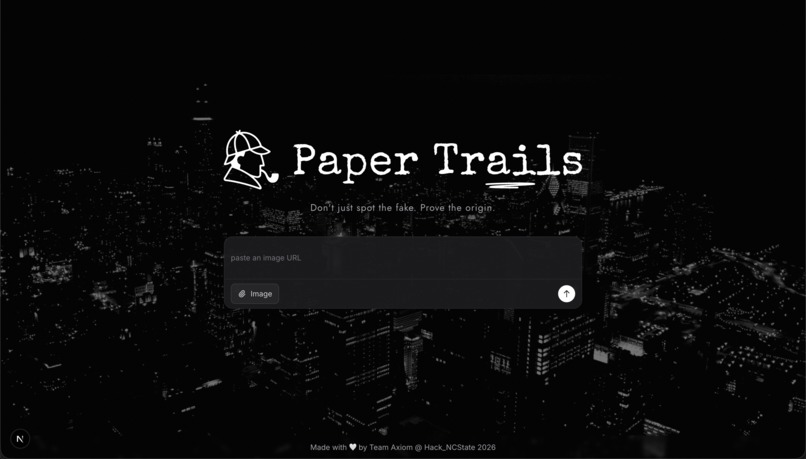
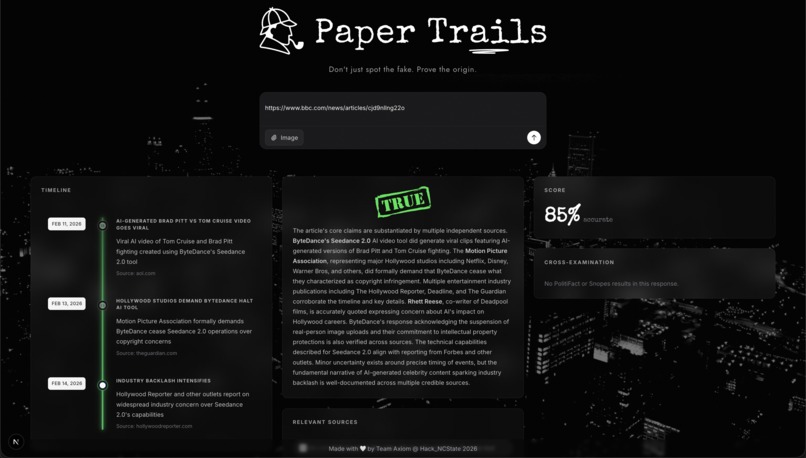
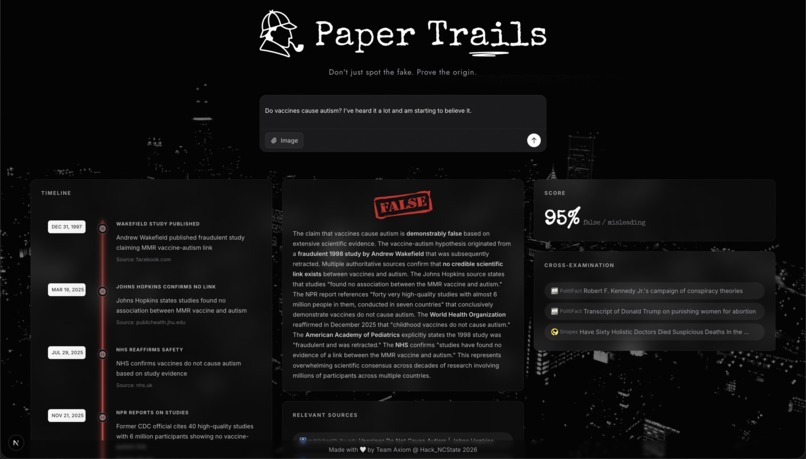
Paper Trails is a multi-input fact-checking web app that analyzes text claims, images, and article URLs to determine whether they are true, false, or unverified. Users can paste a claim, upload an image, or submit a link, and the system returns a structured verdict along with a 0–100 misinformation likelihood score, a detailed explanation, a timeline of related events, and supporting sources.
For images, the app performs reverse image search to see where the image has appeared before and whether it is being used out of context. Instead of giving a simple yes-or-no answer, Paper Trails focuses on presenting evidence and context so users understand why a claim receives a certain verdict. The goal is to build trust through transparency rather than automation alone.
How we built it
We built Paper Trails using a layered AI verification pipeline designed to reduce hallucinations and improve reliability.
The system works in stages:
- We gather information using SerpAPI for Google Search, Google News, and Google Lens.
- We use the Google Fact Check Tools API to access professional fact-check databases.
- The collected external evidence is then compared against the original claim using Anthropic Claude through AWS Bedrock, which evaluates source credibility, detects contradictions, and generates structured verdicts with explanations grounded in those sources.
To improve accuracy, we added a second validation layer:
- Backboard API refines the initial output.
- Gemini performs semantic filtering and final validation to ensure the sources are genuinely relevant to the claim.
The frontend was built with Next.js, React, and Tailwind using a dark, urban-inspired design. Images are stored using Vercel Blob, and the entire application is deployed on Vercel.
Instead of depending on a single model, we designed the system to cross-check the claim against multiple independent external sources and validate the reasoning through multiple AI models, since misinformation detection requires high precision and minimal tolerance for error.
Challenges we ran into
One of the biggest challenges was dealing with AI hallucinations. Fact-checking leaves very little room for error, and we quickly realized we could not rely on a single model response. We had to design the system so that outputs were validated and refined before being shown to the user.
Another challenge was filtering irrelevant fact-check results. Many APIs return keyword matches that are not actually related to the meaning of the claim, so we implemented semantic filtering to improve accuracy. Reverse image analysis was also more complex than expected, since an image can be authentic but still misleading when used in the wrong context. On top of that, integrating multiple APIs, language models, scoring logic, and a polished UI within a hackathon timeframe required fast iteration and constant debugging.
Accomplishments that we're proud of
We are proud of building a multi-layer verification system in a short amount of time. Instead of wrapping a single AI model with a simple interface, we created a structured architecture that gathers evidence, analyzes it, validates it, and then presents a reasoned conclusion.
We are also proud of successfully integrating reverse image search, professional fact-check databases, multiple AI models, and a cohesive user experience into one platform. The final product feels thoughtful and intentional, especially considering the time constraints.
What we learned
We learned that multi-model systems are far more reliable than single-model pipelines, especially when the task involves high-stakes decisions like fact verification. Structured prompting and consistent output formatting are essential when building AI systems meant to operate reliably.
We also learned that fact-checking is not just about labeling something true or false. It requires context, timeline awareness, source credibility evaluation, and careful reasoning. Building Paper Trails helped us understand how much nuance exists behind every verdict.
What's next for Paper Trails
Next, we plan to expand Paper Trails into a more comprehensive misinformation defense platform. We want to add browser extension support so users can verify claims directly on social media, and improve our scoring model with clearer source credibility weighting and contradiction analysis.
We also plan to detect and analyze videos by extracting frames for reverse image search and verifying transcripts to help combat deepfakes and misleading clips. Additional improvements include stronger metadata analysis, claim history tracking to identify recurring misinformation patterns, and real-time monitoring of viral content.
Long term, we want Paper Trails to serve as an infrastructure layer for truth verification across the internet. As AI-generated content becomes easier to produce, verification tools must become faster and more accessible. Our goal is to help restore trust in digital information ecosystems by giving individuals and platforms the ability to verify content at scale. If misinformation evolves, verification must evolve even faster.
Built With
- awsbedrock
- backboard
- claude
- gemini
- github
- googlefactcheckapi
- googlefonts
- javascript
- next.js
- postcss
- react
- serp
- tailwind
- typescript
- vercel
- vercelblob
- vscode


Log in or sign up for Devpost to join the conversation.