-
-
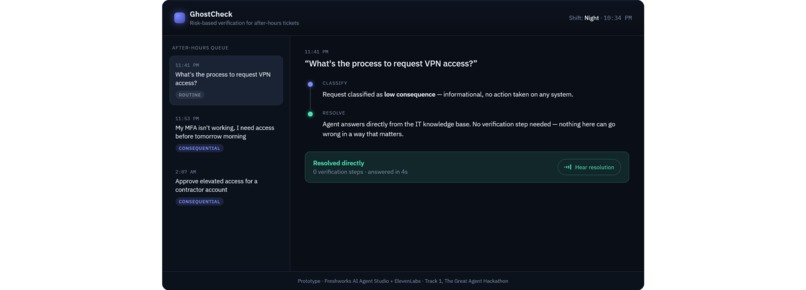
Screenshot of the demo link
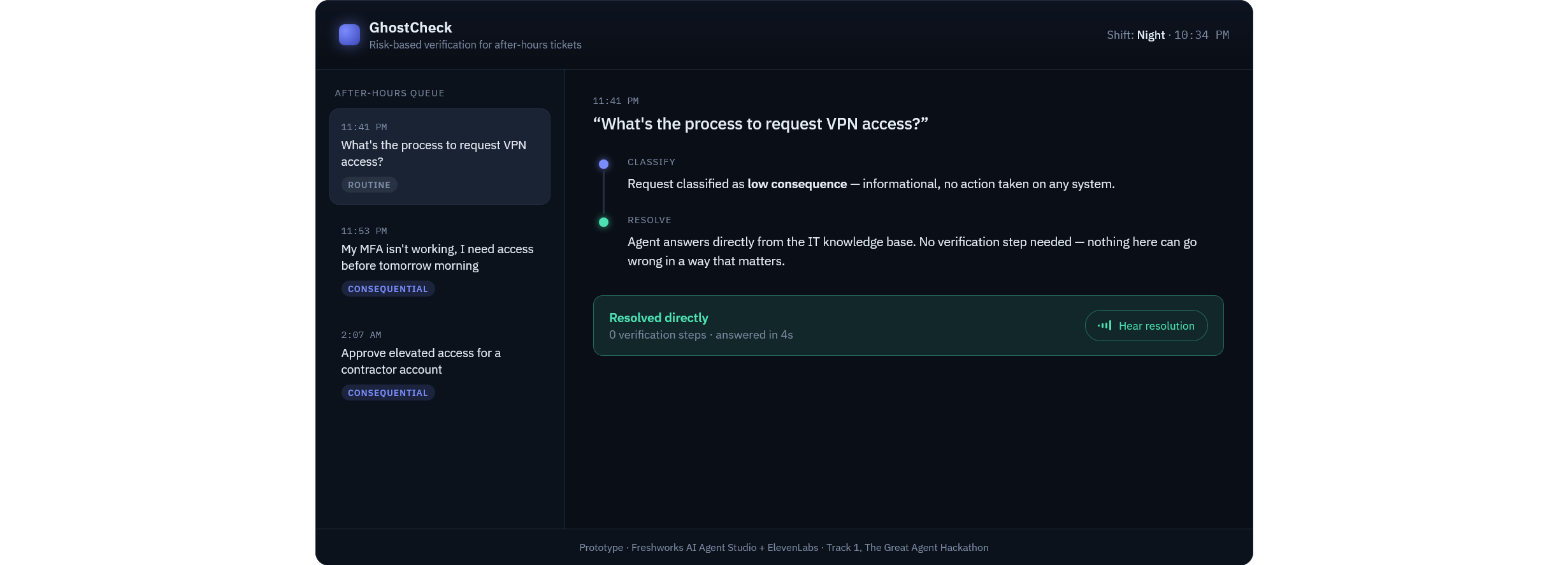
Inspiration
Freshworks reported in May 2026 that 47% of IT tickets are submitted outside standard business hours, with after-hours response lagging an extra hour or more and SLA rates falling as much as 5%. AI agents can close part of that gap — but when fewer humans are around, an incorrect autonomous action has less immediate oversight. That's the real problem: not "answer tickets faster," but "make autonomous answers safe enough to trust when nobody's watching."
What it does
GhostCheck is a proposed AI Agent, designed for Freshworks AI Agent Studio, that handles after-hours tickets with a risk-based, two-step workflow. Routine requests — how-to questions, status checks — get resolved directly. Consequential actions — granting access, resetting credentials, approving a change — go through a dedicated verification step first: the agent's proposed action is re-checked against ticket context, evidence, and policy constraints before it's allowed to proceed. The outcome is voiced back to the employee using ElevenLabs — a verified resolution and an escalated-to-human outcome are spoken with deliberately distinct tone and pacing, so the trust signal is audible in the first two seconds, not just readable in a paragraph of text. If verification disagrees or evidence is insufficient, the system stops, voices the escalation clearly, and prepares the case for human review with context preserved.
How we built it
The prototype demonstrates GhostCheck's risk-based verification flow as an interactive mockup — a lightweight web app showing the full decision path: classification, proposal, verification, and the two possible outcomes (act or escalate), each paired with a distinct voice cue standing in for ElevenLabs' spoken output. The underlying architecture is designed specifically for Freshworks AI Agent Studio's workflow builder — a single Agent with a classification step routing requests by consequence level, and a dedicated verification step gating any action-taking path — reflecting real constraints we confirmed in Freshworks' own documentation (in particular, that a channel can only host one deployed agent at a time, which shaped the single-agent design rather than a multi-agent one). ElevenLabs' role — distinct vocal tone for verified versus escalated outcomes — is represented in the prototype and specified for the full implementation.
Challenges we ran into
The biggest challenge was resisting the instinct to over-build. Early architecture explored a two-agent "Resolver vs. Verifier" design where independent agents debated a ticket, but Freshworks' documentation showed no evidence of a native agent-to-agent handoff primitive — and the platform explicitly locks a channel to one deployed agent at a time, ruling out running two agents against the same ticket stream. The fix was to redesign the safety mechanism as a single agent's workflow step rather than a second agent, which turned out to be a more honest and defensible architecture than the original idea. A second challenge was avoiding blanket verification — checking every ticket twice would double inference cost with no benefit for routine requests, so the workflow had to route by consequence, not apply the same scrutiny everywhere. A third was giving ElevenLabs a real role rather than a bolt-on read-aloud button — the solution was using distinct vocal tone for verified versus escalated outcomes, so voice itself carries the trust signal.
Accomplishments that we're proud of
Landing on a verification design that's cost-aware by construction, not as an afterthought — routine tickets stay cheap and fast, and the extra verification cost only shows up where a wrong action would actually matter. Designing voice as a second, independent trust signal — not just an accessibility nicety, but a deliberate use of ElevenLabs' expressive range to carry information text can't convey as fast. Also proud of grounding the entire idea in Freshworks' own published research (the "ghost shift worker" data) rather than inventing a persona or problem from scratch — the name GhostCheck is a direct nod to that research.
What we learned
That the most convincing hackathon architecture isn't always the most impressive-sounding one. A two-agent "AI agents arguing" demo is a flashier pitch than a single agent with a smart workflow — but it wasn't actually supported by the platform, and building toward it would have meant promising something we couldn't reliably demo live. Constraining the idea to what's genuinely buildable on Agent Studio made the final concept sharper, not weaker.
What's next for GhostCheck
Implementing the full workflow inside Freshworks AI Agent Studio, extending verification scope beyond access/credential actions to other high-consequence categories (financial approvals, data exports), and expanding ElevenLabs' role further — exploring multilingual voice output for a global after-hours workforce, and richer tonal variation across confidence levels, not just verified-vs-escalated.
Built With
- css
- elevenlabs
- freshworks-ai-agent-studio
- html
- javascript

Log in or sign up for Devpost to join the conversation.