-
-
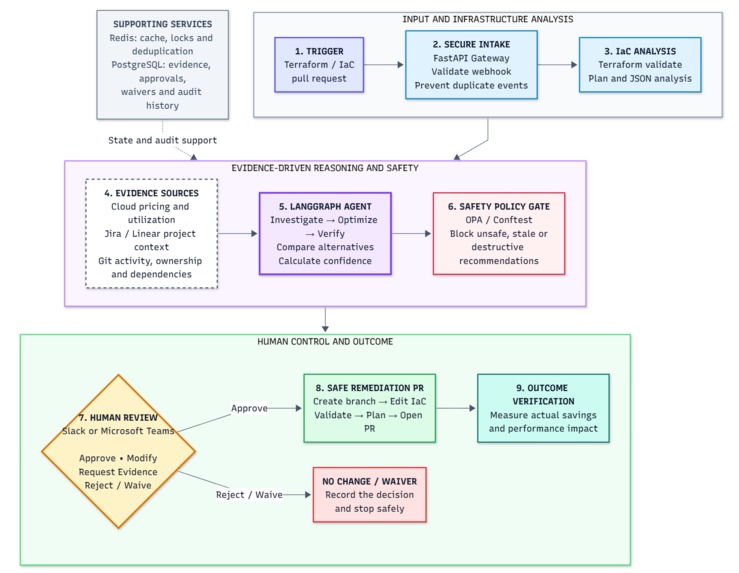
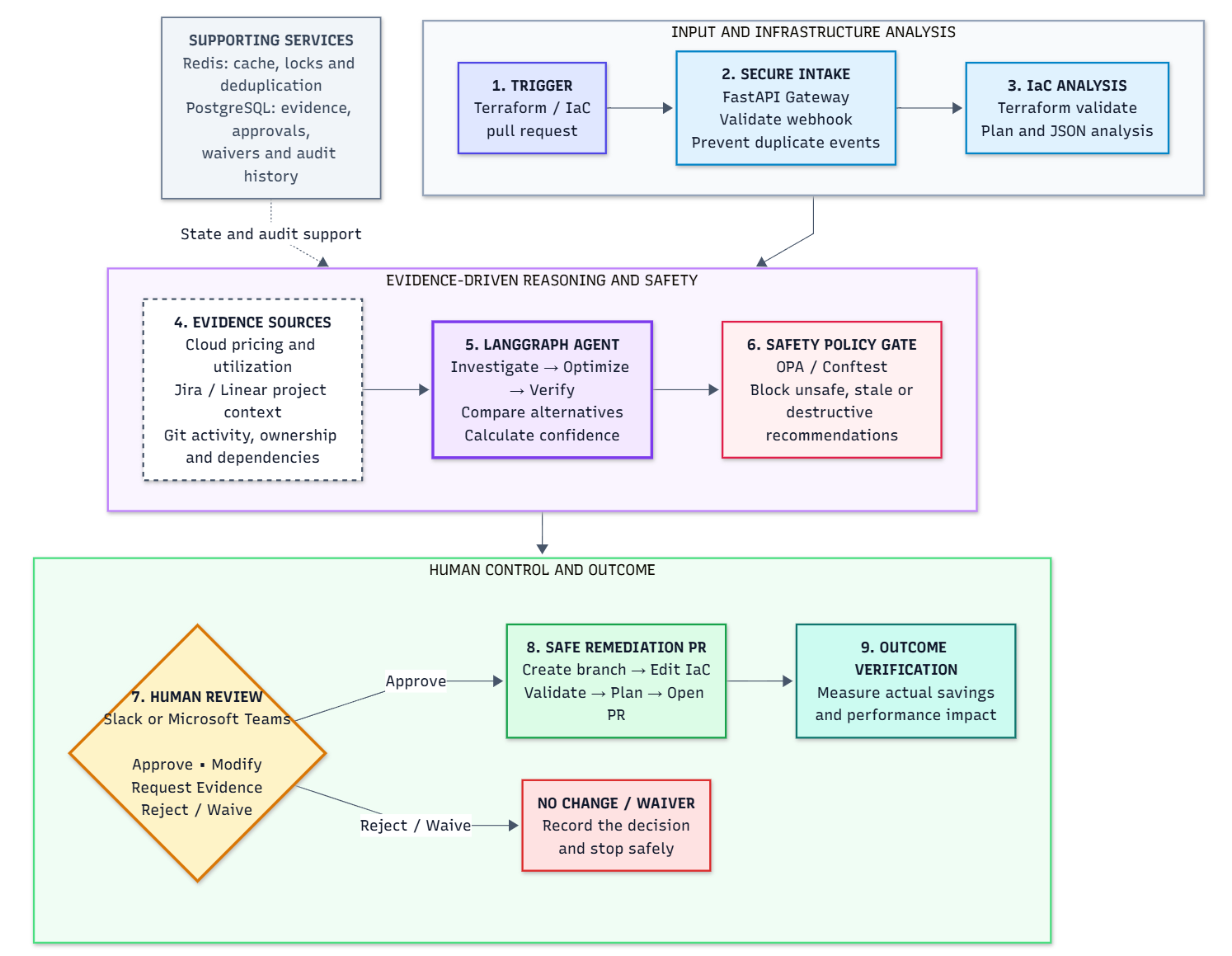
GhostBusters - Architecture Diagram
Inspiration
Cloud waste is a major B2B problem, especially when development, testing, and staging resources remain oversized or continue running after their original project has slowed down or ended.
FinOps teams can usually identify that a resource is expensive, but determining whether it is still needed requires technical and business context from several systems. They may need to inspect cloud metrics, infrastructure code, Jira tickets, repository activity, ownership information, and dependencies before deciding whether a change is safe.
GhostBusters was inspired by this gap between identifying cloud waste and safely acting on it.
What GhostBusters Does
GhostBusters is a project-aware autonomous FinOps remediation agent.
When a developer opens or updates a Terraform or Infrastructure-as-Code pull request, the system is designed to:
- Analyse the proposed infrastructure change.
- Retrieve cloud pricing and utilization evidence.
- Check Jira or Linear project context.
- Inspect GitHub or GitLab activity, ownership, and dependencies.
- Compare multiple optimization options.
- Apply deterministic safety policies.
- Send the recommendation for human approval.
- Generate a validated remediation pull request after approval.
The system does not rely on one signal alone. A completed Jira ticket, an online status, or low CPU usage cannot independently authorize a change. GhostBusters combines business and technical evidence, lowers confidence when evidence conflicts, and can request clarification or take no action when the decision is uncertain.
Current Phase
NeuroX Phase 1 focuses on idea validation and system design, so GhostBusters has not yet been fully implemented.
During this phase, we defined:
- The B2B problem and target users.
- The agentic reasoning workflow.
- The technical architecture and tool integrations.
- Error, ambiguity, and confidence handling.
- Human-in-the-loop safety controls.
- The planned Phase 2 prototype.
What We Learned
While researching the problem, we learned that existing FinOps products already provide cost visibility, rightsizing recommendations, and Infrastructure-as-Code cost checks.
This helped us refine our differentiation. GhostBusters is not intended to replace complete FinOps platforms. It focuses on the business-justification gap: determining whether non-production infrastructure still supports active work before generating a safe remediation.
We also learned that reliable optimization cannot depend only on project status or a single utilization metric. Safe decisions require evidence from project lifecycle, runtime behaviour, repository activity, ownership, and dependencies.
Challenges
The main design challenge was balancing autonomy with infrastructure safety.
Cloud resources may appear idle while still supporting testing, compliance, disaster recovery, or another application. To manage this uncertainty, GhostBusters uses an Investigator, Optimizer, and Verifier workflow, confidence-based abstention, deterministic OPA policies, and a mandatory human approval checkpoint.
Another challenge was keeping the solution easy to adopt. The architecture is designed as a low-friction layer that connects to tools companies already use without replacing their repositories, project-management systems, CI/CD pipelines, or approval processes.
What’s Next
During Phase 2, we plan to build a working prototype using GitHub webhooks, Terraform plan analysis, AWS pricing data, mocked CloudWatch utilization, Jira context, LangGraph reasoning, OPA policies, Redis state management, and Slack approval actions.
The prototype will demonstrate an approved remediation, a conflicting-evidence case where the agent abstains, and an API-failure case where it uses an alternative evidence source.
Built With
- agent
- agentic
- ai
- amazon-web-services
- cloudwatch
- conftest
- fastapi
- finops
- github
- gitlab
- jira
- langgraph
- linear
- microsoft
- ngrok
- open
- opentofu
- policy
- postgresql
- python
- redis
- slack
- teams
- terraform

Log in or sign up for Devpost to join the conversation.