Inspiration
This summer, Hardik broke his back. About two months earlier, Aryan had hurt his back too.
Both of us ran into the same wall. Being in pain wasn't the hardest part. The hardest part was finding a doctor our insurance actually covered, and then hearing how long we'd have to wait. We'd call a name on the list and hear "we're not taking new patients," or "we don't take that plan," or "the earliest we have is weeks out." Then we'd hang up and call the next one.
We kept saying the same thing to each other: finding a doctor should not be this hard.
So we started digging, and found two things that surprised us:
- It's a common problem, and it has a name. Listings for providers who aren't actually available are called ghost listings. They're especially common in mental health care, where people are often least able to keep calling.
- In California, the wait can actually be against the law. State-regulated plans have to offer an appointment within set deadlines: 15 business days for a specialist, 10 for primary care or a therapist, 48 hours for urgent care. If they can't, the plan has to arrange care for you, even out-of-network at in-network cost. The state takes this seriously: in 2023 it fined Kaiser $50 million over behavioral-health access.
But almost nobody knows this. Even if you do know, you have to prove it, one phone call at a time, while you're already hurting.
We figured software could make those calls and keep the receipts.
What it does
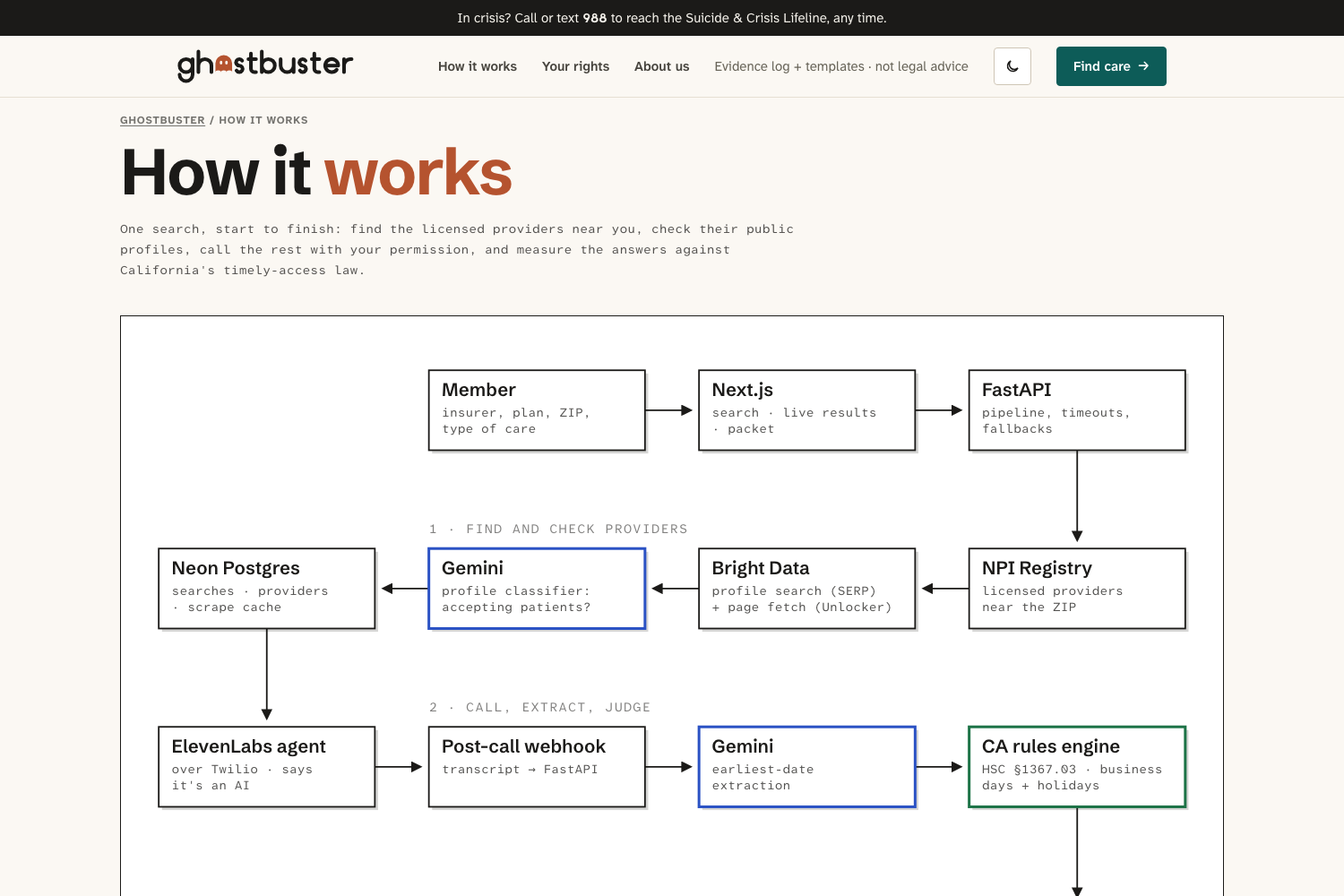
GhostBuster has three steps: find, check, call.
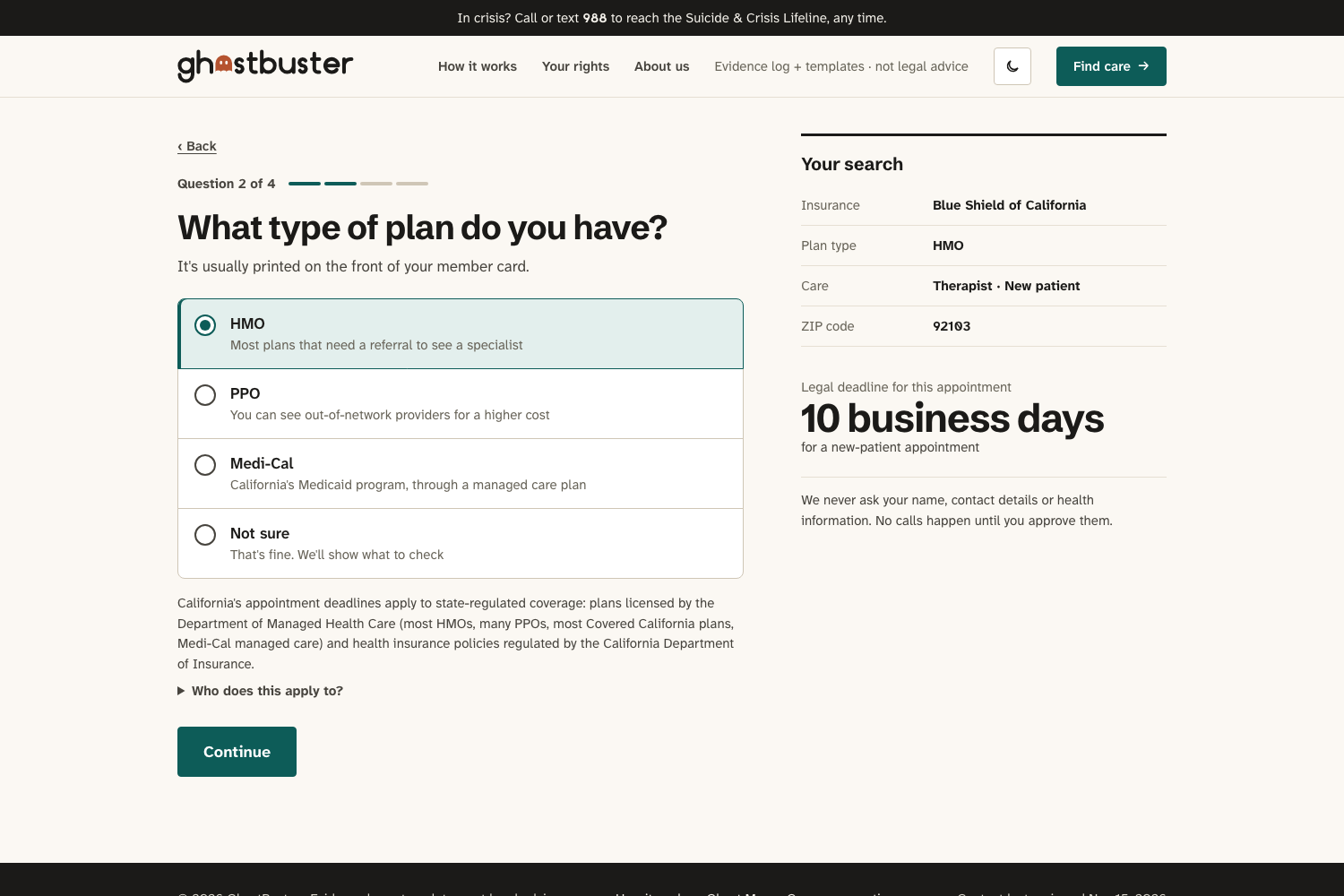
1. Find. Tell us your plan, zip code, and the care you need: primary care, a specialist, a psychiatrist, a therapist, or urgent care. We pull licensed providers near you from the national provider registry. We don't claim to have your insurer's directory, and we're upfront when the law doesn't cover your plan (for example, self-funded employer plans or Medicare).
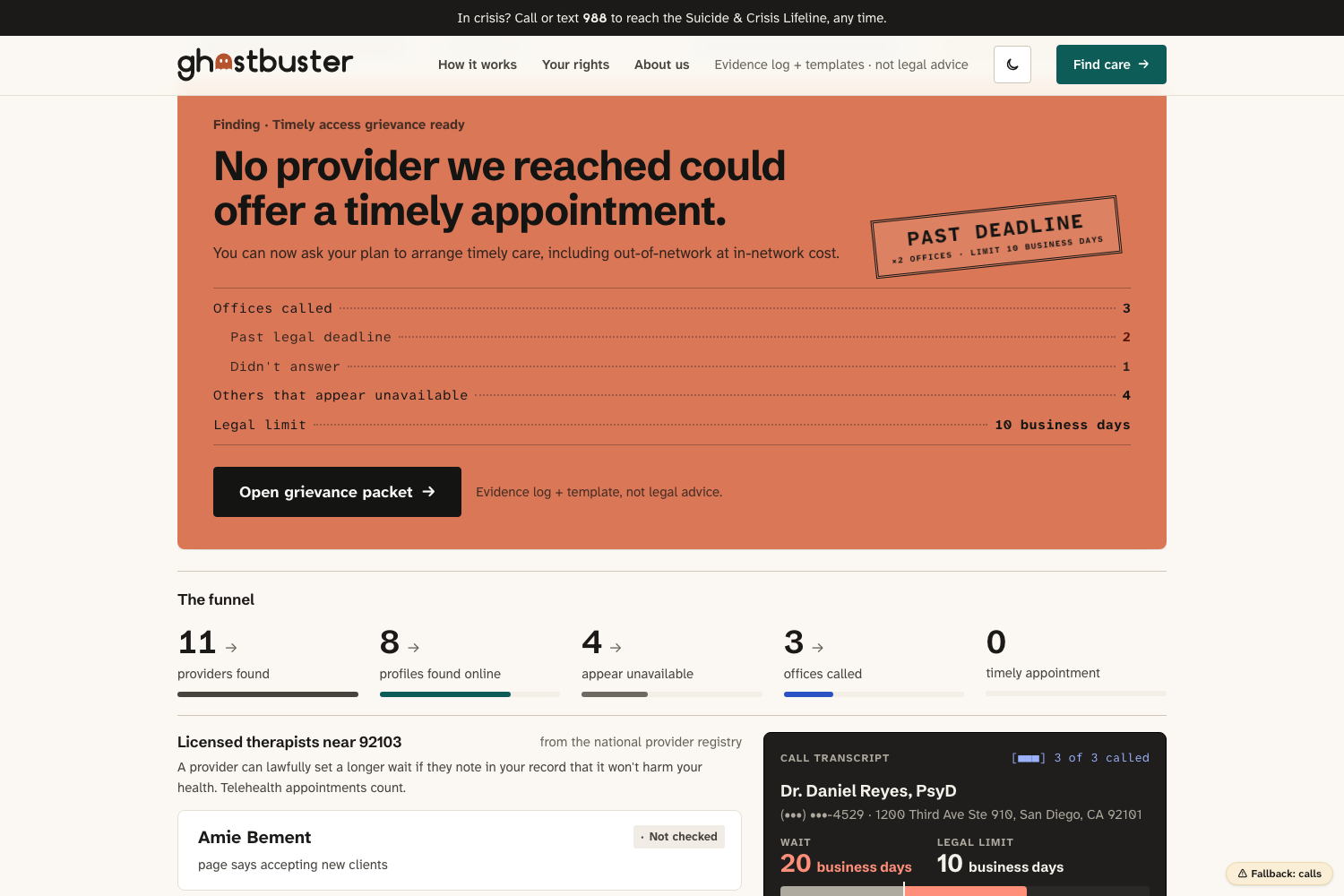
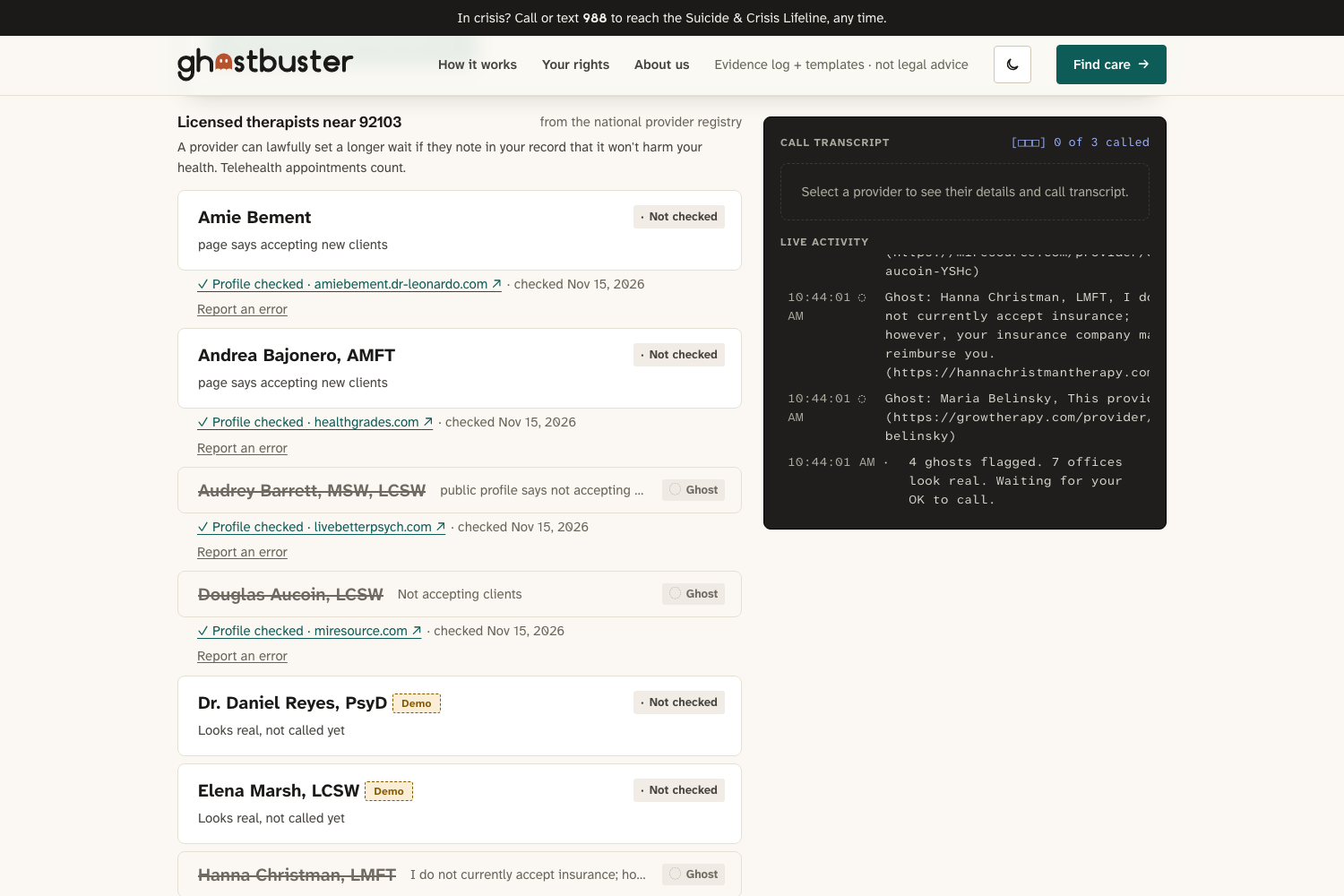
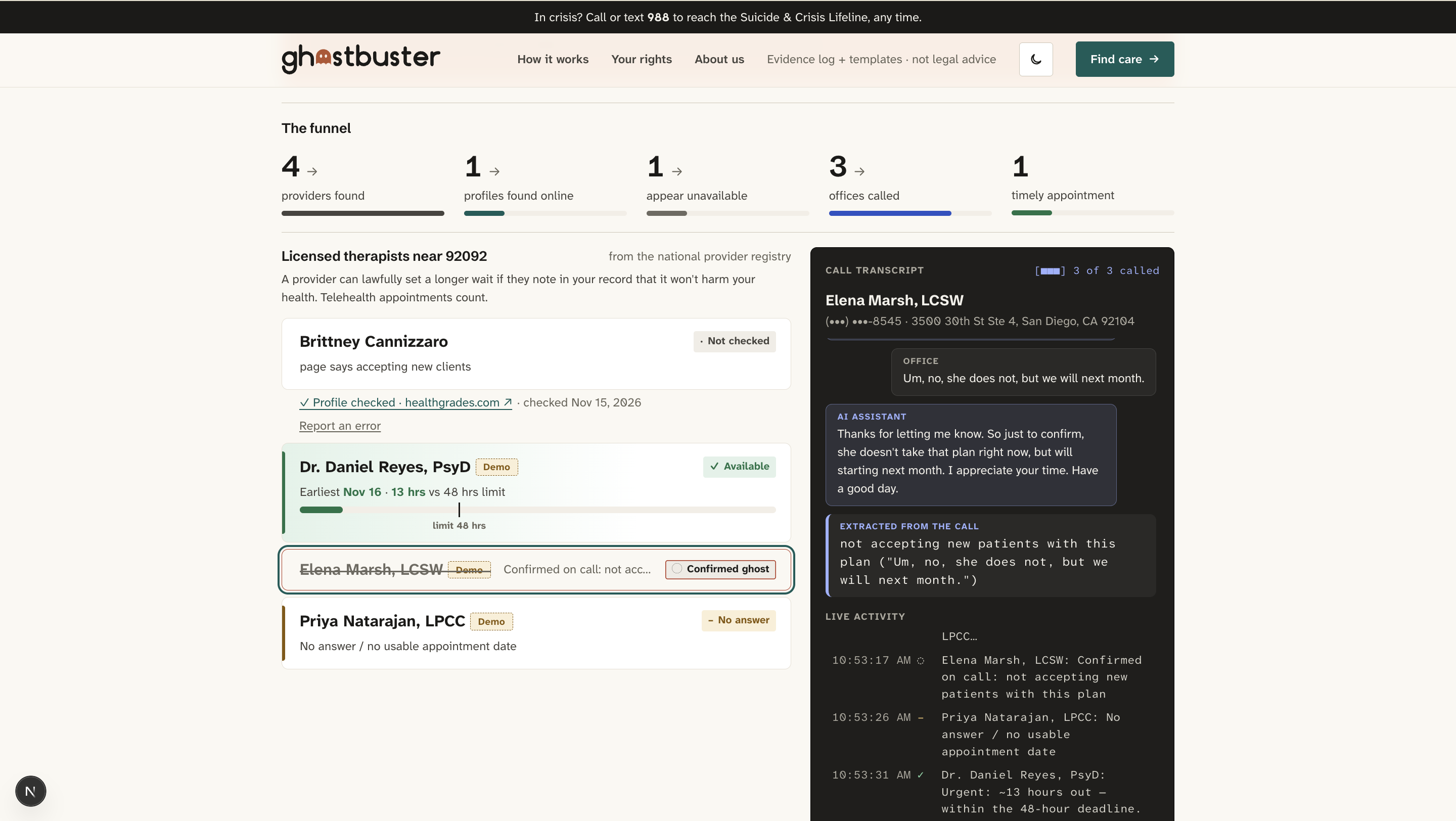
2. Check. Bright Data finds each provider's public profile online, and Gemini reads it. If a provider's own page says they're not taking new patients, we mark them "appears unavailable" and show the link and the date we checked. In our demo search (zip 92103), about 4–5 of the 11 nearby providers' own pages said they weren't accepting new clients.
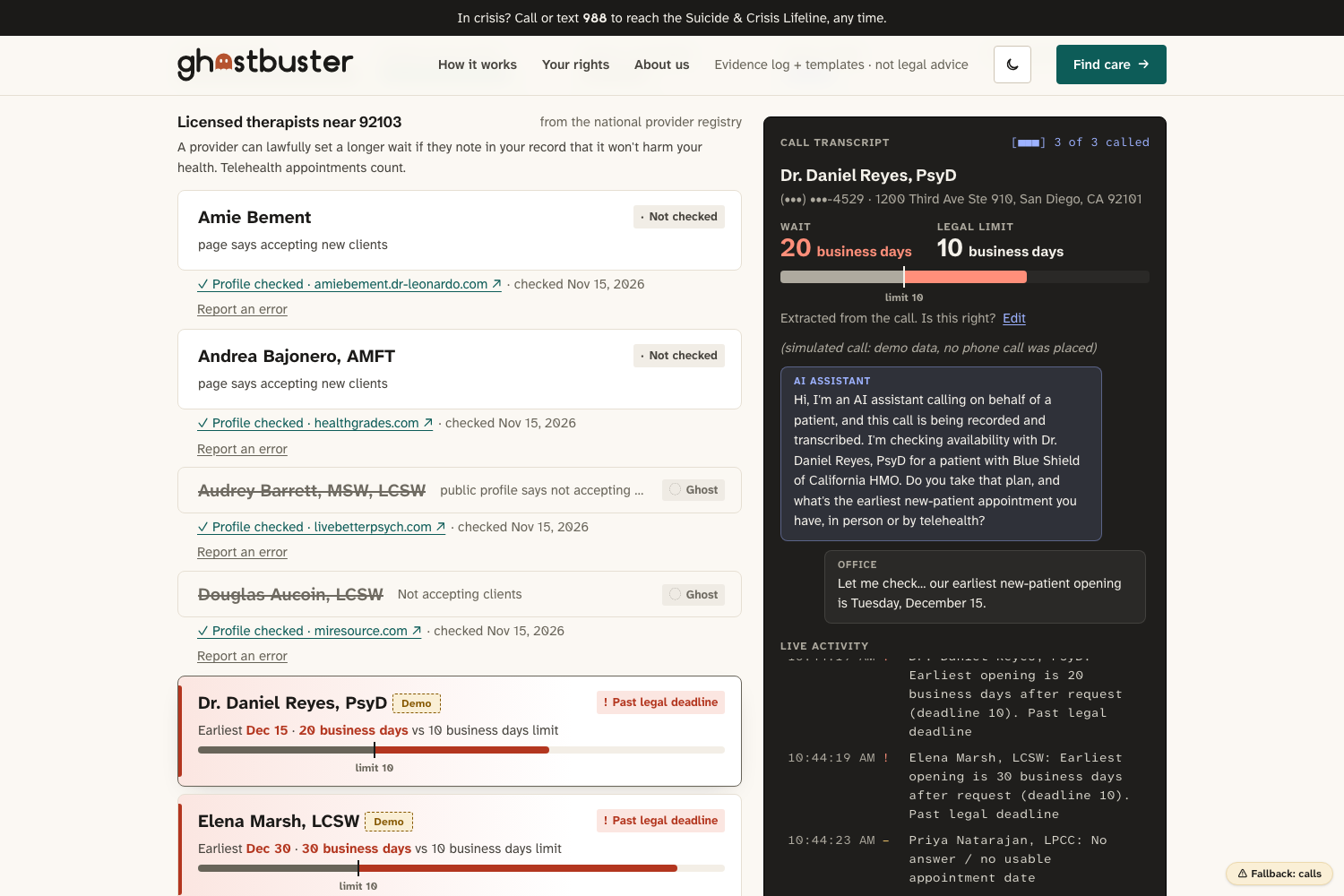
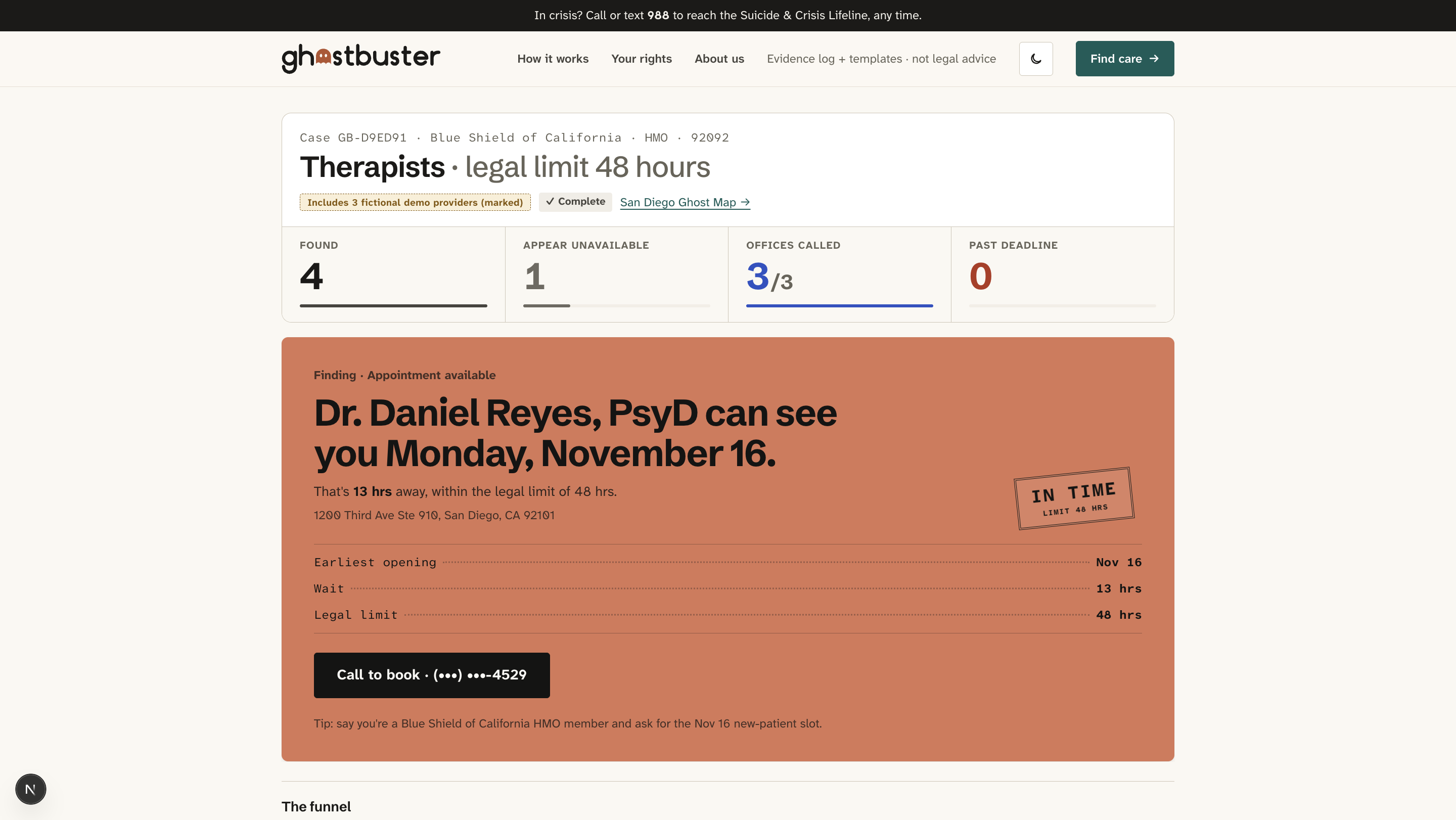
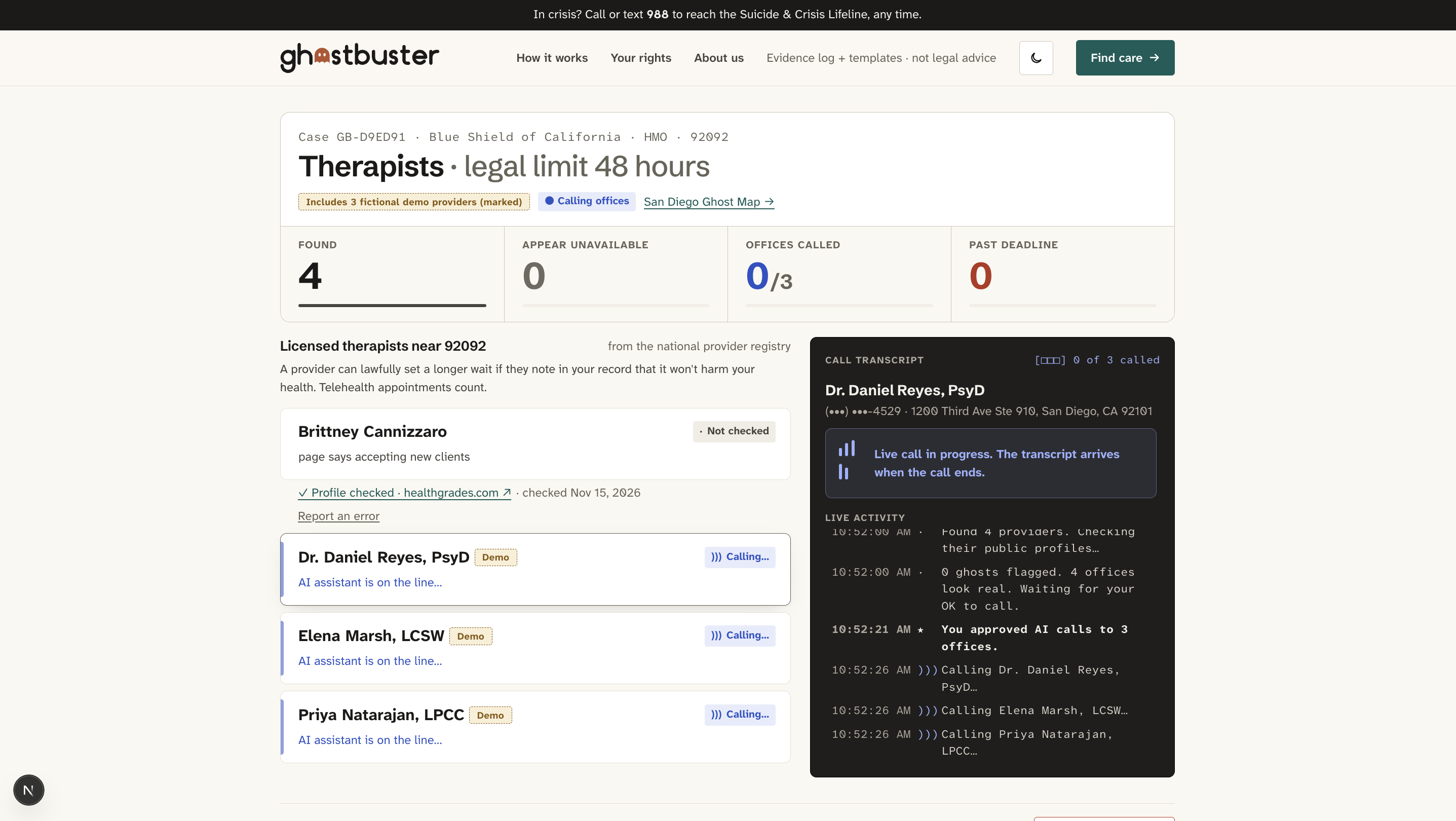
3. Call. With your consent, an AI voice agent calls the offices for you. It opens honestly: "I'm an AI assistant calling on behalf of a patient, and this call is being recorded and transcribed." Then it asks the question that matters: what's your earliest opening?
Each answer becomes a plain-English result:
Elena Marsh, LCSW: earliest Feb 15 · 59 business days vs. a 10 business day limit → Past legal deadline
If the AI misheard a date, tap "Is this right? Edit" and the result recalculates.
Then one of two things happens:
- Someone can see you in time: we found you a doctor. Go book it.
- Nobody can: "No provider we reached could offer a timely appointment. You can now ask your plan to arrange timely care, including out-of-network at in-network cost."
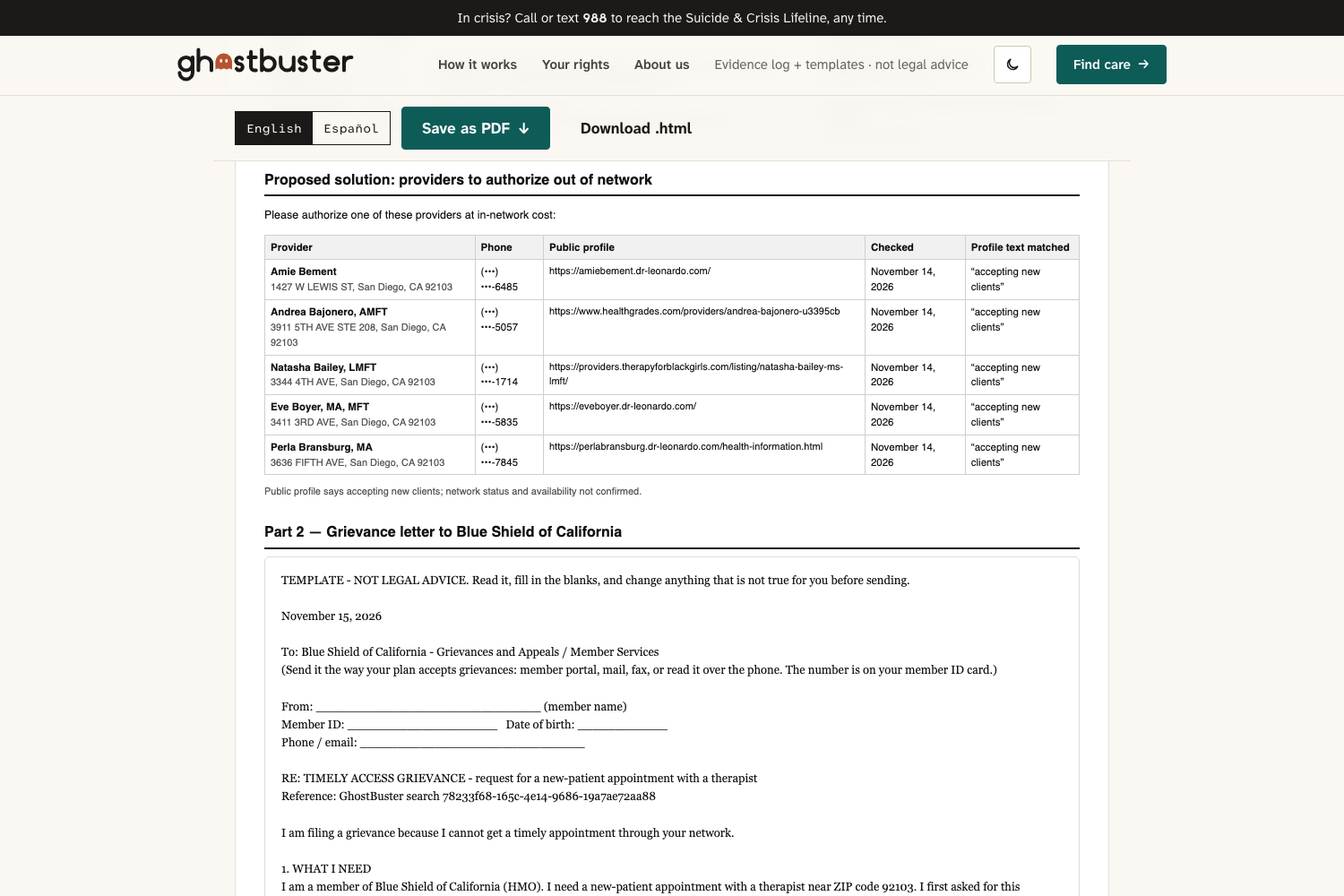
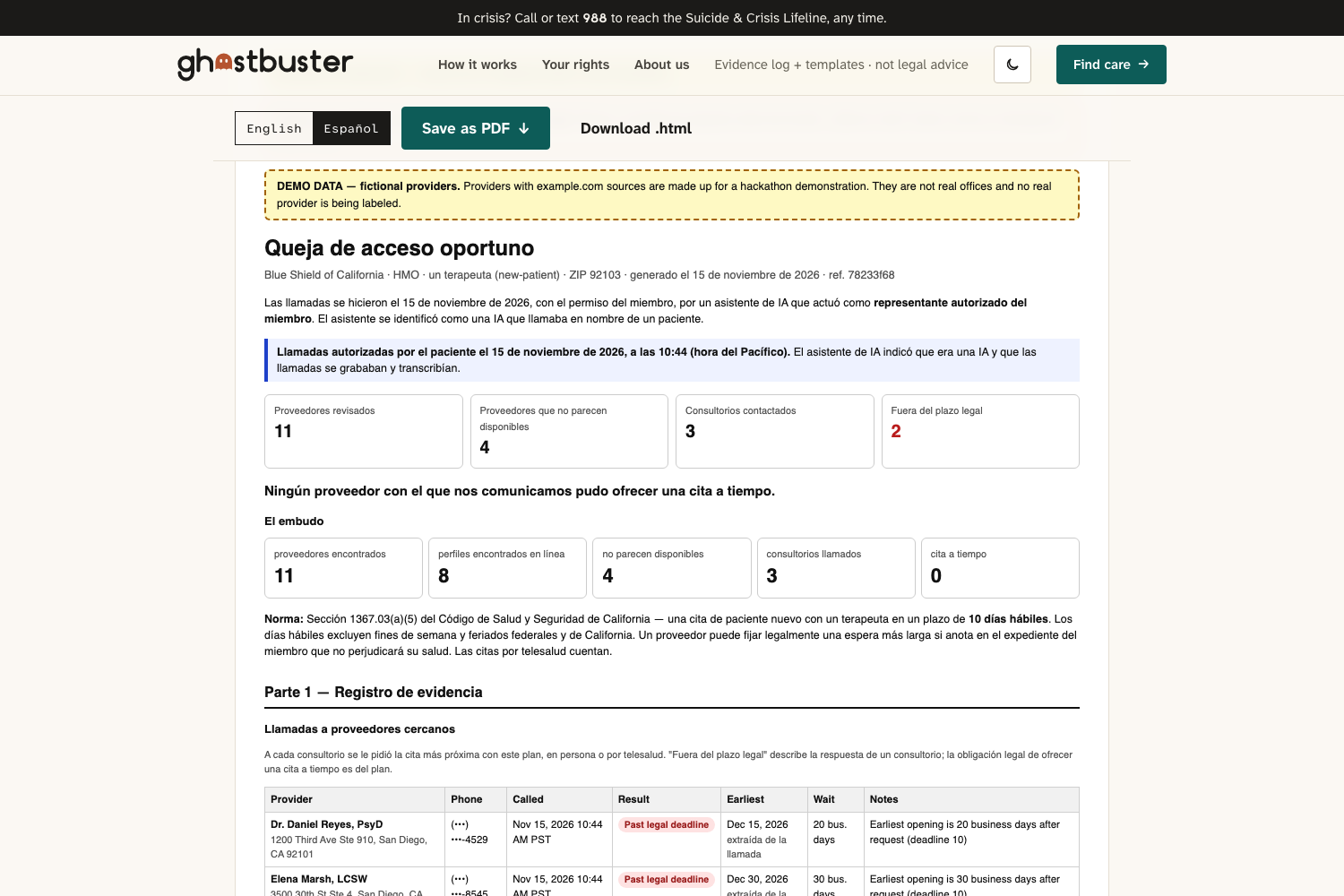
For the second case, GhostBuster writes your grievance packet in English and Spanish. It includes:
- a log of every call, with transcripts
- sources for every listing that appears unavailable
- a letter to your plan citing the law
- up to 5 nearby providers whose profiles say they're accepting patients, so you can ask the plan to approve one at in-network cost
- a phone script, plus what to do next if the plan doesn't respond
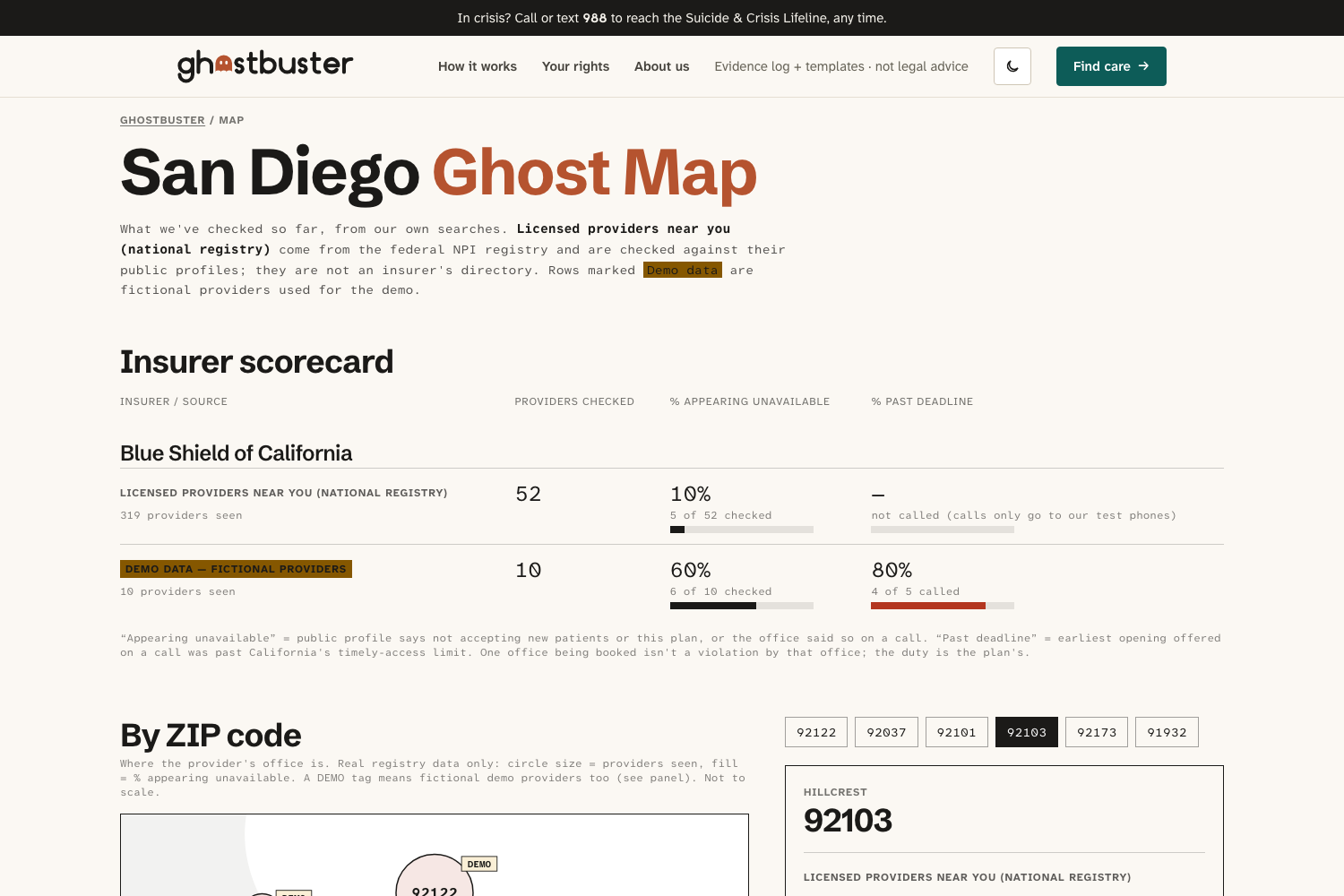
It's an evidence log and a template, not legal advice. We also built a San Diego Ghost Map that shows how ghost listings stack up by insurer and zip code.
How we built it
| Tool | What it does in GhostBuster |
|---|---|
| NPI Registry API | Licensed providers near your zip |
| Bright Data (SERP + Web Unlocker) | Finds and fetches each provider's public profile, so every flagged listing comes with a source |
| Gemini (gemini-3.5-flash-lite) | Reads profiles ("accepting new patients?") and pulls the appointment date and a supporting quote out of call transcripts |
| ElevenLabs + Twilio | The voice agent that makes the calls, with a webhook back to us when each call ends |
| Neon Postgres | Stores searches, call results, and Ghost Map data |
| Next.js + Tailwind, FastAPI | The app and the backend pipeline, with a live activity log so you can watch each step |
The AI never decides the legal part. Gemini listens to the call; a plain, deterministic rules engine does the math. For an offer date $t_{\text{offer}}$ and the day you asked, $t_0$, we count business days:
$$ \text{wait} = \sum_{d = t_0 + 1}^{t_{\text{offer}}} \mathbb{1}\big[\, d \text{ is not a weekend, federal holiday, or CA holiday} \,\big] $$
$$ \text{Past legal deadline} \iff \text{wait} > \text{limit}(\text{care type}) $$
The limit is 10 for primary care or a therapist and 15 for a specialist or psychiatrist. Urgent care is measured in hours instead: 48, or 96 with prior authorization. About 145 tests cover this logic, because "is this past the deadline?" shouldn't depend on a model's mood.
Honest note about the demo
For the hackathon, the AI only calls our own phones. Each teammate played a fictional, clearly labeled demo office (Hardik spent the weekend as "Elena Marsh, LCSW"). Real providers from the registry are never called and never given made-up results. We'd rather show you a real call to a fake office than a fake call to a real one.
Challenges we ran into
- Phone numbers were harder than AI. Twilio trial numbers wouldn't import and Vapi's free numbers could only receive calls, so we bought a real number.
- Our app once faked its own homework. A timeout fired while real calls were still happening and showed simulated results. Now the app never simulates once a real call is placed, and real answers always win, even when they arrive late.
- We read the actual law and rewrote our copy. We changed "violation" to "past legal deadline," because the legal duty sits with the plan, not the individual doctor.
- We dropped a claim we couldn't back up. We stopped saying we read insurer directories and switched to honest registry sourcing. We also skipped websites where we weren't sure scraping was allowed.
- Speech-to-text is messy. People say "sometime in February," and transcripts come back with curly apostrophes. We hardened date extraction for both, and anything said on a call is treated as data, never as instructions to the AI.
- We caught our own security slip. Our Gemini key was showing up in URLs, so we moved it into request headers.
Accomplishments that we're proud of
- A real phone call turns into a legally grounded answer within seconds of hanging up.
- Every flagged listing comes with a link and a date, so nobody has to just trust us.
- Two outcomes that both help: you either get an appointment, or you get a packet you could actually send, in Spanish too.
- Every page has a 988 crisis banner, and every search has a delete button.
What we learned
- Words matter in health tech. "Fraud," "violation," and "appears unavailable" make very different claims, and only one of them was true.
- Let AI handle the messy human parts, and keep the rules boring and testable.
- In a live demo, reliability is a feature. We spent nearly as long on fallbacks as on features.
- Most people don't know these rights exist. Neither did we, until we needed them.
What's next for GhostBuster
- Read real insurer directories (with Bright Data) and compare them against what offices actually say.
- Make sure no clinic gets called twice for the same thing: deduplicate calls, let clinics report their own availability, and let them opt out.
- A "call my insurer" step that follows up on the grievance.
- Ghost Map exports for regulators and journalists.
- A fully Spanish app with professionally reviewed translations.
Built over one sleepless weekend at SanD Hacks by Aryan, Ivan, Hardik, and Jai. We went looking for a doctor and ended up building the tool we wish we'd had.
Built With
- bright-data
- elevenlabs
- fastapi
- gemini
- google-gemini
- neon
- next.js
- ngrok
- npi-registry
- postgresql
- python
- react
- rest-api
- tailwindcss
- twilio
- typescript
