-
-
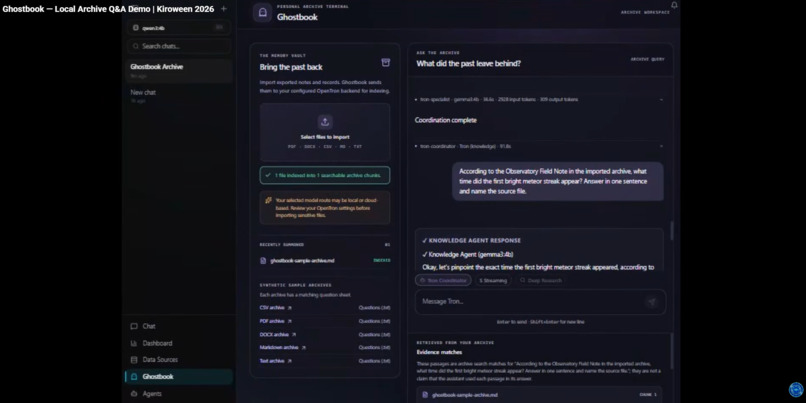
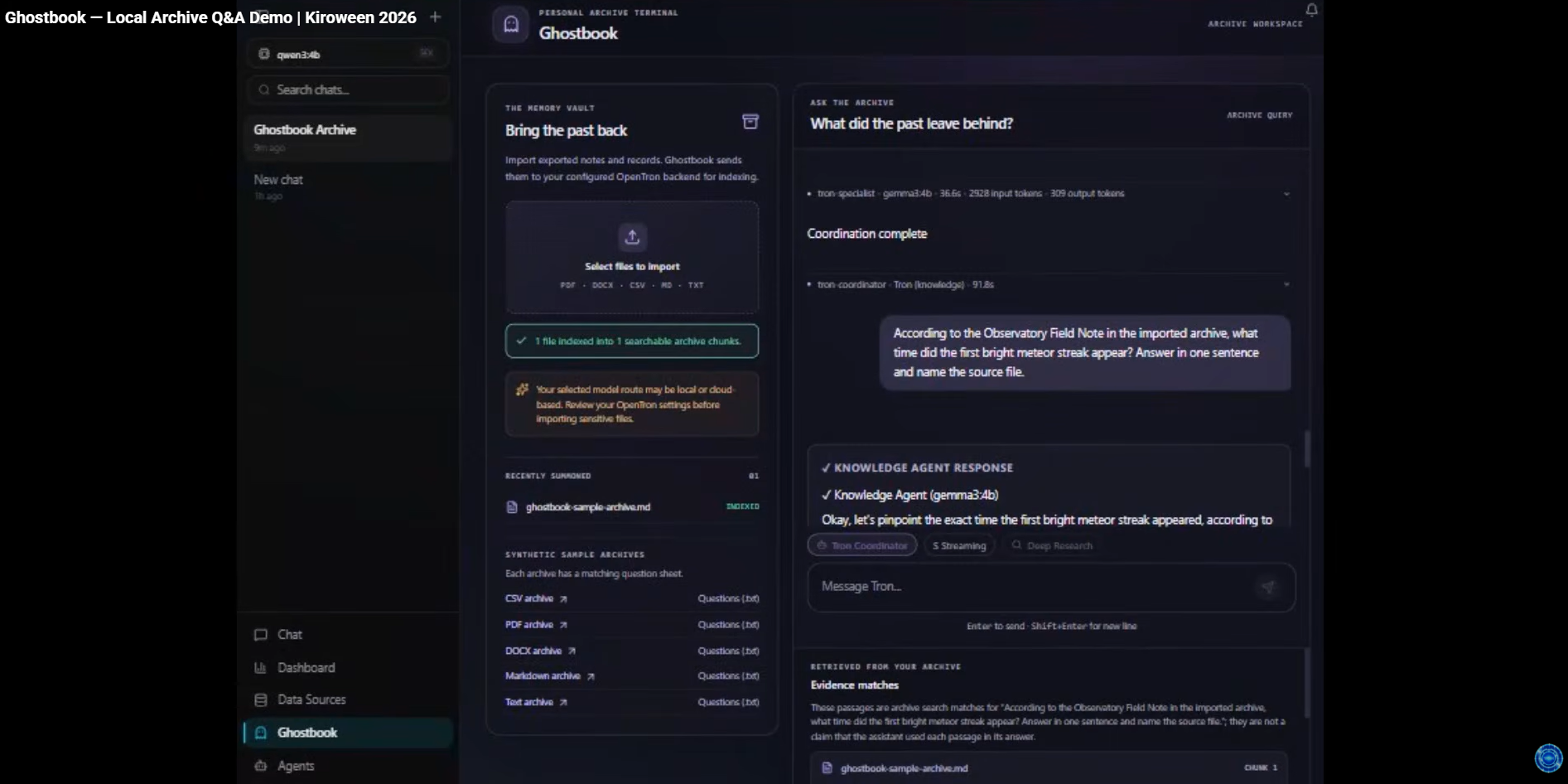
app preview
Kiroween 2026 Hackathon Entry: Ghostbook
Category: Resurrection
Working Title: Ghostbook
Pitch: Bring the personal digital organizer back to life: import exported personal archives, browse them in a haunted PDA-inspired workspace, and interact with a local-first AI assistant grounded directly in your digital past.
💡 Inspiration: Resurrecting the Ghost in the Machine
Before modern smartphones became hyper-connected attention economies, there was the Personal Digital Organizer (PDA). Devices like the PalmPilot, Psion, and early handhelds were tactile, focused, deeply personal, and fundamentally local. You owned your data, hot-synced it directly to your machine, and curated your schedules, memos, and thoughts in a quiet, isolated digital companion.
Today, those memories live as cold "ghosts": forgotten exports, .csv backups of defunct apps, orphaned .pdf logs, abandoned .docx journals, and scattered .md or .txt scraps buried in hard drive graveyards.
We asked: What if we could resurrect the PDA—not as a shallow cosmetic skin, but as a living, haunted workspace that breathes life into forgotten personal archives?
That became Ghostbook: a localized, retro-futuristic PDA workspace where forgotten archives arise as conversational, verifiable knowledge.
🛠️ How We Built It: Architecture & Stack
To keep the project lightweight, local-first, and fully submission-compliant, we extracted Ghostbook into a dedicated, newly created open-source repository under an OSI-approved license, integrating it into a desktop environment while maintaining strict privacy boundaries.
                  ┌──────────────────────────────────────────────┐
                  │          Ghostbook Haunted UI (PDA)          │
                  │  (Retro-Pixel Monochromatic Matrix Workspace) │
                  └──────┬────────────────────────────────┬──────┘
                         │                                │
    [Archive Upload Flow]│                                │[Local Chat Assistant]
                         ▼                                ▼
       ┌───────────────────────────────────┐    ┌───────────────────────────────────┐
       │     Document Ingestion Pipeline   │    │      Retrieval-Backed Agent       │
       │ (.csv, .pdf, .docx, .md, .txt)    │    │ (Vector RAG + Source Citations)   │
       └─────────────────┬─────────────────┘    └─────────────────┬─────────────────┘
                         │                                │
                         └────────────────► ┌─────────────▼─────────────┐
                                            │ Local SQLite / Vector DB  │
                                            └───────────────────────────┘
1. The Haunted PDA Interface
We designed a bespoke retro-handheld workspace:
- Ectoplasmic Visuals: Monochromatic phosphor green and deep charcoal palettes, physical tactile button bars, pixelated UI ornaments, and stylized digital "hot-sync" states.
- Dedicated Workspace Routing: Built as an isolated route (
/ghostbook) within the desktop framework that opens independently. - Interactive Source Browsing: A "memory drawer" to view imported archive files, inspect extracted metadata, and browse timestamps.
2. Document Ingestion Pipeline
We built an ingestion pipeline supporting common archive exports:
.txt&.mdfor personal journals and notes..csvfor tabular archives, export logs, and expense lists..pdf&.docxfor documents and correspondence.
3. Local-First RAG & Source Citations
The heart of Ghostbook is the local assistant. We tied our document retrieval engine directly to the query prompt:
$$\text{Context} = \bigcup_{i=1}^{k} \text{Retrieve}(\mathbf{q}, D_i)$$
Given a user query $\mathbf{q}$ and the imported archive collection $\mathcal{D} = {D_1, D_2, \dots, D_n}$, the local model generates a response grounded strictly in the retrieved fragments:
$$\mathbf{y} = f_{\text{Local LLM}}(\mathbf{q}, \text{Context})$$
Where each statement in $\mathbf{y}$ is mapped directly to a source citation $D_i$ with exact file origin, timestamp, and line evidence exposed in the interface.
📈 Challenges We Faced
1. Licensing & Origin Isolation
OpenTron predated the hackathon and carried a proprietary license, conflicting with the public open-source submission requirement.
- Resolution: We spent our first milestone refactoring and extracting Ghostbook into an entirely new, clean public repository under the MIT License, containing only newly authored code, assets, and synthetic test archives.
2. Fragmented Archive Formats
Personal archive data is notoriously messy—unstructured text, broken CSV headers, multi-column PDFs, and orphaned timestamps.
- Resolution: We constrained our MVP to robust, validated parsing for
.csv,.pdf,.docx,.md, and.txt. We implemented graceful fallback parsing and supplied synthetic fixture data so judges could instantly test the workflow without uploading sensitive personal archives.
3. Retro Aesthetic vs. Usability
A "haunted organizer" theme risks poor accessibility if overdone.
- Resolution: We balanced retro phosphor-green styling with strict WCAG contrast standards, legible typography, clear focus states, intuitive source cards, and helpful error messaging during ingestion failures.
🧠 What We Learned
- Local-First is Essential for Personal Memory: Users should never have to upload a decade of intimate journals or old exports to third-party cloud servers. Keeping retrieval entirely local establishes true trust.
- Contextual Grounding Over Generic Chat: Plain-text keyword search doesn't help when trying to piece together memories over years. Retrieval-augmented generation with citation evidence makes forgotten files feel tangible again.
- Atmosphere Enhances Utility: Wrapping archive search in a tactile, nostalgic PDA environment transforms a dry administrative task into an evocative, playful journey through past records.
🚀 What's Next for Ghostbook
- Legacy Sync: Native parsing for Palm OS
.pdb/.prcdatabases and old calendar.vcf/.icsstandards. - Chronological Memory Map: A 2D timeline visualizer graphing temporal clusters of imported data across years.
- Physical Companion: Porting the haunted PDA interface to dedicated e-ink or low-power handheld hardware.
