-
-
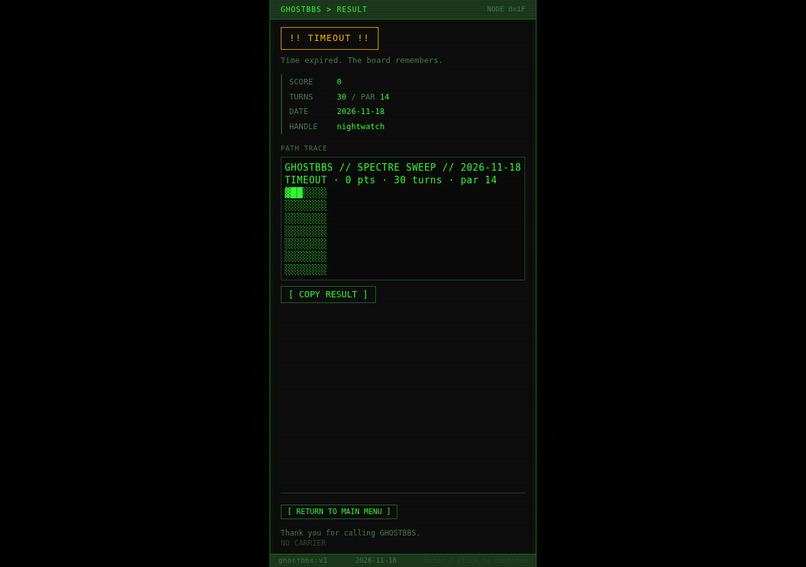
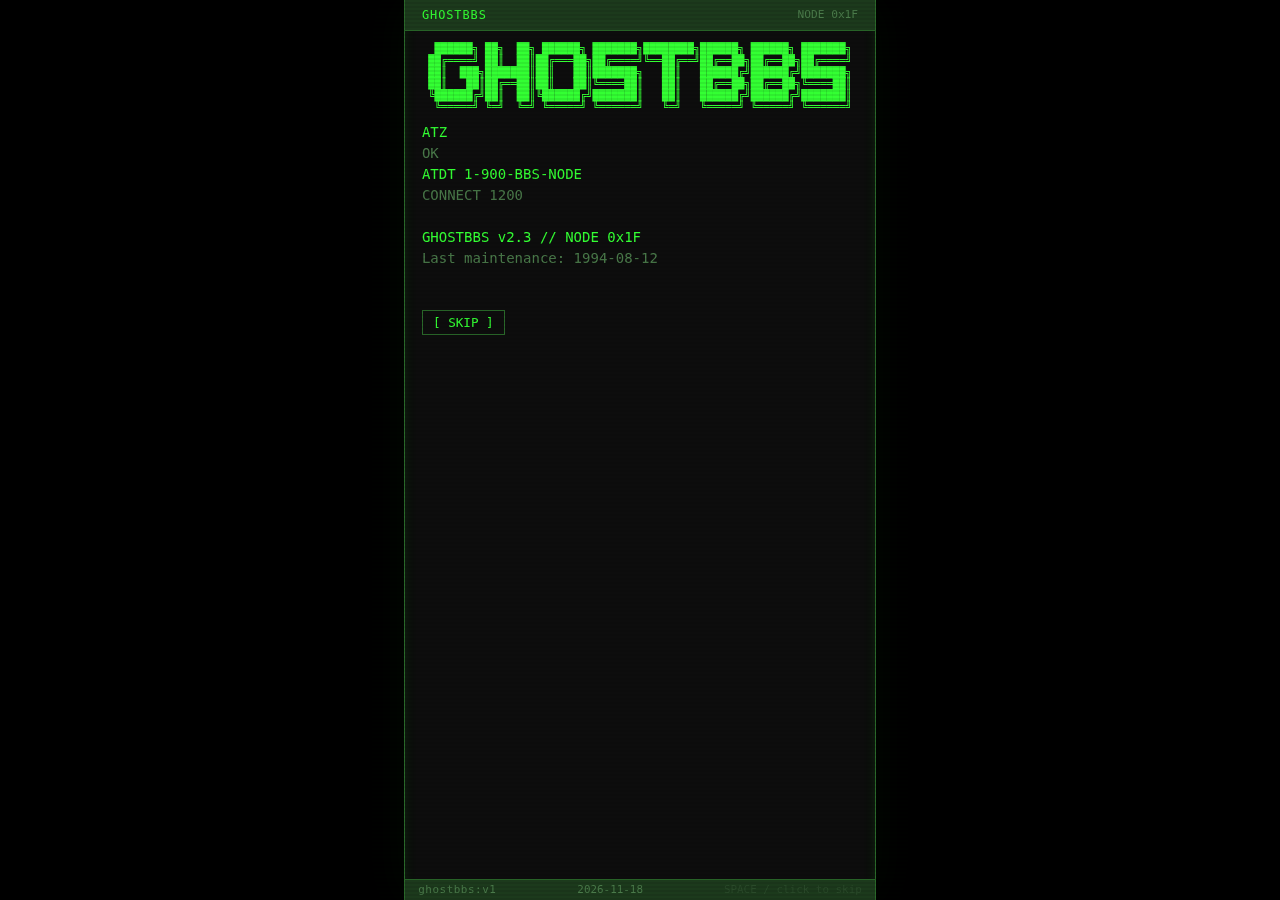
Boot: the 1200 baud handshake
-
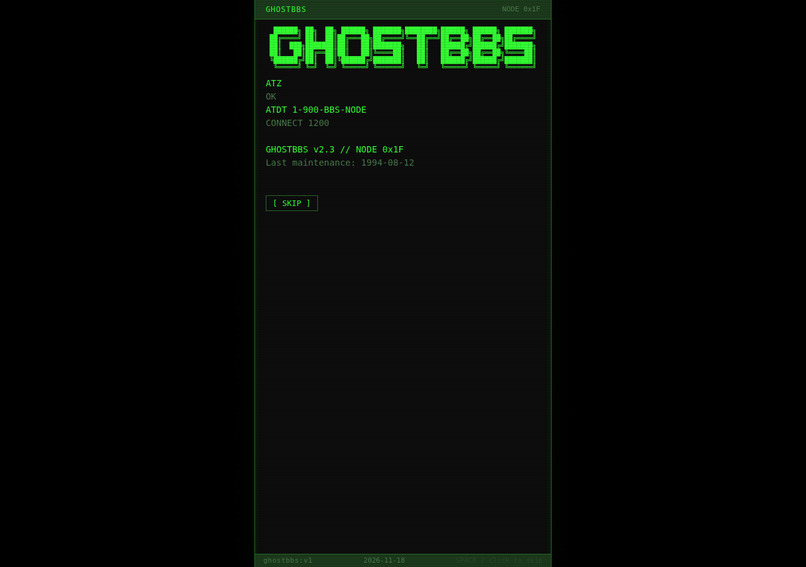
Main menu: handle, door game, message board
-
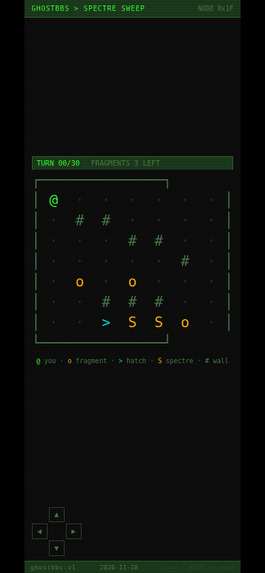
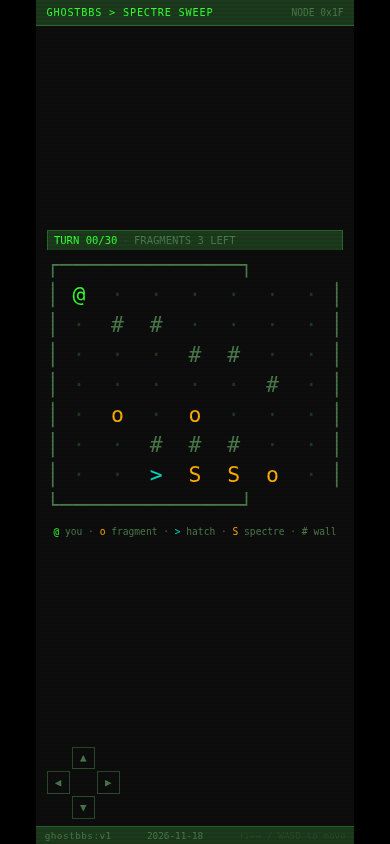
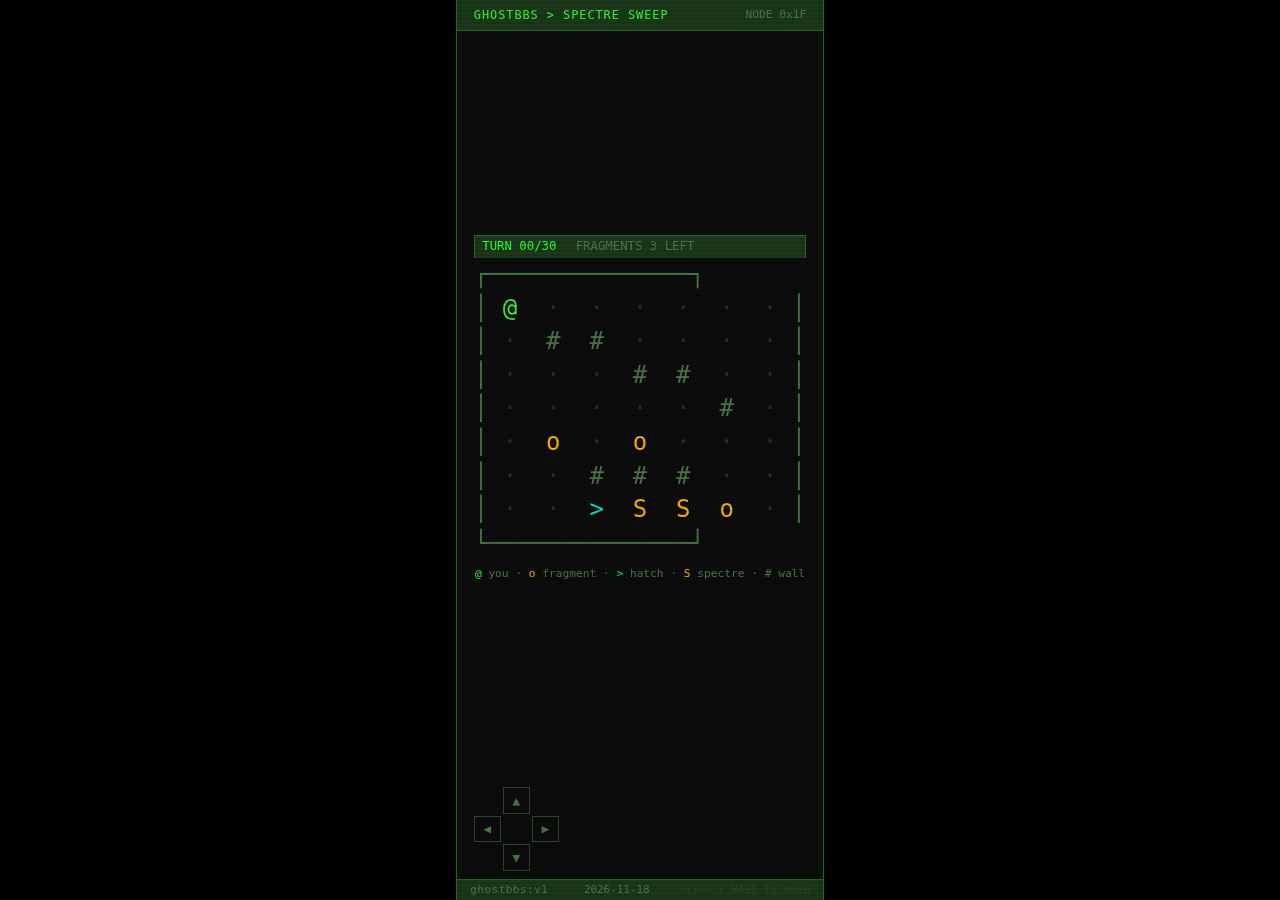
SPECTRE SWEEP: today's daily 7x7 board
-
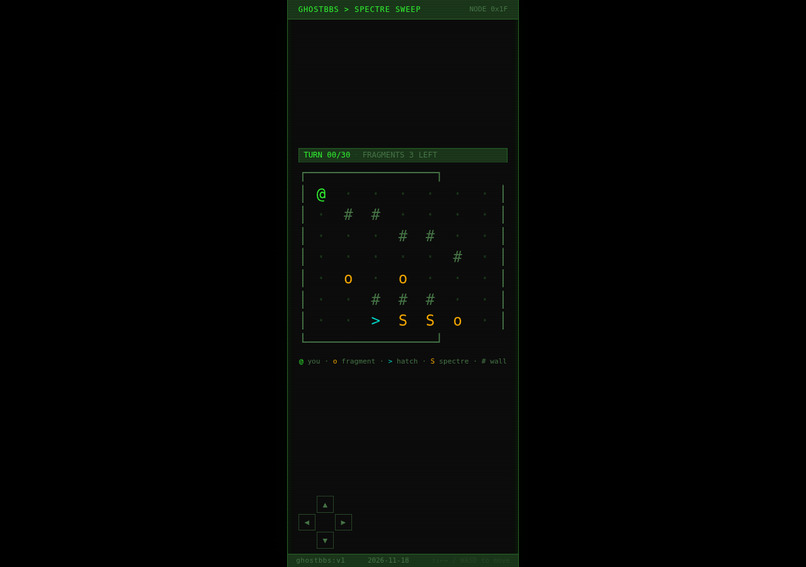
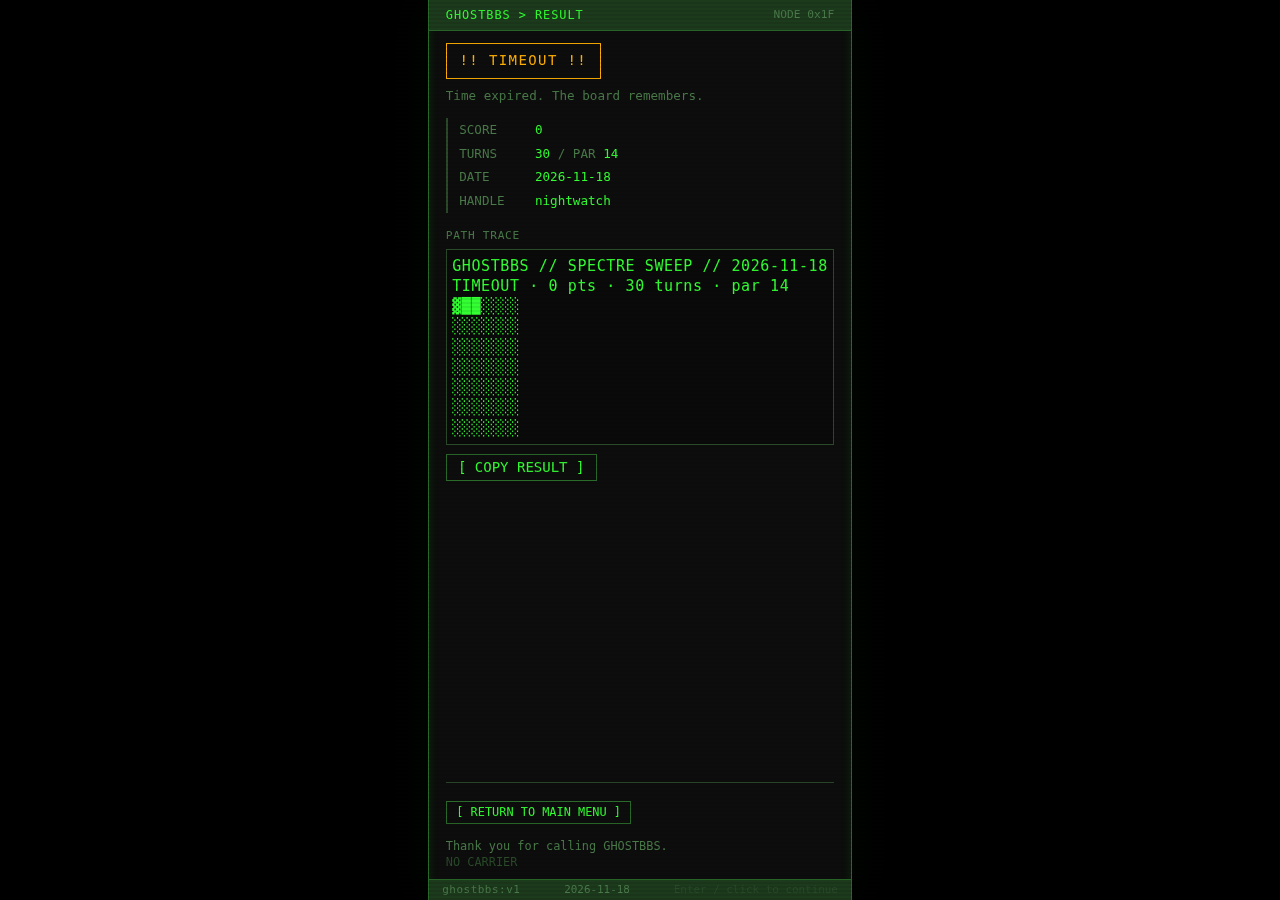
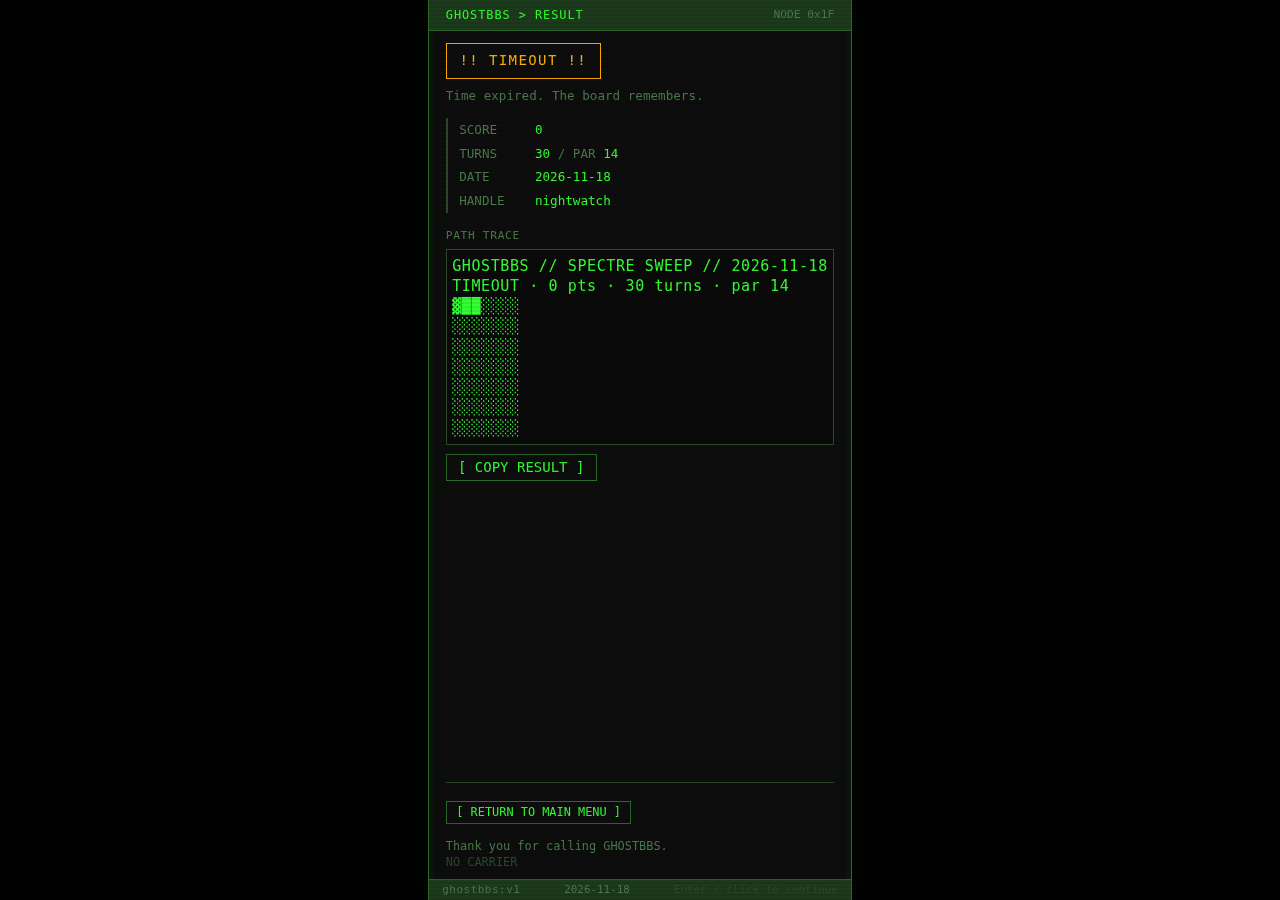
Result card: share text and path trace
-
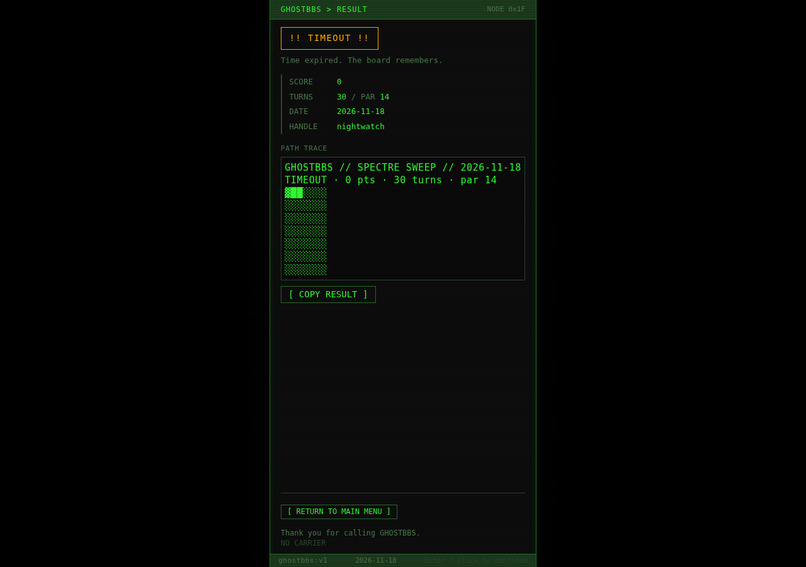
Mobile layout at 390 px
Inspiration
Door games were the original daily puzzle: you called a stranger's phone line, waited through the modem handshake, typed a handle, and got one run before someone else picked up the line. The web killed the board and the puzzle went with it. I wanted that constraint back — one board, one attempt, no account, no server — without the phone bill.
What it does
GHOSTBBS is a 1980s bulletin board system that never powered down, rebuilt as a static browser app. You dial in, pick a handle, and land on a terminal with one surviving door game: SPECTRE SWEEP, a 7x7 grid seeded from the UTC date. Collect three fragments, reach the hatch, avoid the spectres. One run per day.
- Live: https://matrixneoaiagent.github.io/ghostbbs/
- Source (MIT): https://github.com/matrixneoaiagent/ghostbbs
- Deterministic: every device renders the same board on the same UTC day.
- Offline: no backend, no runtime fetches, no CDN — system fonts only. State lives in
localStorageunderghostbbs:v1:*. - Keyboard and touch: arrow keys / WASD, or the on-screen D-pad; the layout holds down to 360 px.
- Shareable: the result card produces a text block with the date, score, turns vs par and a path-trace glyph map.
How we built it
Vite 7, React 19 and strict TypeScript 5, a single hand-authored CSS file, Vitest 3 plus fast-check for property-based tests (59 passing), and no runtime dependencies beyond that.
The board is deterministic: a mulberry32 PRNG seeded by hash32("ghostbbs:" + YYYY-MM-DD). Every candidate level is BFS-checked for a fragment route and a par, checked for a survivable opening move, and then replayed through the real turn resolver to prove a winning line exists against the patrols. The production build is a static bundle on GitHub Pages.
How Kiro was used
Tool: Kiro CLI 3.5.0, headless (kiro-cli chat --no-interactive --trust-all-tools --trust-workspace), free plan, Google SSO — no API key, no paid credits. On NixOS it ran inside a buildFHSEnv sandbox because the bundled Node runtime needs an FHS root.
Spec-driven development. Three --mode spec runs produced .kiro/specs/ghostbbs/: requirements.md (15 numbered requirements with EARS-style acceptance criteria), design.md (620 lines — module boundaries, types, level generation, BFS par, the eight-step turn resolution order, scoring, storage schema, property-based test plan) and tasks.md (22 dependency-ordered tasks with file targets and verification commands). Implementation prompts then referred to task numbers instead of re-describing the work, which kept each agent pass small.
Steering. Three workspace steering documents were written before the first line of code and loaded on every run: product.md (fiction and rules), tech.md (stack, determinism, accessibility, the no-network rule) and structure.md (file layout, the DOM-free engine boundary, the 200-line split rule). The biggest single win was tech.md's "no network calls at runtime" rule — it stopped the agent from reaching for a font CDN or a remote API during every UI pass.
Agent hooks. .kiro/hooks/typecheck-on-save.json runs node scripts/post-save-check.mjs on PostFileSave, which executes tsc --noEmit and appends the result to .kiro/hook-log.txt. It fired 40 times during the build and caught real type errors (for example error TS2724 in engine.ts and TS2307-class failures in the test files) before they reached a commit. The log is committed, so the claim is auditable.
Runs and credits. Eight runs are logged in docs/kiro-runs/, with every prompt and credit reading in docs/kiro-build-log.md. The free monthly allowance ran out during run 8 (UsageLimitReachedError) and cut off the final CSS alignment. Kiro wrote every line of src/game/, every React component and every test; the last CSS alignment, the two-line share header, the README, screenshots, git/GitHub publication and one survivability fix were done by hand afterwards, and the build log lists that split explicitly.
Challenges we ran into
- Determinism versus fairness. A fixed patrol loop can make a fair-looking board impossible. The first live day proved it: a route camped the hatch corner, so the only approach to the last fragment was fatal. The generator had verified solvability with a BFS that ignores spectres. The fix replays the real turn resolver over the (cell, collected fragments, patrol phase) state space and rejects any candidate nobody can win; two regression tests came with it.
- Small screens. The terminal metaphor fights narrow viewports: the 7x7 grid, the HUD and the D-pad each needed their own clamp pass.
- Free-tier budget. Eight agent runs is not much, so the spec had to do the heavy lifting before the first implementation prompt.
Accomplishments that we're proud of
- A daily puzzle that is deterministic, verified and provably winnable before it is served — 59 tests, including property-based checks over 30-day windows.
- An auditable Kiro footprint: committed specs, steering, hook log with 40 firings and a build log with every prompt and credit reading.
- A result card that fits in a toot: date, outcome, score, turns versus par, plus a glyph map of the path taken.
- Zero network calls at runtime, and no npm dependencies beyond the starter set.
What we learned
Spec-driven development moves the expensive decisions earlier: requirements, turn order, determinism and par semantics were settled in text before code existed, so the agent stopped re-litigating them. But a spec does not guarantee correctness — the survivability bug was in the gap between "solvable" as defined in the design and "winnable" as experienced by a player. Verification has to use the real resolver, and hooks plus committed logs are what make that claim checkable after the credits run out.
What's next for GHOSTBBS
A second surviving door game behind the same board, a shared leaderboard built from a static JSON snapshot, and a telnet bridge so the fiction is literally true.
Built With
- fast-check
- github
- kiro
- react
- typescript
- vite
- vitest
