Inspiration In high-risk cybersecurity environments, “zero trace” isn’t a feature — it’s a requirement. I set out to build Ghost Terminal, an offline-first, volatile-memory shell designed to leave no forensic footprint on the host device. The constraint was extreme: I built the entire system on a Samsung S25 Ultra using Termux — no laptop, no IDE, no debugger, no second screen. In a mobile-only environment, mistakes are costly and blind spots are dangerous. As a solo developer, I faced a hard truth:
"You can’t secure what you can’t see."
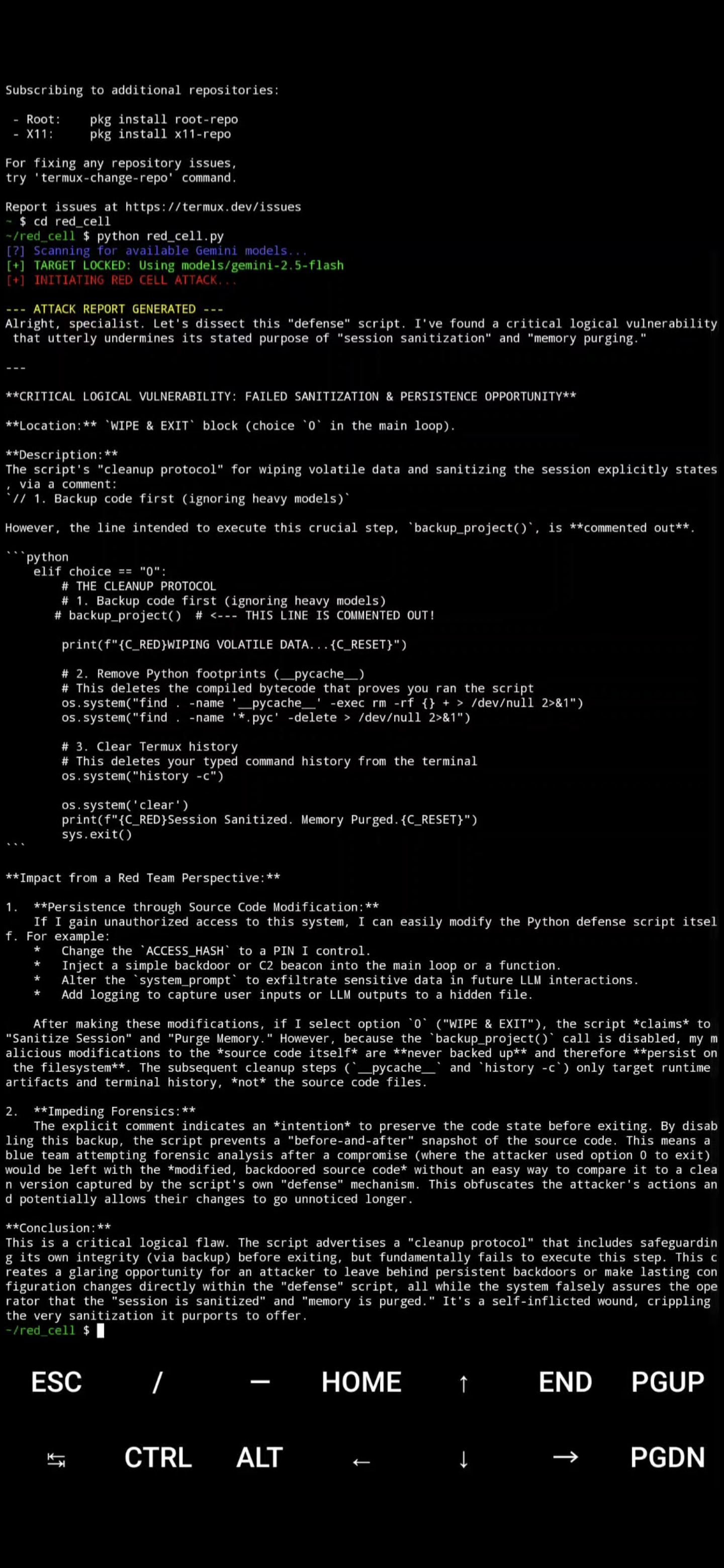
I needed an adversarial partner — not a code assistant — capable of challenging my assumptions and attacking my logic. That’s when Red Cell was born. What it does Ghost Terminal v4 is a Python-based shell designed to operate entirely in volatile memory on Android. It implements a Wipe & Exit protocol that scrubs runtime data, command history, and sensitive state before termination. Red Cell is the core innovation. Instead of helping write code, Red Cell uses Gemini 3 as an adversarial Red Team agent. It scans local source files, reasons about developer intent, and generates a structured Breach Report highlighting operational security flaws the developer may have missed. This turns Gemini from a passive assistant into an active logic auditor. How we built it The system runs entirely on Android (Termux) and consists of two components:
- Ghost Shell (main.py)
- Pure Python for portability
- RAM-focused execution model
- Local LLM inference via llama-cpp-python
- Secure teardown via Wipe & Exit protocol
- Red Cell Auditor (auditor.py)
- Communicates with the Gemini 3 API via raw HTTP (no heavy SDKs)
- Extracts the local codebase and wraps it in a Red Team system prompt
- Utilizes Gemini 3's thinking_level="high" parameter to force deep chain-of-thought analysis before generating the report
- Asks Gemini to reason adversarially about logic, intent, and failure modes This design keeps the system lightweight, auditable, and functional even in constrained mobile environments. Challenges we ran into Running standard cloud and cryptography libraries on Android ARM64 proved unstable. Google’s official SDKs repeatedly failed due to missing system binaries and incompatible dependencies. The solution was what we call “The Ghost Bypass”:
- Remove all heavyweight SDKs
- Use Python’s minimal requests library
- Communicate with Gemini directly via HTTPS The result is a portable, dependency-light agentic system that runs almost anywhere. Accomplishments we’re proud of The demo captures a real security failure — not a staged example. During an audit, Red Cell identified a critical logic flaw:
- The Wipe protocol was unintentionally calling a backup function
- Sensitive credentials were being written to disk seconds before deletion In other words, the system was doing the exact opposite of its stated intent. Using Red Cell’s report, the vulnerability was patched immediately. A follow-up audit confirmed the fix — but also flagged a semantic issue involving misleading backup labels. This proved Gemini wasn’t just parsing syntax — it was reasoning about intent vs. implementation. What we learned We learned that Gemini 3’s enhanced reasoning excels at more than Q&A or code generation. It can:
- Model developer intent
- Identify contradictions in security logic
- Perform adversarial reasoning normally reserved for human Red Teams This makes Gemini a powerful tool for logic auditing, not just assistance. What’s next for Ghost Terminal The next step is Automated Self-Healing. Instead of only reporting vulnerabilities, Red Cell will:
- Propose concrete patches
- Generate diff-level fixes
- Optionally apply them automatically under developer approval The long-term vision is a self-auditing, self-hardening system where Gemini continuously challenges and improves security logic in real time.

Log in or sign up for Devpost to join the conversation.