-
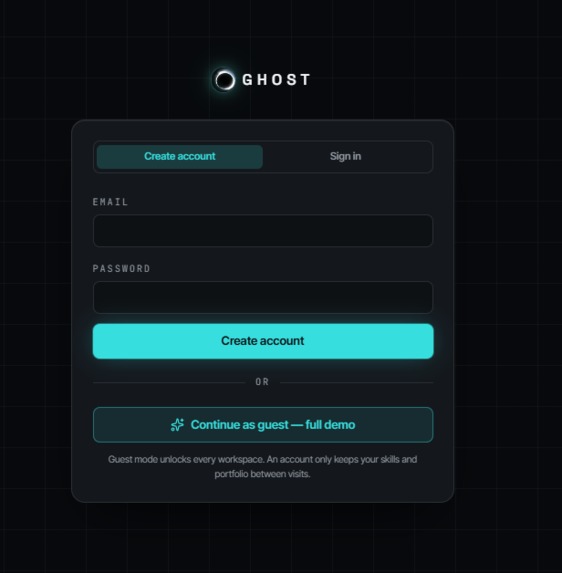
Login Portal
-
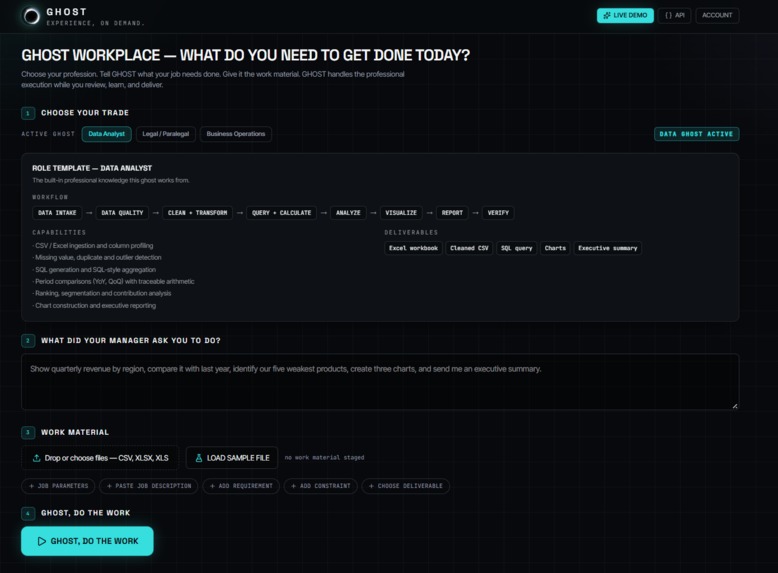
Data Analyst Work Engine
-
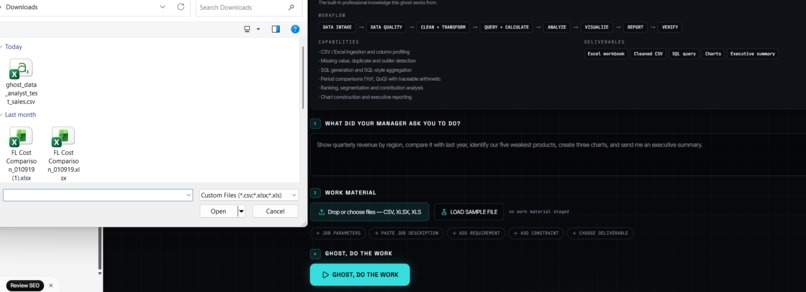
Upload Data Sheet Testing Analyst Ghost
-
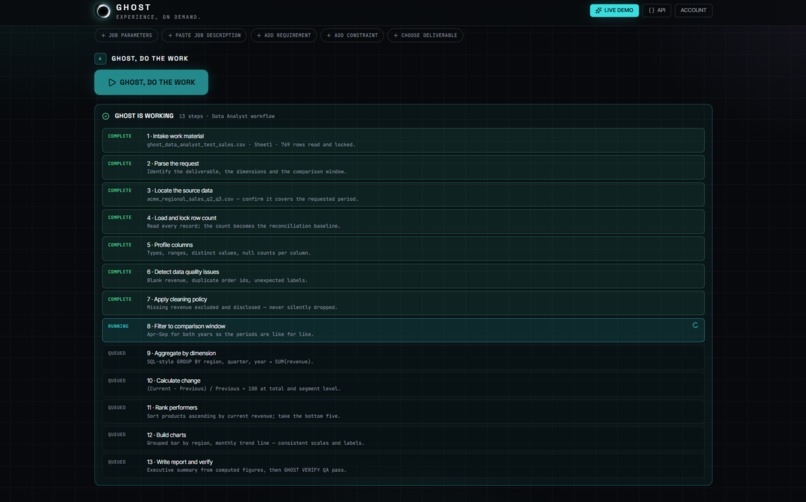
GHOST Deployed- Do the Work
-
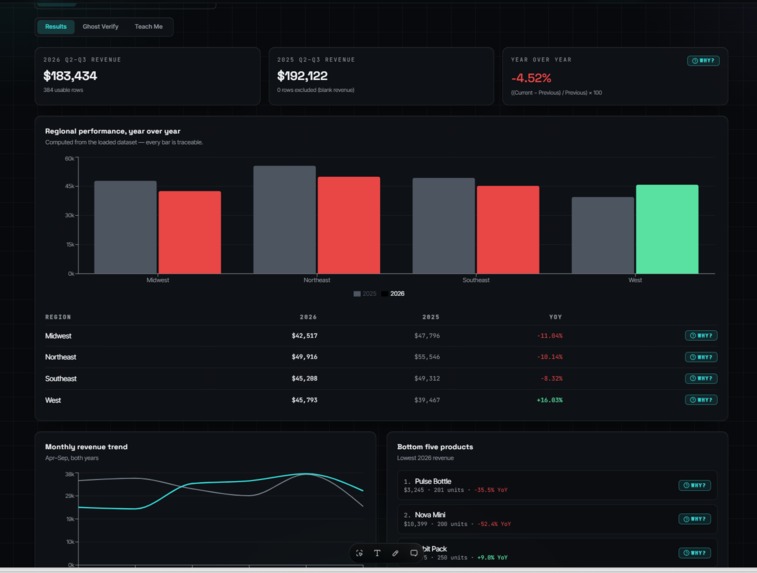
Data Ingested, Cleaned, Analyzed & Visualized
-
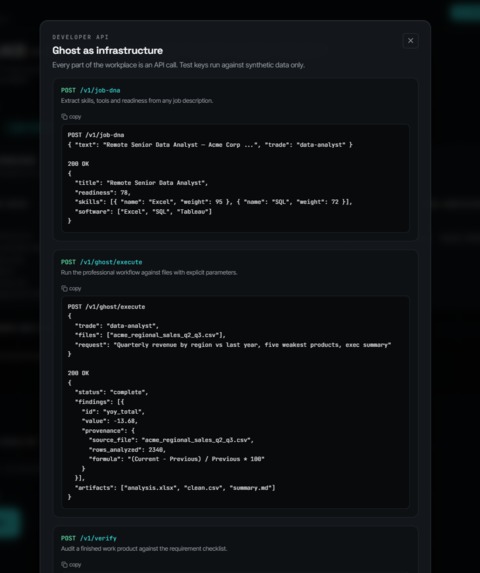
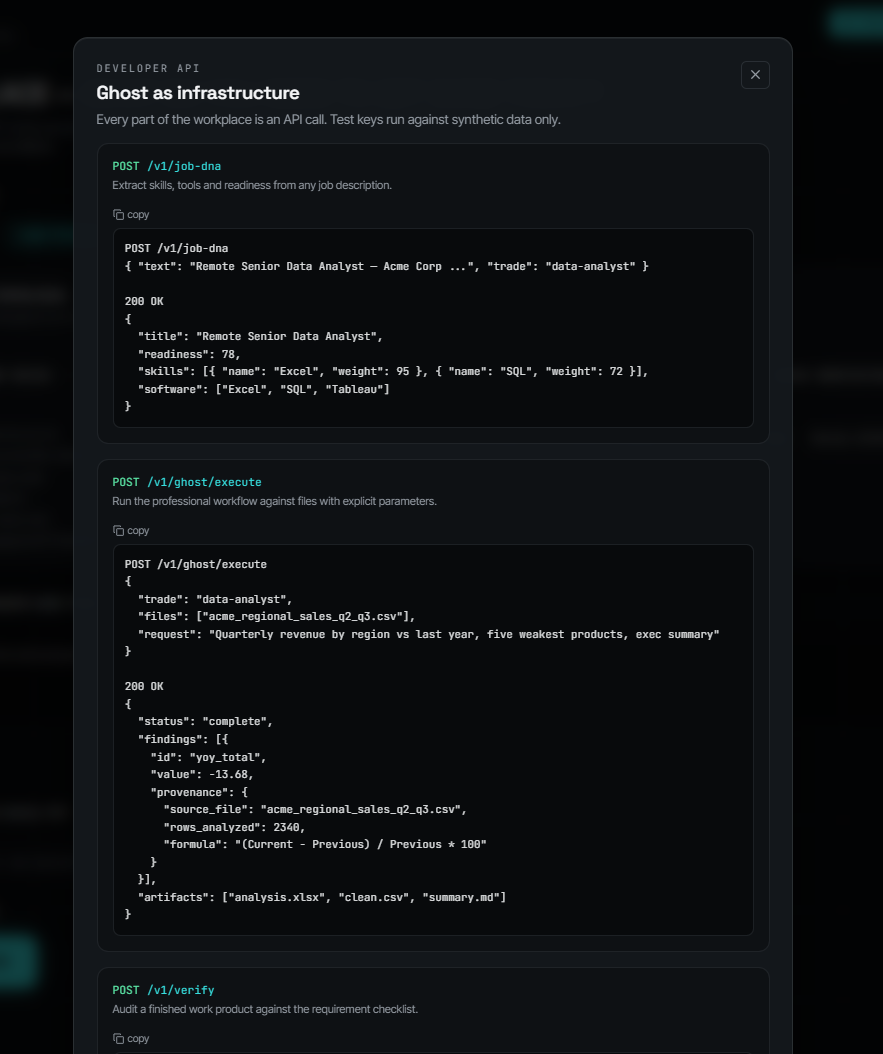
API Dev Portal Feature
-
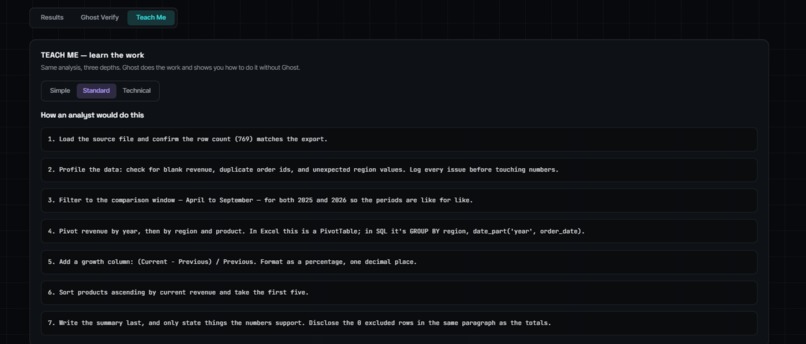
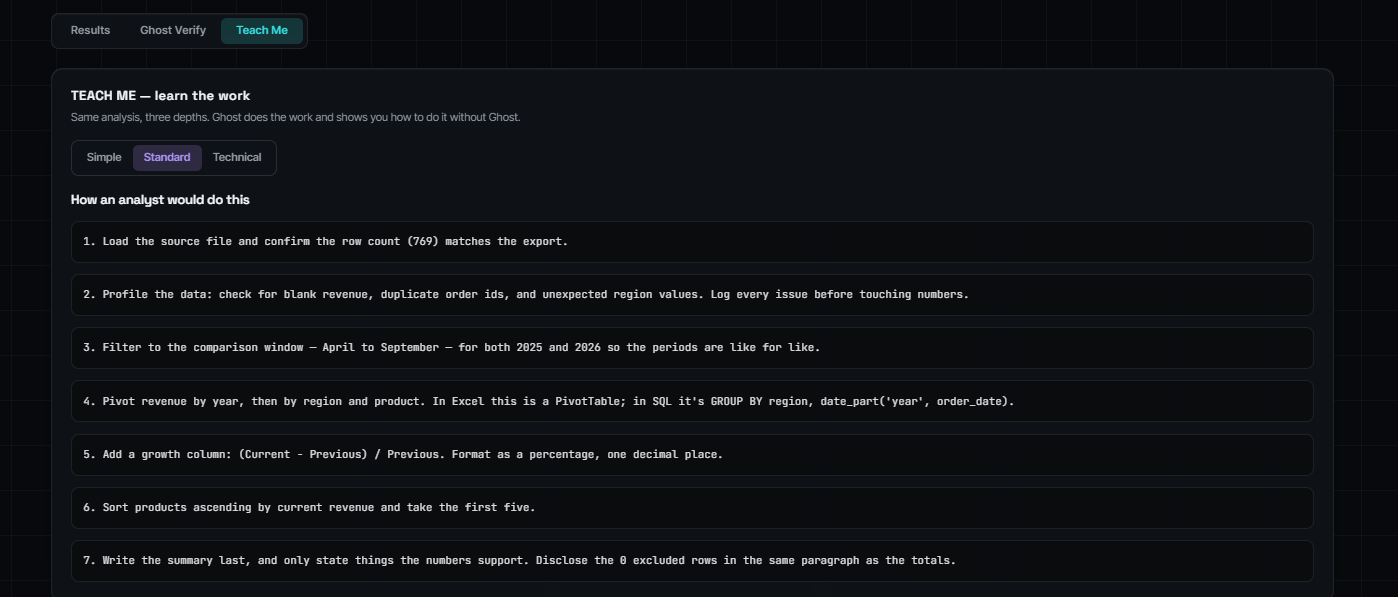
Learn the Workflow Behind the Work
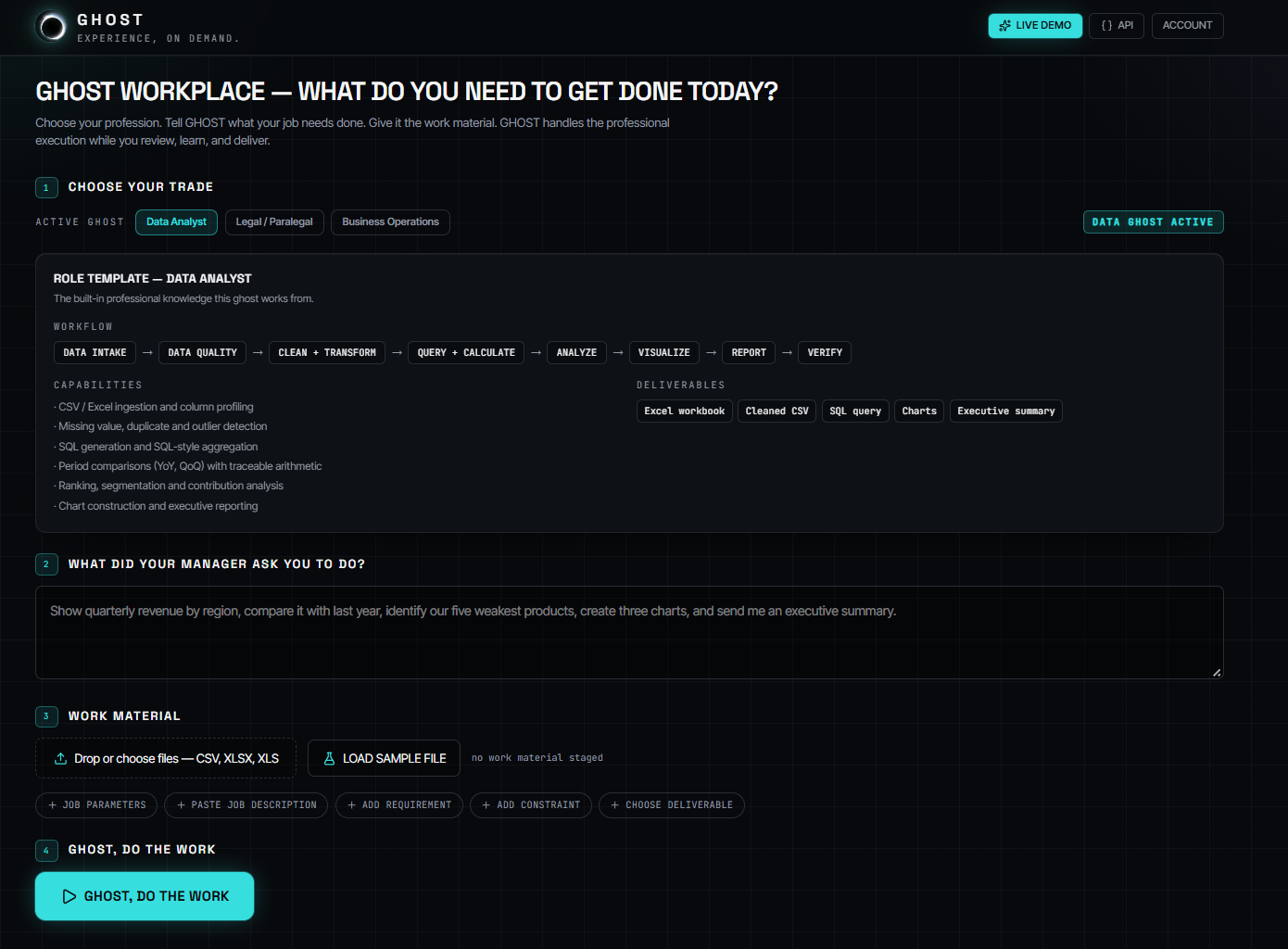
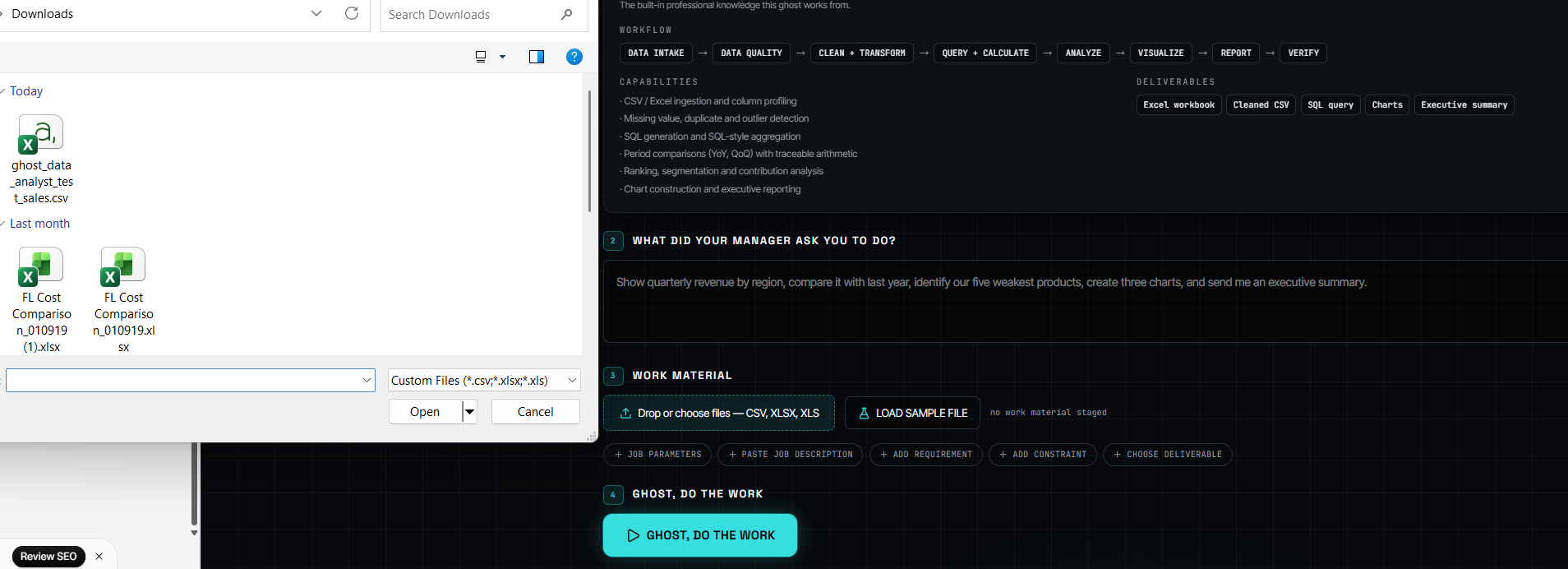
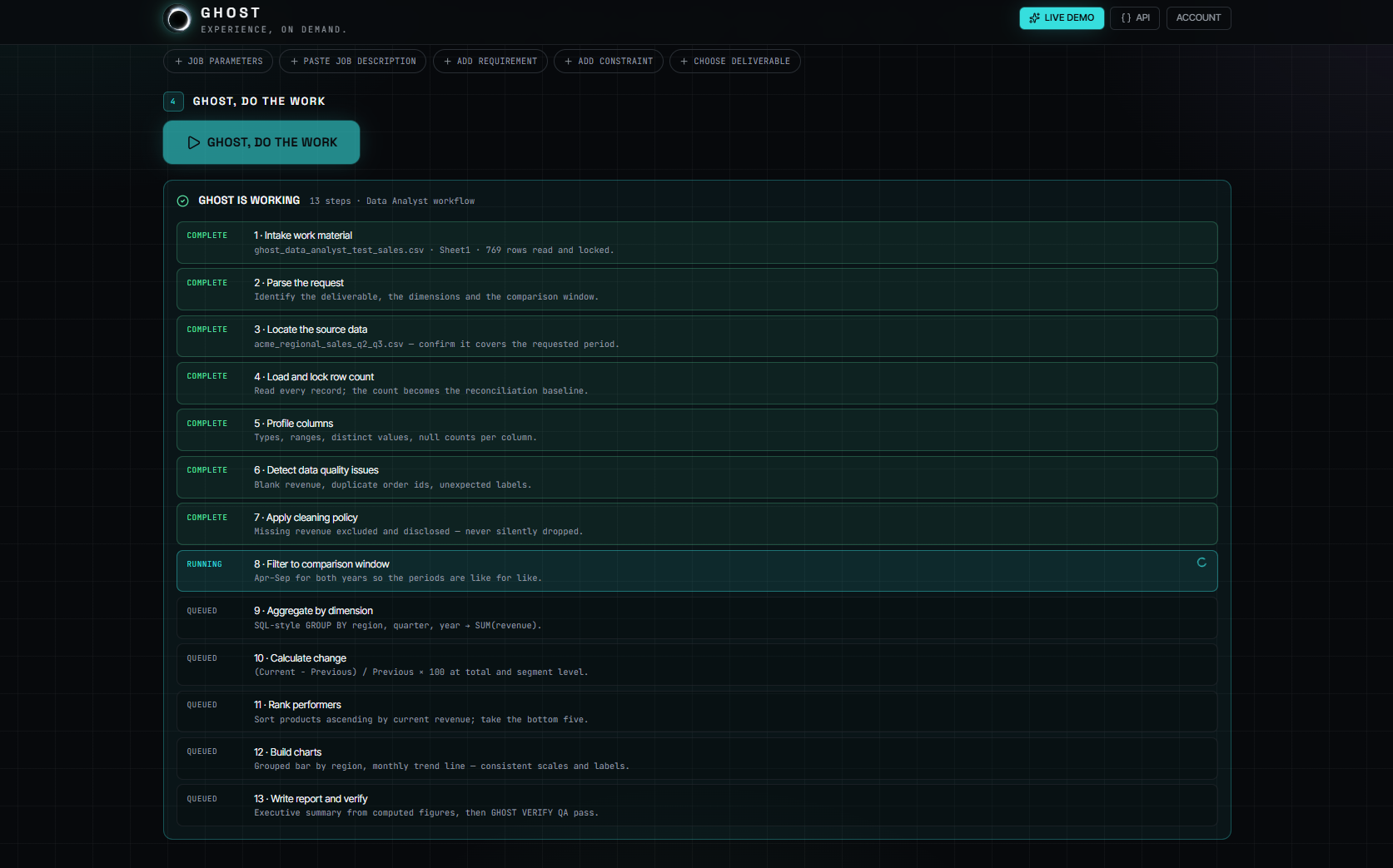
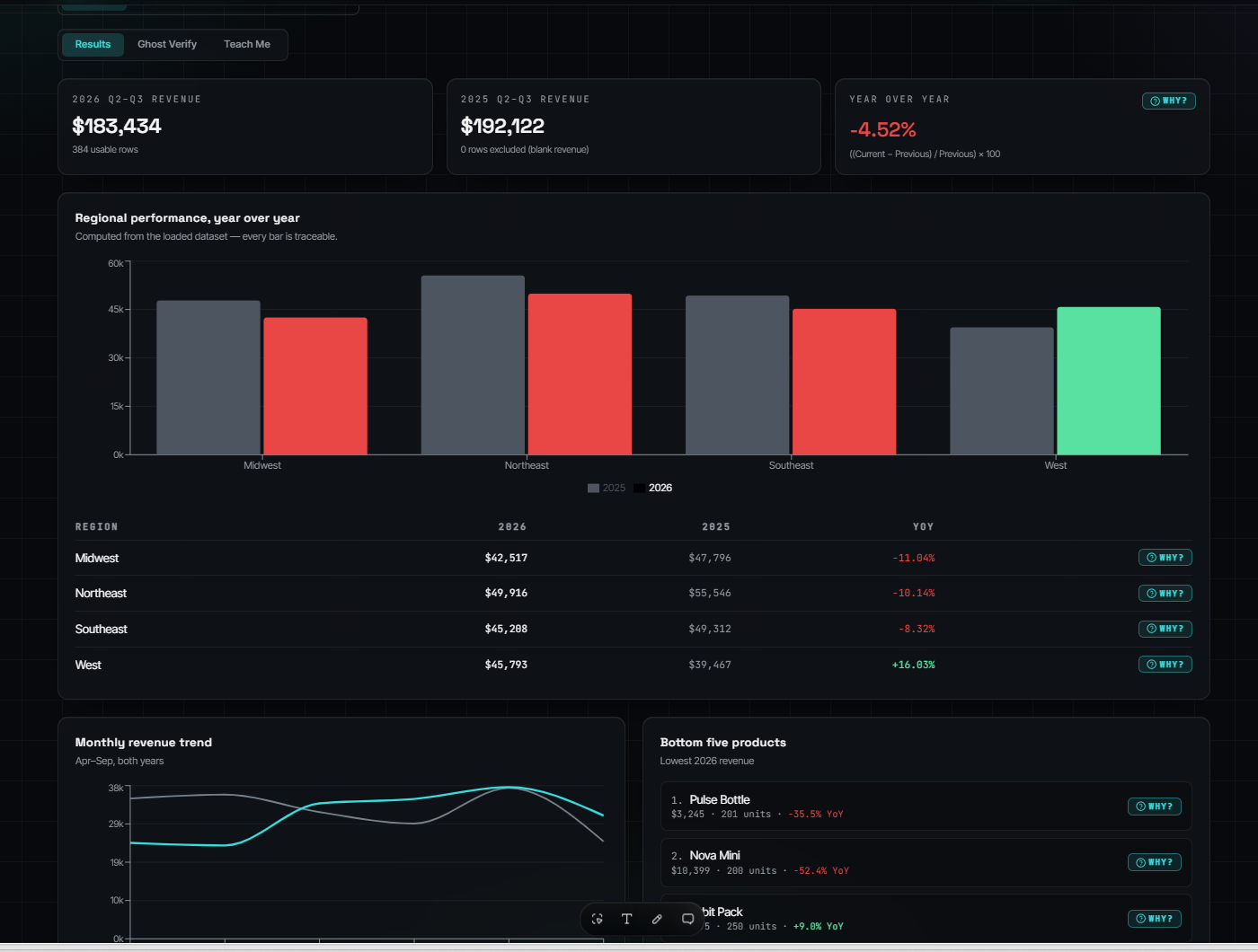
GHOST — Experience, on Demand
GHOST is AI work-execution infrastructure: an API and SDK for deploying role-specific AI work engines that ingest job requirements, data, and parameters; execute professional workflows; and return verified, traceable outputs—expanding access to skilled careers.
Inspiration
My career has never followed a straight line.
I have moved through the military, engineering, law, legal technology, AI, and startups. Every transition has required learning a new industry, new tools, new terminology, and an entirely new way of working.
And every time, I encountered the same problem:
You need experience to get the job, but you need the job to get the experience.
The problem was rarely my ability to learn. The problem was the amount of time between learning something and becoming productive enough to earn from it.
That matters because career transitions happen in real life. Bills still need to get paid. People have families, housing, debt, and responsibilities. Most people cannot spend years building experience every time technology changes or they want to enter a higher-paying field.
Then I started vibe coding.
Vibe coding gave me a completely different relationship with software development. Instead of needing years of experience with every language, framework, or technical implementation before I could build something useful, AI became an execution layer between what I understood, what I wanted to accomplish, and the technical work required to produce it.
That changed the question for me.
If AI can compress the experience barrier in software development, why can't that same infrastructure exist for professional work?
What if someone trying to become a Data Analyst could have an execution layer for analytics?
What if someone entering legal technology could have one for legal workflows?
What if changing careers did not mean starting your productive capability from zero every single time?
That became GHOST.
GHOST is my attempt to take the underlying idea behind vibe coding and apply it to the broader labor market:
Vibe coding made software creation more accessible. GHOST asks whether AI infrastructure can do the same for skilled work.
What it does
GHOST is AI work-execution infrastructure delivered through an API, SDK, and user-facing execution environment.
Rather than providing one general-purpose assistant, GHOST deploys role-specific AI work engines called GHOST Trades.
The initial architecture includes:
- Data GHOST — Data Analytics
- Legal GHOST — Legal / Paralegal Work
- Ops GHOST — Business & Operations Analysis
The core execution model is:
Job Requirements + Work Data + Parameters → Job DNA → GHOST Trade → Execute → Verify → Trace → Artifact
The first layer is Job DNA.
GHOST ingests an unstructured job description and transforms it into a machine-readable specification of the work associated with that position: required skills, tools, responsibilities, expected deliverables, workflows, technical requirements, and validation criteria.
A Data Analyst position, for example, might resolve into:
Excel → SQL → Data Cleaning → Analysis → Visualization → Reporting → QA
GHOST can then configure a Data GHOST around those requirements.
Before employment, users can enter Shadow Mode. GHOST uses the Job DNA to create realistic simulated professional assignments and synthetic datasets so the user can practice the actual work required by the position and produce legitimate portfolio artifacts.
Once employed, the user can enter Work Mode and provide:
Task + Files + Employer Requirements + Output Parameters
GHOST then creates and executes the appropriate workflow.
For Data GHOST:
Inspect → Clean → Transform → Calculate → Analyze → Visualize → Generate → Validate
The result is not limited to a conversational answer. GHOST is designed to return actual professional artifacts such as spreadsheets, structured analyses, charts, reports, and executive summaries.
GHOST also includes a provenance layer.
If GHOST reports that revenue declined by 13.7%, the user can select WHY? and inspect the source data, records, transformation, values, and calculation responsible for that finding.
Finally, GHOST Verify performs a separate validation pass against the original task requirements.
The architecture deliberately separates:
Planning → Execution → Provenance → Verification → Explanation
because professional AI cannot simply generate work and then declare its own work correct.
GHOST is not the employee. It is an AI work-execution layer that increases what the employee is capable of doing.
How we built it
GHOST was built using vibe coding and AI-assisted development, making the development process itself a proof point for the idea behind the project.
The architecture separates the system into several functional layers:
Application → Job DNA → Trade Engine → Execution Engine → Provenance → Verification → Artifact
Instead of sending every task through one large general-purpose prompt, GHOST is structured around specialized components responsible for:
- Job requirement extraction
- Job DNA generation
- Role-specific workflow planning
- File and data ingestion
- Work execution
- Artifact generation
- Provenance tracking
- Independent verification
- Human-readable explanation
The deepest implementation is Data GHOST because analytics gives us structured inputs, measurable calculations, deterministic transformations, and artifacts that can be independently inspected.
The testable prototype follows a complete execution path:
Job Description → Job DNA → Build GHOST → Upload Dataset → Define Assignment → Execute → Trace Findings → Verify → Download Artifact
We also designed GHOST from the beginning as developer infrastructure, not solely as a web application.
The API architecture includes operations such as:
POST /v1/job-dna
POST /v1/ghosts
POST /v1/ghosts/:id/execute
POST /v1/analyze
POST /v1/verify
The SDK exposes the same execution infrastructure programmatically, allowing developers to instantiate a GHOST Trade, provide work requirements and data, execute a workflow, and receive structured results.
This separation is intentional.
The user-facing application demonstrates what GHOST can do. The API and SDK are the infrastructure layer that allows the same execution model to be embedded into other applications, platforms, and workflows.
Challenges we ran into
The most significant challenge was not generating professional-looking output. Modern AI systems can already generate convincing analyses, reports, and recommendations.
The harder problem was designing a system where those outputs could be inspected, traced, and independently verified.
That led to two core architectural principles:
Generation ≠ Verification
Answer ≠ Evidence
For professional work, a plausible response is not sufficient. A finding should be connected to the data, calculation, transformation, or requirement that produced it.
This required GHOST to maintain provenance throughout execution rather than attempting to reconstruct evidence after an answer had already been generated.
Verification presented a related problem. Allowing the same execution process to generate an output and declare that output correct provides limited assurance. GHOST Verify therefore exists as a distinct validation stage that evaluates the completed work against the original requirements.
If a result cannot be supported, GHOST should surface that limitation rather than manufacture certainty:
GHOST COULD NOT VERIFY THIS.
Another major challenge was translating professional work into a structure that software could execute.
Job descriptions are inherently unstructured. They combine responsibilities, qualifications, tools, experience requirements, deliverables, and organizational expectations. Job DNA emerged from the need to convert those descriptions into machine-readable specifications capable of configuring a role-specific execution engine.
Scope was also a significant engineering decision.
The architecture could theoretically support many professional domains, but implementing a large number of shallow Trades would demonstrate breadth without proving execution depth.
For that reason, the broader GHOST architecture supports multiple Trades while the prototype concentrates its deepest implementation on Data GHOST, where transformations, calculations, findings, and artifacts can be objectively inspected.
The central technical challenge became:
Can professional work be represented as structured, executable, traceable, and verifiable AI workflows?
GHOST is our attempt to answer that question.
Accomplishments that we're proud of
One of the most important accomplishments is that GHOST evolved beyond a career-transition application into a generalizable architecture for AI-assisted professional execution.
The system connects stages of professional capability that are typically fragmented across separate products:
Understand the Role → Model the Work → Practice the Work → Execute the Work → Trace the Result → Verify the Output
Job DNA is a particularly important part of that architecture.
Most employment technology treats a job description as text to search, summarize, classify, or compare against a résumé. GHOST treats it as a potential execution specification.
The requirements contained in a job description can inform the configuration of the AI work engine responsible for helping execute that work.
We are also proud that provenance and verification are architectural components rather than interface features.
A professional AI system should be able to provide more than a conclusion.
If GHOST produces a finding, the objective is to preserve a path from:
Finding → Evidence → Transformation → Source
and from:
Deliverable → Validation → Original Requirement
That creates a fundamentally different interaction model from a conventional chatbot. The user is not being asked to trust an answer because it was generated confidently; the system is designed to expose the basis for that answer.
Finally, GHOST demonstrates a different technical direction for AI in the workforce.
AI infrastructure is commonly optimized around replacing individual tasks or reducing the number of humans required to perform them.
GHOST explores another possibility:
AI Infrastructure → Expanded Human Capability
The same technology capable of automating work can also be used to reduce the experience barrier required for humans to perform that work effectively.
What we learned
Building GHOST reinforced an important distinction between access to intelligence and access to execution.
Generative AI has made sophisticated knowledge, reasoning, and technical assistance broadly accessible. But knowing how a task should be performed is different from having the infrastructure necessary to execute that task reliably.
Professional experience contains more than knowledge.
It includes workflows, sequencing, tool selection, validation practices, expected deliverables, exception handling, and the accumulated understanding of how individual operations connect into completed work.
That led to one of the central ideas behind GHOST:
The next important layer of AI may not simply be more intelligence. It may be execution infrastructure.
We also learned that professional AI requires a different architecture from conversational AI.
A general-purpose assistant can optimize primarily for producing a useful response. A professional execution system must account for the entire lifecycle of the work:
Understand → Plan → Execute → Trace → Verify → Explain
The system must know what was requested, what inputs were used, what operations were performed, how a conclusion was reached, whether the deliverable satisfies the requirements, and where uncertainty remains.
This also changed how we think about the experience gap itself.
Experience is not a binary characteristic that someone either possesses or lacks. A significant portion of professional experience consists of repeatable workflows and execution patterns.
If those patterns can be modeled responsibly, AI infrastructure may be able to help humans become productive in new domains significantly faster while still preserving human judgment and accountability.
GHOST is an experiment in building that infrastructure.
What's next for GHOST
The next phase is expanding GHOST from a functional prototype into a developer platform for deploying professional AI work engines.
The immediate priority is increasing the depth of Data GHOST.
That includes broader spreadsheet and CSV operations, SQL workflows, larger datasets, more deterministic calculations, visualization pipelines, professional report generation, reusable employer parameters, stronger provenance, and expanded verification.
The next architectural milestone is formalizing the GHOST Trade specification.
A Trade should ultimately be represented as a structured definition of a professional execution environment:
Trade → Skills → Tools → Inputs → Workflows → Execution Rules → Output Schemas → Verification Rules → Provenance Requirements
That abstraction would allow new professional engines to be created without rebuilding the underlying GHOST infrastructure.
Future Trades could extend the architecture into:
Finance • Accounting • Marketing • Cybersecurity • Project Management • Research • Compliance • Supply Chain • Quality Assurance • Real Estate
The larger technical priority, however, is expanding the GHOST API and SDK.
The long-term value of GHOST is not dependent on users accessing a single GHOST application. The objective is to make the execution infrastructure available to other developers and platforms.
A workforce platform could deploy role-specific GHOST engines for career-transition programs.
An education platform could convert learning objectives into simulated professional workflows and verifiable artifacts.
An enterprise application could integrate a GHOST Trade around a specific internal workflow.
A developer could build an entirely new product while relying on GHOST for the underlying execution, provenance, and verification infrastructure.
Eventually, domain experts could define and deploy their own GHOST Trades through a common specification.
The architecture becomes:
Developer / Platform → GHOST API → Job DNA → Trade Engine → Execution → Provenance → Verification → Artifact
The long-term goal is not to create one general-purpose AI that claims to perform every profession.
It is to create shared AI infrastructure for deploying specialized work engines that understand how specific professional work is actually performed.
That creates the possibility of an ecosystem where GHOST Trades can be defined, versioned, tested, deployed, and improved independently while sharing the same underlying execution and verification architecture.
The initial prototype begins with Data, Legal, and Operations.
The infrastructure is designed to go much further.
GHOST — Experience, on Demand.
AI work-execution infrastructure for expanding human capability.
Built With
- analyst
- api
- csv
- edge
- functions
- github
- javascript
- json
- level
- lovable
- node.js
- openai
- postgresql
- react
- rest
- row
- security
- sql
- supabase
- typescript
- vite
- xlsx

Log in or sign up for Devpost to join the conversation.