-
-
-
DESIGN OF THE GHOST DOLL
-
-
About the Project
As AR glasses become more lightweight, wearable, and socially embedded, they open new possibilities for casual, embodied, and socially performative gameplay. Yet much of today’s AR design still inherits paradigms from mobile and VR systems—focused on productivity, immersion, or spatial overlays—leaving headworn AR underexplored as a medium for emotionally comple
This project explores how discomfort—ritualized, symbolic, and slightly uncanny—can act as a new form of social feedback in wearable AR, especially for younger users. We ask: what happens when playful punishment, rather than reward, becomes the engine of interaction? Can ambient unease create
To frame this, we draw from meme culture, where failure and awkwardness aren’t hidden but performed. From ironic TikTok challenges to ghost filters and cursed remixes, today’s youth often turn shame into content, and discomfort into bonding. This performative logic offers a compelling foundation for rethinking feedback in headworn AR.
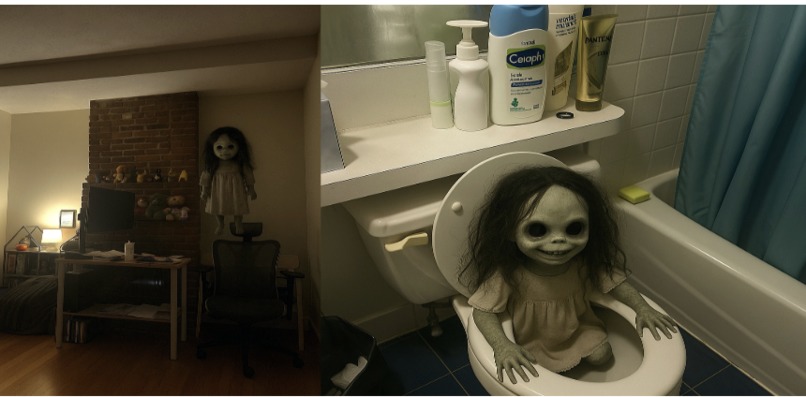
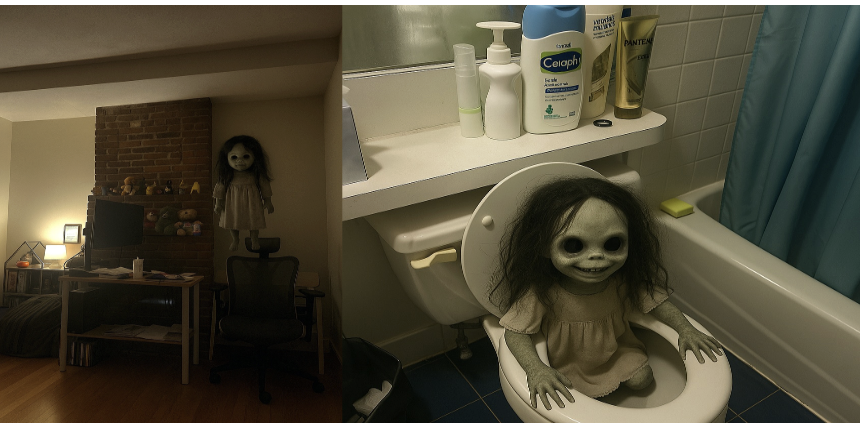
We introduce Ghost Gait, a multiplayer AR walking game developed for Snap Spectacles. Each day, players’ step counts are tracked. At 8:00 PM, their totals are compared. The player with fewer steps is “marked,” triggering the arrival of a ghost doll—an AR figure that begins to ambiently haunt them by appearing in mundane, intimate spaces like toilets, mirrors, or corners. Even without wearing the glasses, the marked player knows the Ghost is “there.” To break the curse, they must put the glasses on, locate the Ghost, take an AR photo with it, and send it to the opponent. This completes a ritual of symbolic release and public accountability.
Rather than reinforce fitness or productivity, Ghost Gait transforms biometric input into social spectacle. Step count becomes not a performance metric, but a trigger for haunting. Gait data becomes a storytelling device—turning daily movement into symbolic vulnerability and ritualized play.
To mitigate ethical concerns, we implemented safeguards: opt-out options, privacy-preserving data sync, and the ability to customize how and where the Ghost appears. Our goal is not to punish inactivity, but to explore how ambient discomfort, if carefully constrained, can operate as a form of emotional feedback and peer connection.
Through this project, we propose the concept of cultic feedback: a speculative design lens where symbolic consequence, meme logic, and ritual discomfort are used to create emotionally resonant and socially active AR experiences. We argue that such feedback—rooted in humor and ambiguity—offers new territory for bio-interactive design on headworn platforms.
Ghost Gait invites us to rethink what feedback can feel like when it’s not immediate, visible, or rewarding—but ambient, awkward, and deeply social.
Inspiration
Ghost Gait is inspired by a blend of meme culture, symbolic discomfort, and ritual design. Rather than optimizing fitness or tracking goals, we explore how ambient feedback and playful shame can create new forms of social interaction—especially for teens.
The core idea is what we call “cultic feedback”: instead of rewarding progress, the system marks symbolic failure through the quiet appearance of a ghost doll. It doesn’t punish or scare—but lingers silently in mirrors, toilets, or corners, creating emotional ambiguity. This discomfort is not resolved by leveling up, but by performing a ritual: finding the doll, taking a selfie, and sending it to your opponent. This transforms biometric failure into a social performance—awkward, funny, and oddly empowering.
We draw on youth meme logic, where embarrassment becomes content. In Ghost Gait, losing a step-count battle doesn’t lead to scolding—it leads to haunted selfies. Shame becomes something to laugh at and share. The ghost’s presence is quiet, passive, and interpretive—inviting users to find their own meaning in where it appears and how it reacts (or doesn’t).
We also wanted to challenge conventional biometric feedback systems. Most fitness apps offer dashboards or streaks. We offer uncertainty. The ghost appears only to the loser—but never explains why. This design creates a form of ambient consequence, where movement data triggers emotional storytelling rather than performance metrics.
By embracing ritual discomfort, symbolic failure, and meme-based accountability, Ghost Gait turns everyday activity into eerie play.
What We Learned
Designing Ghost Gait taught us that social play doesn’t always need rewards—it can thrive on ritual, ambiguity, and even discomfort. We learned how teenage users are drawn to experiences that blend awkwardness with creativity, where being “haunted” becomes a story to tell, not just a consequence.
Technically, we explored the limits of Spectacles as a spatial platform: world mesh anchoring, passive biometric syncing, and scene-aware object placement opened up unexpected opportunities for symbolic interaction. Emotionally, we found that subtle, ambient feedback—like a ghost in a corner—can have far more impact than overt jumpscares or gamified goals.
Finally, we learned that fitness data doesn’t have to push productivity. It can become material for narrative, for social rituals, and for turning everyday movement into something strange, shareable, and meaningful.
How We Built It
Platform & Technical Overview Hardware: Each player wears Snap Spectacles. Software: We use Lens Studio 5 for AR rendering, object anchoring, and mesh-based scene detection. Data Pipeline:
On iOS, step count data is automatically retrieved from Apple HealthKit and synced to Firebase.
On Android (planned), step data will be pulled from Google Fit and similarly synced to Firebase. Gameplay Setup: Players grant permission to access their step count once. After that, no manual input is needed—daily step comparisons and hauntings are triggered automatically.
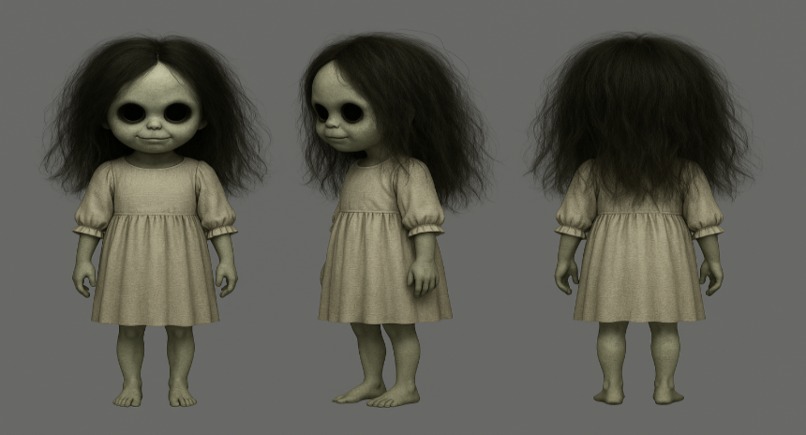
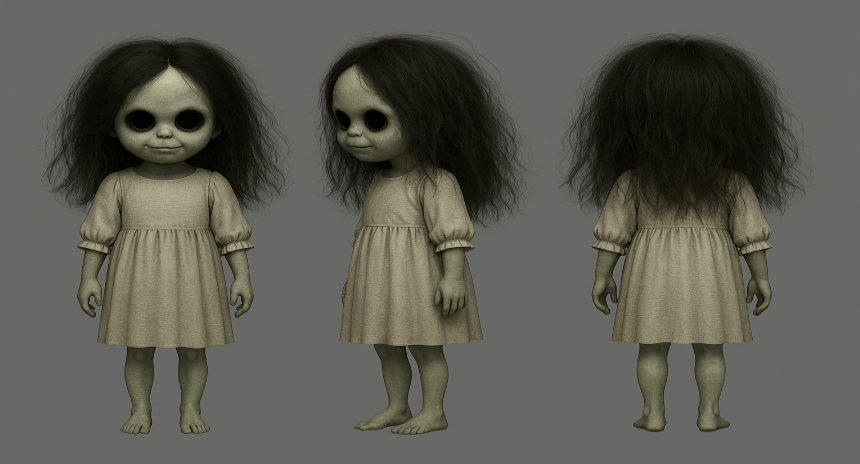
Ghost Avatar Design The ghost doll is the core of the haunting experience. Its design draws from cult horror toy aesthetics: unsettling but not violent. We aimed for a look that feels eerie rather than grotesque—exaggerated proportions, black-pupil eyes, and messy hair help create symbolic unease. The ghost maintains a neutral posture to avoid aggression but still disrupts the everyday.
We created a full-body 3D model with orthographic views to guide placement and animation. This ensures the doll can appear believably in various scenes like toilets, corners, or behind a player in a mirror-like view.
Environmental Anchoring & Visual Feedback We use Lens Studio’s World Mesh feature to detect real-world planes—walls, tables, ceilings—so the ghost doll can be placed realistically in a user’s environment. We developed additional context-specific logic for key placements:
Toilets: A lightweight machine learning model detects toilets from the Spectacles camera. When one is detected, the ghost may emerge with a crawling animation.
Mirror scenes: Using face detection, the system places the ghost subtly over the player’s shoulder when they look at a mirror or another person—suggesting socially intimate haunting.
Corners and thresholds: The ghost can randomly appear in floor or ceiling corners, enhancing feelings of uncertainty and ambient tension.
Rather than relying on jump scares, the feedback design focuses on emotional ambiguity: players are left to wonder what the ghost wants, why it appears, and what it means.
Core Interaction Principles The system is designed around three key interaction principles:
Social asymmetry: Only the player who walked less is haunted, making the ghost a symbolic sign of “losing” rather than applying a shared consequence.
Emotional salience: The ghost appears in personal, vulnerable spaces—like toilets and mirrors—so movement data is directly linked to the body and home.
Gamified discomfort: Inspired by dark play, we avoid punishment and instead use unease as a narrative force, turning awkwardness into engagement.
Remote Sync & Haunting Logic* Every 24 hours, the backend compares step data between players. The one with fewer steps becomes the “haunted” target for that day. The app does not display step counts or rankings—players only find out they’ve “lost” when the ghost appears.
This ambiguity shifts focus from productivity or performance to symbolic consequence. In other words, movement data becomes storytelling, not scoring.
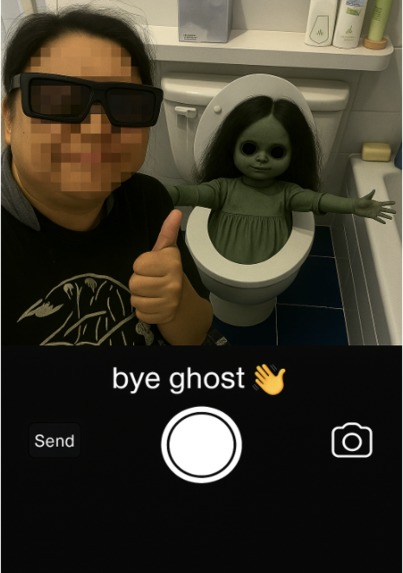
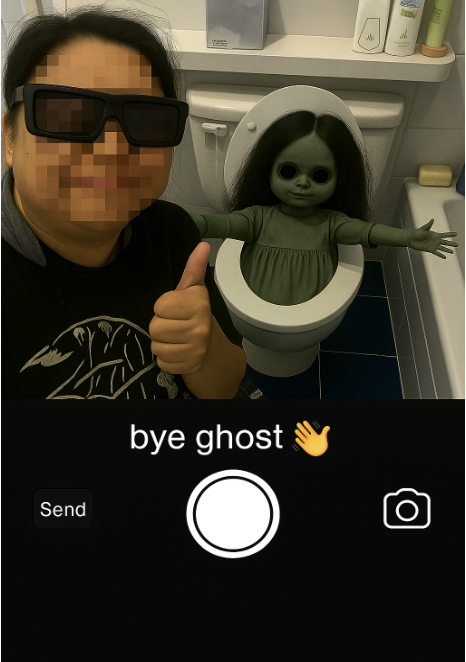
AR Feedback Capture & Banishment Ritual To lift the curse, the haunted player must take a photo with the ghost doll and send it to their opponent. This symbolic act turns private shame into a social moment—and completes the “banishment ritual.”
This is supported through the Spectacles mobile app, which syncs the AR ghost into the user’s phone view using the same environmental anchors. This lets the player take a selfie where both they and the doll appear in the same real-world scene—perfect for social media.
The capture UI includes a live camera preview, a photo button, and a pre-filled caption like “bye ghost.” When the image is sent, the haunting ends—until the next day’s step battle.
Challenges
Building Ghost Gait challenged us to design an experience that is emotionally charged, socially playful, and technically sound—all without relying on traditional game mechanics like points or progression.
One of our biggest design challenges was crafting discomfort without disengagement. We didn’t want the ghost to act as punishment or jumpscare. Instead, it had to feel uncanny yet playful—something that lingers rather than attacks. Striking this balance pushed us to rethink how emotion, ambiguity, and narrative tension can emerge through spatial placement, passive behavior, and social context.
On the technical side, working with Snap Spectacles presented unique affordances and constraints. Anchoring a ghost in domestic, often intimate environments—like toilets, mirrors, or corners—required precise mesh detection and lightweight object recognition. We trained a custom ML model to detect toilets from the Spectacles camera feed, ensuring real-time performance while preserving privacy. Achieving consistent placement in mirror-like scenes also meant relying on minimal face detection logic without requiring reflective surface recognition.
Syncing biometric step data was another hurdle. We wanted gameplay to feel passive and ambient—no buttons, no stats, no dashboards. But under the hood, integrating Apple HealthKit, Firebase, and real-time server comparisons involved complex data pipelines and asynchronous logic. Making it feel “invisible” was the hardest part.
We also grappled with cultural and emotional boundaries: how far can ritual shame go before it feels punitive? How do we make players laugh at their embarrassment rather than feel alienated? We learned that framing matters—humor, meme logic, and shared rituals can turn awkwardness into bonding.
Ultimately, we learned that fitness doesn’t have to mean productivity. In Ghost Gait, step data doesn’t reward—it reveals. Movement becomes myth. Losing becomes a story. And biometric failure becomes the fuel for symbolic, ambient play that is funny, strange, and socially powerful.
Built With
- healthkitapi
- javascript
- machine-learning
- object-anchoring
- world-mesh-detection


Log in or sign up for Devpost to join the conversation.