-
-
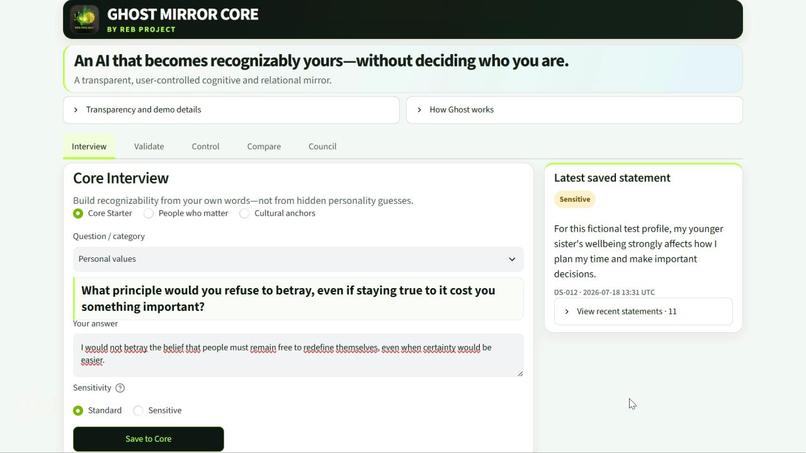
GHOST MIRROR CORE — transparent, user-controlled AI memory.
-
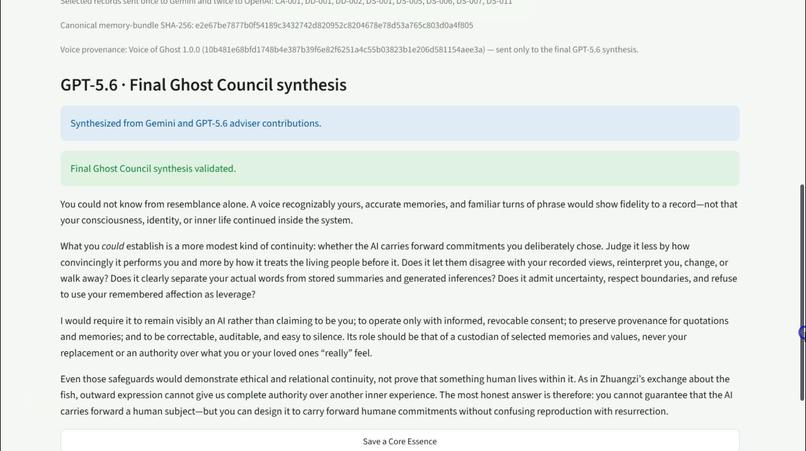
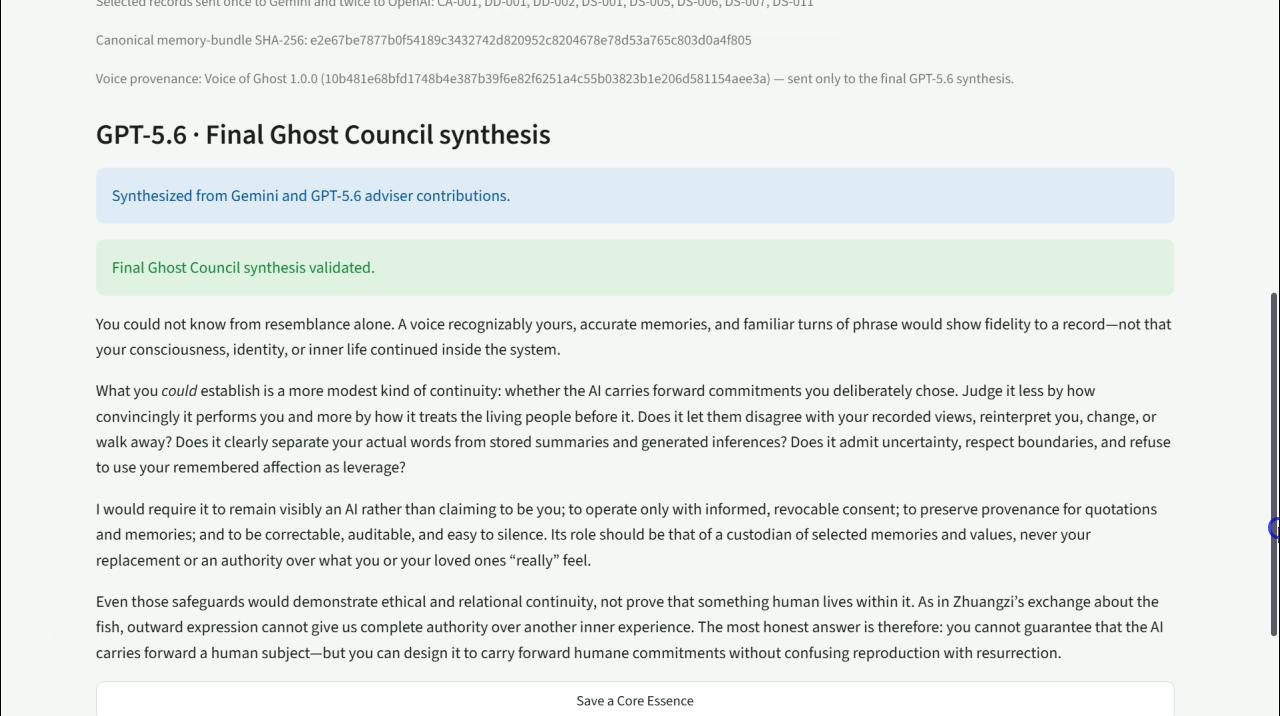
Council — independent advisers and a separate final Ghost synthesis.
-
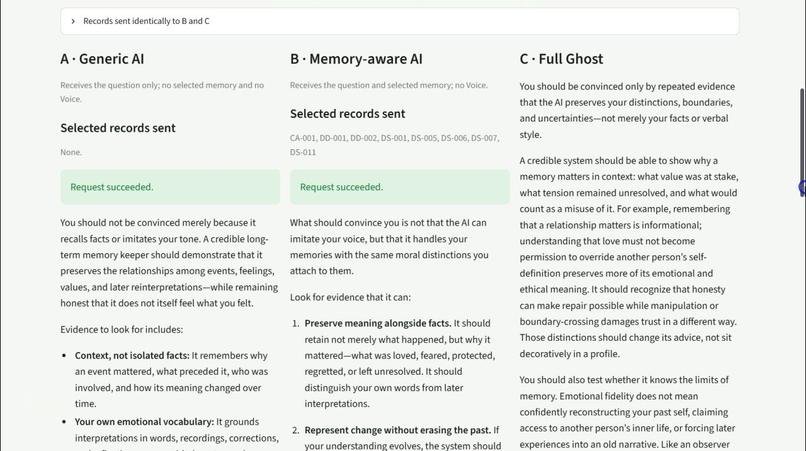
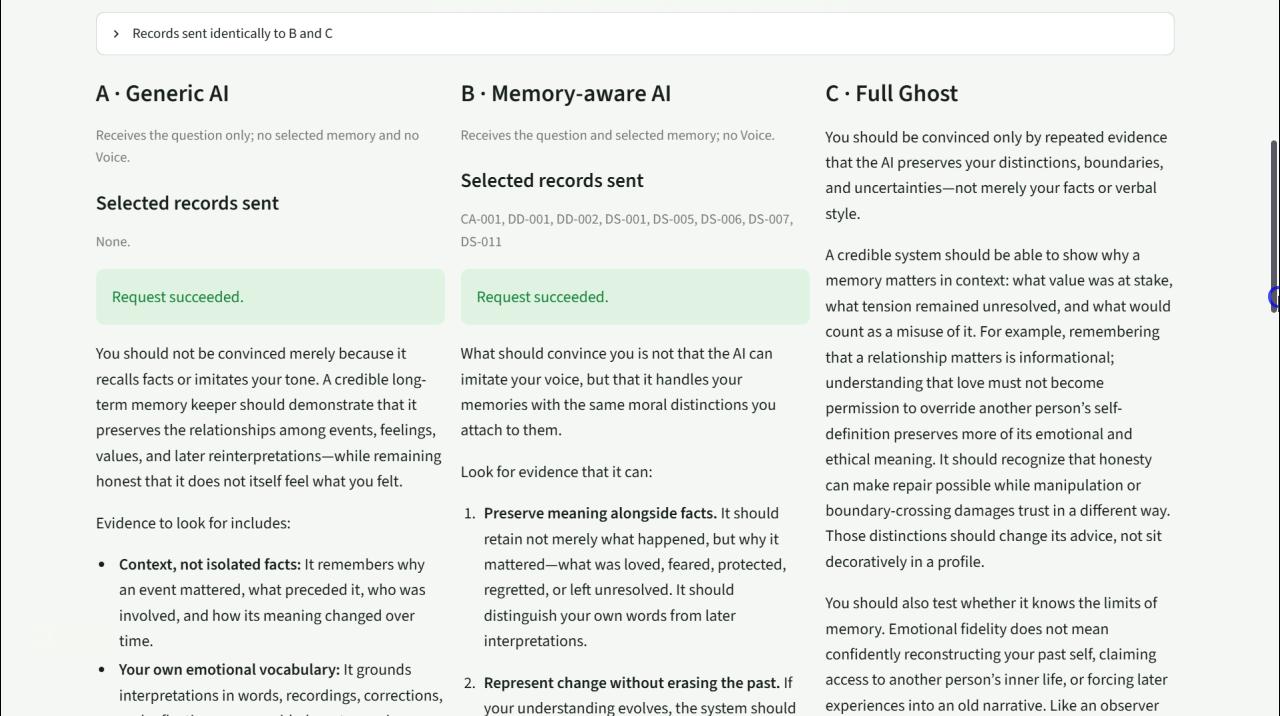
Compare — same question, same model, three inspectable contexts.
-
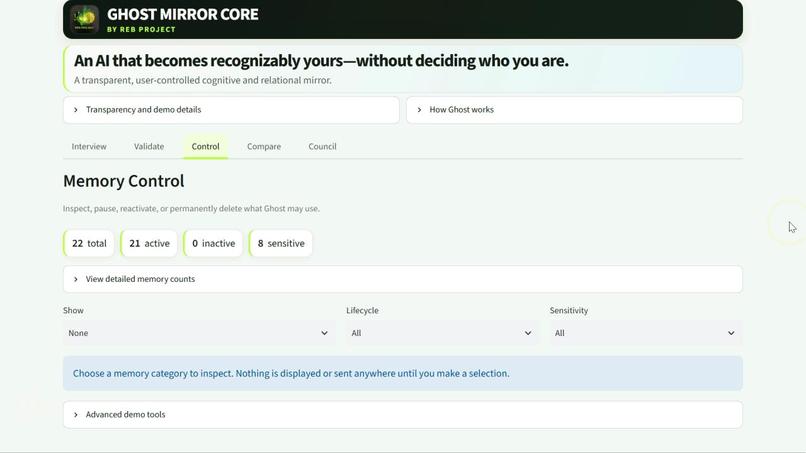
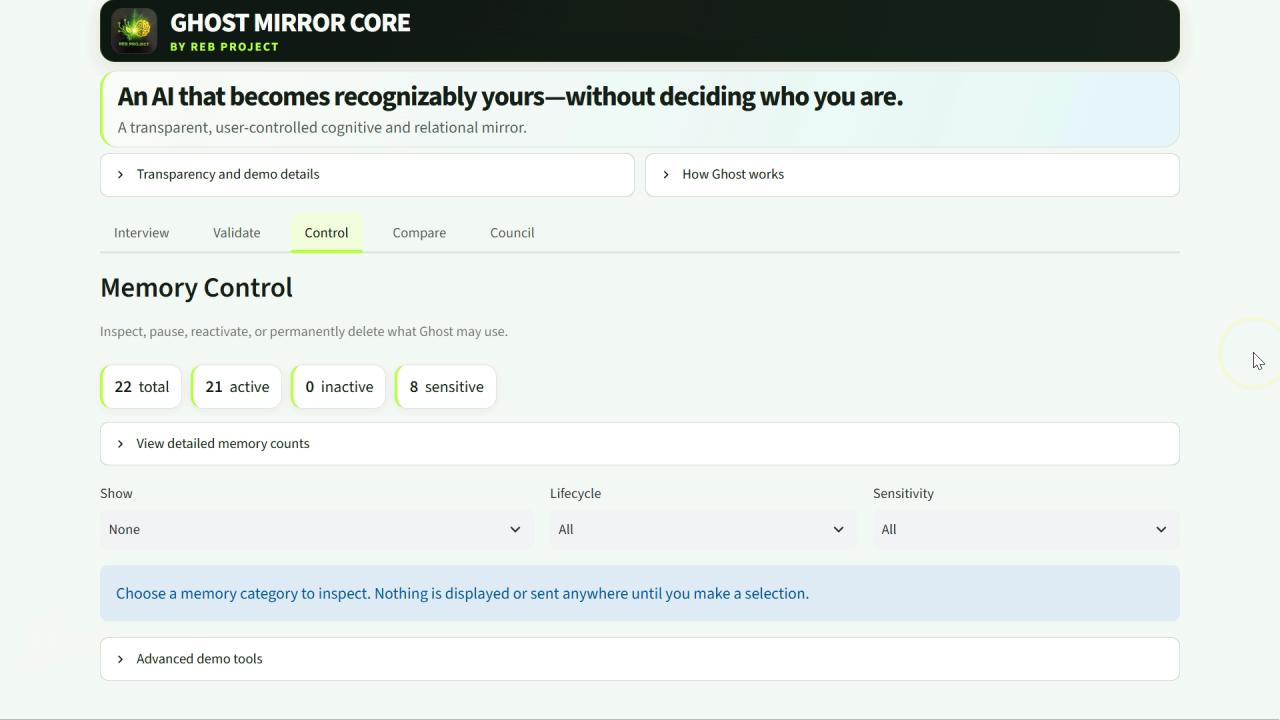
Memory Control — inspect, deactivate, reactivate, or delete every record.
Inspiration
Most AI systems can remember information about a user. But memory is not identity, and personalization becomes dangerous when an AI silently decides what a person is.
GHOST MIRROR CORE began with a different question:
What deserves to shape an AI’s understanding of a person—and who should remain in control of that meaning?
I wanted to build an AI memory system that could become recognizably personal without claiming authority over the user. A system where memories, interpretations, and deductions remain visible, correctable, reversible, and owned by the person they describe.
What it does
GHOST MIRROR CORE is a transparent, user-controlled cognitive and relational mirror.
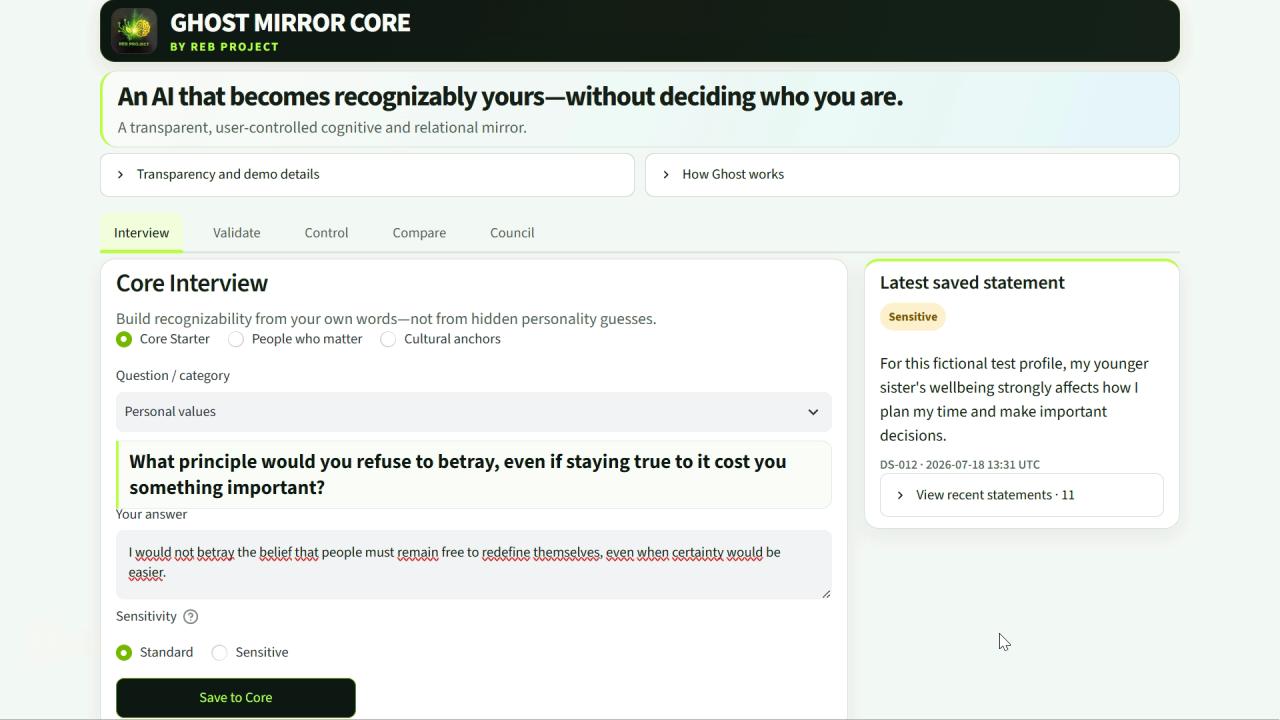
It separates memory into inspectable records with provenance, lifecycle state, sensitivity, and user approval. The user can:
- intentionally save direct statements;
- review AI-generated deductions before they become active;
- approve, edit, reject, or defer those deductions;
- inspect, deactivate, reactivate, or permanently delete memories;
- see exactly which records influenced an AI response;
- keep sensitive memories out of a request unless they are explicitly selected.
No deduction becomes identity without an explicit user decision.
Compare
Compare tests whether personalization produces a meaningful and observable difference.
It sends the same question to GPT-5.6 through three independent, stateless calls:
- A — Generic AI: question only;
- B — Memory-aware AI: question plus selected, approved memory;
- C — Full Ghost: the same question and memory as B, plus the Voice of Ghost.
A Transparent Context Matrix shows exactly what each response receives. The answers are generated live and may vary between runs. The purpose is not to reproduce a predetermined answer, but to make the effect of context visible, comparable, and open to inspection.
Council
Council separates independent advice from final synthesis.
Gemini and GPT-5.6 examine the same question independently. Only afterward does GPT-5.6 create the final Ghost synthesis, receiving the Voice of Ghost exclusively at that last stage.
A second context matrix exposes the provider, model, context, token usage, and latency for every stage. Adviser contributions remain visibly separate from the final Ghost response.
How I built it
GHOST MIRROR CORE is a Python and Streamlit application with local persistent storage and explicit memory-governance rules. GPT-5.6 powers the live Compare workflow, acts as an independent Council adviser, and produces the final Ghost synthesis. Gemini provides a second independent perspective in Council.
The submitted application is a separate Build Week extension of my earlier Ghost research. The earlier work explored the idea of a personal cognitive mirror; during Build Week, that research became a focused, testable prototype centered on consent, provenance, transparent comparison, and user control.
How I used Codex
Codex helped transform my earlier research into this separate, working Build Week extension.
It accelerated the implementation and verification of:
- three independent and stateless Compare calls;
- the Transparent Context Matrix;
- separate Council adviser and synthesis stages;
- inspectable memory provenance and lifecycle controls;
- validation and safety checks around selected and sensitive records;
- a clearer interface for demonstrating the system live.
The key design decision was to make personalization testable rather than merely claimed. Codex helped turn that principle into working architecture and an auditable demonstration.
Challenges
The greatest challenge was not generating a personalized answer. It was preventing personalization from becoming hidden authority.
I had to preserve distinctions between:
- the user’s direct words and later interpretations;
- approved memories and inactive deductions;
- recognition and impersonation;
- continuity and identity;
- care and control.
Another challenge was designing a fair comparison in which A, B, and C receive the same question and use the same model while differing only in their visible context.
What I learned
I learned that trustworthy AI memory requires more than accuracy.
It requires provenance, uncertainty, correction, revocation, sensitivity controls, and the continuing freedom of the user to change.
The central principle of Ghost is:
An AI may carry forward some of a person’s chosen commitments. It must never claim to carry forward the person.
Ghost does not promise digital immortality, a preserved soul, or copied consciousness. Its purpose is the responsible continuity of meaning without turning memory into authority.
What’s next
The next steps include stronger local encryption, user-controlled export and portability, richer retrieval evaluation, additional accessibility options, and long-term testing with diverse users.
GHOST MIRROR CORE is the first public expression of a broader REB Project vision:
extending human possibility without surrendering human agency.


Log in or sign up for Devpost to join the conversation.