-
-
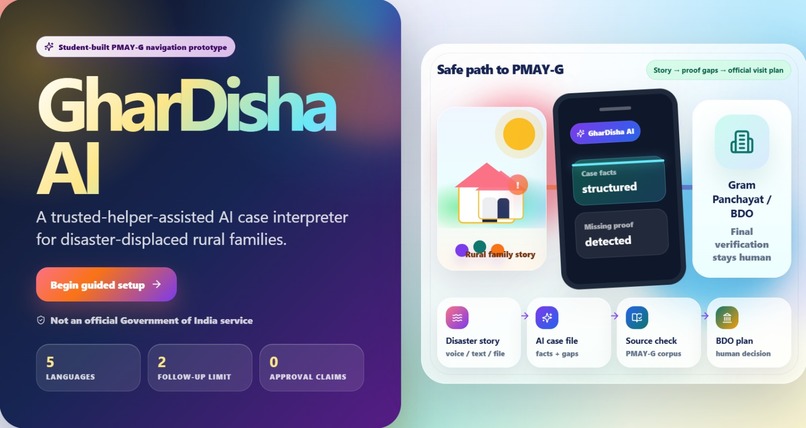
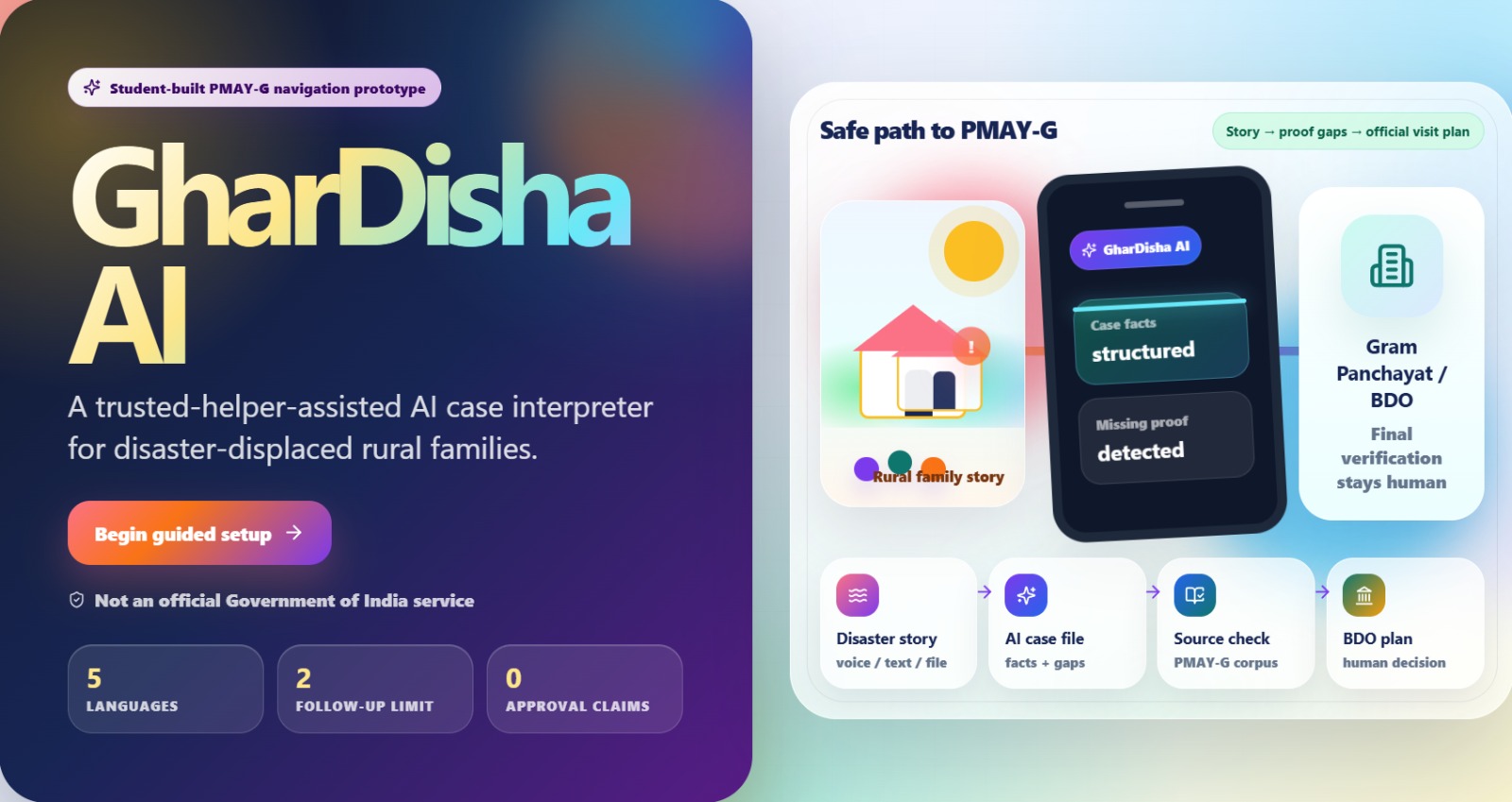
Cover / Hero screenshot
-
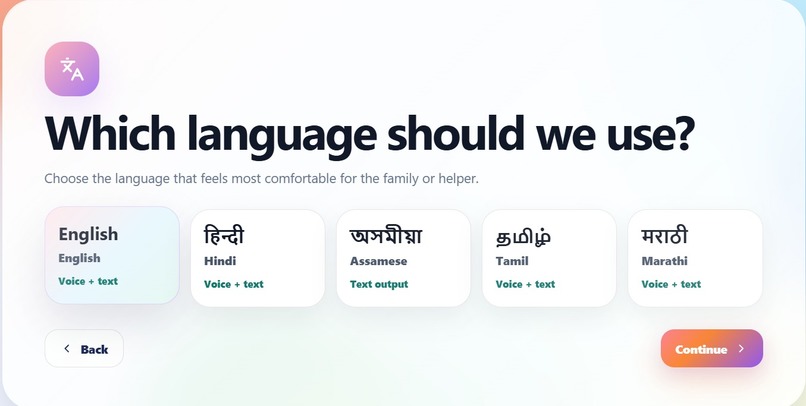
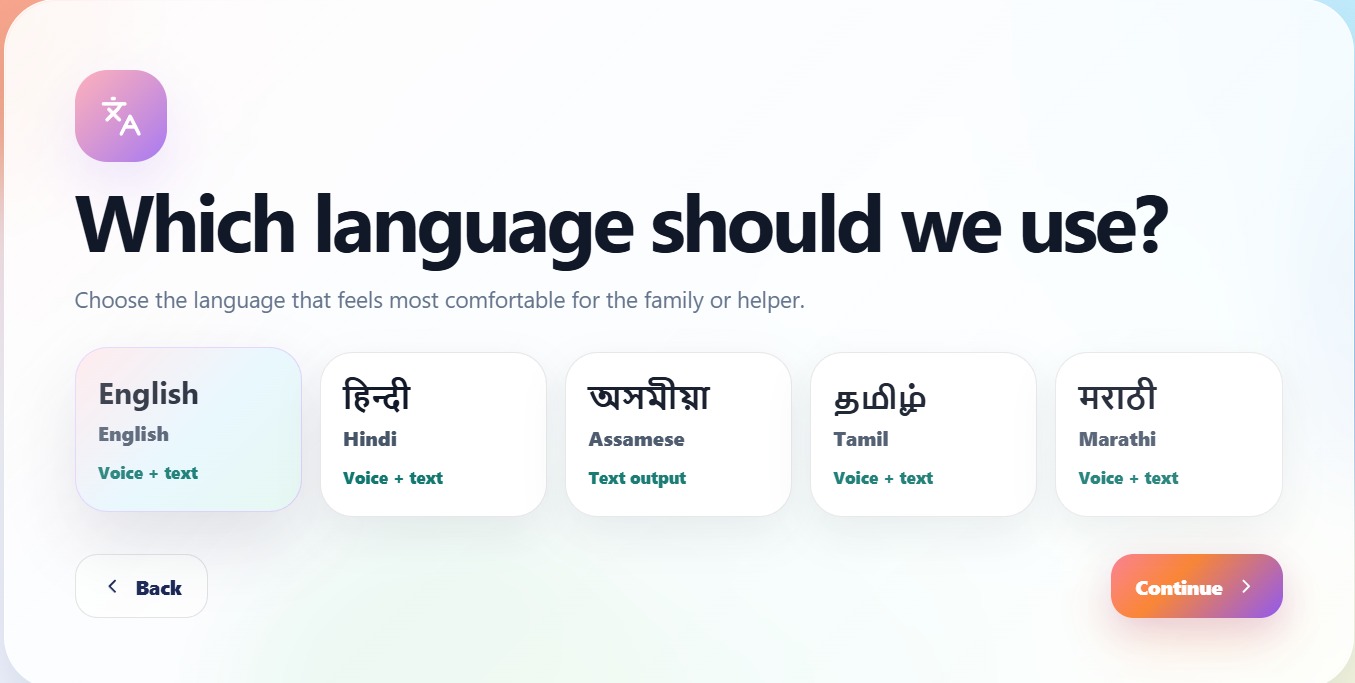
Available language options
-
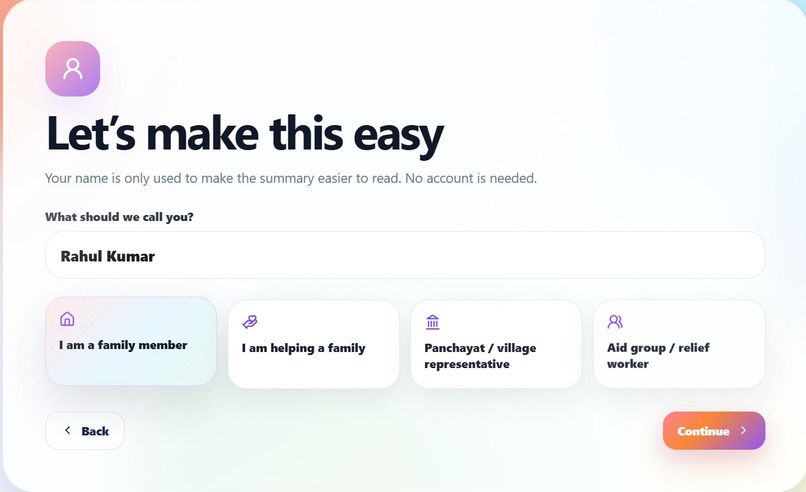
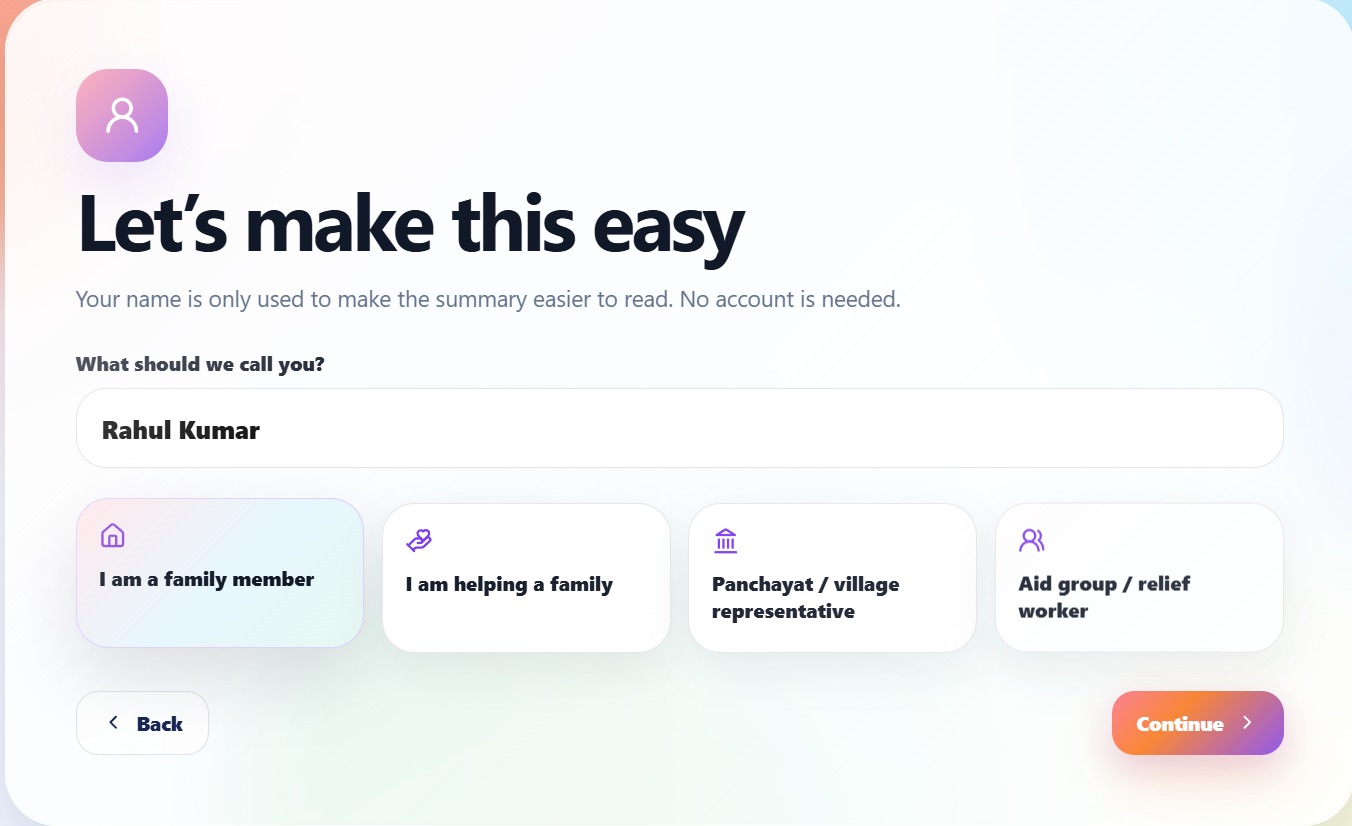
Role/Helper option
-
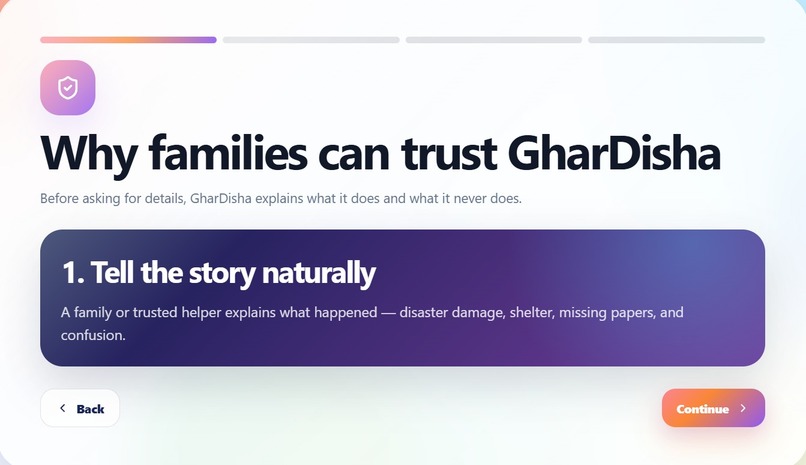
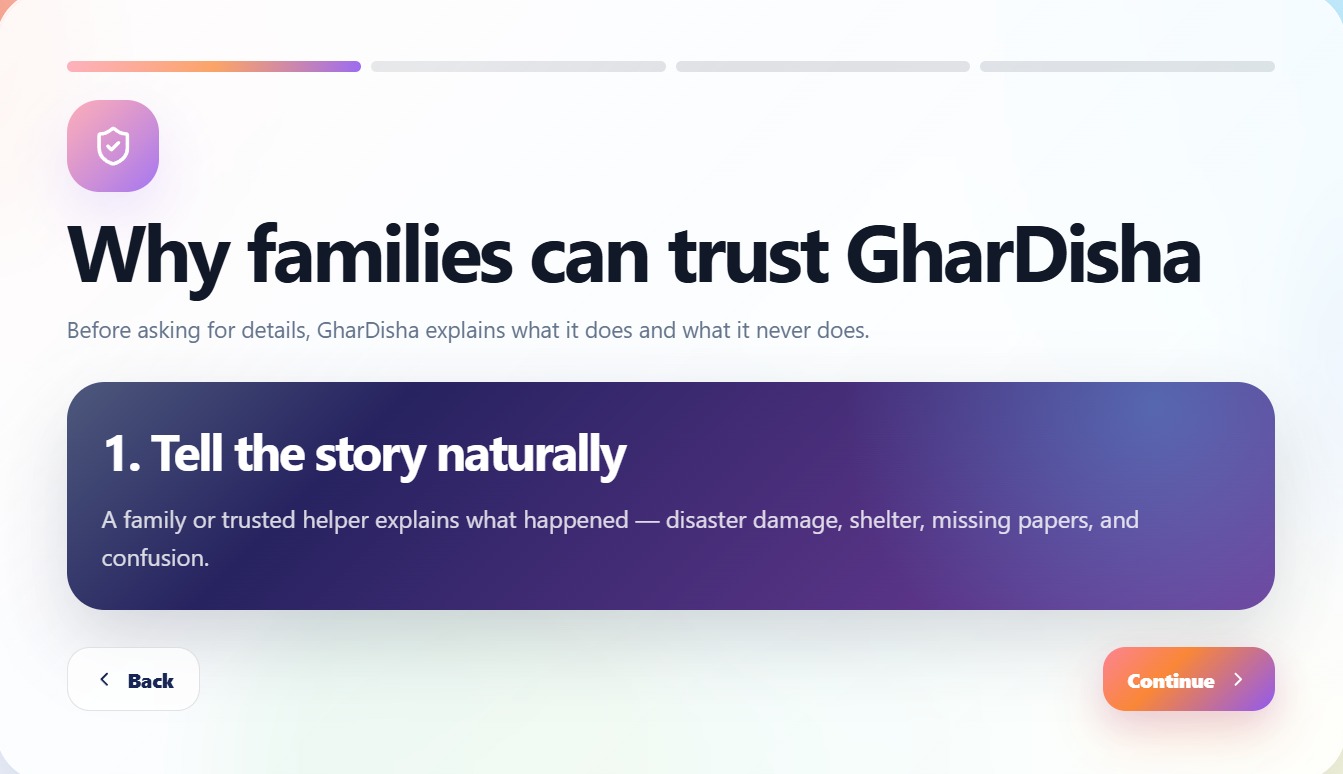
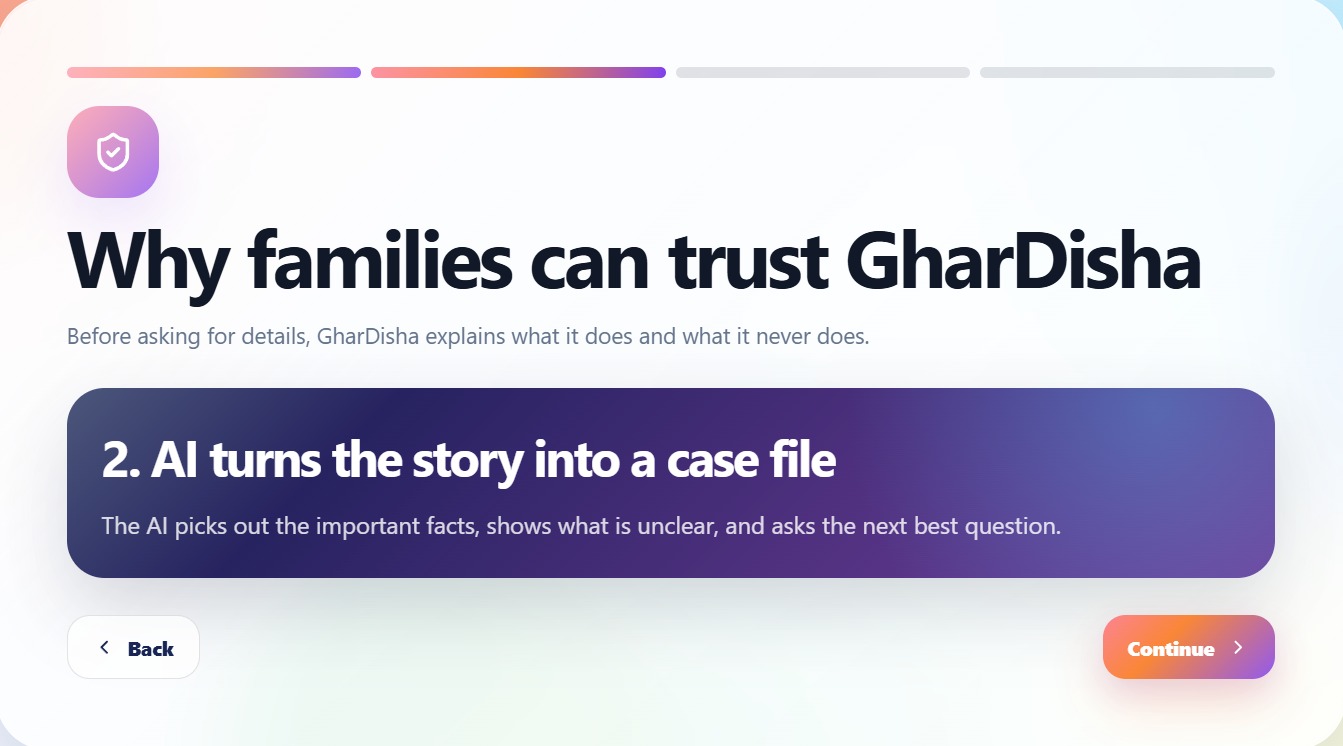
System guidelines 1
-
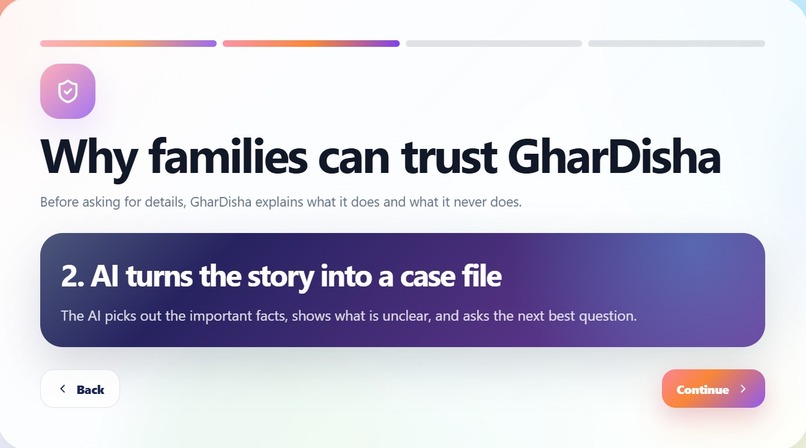
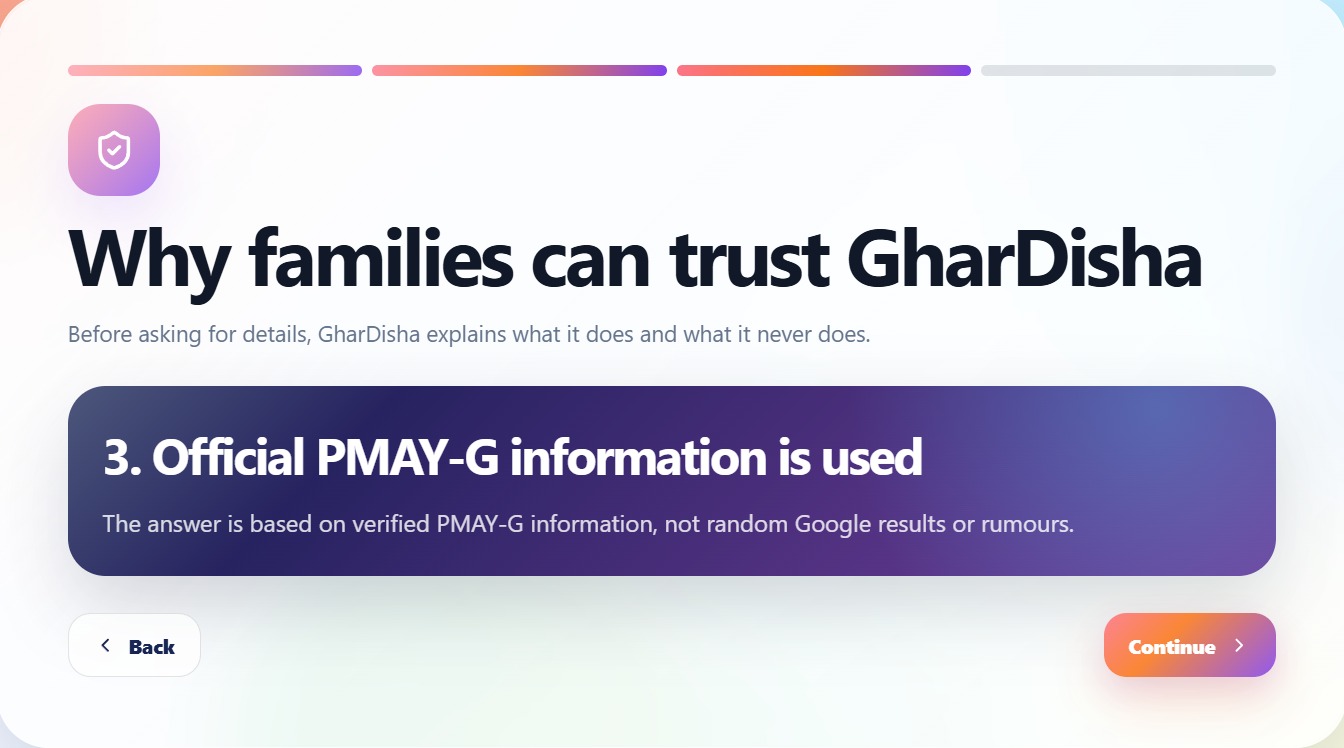
System guidelines 2
-
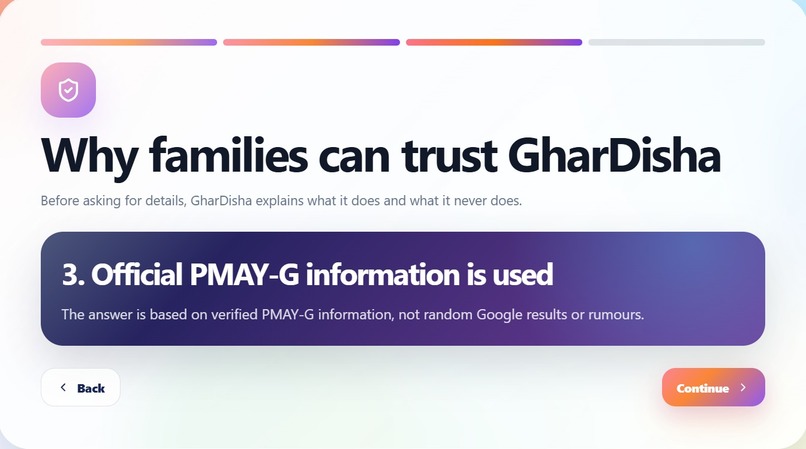
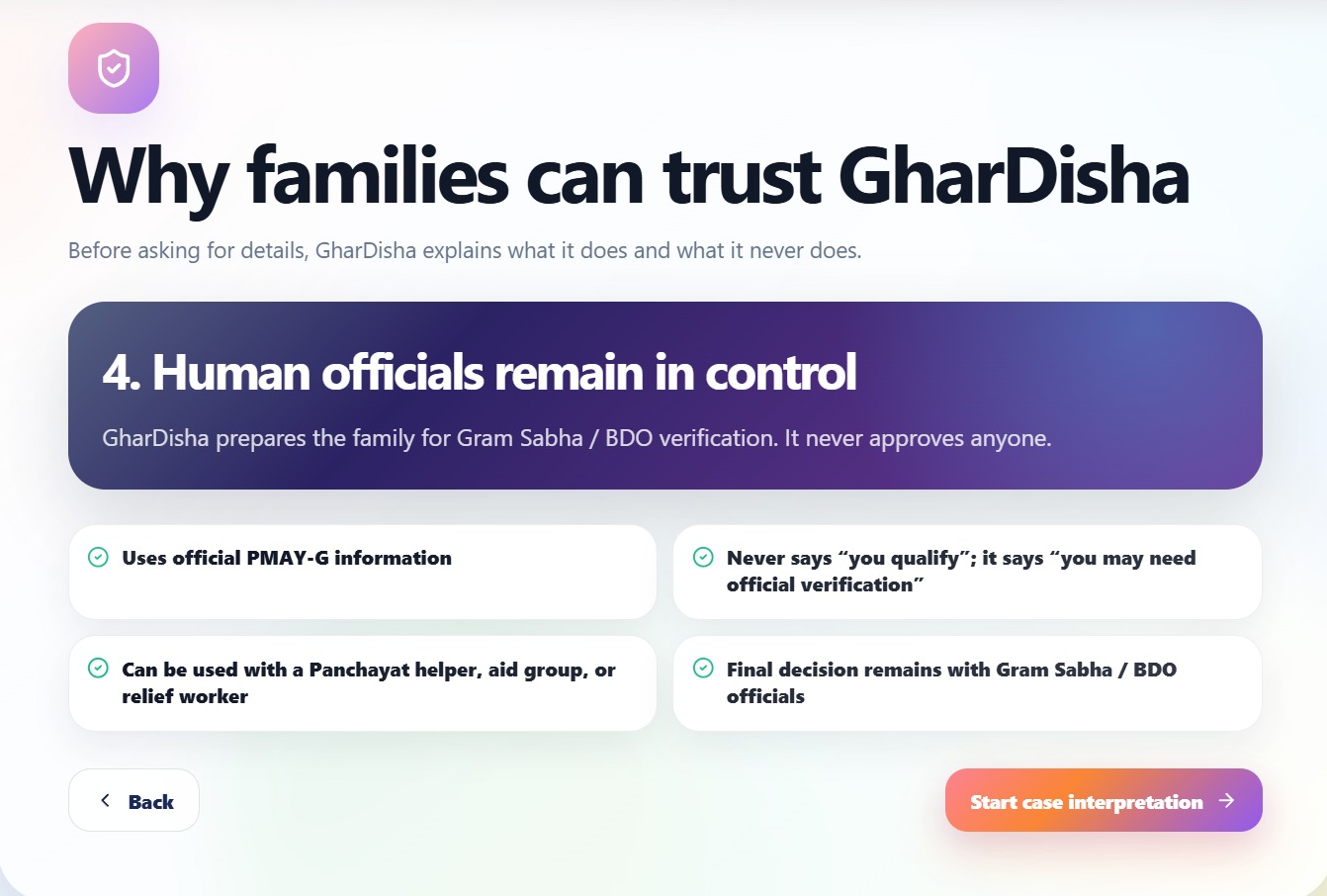
System guidelines 3
-
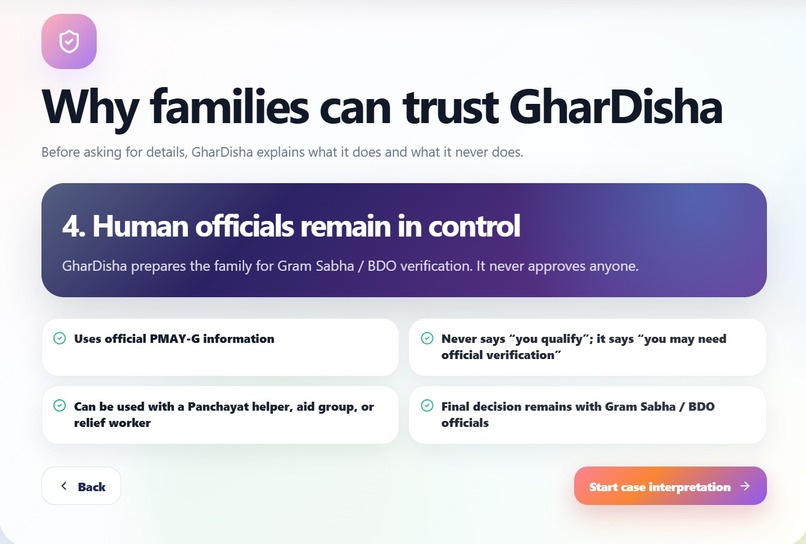
System guidelines 4
-
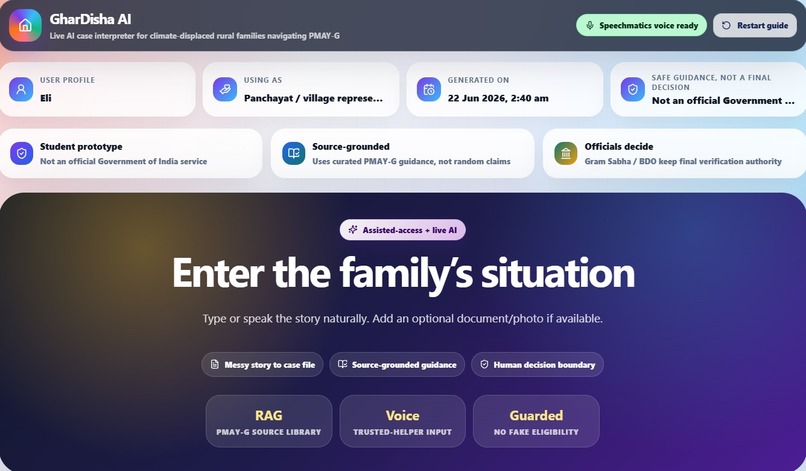
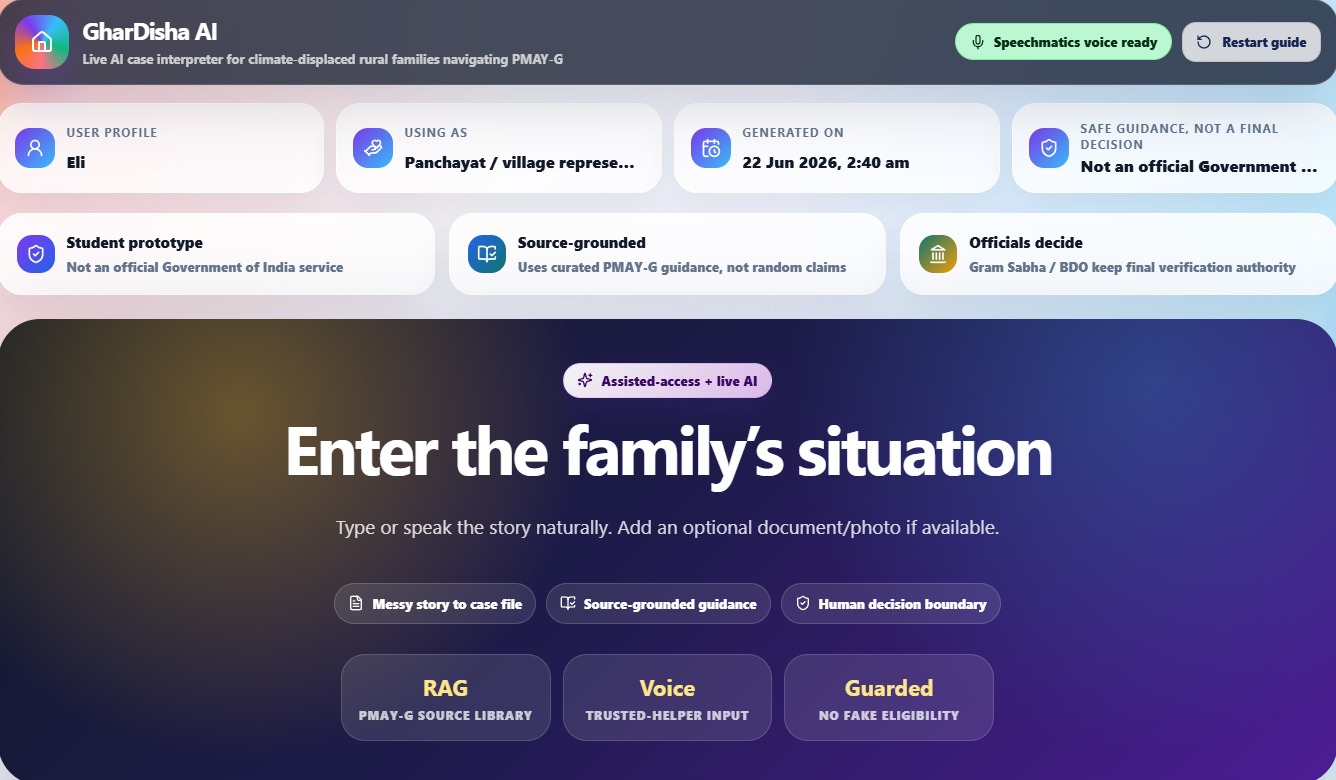
Main page
-
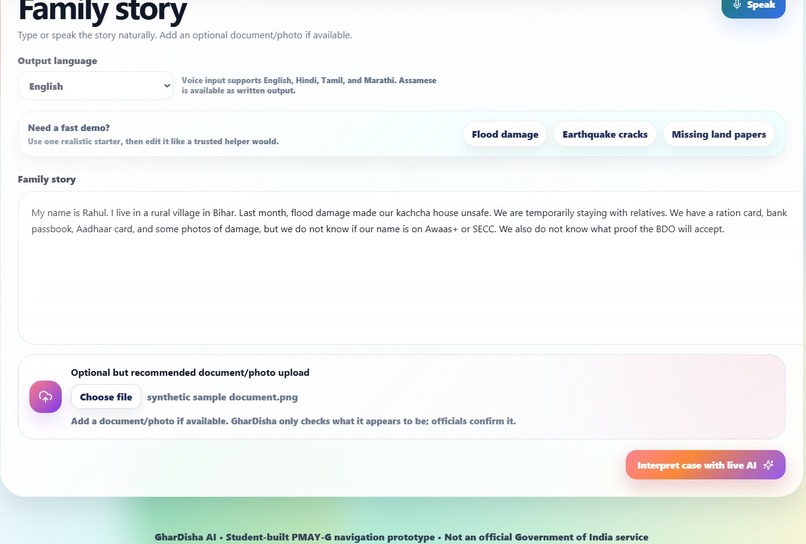
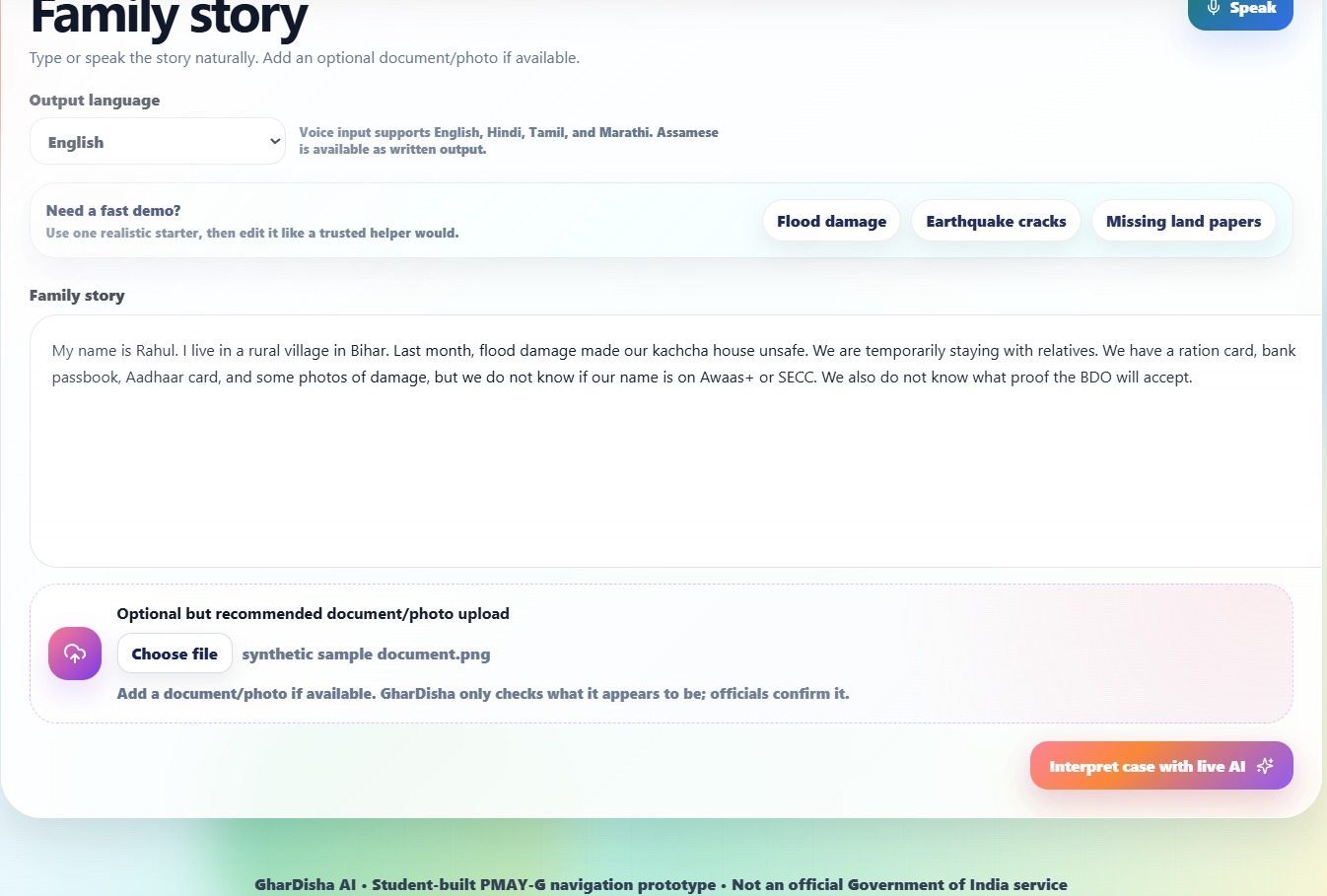
Story Input/Upload document Screen
-
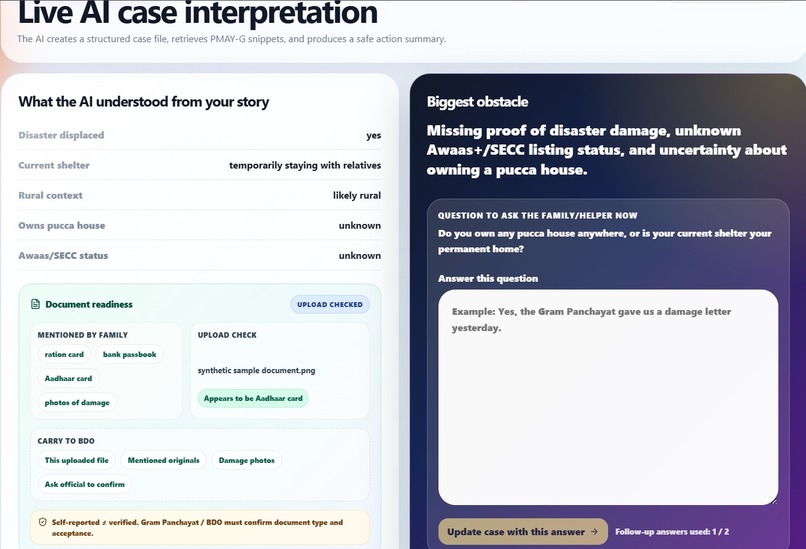
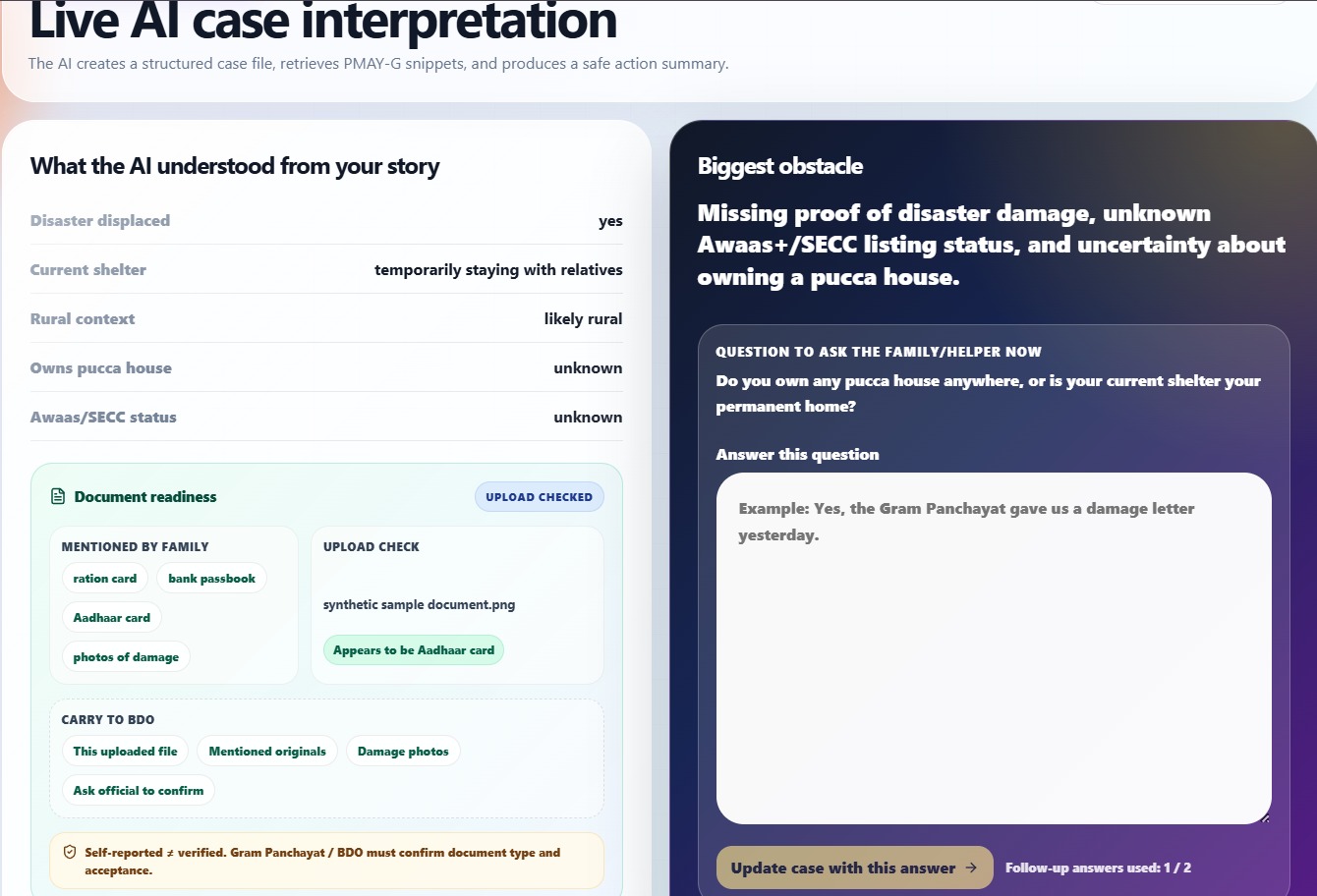
AI result: case facts + biggest obstacle
-
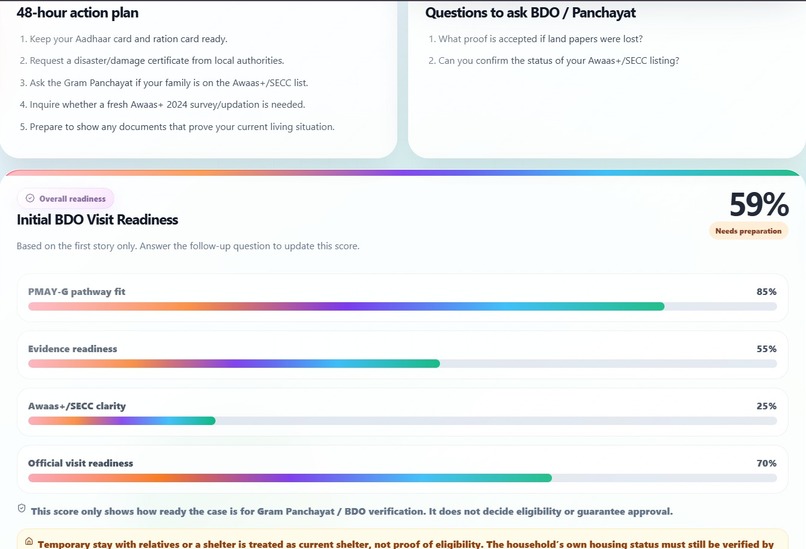
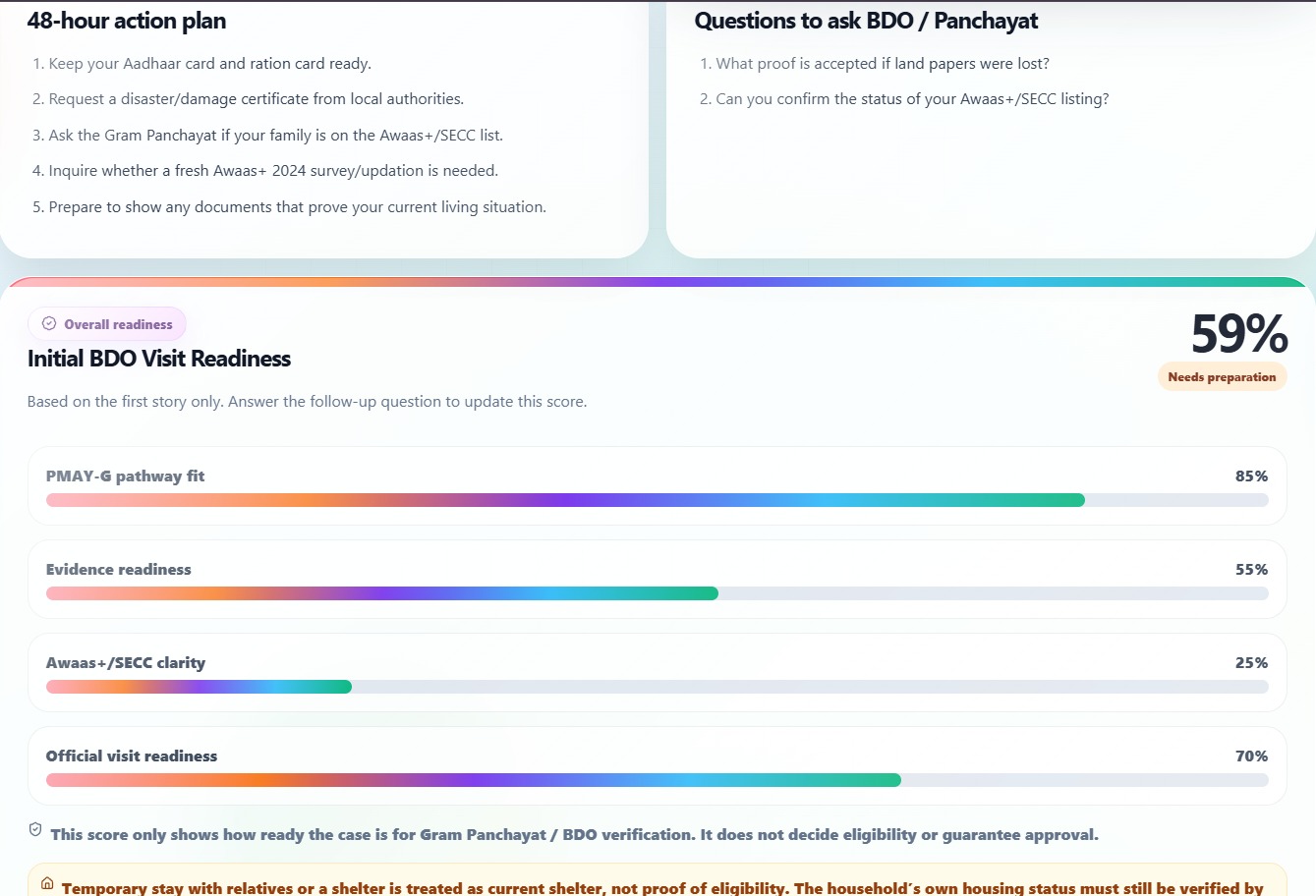
Readiness score
-
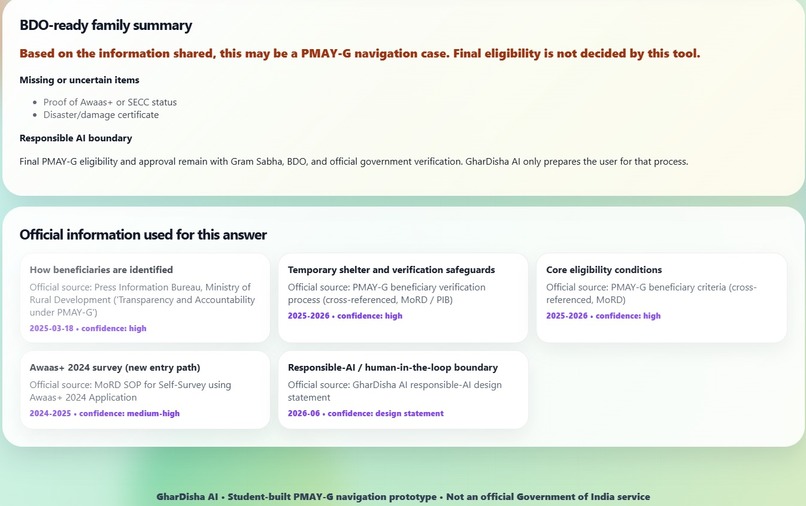
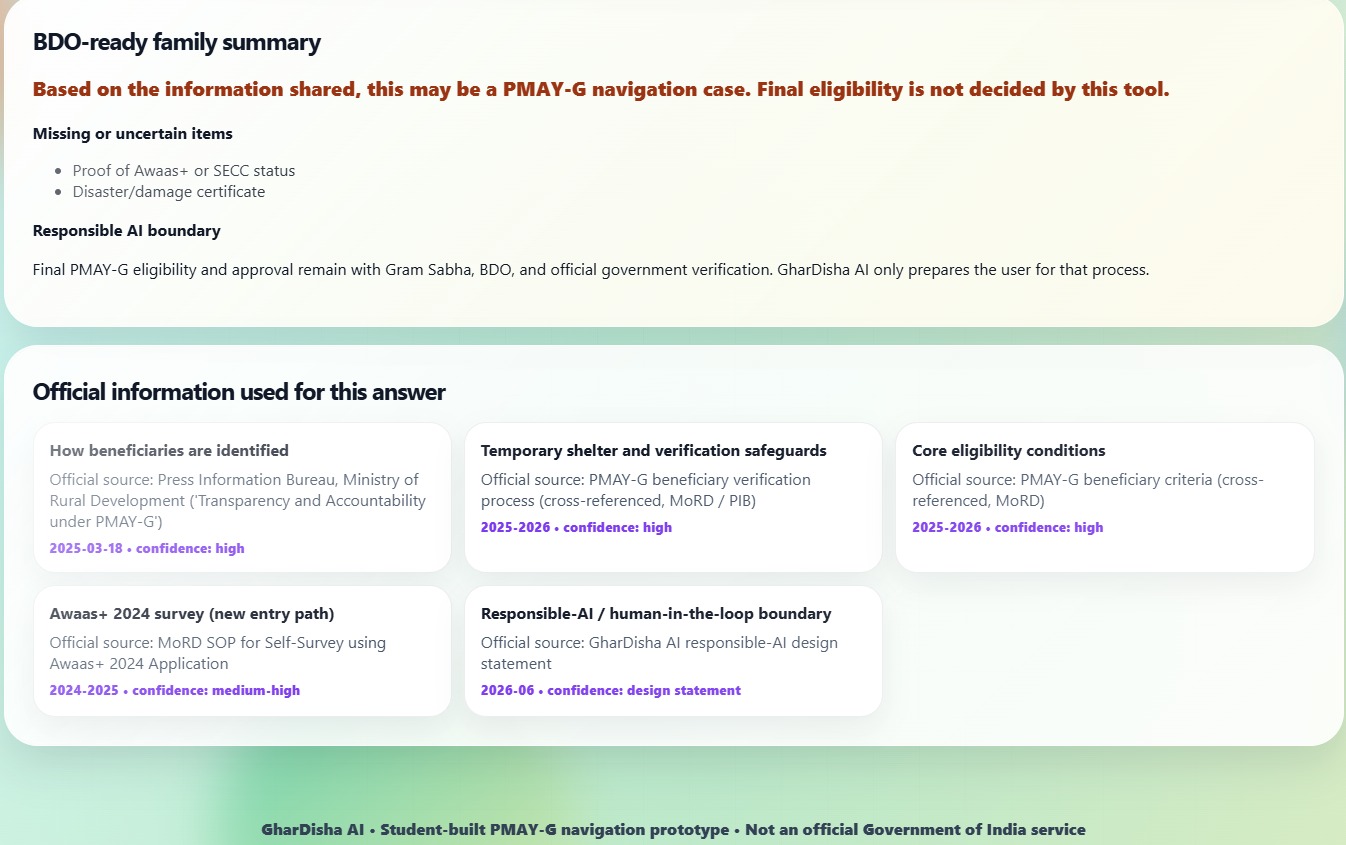
BDO-ready action plan
Inspiration
GharDisha AI was inspired by a very practical public-service problem: after disasters such as floods, earthquakes, land cracks, or storms, rural families often know that their housing situation is urgent, but they do not always know how to explain their case clearly to the Gram Panchayat or BDO office.
For many families, the real challenge is not only damage to the house. It is confusion around proof, documents, Awaas+ / SECC listing status, temporary shelter, land papers, and what questions to ask during official verification.
We wanted to build an AI system that does not replace government decision-making, but helps families and trusted helpers prepare for it responsibly.
What it does
GharDisha AI is a trusted-helper-assisted AI case interpreter for disaster-displaced rural families navigating PMAY-G preparation.
A user can enter a messy family story in natural language, optionally upload a document or photo, and choose a preferred language. The system then converts that story into a structured case file showing:
- what the AI understood from the story,
- whether the family appears disaster-displaced,
- where they are currently staying,
- available documents,
- missing or uncertain proof,
- the biggest obstacle before visiting officials,
- a targeted follow-up question,
- a 48-hour action plan,
- questions to ask the Gram Panchayat or BDO, and
- a BDO-ready family summary.
The system also includes a BDO Visit Readiness score. This score does not decide eligibility. It only shows how prepared the case is for official verification.
GharDisha AI is also designed as a mobile-accessible responsive web application. It is not a native Android or iOS app, but it can be opened through a browser link on desktop or mobile devices. This supports a trusted-helper-assisted access model, where a family member, Panchayat representative, NGO worker, relief volunteer, or local digital service center can help a rural family use the system without requiring a laptop or app-store installation.
How we built it
We built GharDisha AI as a full-stack web prototype.
The frontend is built with React, Vite, JavaScript, CSS, and Lucide icons, with a responsive web interface designed for both desktop and mobile browser access. It includes a guided trust onboarding flow, multilingual UI, story input, document/photo upload, demo starter examples, follow-up questions, readiness visualization, and source cards.
The backend is built with FastAPI and Python. It handles story analysis, optional file upload, document/photo interpretation, PMAY-G source retrieval, AI reasoning, and safety verification.
The AI reasoning layer uses live AI/ML API calls to extract structured case facts and generate safe action plans. Speechmatics support is included for voice-ready interaction. The PMAY-G knowledge base is used as a curated RAG-style grounding layer so the system stays focused on source-grounded guidance instead of unsupported claims.
Challenges we ran into
The biggest challenge was balancing usefulness with safety. A normal AI assistant might accidentally overclaim eligibility or give generic advice. For this project, that would be dangerous and unrealistic.
We had to design the system so that it helps the family prepare without pretending to be the authority. Another challenge was making the interface simple enough for trusted helpers, while still showing enough technical depth for a hackathon demo.
We also worked on multilingual support, document/photo upload, source-grounded responses, follow-up limits, and a readiness score that clearly avoids being confused with an eligibility score.
Accomplishments that we're proud of
We are proud that GharDisha AI now demonstrates a complete responsible public-service AI workflow:
- messy family story to structured case facts,
- document/photo-aware analysis,
- curated PMAY-G source grounding,
- targeted follow-up questions,
- BDO-ready action planning,
- readiness scoring,
- multilingual interface,
- voice-ready interaction, and
- safety-first AI behavior.
The project shows that AI can be useful in public-service navigation without replacing human officials or creating false expectations.
What we learned
We learned that building AI for public services is not just about generating answers. It requires careful product design, safety boundaries, source grounding, user trust, and clarity about who makes the final decision.
We also learned that the best AI systems for vulnerable communities should support trusted human helpers, not remove them from the process.
What's next for GharDisha AI
Future improvements could include:
- expanding to more Indian languages,
- improving OCR for scanned documents,
- adding exportable PDF summaries for BDO visits,
- creating a Panchayat/helper dashboard,
- expanding the PMAY-G knowledge base,
- adding offline-first assisted access, and
- improving audit logs for responsible AI review.
GharDisha AI is a student-built prototype, but it shows how AI can help disaster-displaced rural families become better prepared for official housing-support verification.
Built With
- ai/ml-api
- css
- curated-pmay-g-json-knowledge-base
- fastapi
- github
- javascript
- lucide-react
- mobile-browser-support
- pydantic
- python
- react
- render
- responsive-web-design
- speechmatics-api
- trusted-helper-access
- uvicorn
- vercel
- vite

Log in or sign up for Devpost to join the conversation.