-
-
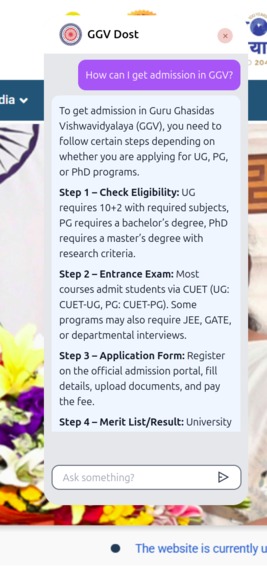
Chat example of the GGV DOST
-
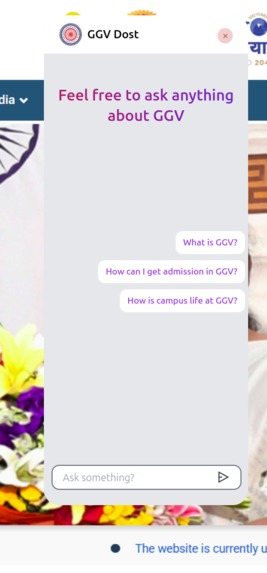
The interface of the GGV DOST
-

Icon of the GGV DOST
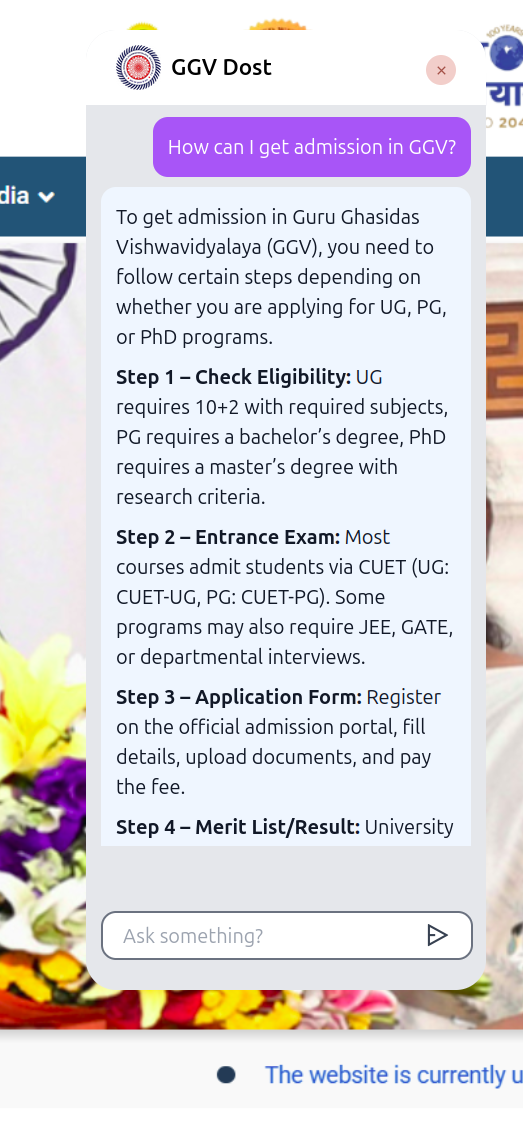
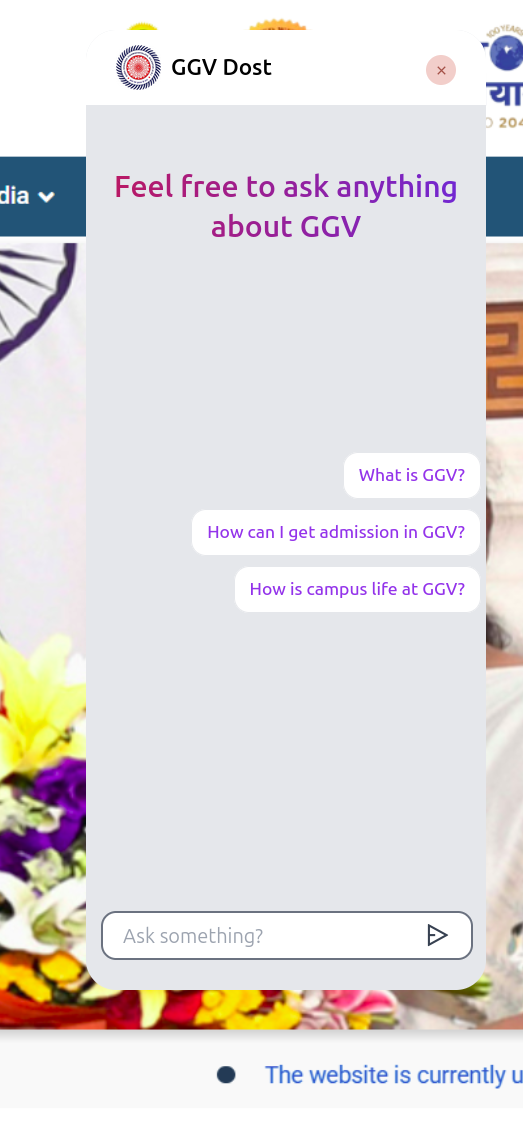

GGV DOST — Data-Driven Onboarding Support Tool
Inspiration
Guru Ghasidas Vishwavidyalaya’s website contains a wealth of academic and administrative information, but it is spread across hundreds of webpages, notices, and PDFs. As students, we often found ourselves manually searching through multiple links just to answer simple questions like deadlines, procedures, or eligibility criteria.
This friction inspired us to ask a simple question:
What if the entire university website could be queried like a conversation?
That idea became GGV DOST — an AI-powered conversational assistant designed to simplify information access for students and staff.
What We Built
GGV DOST is a smart chatbot that centralizes official university information and delivers accurate, context-aware answers using semantic search and Retrieval-Augmented Generation (RAG).
Instead of keyword-based searching, users can ask questions naturally and receive direct, trustworthy responses grounded in official data sources.
How We Built It
The project was designed as a production-style AI pipeline, even though this is a hackathon MVP.
1. Data Collection & Processing
- Scraped official university webpages
- Cleaned and converted raw HTML into structured text
- Applied semantic chunking to store information in context-aware units
2. Semantic Search
- Converted documents and queries into vector embeddings using Gemini embeddings
- Stored embeddings in a MongoDB vector database
- Retrieved the most relevant chunks using Top-K vector similarity search
Mathematically, similarity is computed using cosine similarity:
[ \text{similarity}(q, d) = \frac{q \cdot d}{|q| |d|} ]
where ( q ) is the query embedding and ( d ) is a document embedding.
3. Answer Generation (RAG)
- Retrieved content is injected into prompts
- A Gemini LLM generates answers strictly grounded in retrieved data
- This minimizes hallucinations and improves trustworthiness
4. System Architecture
- Frontend: React-based conversational UI
- Backend: FastAPI for request handling and AI orchestration
- Deployment: Dockerized services running on Google Cloud Run
What We Learned
- How semantic search is fundamentally different from keyword search
- Designing and implementing a Retrieval-Augmented Generation (RAG) pipeline
- Building an end-to-end AI system: from data ingestion to cloud deployment
- The importance of grounding LLM responses in verified data
- How to balance technical depth with usability in real-world systems
Challenges We Faced
- Data inconsistency: University webpages vary widely in structure and formatting
- Chunking strategy: Finding the right balance between context size and retrieval accuracy
- Time constraints: Building a full pipeline within a hackathon timeline
- Scope control: Prioritizing core functionality over polish and extra features
Despite these challenges, we successfully built a functional prototype with the core system working end to end.
What’s Next
- Expand data coverage to include PDFs and notices
- Add multilingual support
- Improve response explainability with source citations
- Deploy the system campus-wide and adapt it for other universities
Conclusion
GGV DOST demonstrates how AI can transform fragmented institutional information into a single, intelligent conversational experience. While this is an MVP, the foundation is scalable, extensible, and impactful — making information access faster, simpler, and smarter.

Log in or sign up for Devpost to join the conversation.