Agents submission reference id's -> 2da3207f-fc15-4364-86ef-4b7e05c23fdc , 0eb466e6-e050-4f68-9e51-d7371cd19008, b35f581c-19f2-47dc-a7c0-cd374578d418, 56a0bb1c-6554-4272-bb5f-18866afd51b9, 133d80f6-30ea-4fac-bba2-f5b3b2f4bd59 .
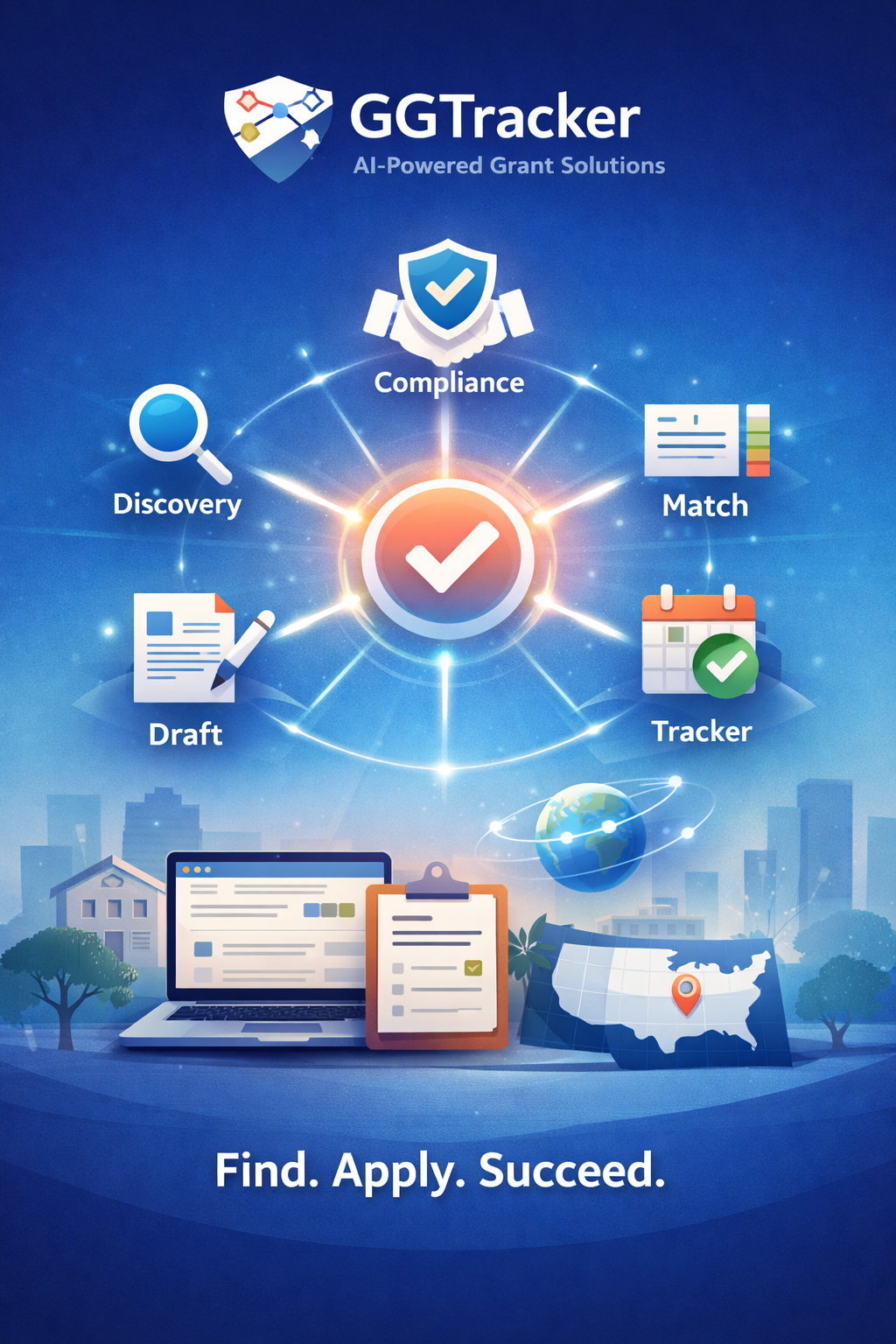
GGTracker is an AI-powered grant discovery and application platform built for U.S. nonprofits and NGOs. We designed it to solve a real workflow problem: finding the right grants is slow, matching is noisy, compliance checks are fragmented, drafting takes too long, and deadlines slip through the cracks. GGTracker turns that scattered process into one connected workspace powered by 5 Airia agents: Discovery, Match, Compliance, Draft, and Tracker.
Instead of acting like a generic chatbot, GGTracker behaves like a grant operations copilot. It helps organisations build a profile, discover relevant opportunities, understand why they match, generate editable application drafts, and track next steps through to submission.
This will be extended to India and other countries in future updates.
Inspiration
Nonprofits do incredibly important work, but funding workflows are still painfully manual. Teams spend hours digging through grant portals, reviewing eligibility, rewriting similar application sections, and trying not to miss deadlines. Smaller organisations are hit the hardest because they often do not have a dedicated grant operations team.
We were inspired by the idea that AI should not just answer questions, it should reduce operational friction in high-impact work. We wanted to build something that feels like real software for nonprofit teams, not just a demo prompt box. The Airia hackathon was the perfect fit because the product naturally maps to multiple specialized agents working together across one workflow.
What it does
GGTracker helps nonprofit teams go from organisation profile to active application pipeline.
It allows users to:
create an organisation profile with mission, budget, NTEE focus, and service geography run an AI-powered grant search using Airia agents see matched grants ranked by fit score review compliance and eligibility signals before investing time generate structured draft sections for applications edit those drafts in a human-in-the-loop workflow approve applications and turn them into deadline-based tracked work monitor upcoming deadlines in both list and calendar views The platform is built around 5 Airia agents:
Discovery Agent: understands the organisation and frames search direction Match Agent: scores grants against mission, geography, and budget Compliance Agent: flags eligibility and readiness risks Draft Agent: produces the first pass of the application content Tracker Agent: creates milestones and next steps after approval How we built it We built GGTracker as a full-stack monorepo with a strong separation between product experience, backend orchestration, and agent execution.
Frontend:
React + Vite + TypeScript Tailwind CSS + shadcn/ui TanStack Query for fetching and polling React Hook Form + Zod for form flows Recharts and Framer Motion for polished product UX Backend:
Node.js + Express + TypeScript Prisma ORM Neon PostgreSQL as the main database pgvector for semantic grant pre-ranking JWT auth PostgreSQL-backed async job tracking with no Redis required AI and data layer:
Airia is the core orchestration layer for the 5 product agents Grants.gov is used as the source of grant opportunity data SAM.gov is used for verification/compliance context Gemini is used for embeddings and limited local fallback behavior One of the most important architectural decisions was to keep all agent execution on the backend. The frontend never calls Airia directly. Instead, the backend creates async jobs in PostgreSQL, triggers the right Airia pipeline, stores the result, and lets the frontend poll progress. That gave us a clean and demo-friendly “agents at work” experience while keeping the system simple and reliable.
Challenges we ran into
One of the biggest challenges was making the Airia integration production-like instead of fake. Airia is not a generic LLM API, so we had to align the backend with the actual interface format, pipeline IDs, request shape, and auth headers instead of guessing.
Another major challenge was getting structured output right. For the product to feel reliable, each agent had to return consistent JSON that the backend could trust. That meant tightening prompts, defining schemas carefully, and iterating until the outputs were stable enough for real UI flows.
We also ran into challenges around:
making the 5-agent workflow feel cohesive instead of disconnected building async background jobs without adding queue infrastructure improving relevance by combining semantic ranking with direct scoring logic keeping the UX polished while still shipping end-to-end functionality handling local environment issues like CORS, API setup, and service configuration cleanly for demo readiness Accomplishments that we're proud of We are proud that GGTracker feels like a real product, not just a prototype with AI attached.
A few things we are especially proud of:
building an Airia-first workflow with 5 distinct agents tied directly to product behavior creating a polished end-to-end UX from onboarding to tracking making the “Find Grants” experience feel like a true demo moment with visible agent progress turning matched opportunities into persistent application records instead of one-off search results supporting human-in-the-loop editing instead of pretending AI should submit everything automatically keeping infrastructure simple with PostgreSQL-backed async jobs instead of adding Redis or queue services writing beginner-friendly setup documentation so the project is understandable beyond the demo video What we learned We learned that good AI products are not just about model outputs, they are about orchestration, reliability, and user confidence.
A few key lessons stood out:
structured output matters more than clever prompting when AI has to drive real UI workflows agent architecture is much clearer when each agent has one visible responsibility users trust AI more when they can see why something matched, why something failed, and what they can edit human-in-the-loop design is essential in grant workflows, especially around compliance and application drafting strong product UX can make complex multi-agent systems understandable even for non-technical users We also learned how important it is to align implementation with the real platform docs when integrating a system like Airia. That discipline made the product far more stable.
What's next for GGTracker We see GGTracker as the foundation for a much broader nonprofit funding operations platform.
Next steps include:
deeper compliance intelligence using richer eligibility parsing attachment and document management for full application packages collaborative review workflows for teams and approvers automatic reminder delivery and submission readiness alerts stronger semantic matching across larger grant datasets richer analytics around pipeline health, deadlines, and win rates submission export workflows tailored to real grant requirements improved production deployment, monitoring, and role-based access Longer term, we want GGTracker to become the operating system for nonprofit grant teams: discover, qualify, write, review, submit, and track funding work in one place.
Why GGTracker Matters
GGTracker is not just an AI demo. It is a focused attempt to use AI where operational complexity blocks mission-driven work. Nonprofits should spend more time delivering impact and less time fighting fragmented funding workflows. By combining agent orchestration, semantic search, human review, and deadline management, GGTracker shows how AI can act as infrastructure for real-world social impact teams.
Geographic expansion
GGTracker launched with the US market because Grants.gov provides an open, zero-auth API with 15,000+ active federal opportunities — the fastest path to a working demo with real data. As an Indian founder, the longer-term goal is to bring GGTracker to India, where 3.3 million registered NGOs face the same workflow problems with far less tooling support. The India roadmap includes DBT Bharat scheme data, CSR funding portals (where corporates are mandated to deploy ₹25,000+ crore annually), and NGO-DARPAN integration. Beyond India, the agent architecture is data-source agnostic — any country with structured grant data can be added as a new Discovery layer without changing the core product.
Built With
- airia
- next.js
- node.js
- typescript


Log in or sign up for Devpost to join the conversation.