-
-
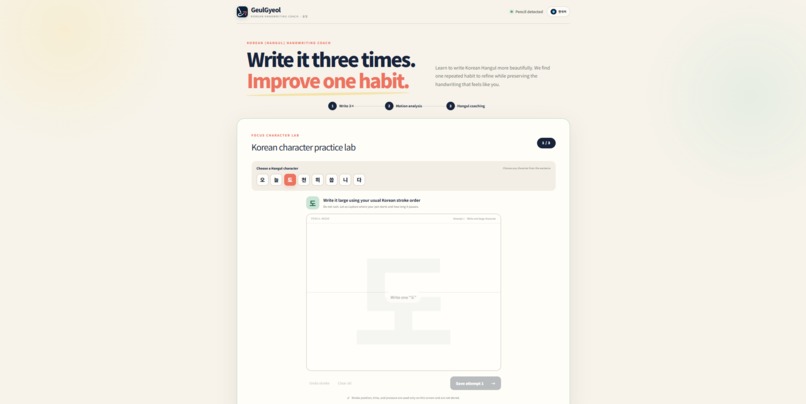
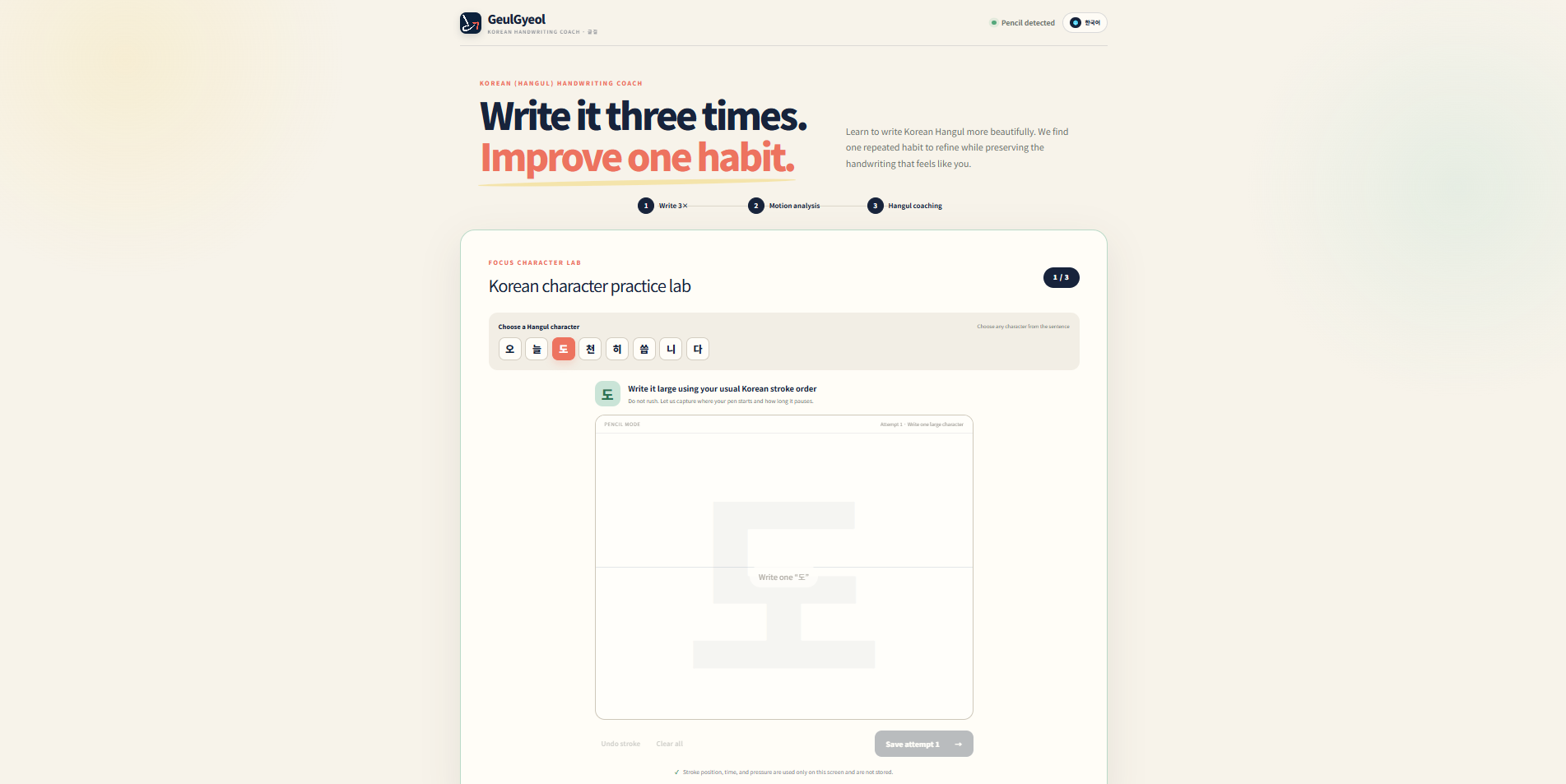
Choose a Hangul character and practice writing it three times with a pen or touchscreen.
-
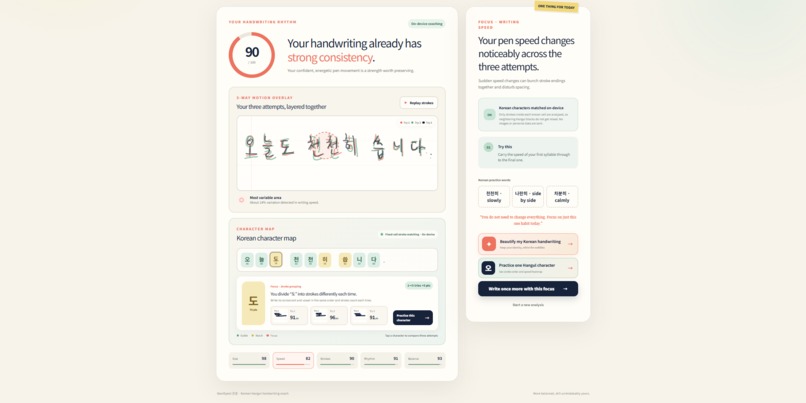
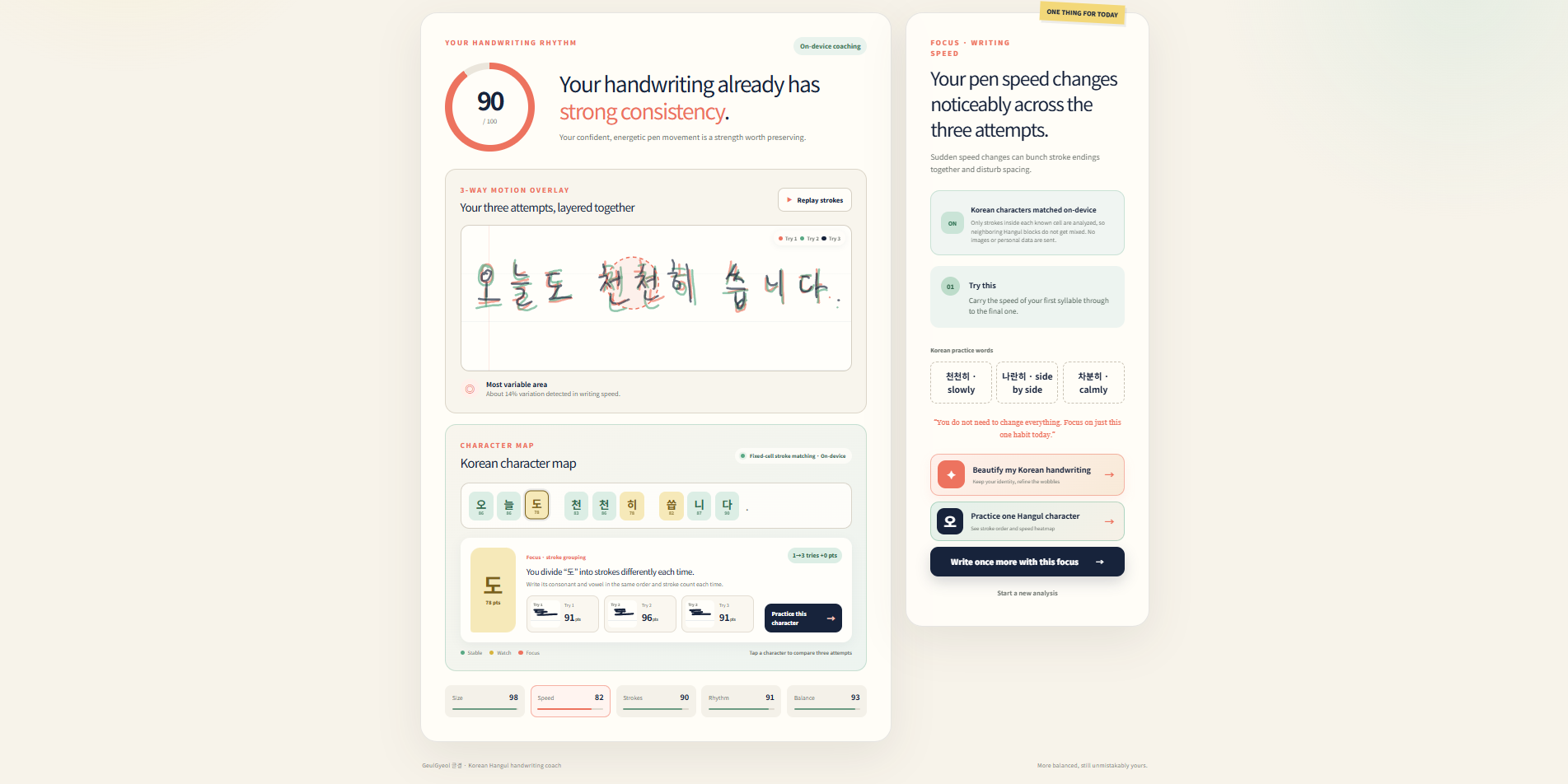
Review your handwriting analysis and receive one focused habit to practice today.
-
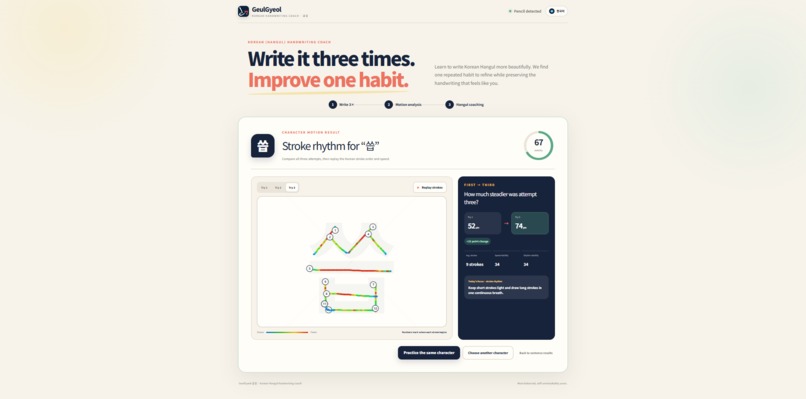
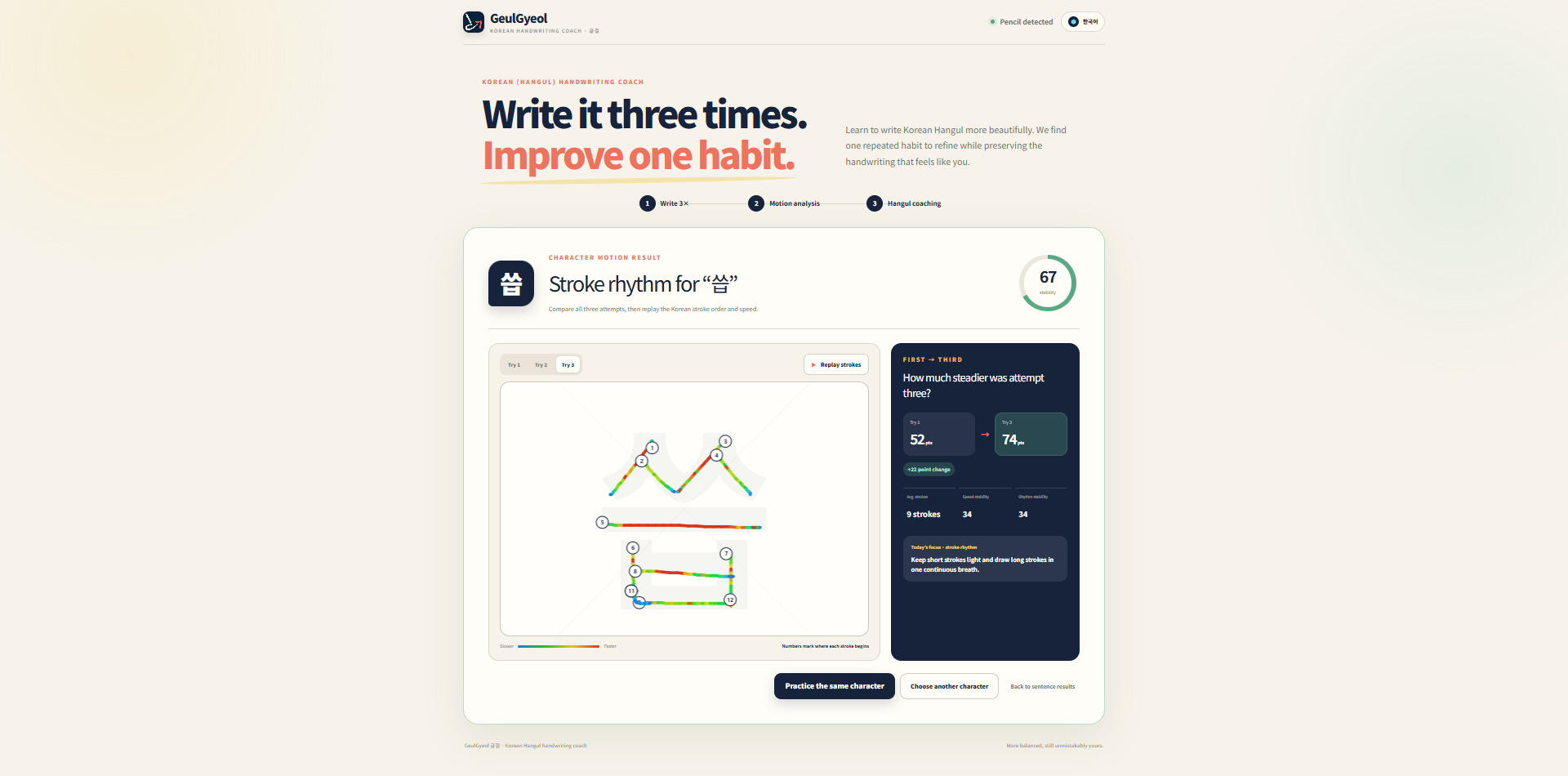
Compare stroke order, speed, and rhythm across three handwriting attempts.
-
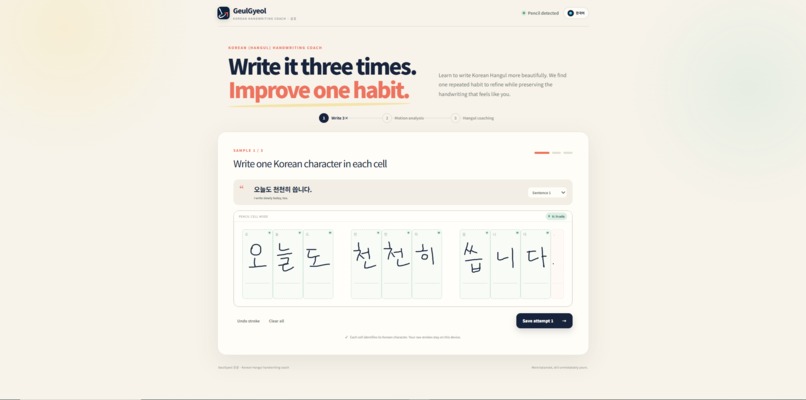
Complete a full sentence to capture natural spacing, balance, and writing rhythm.
-
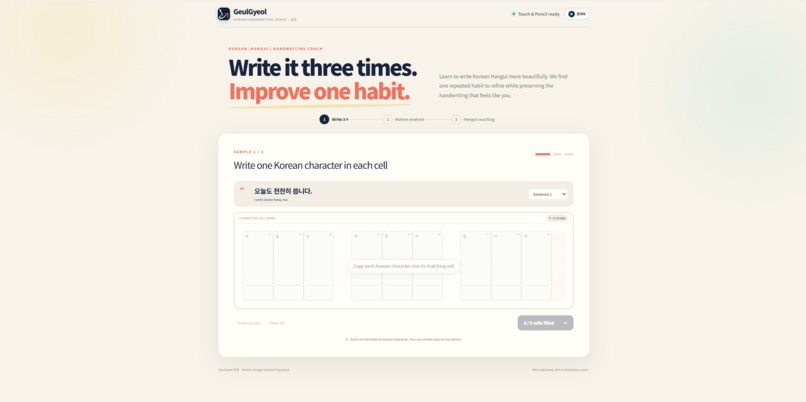
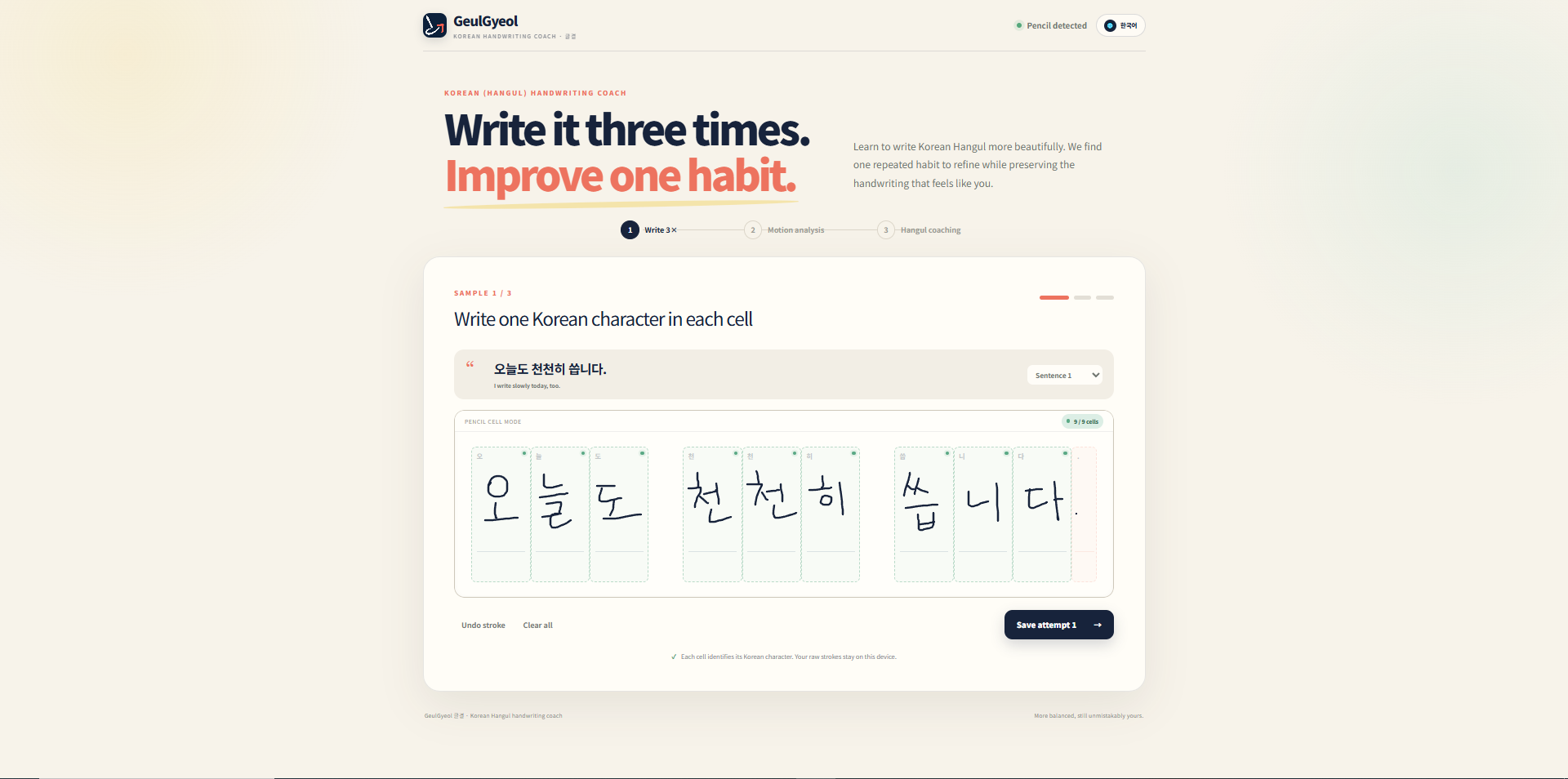
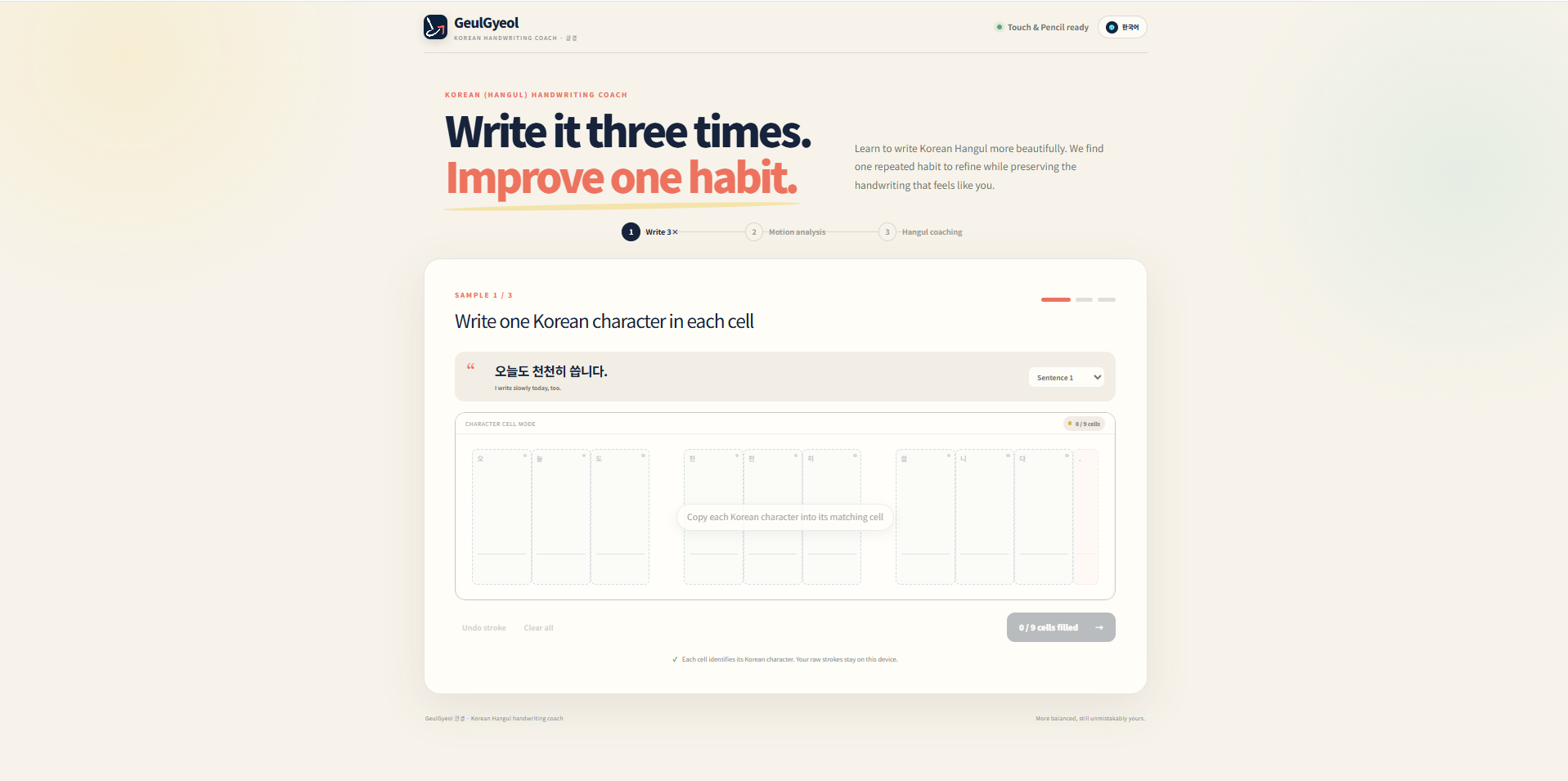
Copy each character of a Korean sentence into its matching practice cell.
-
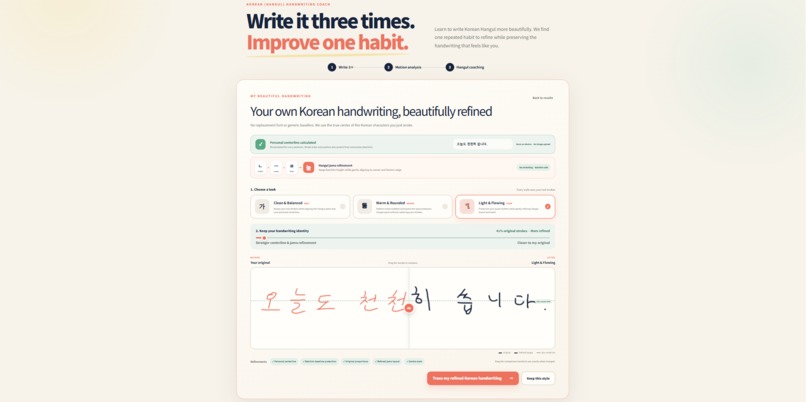
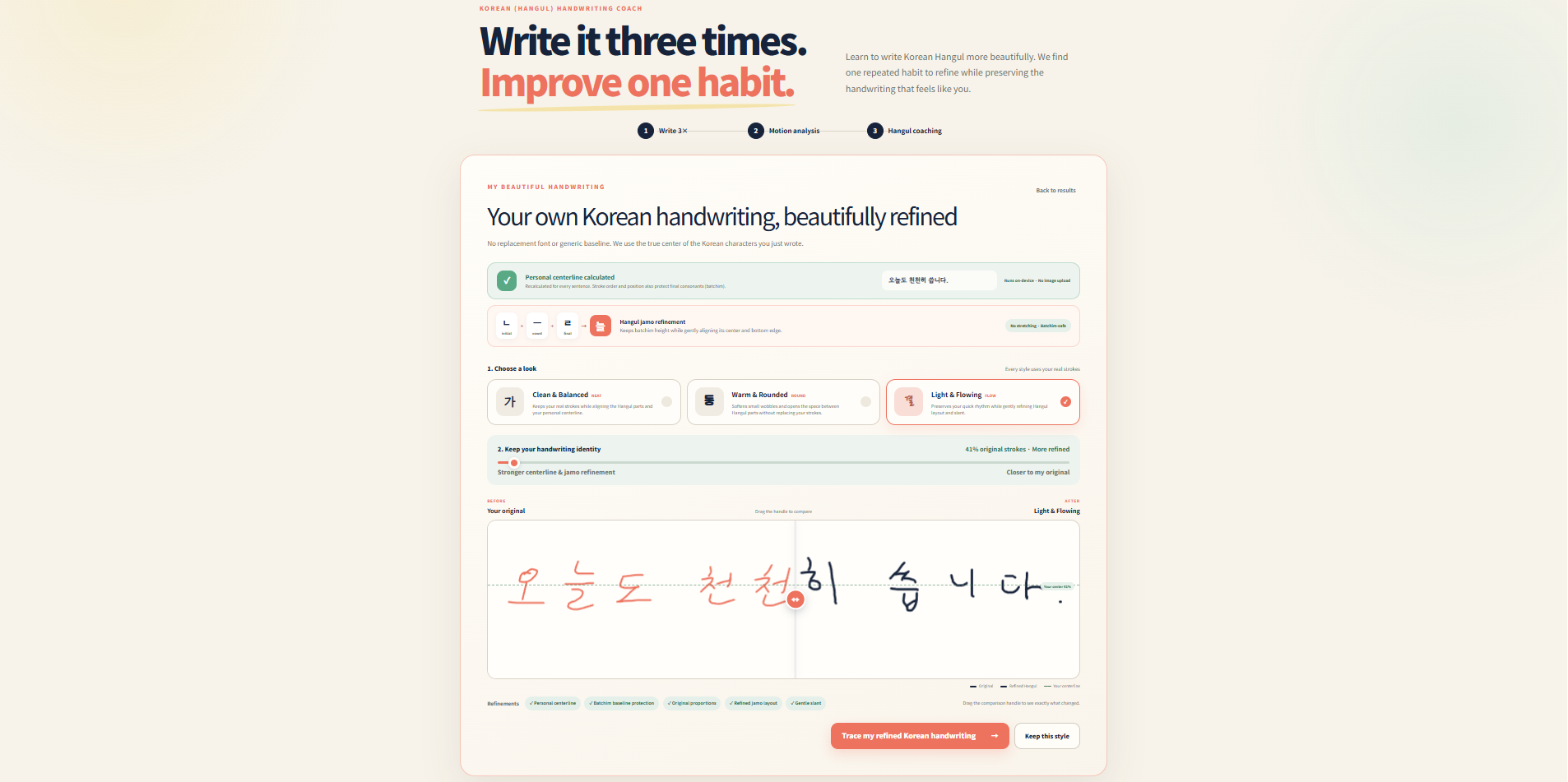
Refine your handwriting style while preserving the unique character of your original writing.
Inspiration
Many Korean learners can recognize Hangul on a screen but still feel uncomfortable writing it by hand. Most language-learning tools focus on typing, tracing a perfect font, or checking whether an answer is simply correct or incorrect. However, natural handwriting is more personal. Every learner has a different rhythm, spacing, balance, and stroke movement.
We created Geulgyeol to make Korean handwriting practice feel more focused and encouraging. Instead of correcting everything at once, Geulgyeol helps learners repeat a short sentence, identify one recurring habit, and improve it step by step.
Our core idea is:
Write it three times. Improve one habit.
What it does
Geulgyeol is a browser-based Korean handwriting practice tool designed for mouse, touchscreen, and digital pencil input.
Users choose a Korean sentence and write each Hangul character inside an individual practice cell. They complete the same writing sample three times so the system can compare repeated patterns rather than judging a single attempt.
The experience is divided into three stages:
- Write the sample three times
- Analyze repeated handwriting patterns
- Receive focused Hangul coaching
Geulgyeol looks at details such as stroke movement, spacing, alignment, character proportions, and consistency. It then provides one clear improvement point while preserving the learner’s personal handwriting style.
How we built it
We built Geulgyeol as a responsive web application that works directly in the browser.
The writing area captures each stroke as a sequence of coordinates, along with information such as stroke order, direction, and timing. Each Hangul character is written in its own cell, allowing the system to compare the learner’s input with the structure of the intended character.
The handwriting data is processed into a structured summary of repeated tendencies across the three attempts. This structured information can then be used to generate short, supportive, and understandable coaching feedback.
We also designed the interface to remain simple and calm. The user sees one sentence, one clear task, and one improvement goal at a time.
Challenges we ran into
One major challenge was supporting different input methods. Mouse input, touch input, and digital pencil input behave differently depending on the browser and device. We had to normalize these interactions so the writing experience would feel consistent.
Another challenge was deciding what should count as a real handwriting habit. Natural handwriting always contains small variations, so comparing every stroke against a perfect digital font would be too strict and discouraging.
To solve this, we focused on repeated tendencies across three samples. A single unusual stroke may be accidental, but the same pattern appearing several times is more likely to be useful for coaching.
We also had to balance detailed analysis with simple feedback. Too many corrections can overwhelm learners, while vague comments such as “write more carefully” are not useful. Our goal was to provide one specific and achievable suggestion at a time.
Accomplishments that we're proud of
We are proud that Geulgyeol turns handwriting practice into a focused learning experience instead of a simple tracing exercise.
The project supports character-by-character writing, multiple input methods, repeated sample comparison, and a structured three-step learning flow.
We are also proud of the product design. The interface communicates the purpose of the project immediately while keeping the writing area clean and distraction-free.
Most importantly, Geulgyeol does not try to make every learner’s handwriting identical. It aims to improve readability and balance while preserving the handwriting that still feels like their own.
What we learned
We learned that meaningful handwriting feedback requires more than checking the final shape of a character. The movement used to create that shape—such as stroke direction, spacing, and repetition—can provide valuable information.
We also learned that repeated practice becomes more effective when the learner has one clear goal. Writing the same sentence three times feels less mechanical when the learner understands what to observe and improve.
Another important lesson was that structured analysis produces better coaching than unorganized raw data. Clear evidence allows the feedback to be more specific, consistent, and useful.
What's next for Geulgyeol: Korean Handwriting Practice
Next, we plan to add more practice sentences, difficulty levels, multilingual explanations, and long-term progress tracking.
We also want to improve the handwriting analysis system so it can identify more detailed patterns in spacing, balance, proportions, and stroke movement.
Future versions could include personalized lesson recommendations, teacher tools, pronunciation support, and exercises designed around common difficulties experienced by learners from different language backgrounds.
Our long-term goal is to make Korean handwriting practice feel less like copying a worksheet and more like learning with a patient personal coach.
Built With
- cloudflare
- css3
- html5
- next.js
- pointer-events-api
- react
- typescript
- vinext
- vite

Log in or sign up for Devpost to join the conversation.