-
-
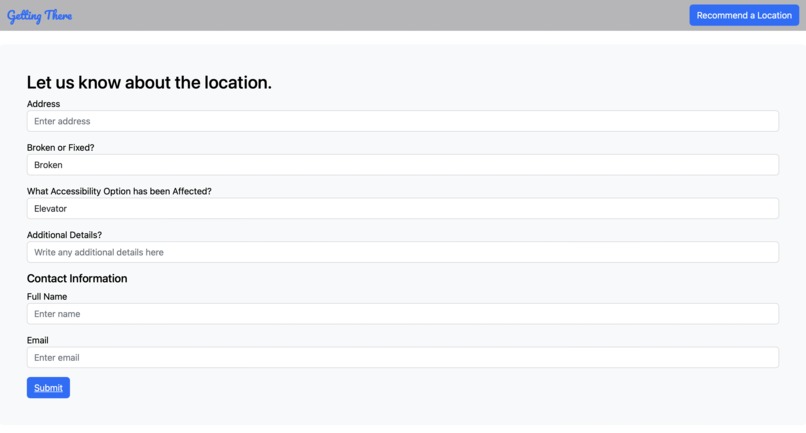
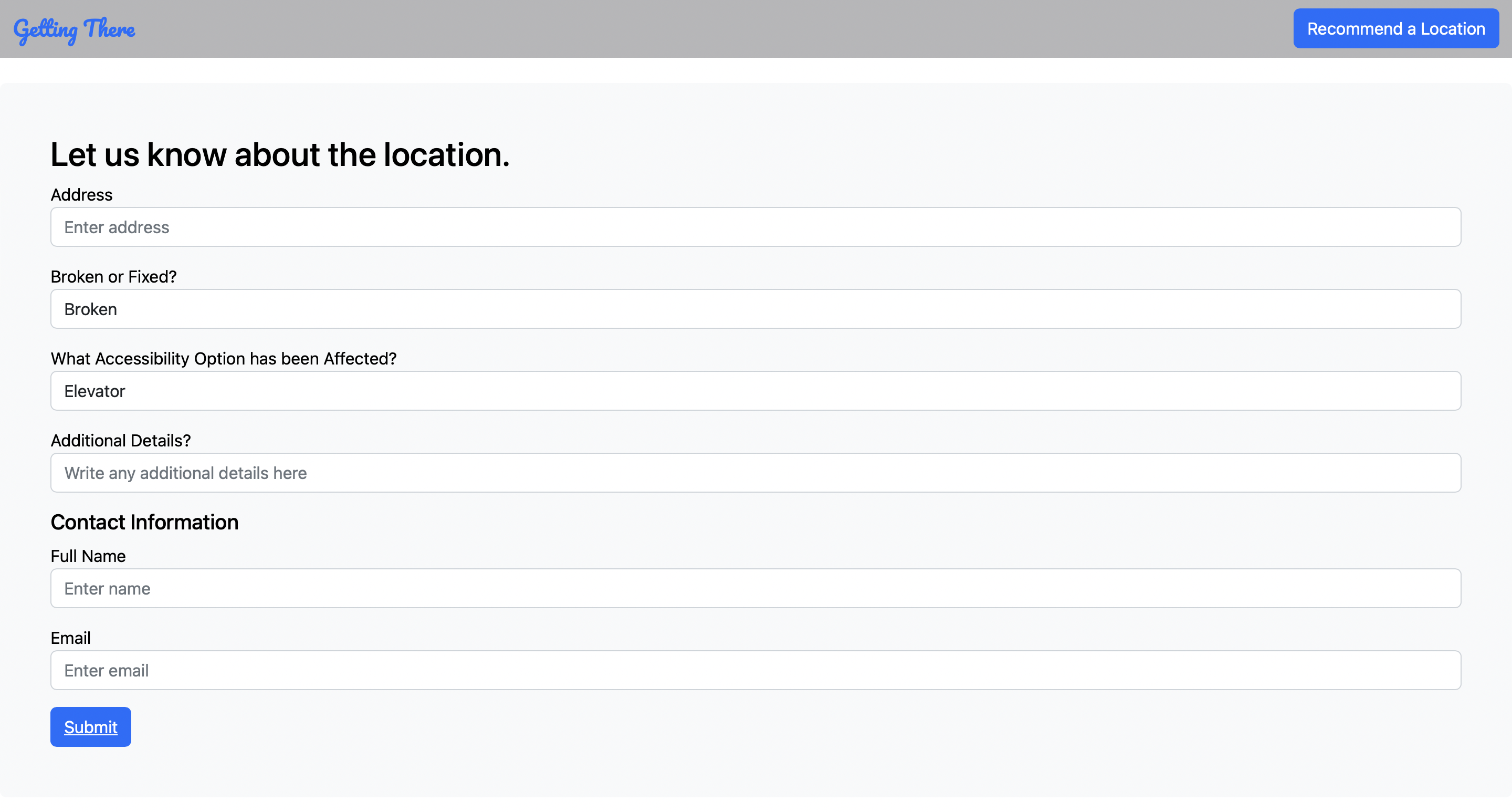
Form where user can give feedback to what was going on with a location and contact information.
-
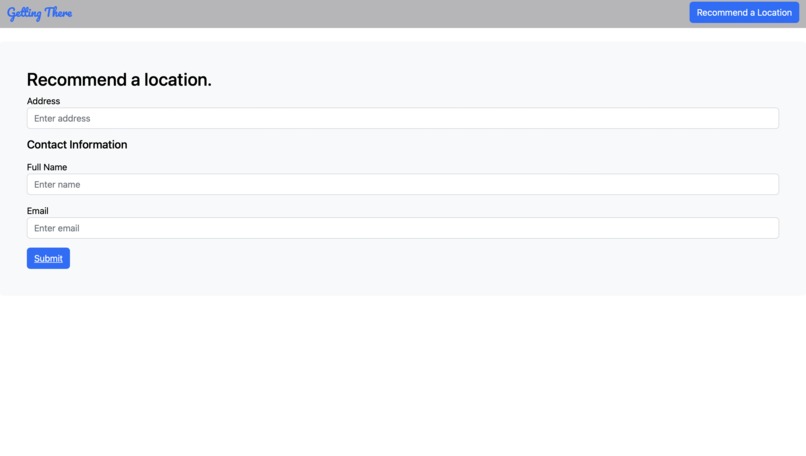
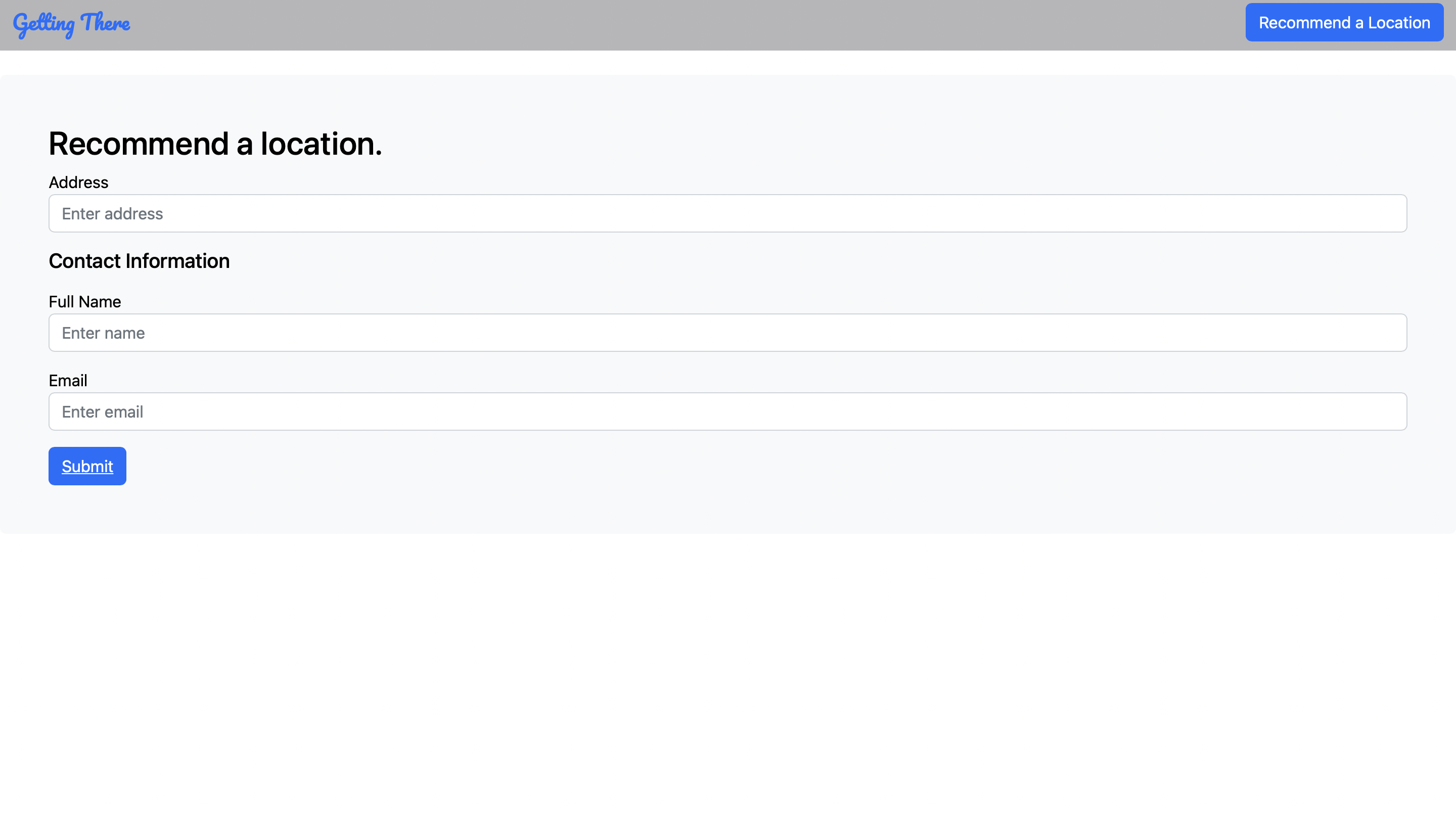
Form where user can recommend a location to be added to the map and contact information to let them know when it has been.
-
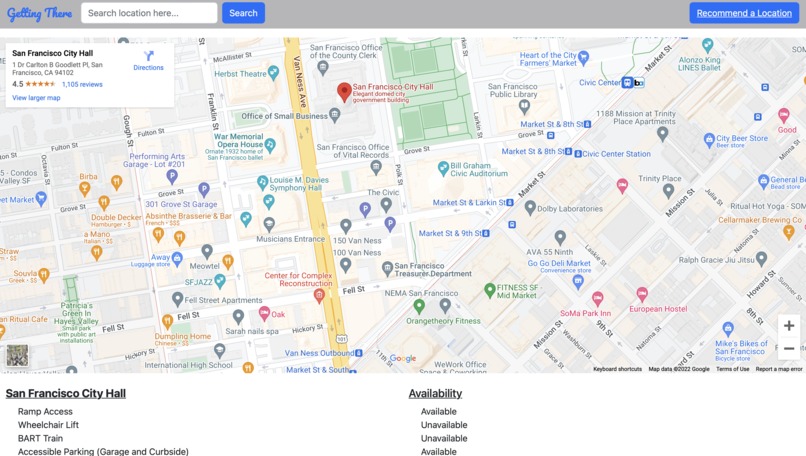
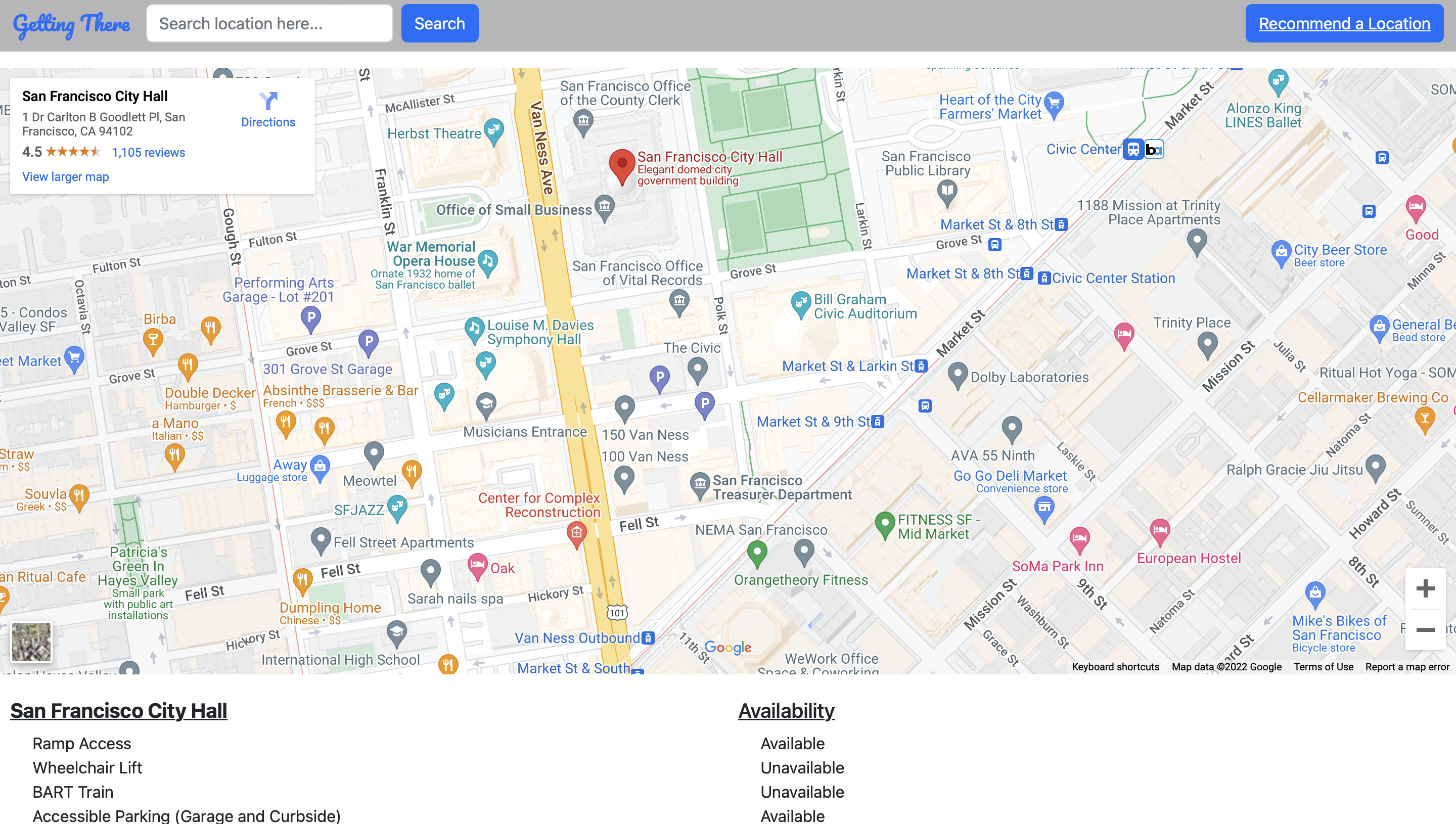
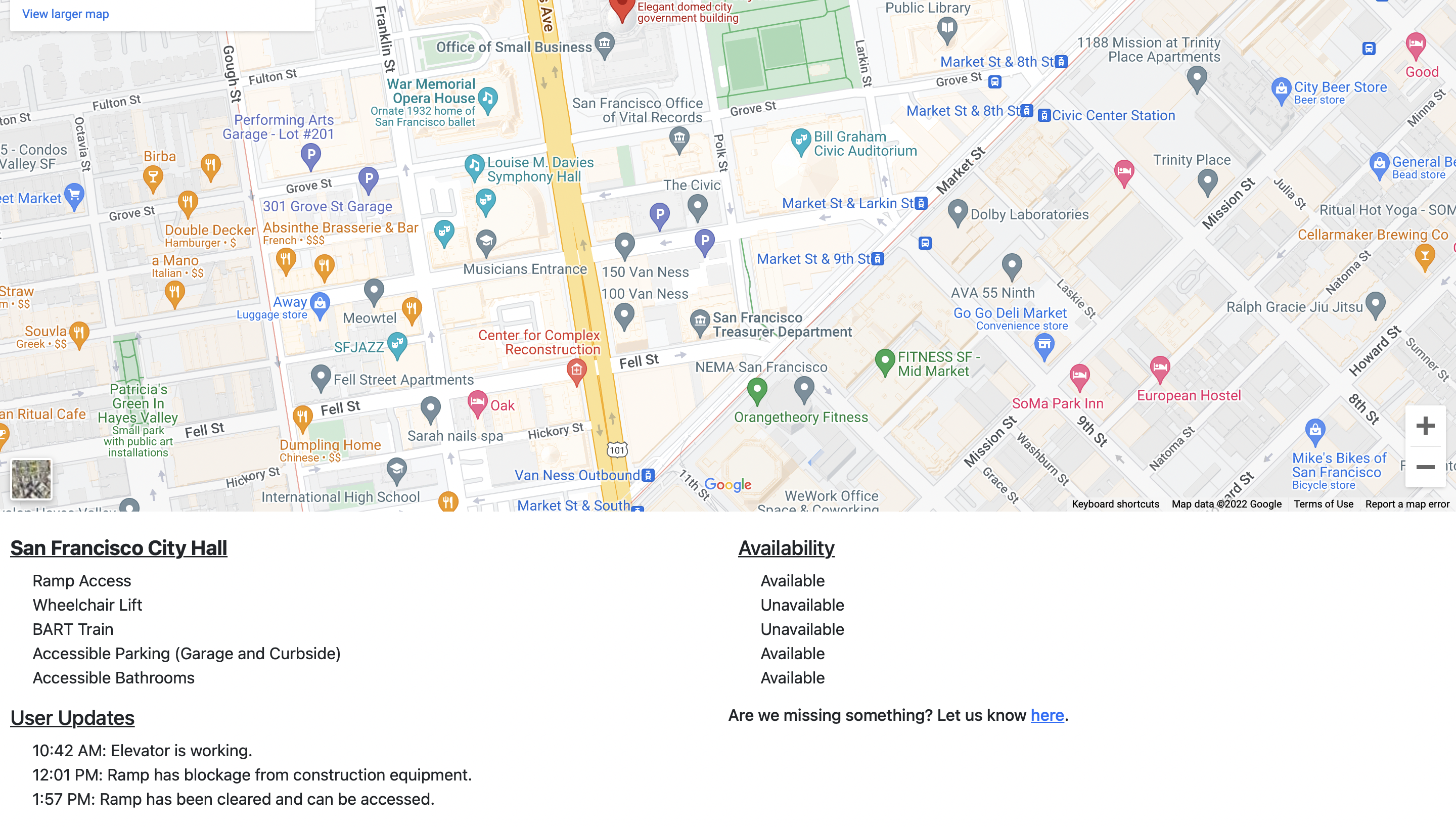
Homepage where user can select a location and view accessibility options and their status.
-
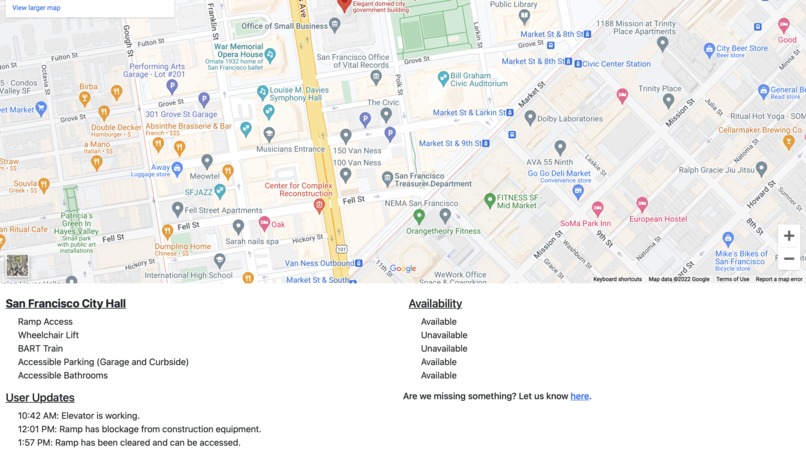
Homepage where user can select a location and view accessibility options and their status.
Inspiration
We, my partner Jane Kuszmaul and I (Yasminie Sahadeo), drew our inspiration from how little accommodations are explicitly provided for people with disabilities. In a world where able-bodied people are the majority, simple things like providing information about whether there is ramp access for someone in a wheelchair is often overlooked.
We decided to address the lack of information surrounding physically navigating spaces as someone with mobility challenges. Imagine you’re making plans to take a trip to the grocery store. Think about the following questions:
- Is there accessible parking?
- Are there ramps available for wheelchair access?
- Are the accessibility options offered available for use?
What it does
Our application, Getting There, aims to provide up-to-date information about accessibility options and their status via an interactive map. This map would have clickable icons that bring up the accessibility information for that location and if they are available for use or not. It also allows users to send updates about different locations, such as if they find an elevator is broken, or a new ramp has been installed. This will allow for more flexible travel, and to track places with consistently poor accessibility as targets for advocacy. Users can recommend a location to be added to the map, helping to expand the knowledge of accessibility options for all.
How we built it
I, Yasminie, created the main page where the interactive map would be placed and the example text is shown. My partner, Jane, created the recommendation and update form, as well as the thank you page for users to give their own feedback of their choice.
Creating the main page was done with HTML, CSS, and Bootstrap. In conjunction with HTML, I used Boostrap to give the website a nicer appearance. I added a navbar on top where the user would be able to search for a location by name, and have it pulled up on the embedded Google map. There is also a button where a user could recommend a location via a form. Because I could not figure out how to set custom markers in time, I left example text below the map to show what I would have liked to have done. I added a clickable link to have the user update the location’s if anything was not correct or needed to be added via a form.
For Jane, the forms were made with a jumbotron format. The recommendation form was made with a box for the user to enter their requested location, and a small section for contact information to alert the user once their location has been added. The update form let’s the user enter the address, the status of the service, what type of service it is, and any other comments the user might have. It also asks for contact information to let them know when it’s been updated. Both pages link to a simple thank you page to let the user know their input was received.
Challenges we ran into
For me, Yasminie, I ran into creating the custom markers for the embedded Google maps I had on the main page. To do this, I needed a verified domain and an API key, which I just didn’t have. It was supposed to be verified through an Amazon service, but I am not familiar with Amazon services as well as Google Cloud Platform services. Because of this and time, I decided to create an example text to show what I would like to represent instead.
For Jane, she was not too knowledgeable about HTML, CSS, or Bootstrap. It was something new to her and she wasn’t quite sure about the code and workings of the website. Because of this, she decided to stick to simpler forms and a thank you page.
Accomplishments that we're proud of
Both Jane and I are proud that we completed our first hackathon! Although it was our first, we made an effort to communication with each other as clearly and as effectively as possible every few days. We are thrilled that we got to work together and create an idea that would benefit the world in a way, even if we couldn’t bring it to full fruition.
I am proud that I was able to create a website and become more familiar with GitHub.
Jane is proud that she was able to learn and get down the basics of HTML, CSS, and Bootstrap within a few days.
What we learned
Jane and I become more knowledgeable about the languages in our project and learned to build our communication skills, especially over long distances. We also learned how much time and effort it takes to produce a quality project, and the experience needed to complete it.
What's next for Getting There
Jane and I believe it is a solid idea to make a mainstream app for those who would like to know more about the accessibility options around them. With enough support and patience, we believe this app could make a difference in society with further development.

Log in or sign up for Devpost to join the conversation.