Inspiration
Sitting in the living area of a six-person apartment, we began brainstorming a productivity app. That’s when Sonya's roommate Krithi shared her dream tool: one that considered the phases of her menstrual cycle to make planning feel natural.
This wasn’t about helping women get things done -- they already do that every day. It was about recognizing an invisible source of friction and turning it into an advantage. By listening, researching, and drawing from the real stories of women we knew, we built getitdone: a tool that transforms the menstrual cycle into a strategic framework, helping women work with their biology, not against it.
What it does
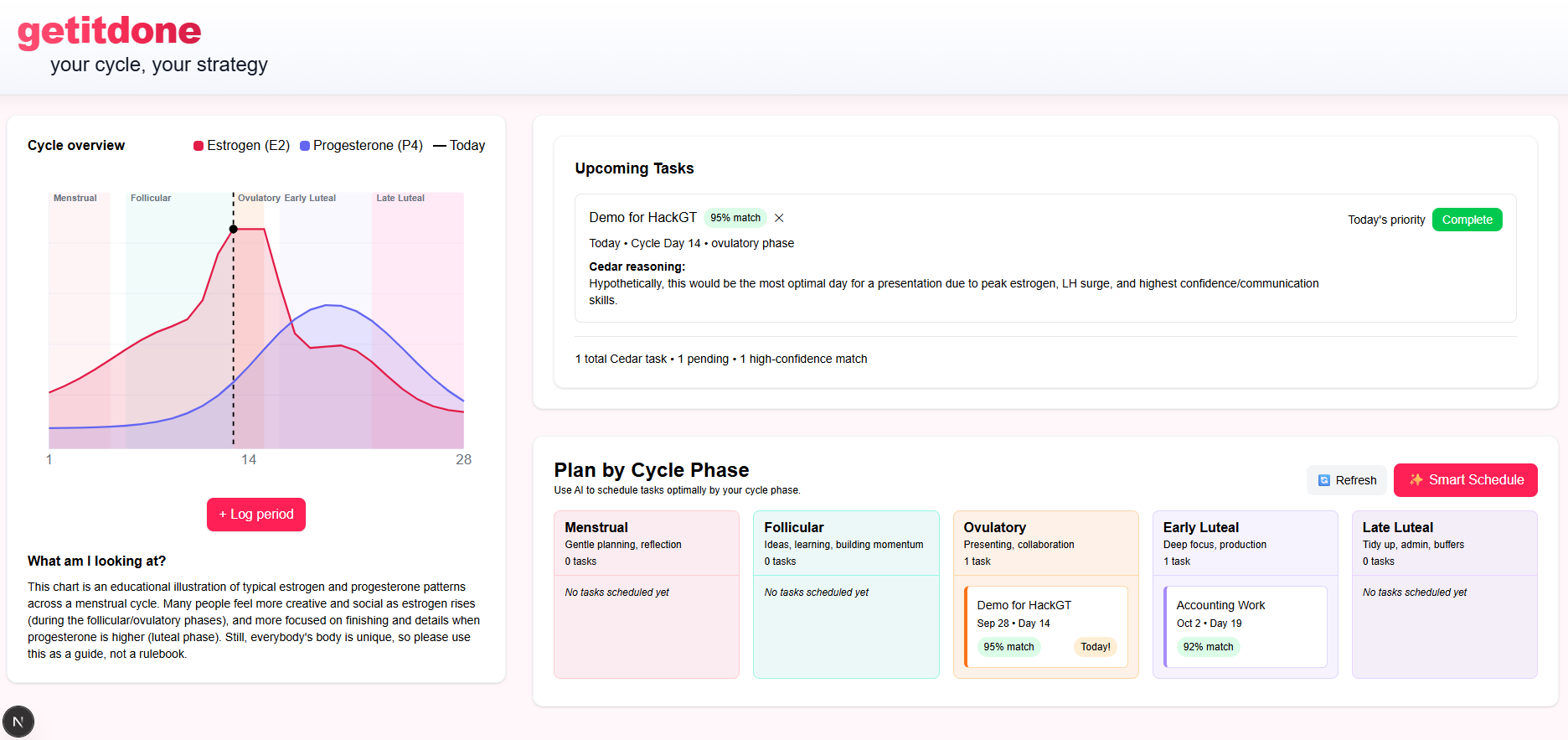
getitdone uses AI heuristics to align tasks with cycle phases and surface what’s most natural today. The dashboard shows:
- An Upcoming Tasks section that features previously planned tasks slotted for that day.
- A phase-based Kanban (Menstrual, Follicular, Ovulatory, Early Luteal, Late Luteal) that auto-buckets new tasks; late-luteal-style work (review, polish, admin) is nudged into that column.
- An educational hormone trend graph that illustrates typical estrogen/progesterone patterns across a cycle, plus a Log period button to recalculate your current day instantly. By syncing task type with phase--without being prescriptive--getitdone turns cycles into strategy.
How we built it
We built getitdone on a modern web stack designed for speed, flexibility, and privacy:
- Frontend: Next.js + TypeScript with Tailwind CSS for a clean, responsive UI, and lightweight custom components for the "Kanban" board and hormone graph.
- Backend & data: Supabase (PostgreSQL under the hood) handles user tasks and cycle data, with schema designed for flexibility across different cycle lengths.
- AI & agents: Mastra powers the task-phase alignment agent, while Gemini API supports natural-language task interpretation. CedarOS provides a secure, policy-driven interface layer for user data.
This stack made it possible to prototype a phase-aware productivity tool in just a few days while still leaving room for future ML-driven personalization and integrations.
Challenges we ran into
- Writing guidance that supports productivity without drifting into medical advice.
- Design that feels empowering and optional, not prescriptive.
- Getting phase heuristics to feel “right” across different cycle lengths.
- Making the hormone chart informative while clearly “educational, not diagnostic.”
Accomplishments that we're proud of
- A working, phase-aware Kanban with instant, sensible auto-placement.
- Clear “fit today” feedback that reduces planning friction without judgment.
- A polished hormone graph with qualitative tooltips that users understood at a glance.
- Thoughtful design that testers described as “supportive, not restrictive.”
What we learned
- Tone matters: users want nudges, not rules.
- Splitting Luteal into two phases: Early and Late, made suggestions feel noticeably more accurate.
- Simple heuristics can deliver outsized value for planning; ML can come later for personalization.
- People appreciate user-centered software, especially for sensitive topics such as health.
What's next for getitdone
multi-user login: We already have women waiting to use our app to optimize their productivity! This is our first priority.
smarter cycle and productivity tracking: Utilize machine learning to adapt more specifically to individual cycle patterns.
break down of long term tasks: Save women time by breaking down large tasks and slotting each microtask into its respective menstrual phase.
Built With
- cedaros
- css
- geminiapi
- mastra
- nextjs
- postgresql
- supabase
- tailwind
- typescript


Log in or sign up for Devpost to join the conversation.