
Inspiration
I ran into this problem constantly while coding. Whenever I got stuck on a bug or needed to learn a library, I'd open YouTube for a tutorial. But a few minutes in, I’d see something interesting in the recommendations or click into Shorts, and suddenly an hour had disappeared.
Existing screen-time blockers (like Apple Screen Time, Opal, and Forest) force an all-or-nothing choice: you either block YouTube completely and lose access to tutorials and study material, or you unblock it and risk losing half your day to entertainment and algorithm feeds.
Why can't our devices enforce our intent instead of just shutting down the whole app?
That's why I built Gethen: an on-device Semantic Firewall that surgically filters out brainrot and rabbit holes while keeping educational tools wide open.
What it does
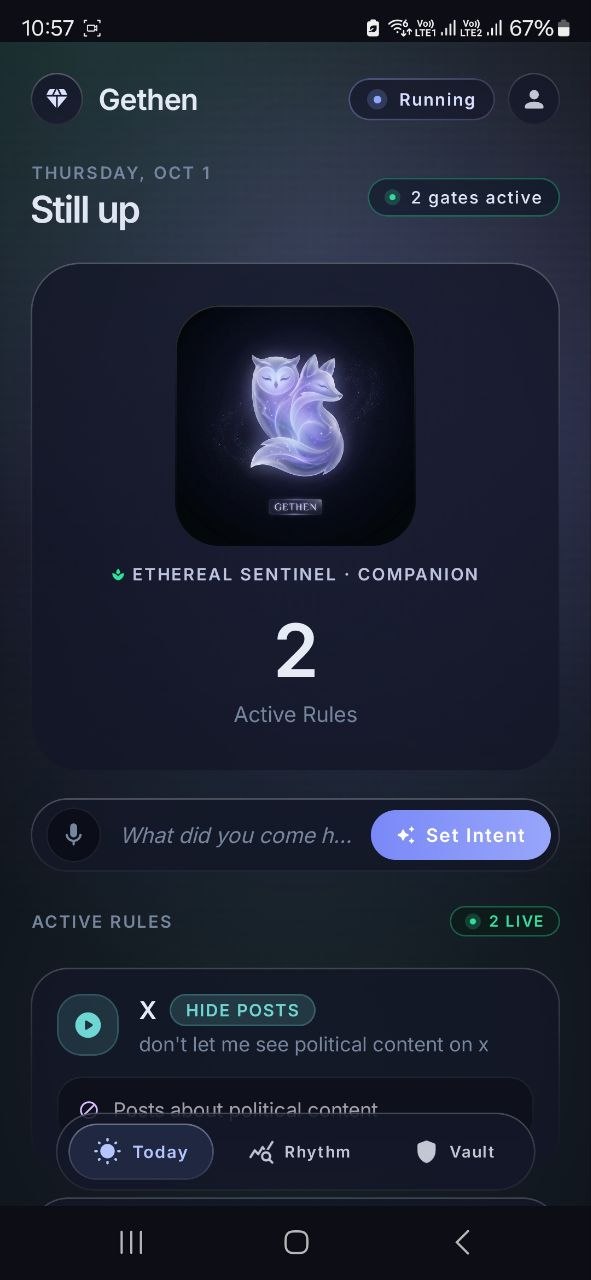
Gethen lets you enforce natural-language intentions across your phone in real time:
- Semantic Intent Shields: Instead of blocking an entire app, you define what’s allowed or forbidden. You can say "Don't let me watch reality TV or gaming on YouTube" or set a strict positive focus: "Only allow coding tutorials and CBSE maths lectures."
- Real-Time Gating: Gethen inspects screen metadata as you browse. Educational content plays normally; the moment you tap a video or post that violates your rule, an unskippable gate drops in under 300ms.
- Full App Blocking: For times when you just want a complete cutoff, Gethen also supports classic scheduled app blocking and lockouts—matching the baseline features of traditional blockers.
- Contextual RevenueCat Monetization:
- Free users get standard scheduled blocks plus 3 free AI semantic intercepts per day.
- Pro subscribers unlock unlimited real-time AI shields.
- When a free user hits their daily limit, a native RevenueCat Paywall appears right at the moment they get intercepted—reaching users at the exact moment their intent to stay focused is highest.
- Zero-Knowledge Privacy by Default: No account creation, no email sign-up, and no tracking. Sensitive applications (banking, password managers, private chats) are strictly excluded from the accessibility engine by default.
How we built it
- Native Android (Kotlin): Built as an
AccessibilityServicethat draws low-latency overlay gates using Android's native window system. - Modular
AppAdapterPattern + Universal Fallback: We built targeted structural adapters for YouTube and Instagram to cleanly extract metadata from their custom UI trees. For any other app, Gethen falls back to a window-level visible text aggregator so protection works everywhere. - Fast System 1 AI: Instead of using slow, chatty LLMs that take 3–5 seconds to respond, we integrated TypeSafe’s Jev (
jev-1.13)—a fast, discriminative probability engine that evaluates text against criteria in under 300ms. - RevenueCat In-App Purchases: Integrated the
purchases-androidSDK andRevenueCatUIto manage entitlements (pro_firewall) and render remote paywalls natively. - COGS-Driven Unit Economics: We modeled our subscription pricing against real token costs. At $0.042/M tokens, an active user burns ~$5.06/month. Pricing our Pro tier at $9.99/mo with RevenueCat guarantees a sustainable 50–55% gross margin.
Challenges we ran into
- First Time with Kotlin and Mobile Development: I had never built an Android app or written Kotlin before this hackathon. Going from zero mobile experience to building an active accessibility service, overlay managers, and API pipelines in under a week was an intense learning curve.
- First Time with In-App Purchases: Handling Google Play Billing from scratch sounded intimidating. RevenueCat made integrating subscriptions surprisingly painless—what could have taken days of backend billing architecture took just a few hours using their SDK and pre-built paywall flows.
- Android View Virtualization & Flings: Early on, we tried masking individual posts inside scrolling feeds. Because Android recycles views rapidly during 60fps flings, overlay boxes drifted across the screen. Pivoting to full-window and bottom-sheet interstitial gates created a rock-solid, jitter-free experience.
Accomplishments that we're proud of
- True Zero-Knowledge Privacy: Unlike most commercial blockers that require you to create an account and sync your screen habits to their servers, Gethen has no user accounts, no login, and no centralized database. Everything runs locally on your device. Even our AI requests pass only anonymized text fragments via our proxy, meaning no one can build a behavioral profile on you.
- Shipping a Working Prototype in Under a Week: Taking an ambitious concept—real-time semantic filtering inside third-party apps—from zero to a working APK on a physical phone in seven days.
- Sub-300ms Interception: Watching a user open YouTube, watch a programming tutorial completely uninterrupted, and then seeing Gethen instantly intercept the screen the moment an entertaining video is tapped.
- Dual-Engine Open Source Model: Keeping the codebase open source with BYOK (Bring Your Own Key) support for developers and security enthusiasts, while providing a turnkey 1-tap subscription powered by RevenueCat for everyday users.
What we learned
- Kotlin & Android Accessibility Realities: Learned Android lifecycles, accessibility tree traversal, window managers, and Kotlin coroutines on the fly under tight hackathon pressure.
- Subscription Architecture with RevenueCat: Learned how entitlements, customer info listeners, and remote offerings work together to build a professional monetization engine.
- Discriminative AI vs. Generative LLMs: Learned that for real-time mobile guardrails, fast probability-based System 1 models beat generative chat wrappers every single time in speed, cost, and predictability.
What's next for Gethen
- On-Device Small Language Models (SLMs): Experimenting with local, quantized models (via ONNX or TFLite) to run semantic classification directly on the phone's NPU, driving marginal token costs to zero.
- More Dedicated App Adapters: Expanding the adapter library to include deep integrations for X, Reddit, and LinkedIn feeds.
- Cross-Platform Intent Shielding: Bringing the same semantic firewall philosophy to desktop browsers via a Chrome/Firefox extension.
Built With
- accessibility-service
- android
- artificial-intelligence
- byok
- content-moderation
- coroutines
- digital-wellness
- google-play-billing
- in-app-purchases
- kotlin
- machine-learning
- mobile-security
- natural-language-processing
- open-source
- privacy
- productivity
- rest-api
- revenuecat
- revenuecat-sdk
- semantic-analysis
- subscriptions
- typesafe-jev
- zero-knowledge

Log in or sign up for Devpost to join the conversation.