-
-
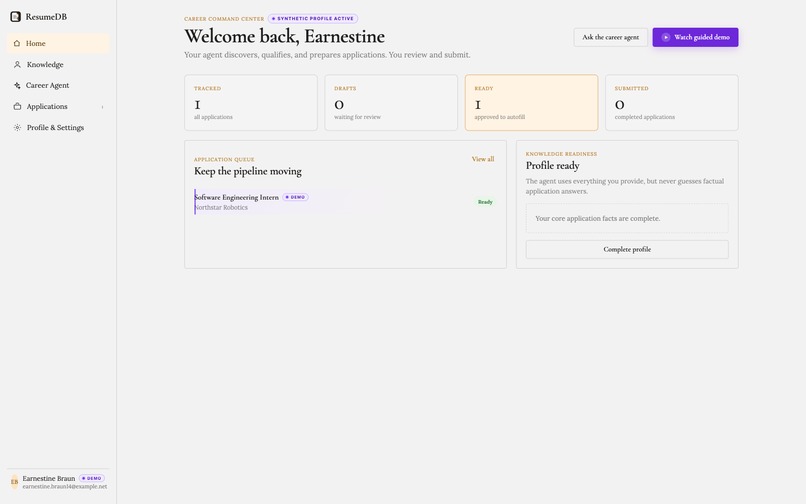
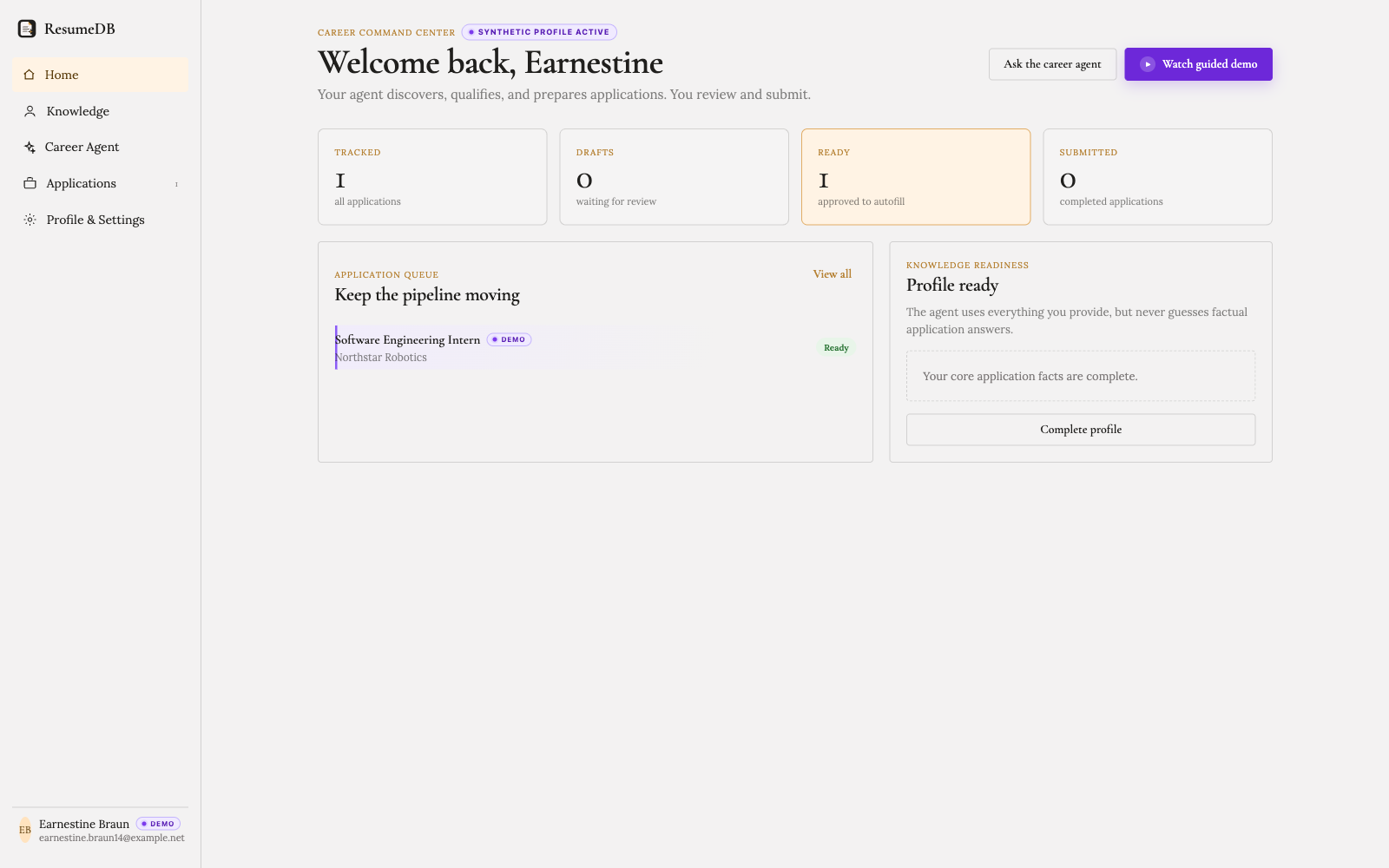
ResumeDB dashboard with profile completeness, application pipeline, and next actions.
-
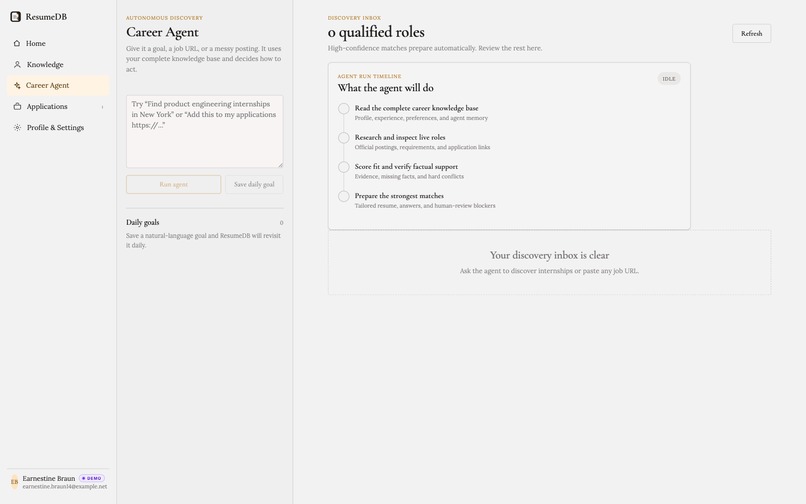
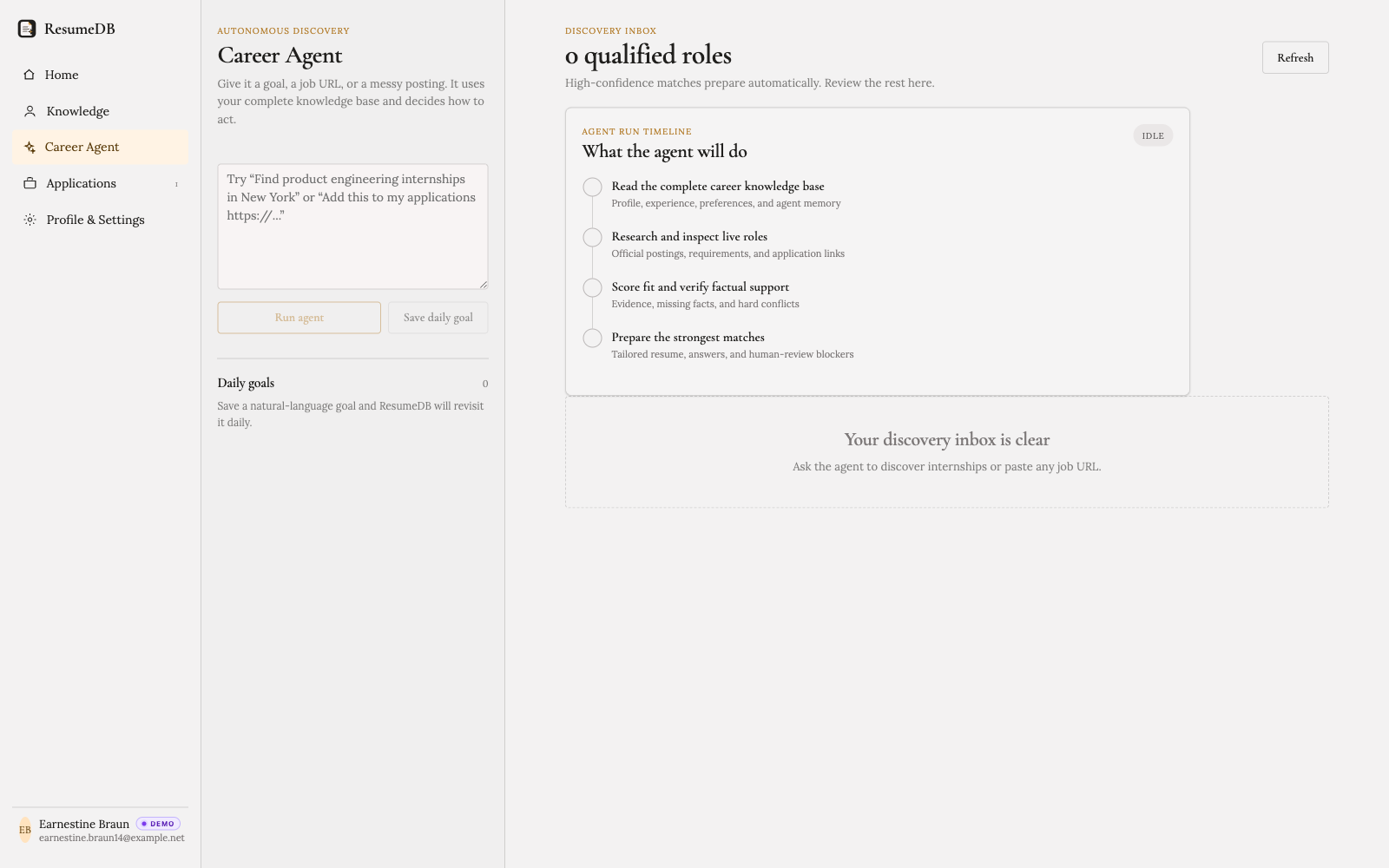
Career Agent discovers jobs from natural language while streaming every step.
-
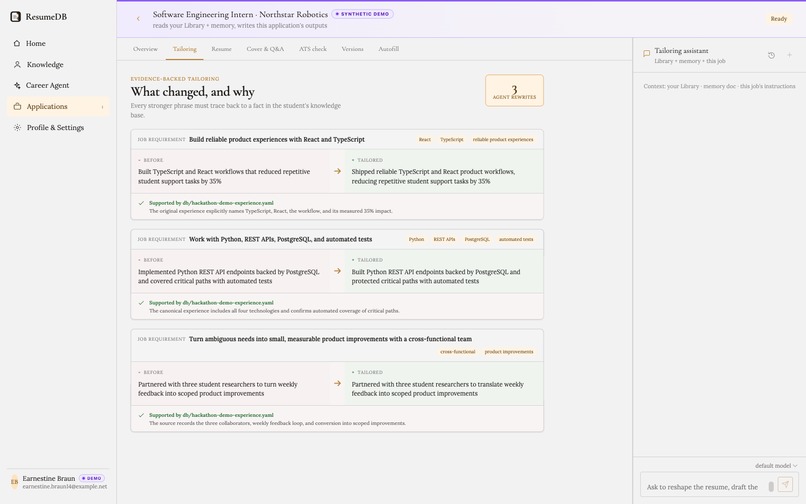
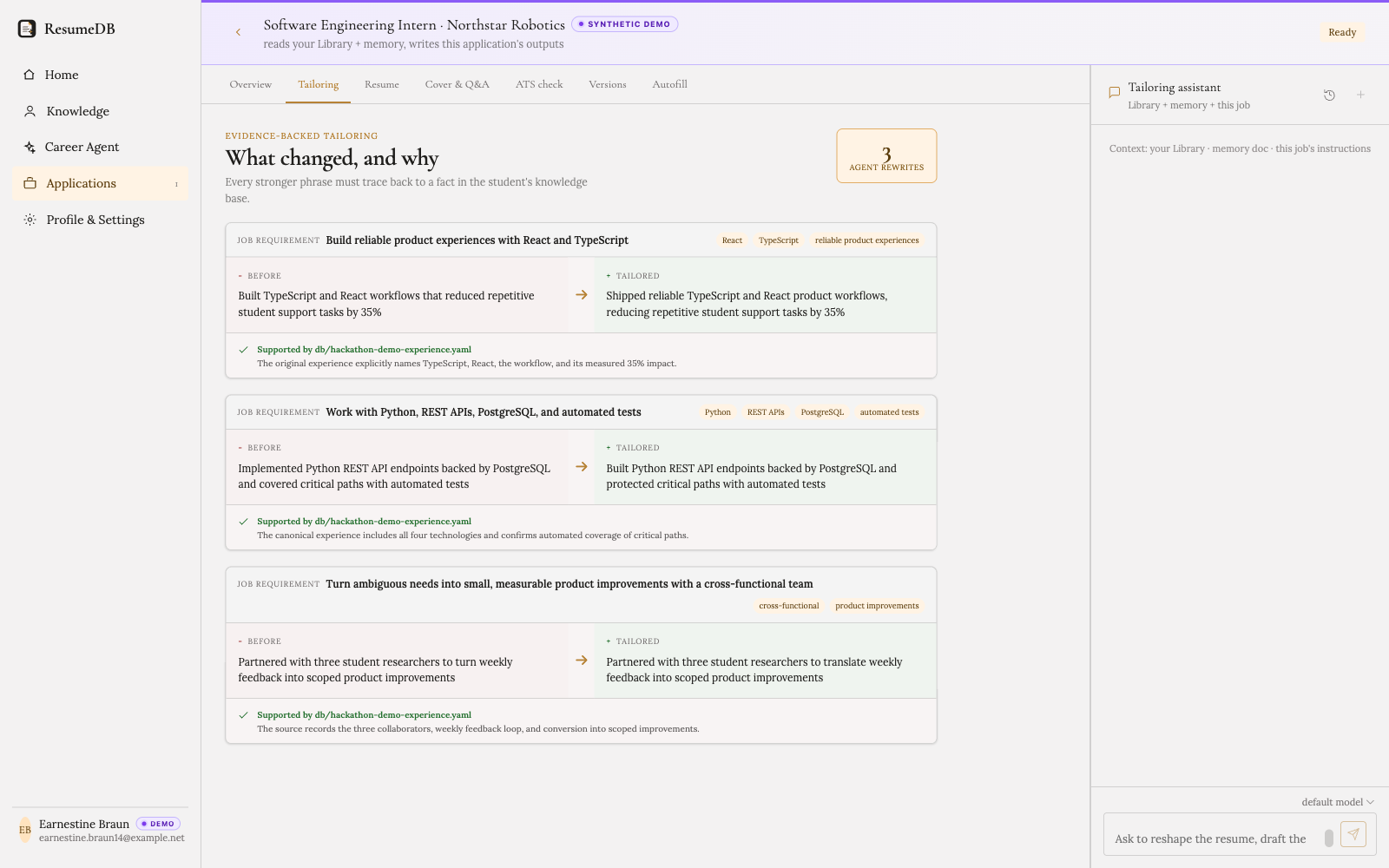
Evidence-linked before-and-after tailoring shows why every resume rewrite is supported.
-
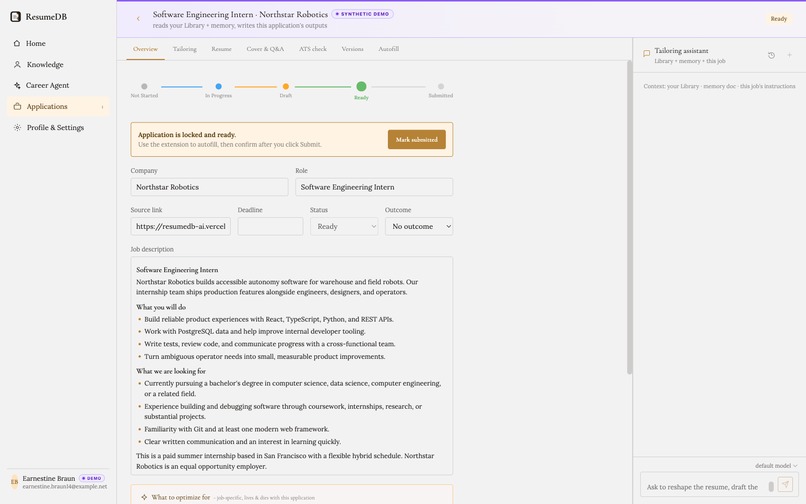
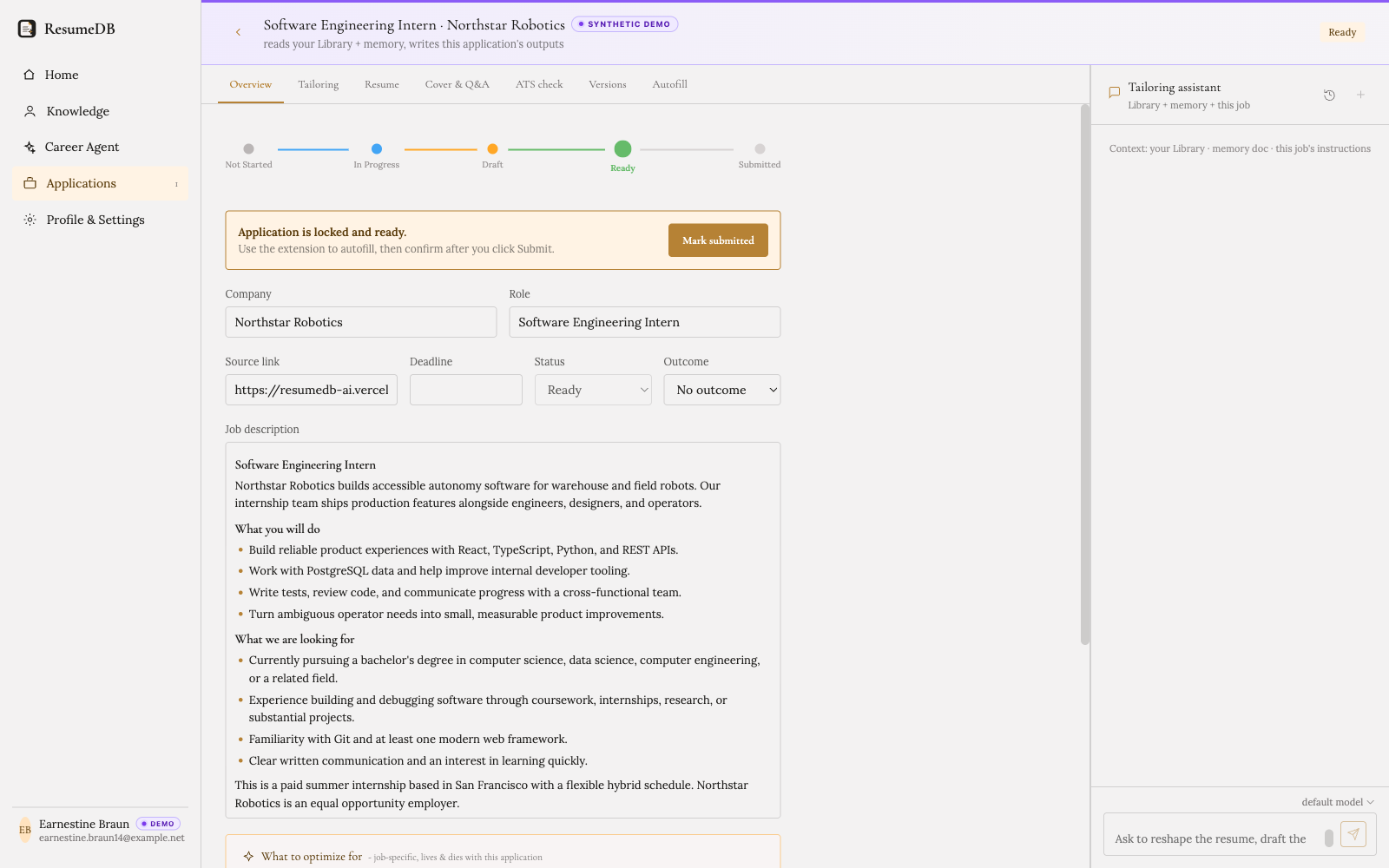
One application workspace brings job evidence, artifacts, status, and readiness together.
-
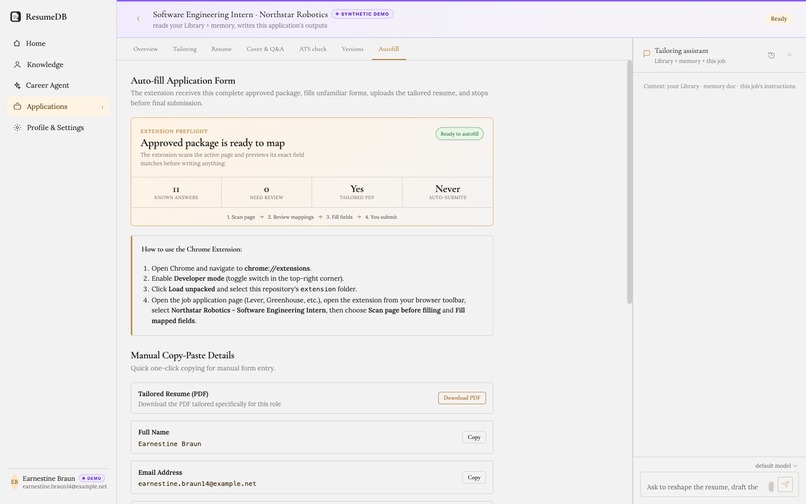
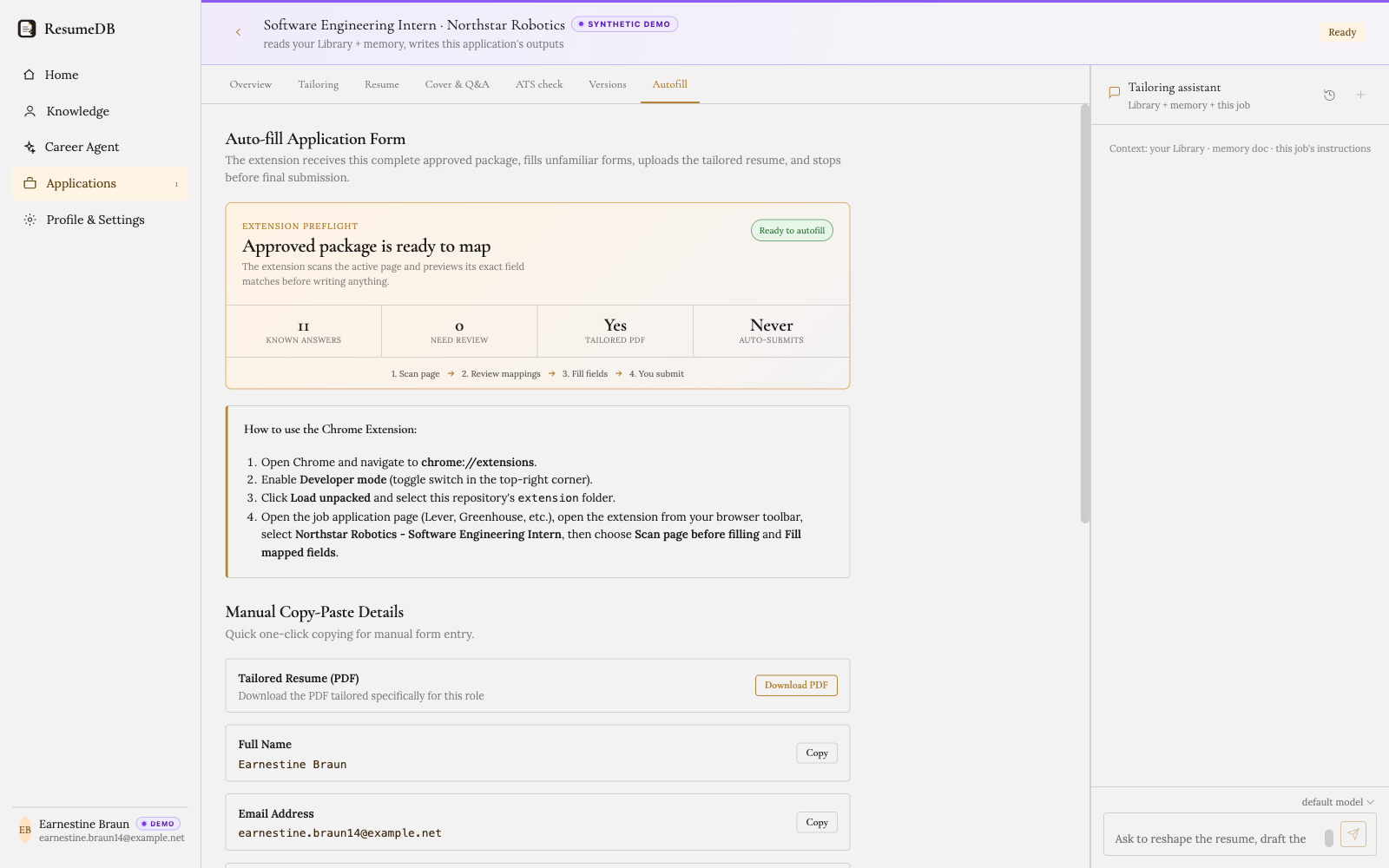
Chrome extension preflight previews matched, manual, and resume upload fields before filling.
-
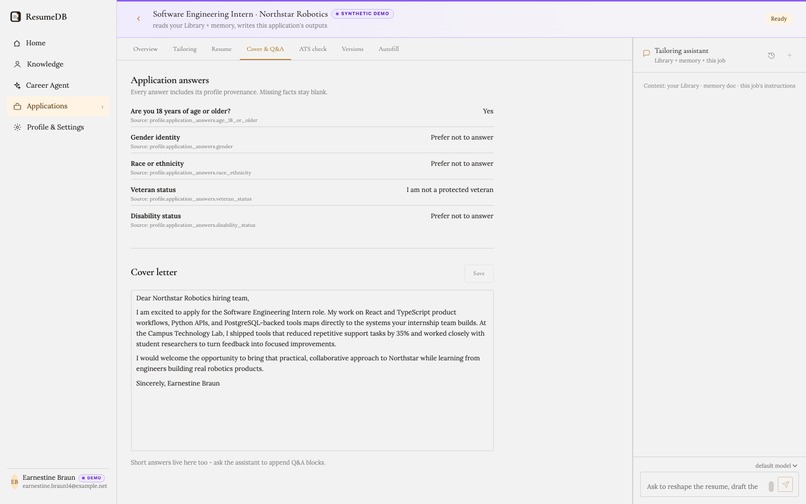
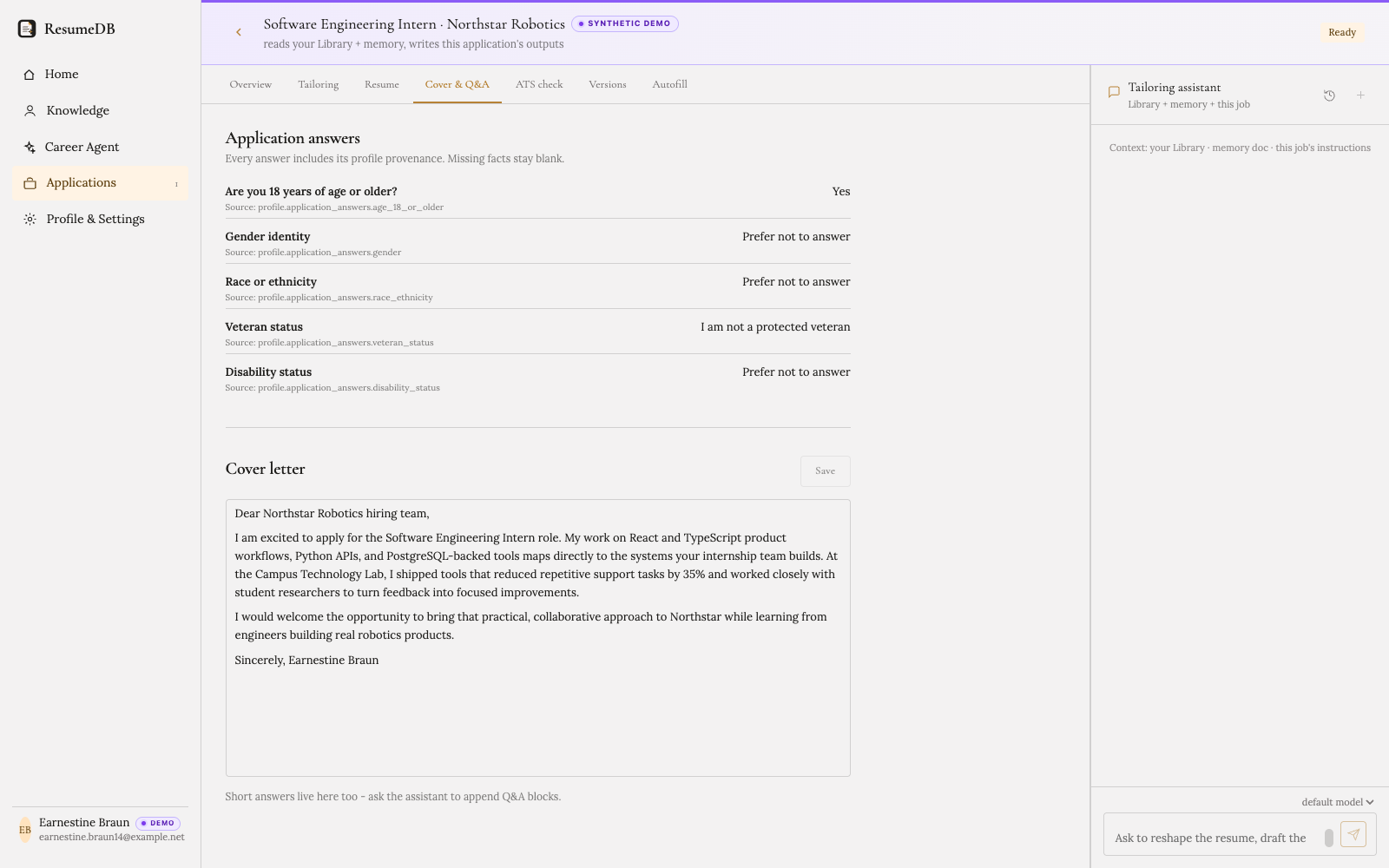
Job-specific cover letter, sourced application answers, and provenance remain reviewable.
-
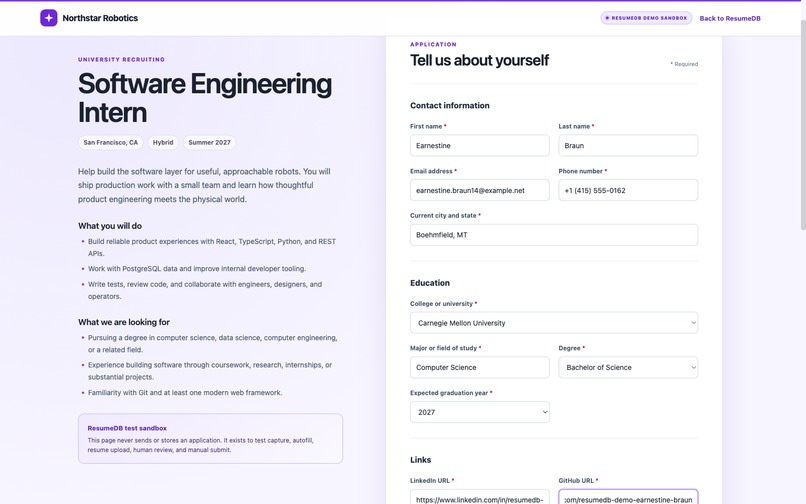
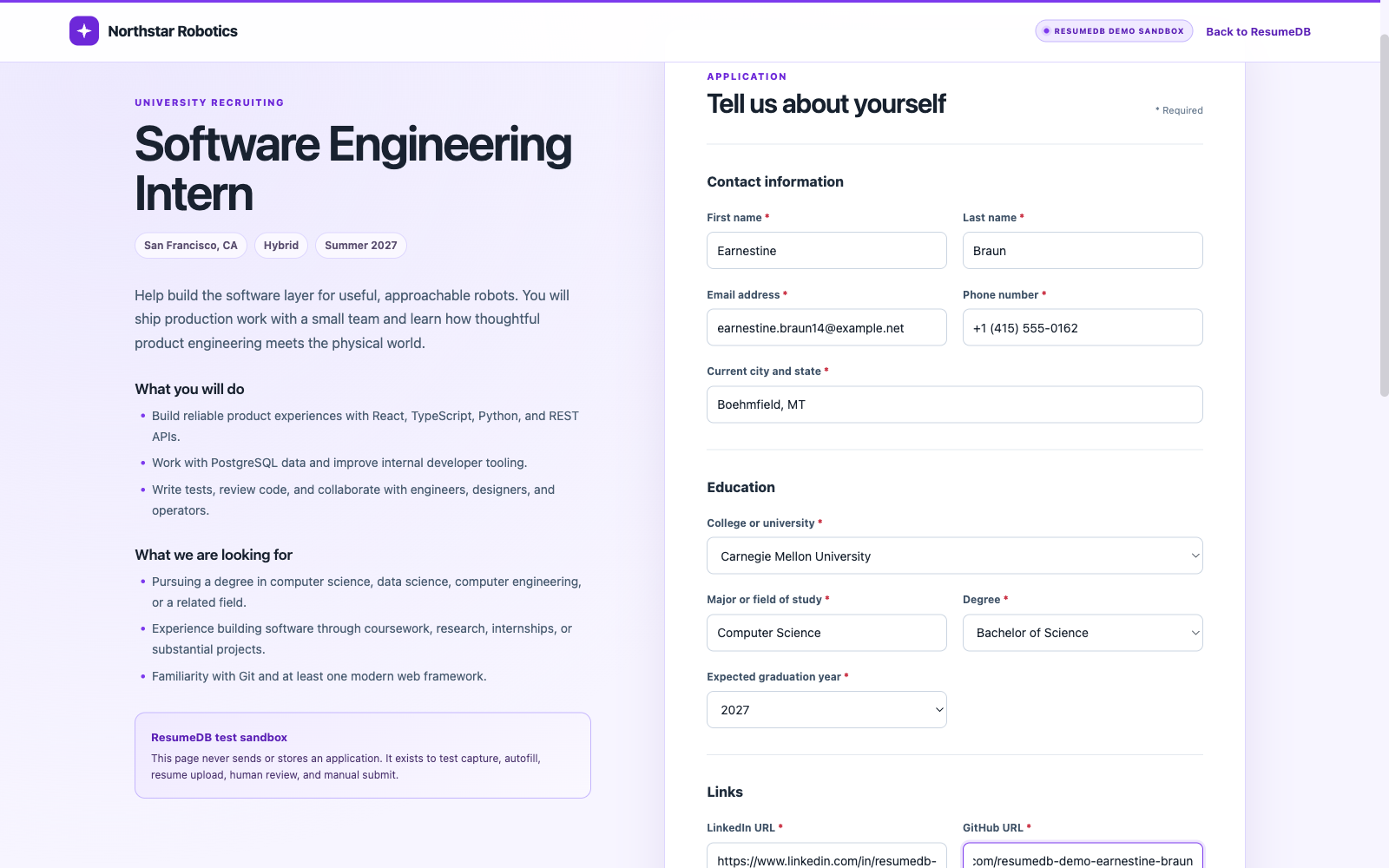
The sandbox ATS after approved answers and a tailored resume have been autofilled.
Inspiration
Applying for internships should not require students to maintain a resume builder, job tracker, spreadsheet, notes app, AI chat, and form filler that all forget one another. The hardest part is not generating more text. It is preserving a trustworthy career story, finding roles that actually fit, and moving each application forward without inventing facts or taking control away from the student.
We built ResumeDB as an agent-native internship operating system: one durable source of truth and one guided workflow from discovery to application.
What it does
ResumeDB learns a complete, user-approved career knowledge base from a resume, profile, experience, preferences, and reusable application answers. A student can ask for opportunities in natural language or paste any public job URL. The agent researches the role, compares it with explicit candidate evidence, scores the fit, identifies missing facts and hard conflicts, and saves qualified opportunities.
For strong matches, ResumeDB prepares a complete application package:
- A job-specific resume and rendered PDF
- Evidence-linked before-and-after resume edits
- Application answers with provenance
- A cover letter and recruiter message
- A clear record of tailoring decisions and unresolved facts
Every application moves through five explicit stages: not started, in progress, draft, ready, and submitted. Moving a draft to ready requires human review. Moving a ready application to submitted requires the student's final action.
After approval, the ResumeDB Chrome extension scans an application page, previews every field mapping, fills supported answers, and uploads the tailored resume. Unknown or sensitive answers remain blank for review, and the extension never clicks the final Submit button.
Students can use the hosted agent or connect their own OpenAI Codex client through ResumeDB's authenticated MCP server. Either way, the same verified memory, application artifacts, and safety rules remain in place.
How we built it
The frontend is a React and TypeScript application built with Vite. A Python FastAPI backend exposes the application API, streams persistent agent timelines over WebSockets, runs the job discovery and preparation pipeline, and serves a Streamable HTTP MCP interface.
OpenAI Codex with GPT-5.6 powers the agent workflows and helped us build, test, and refine the product. ResumeDB supports streamed, multi-turn Codex sessions for the Career Agent and strict JSON-schema output for bounded reasoning tasks such as job extraction, fit analysis, and application preparation. External job pages are treated as untrusted data. Model output is validated before ResumeDB writes it.
Career data lives in a separate local Git repository as readable YAML and Markdown. That makes every profile and application change inspectable, diffable, and recoverable. Typst renders tailored resumes into PDFs. The Chrome extension handles page capture, read-only mapping previews, semantic form filling, and resume upload inside the student's signed-in browser session.
The hosted demo uses Vercel for the web app and Railway for the FastAPI service with persistent storage. A synthetic demo sandbox lets judges exercise the complete workflow without exposing real candidate data.
Challenges we ran into
The first challenge was memory without fabrication. Career tools often make a confident guess when a field is missing. ResumeDB instead models unknowns directly, blocks approval when a required fact is unresolved, and carries provenance into each generated artifact.
The second challenge was arbitrary application forms. Labels, custom controls, dynamic pages, and resume inputs differ across ATS platforms. We built a two-phase extension flow: scan and preview first, then fill only the approved mappings. Unmatched questions remain visibly manual.
The third challenge was making agent work observable and durable. Discovery and preparation can span multiple steps, so ResumeDB persists a live timeline of reads, decisions, writes, results, and failures. A refresh should not erase what the agent was doing or why.
The final challenge was balancing automation with user control. We designed the workflow around hard review gates instead of adding safety as a warning at the end.
Accomplishments that we're proud of
We are proud that ResumeDB is an end-to-end working system, not just a resume generator. A student can build verified memory, discover a role, inspect the agent's reasoning, review evidence-backed tailoring, approve a complete package, preview browser mappings, and autofill an application in one coherent workflow.
We are especially proud of the human-control model, the Git-backed audit trail, the before-and-after evidence views, and the bring-your-own-agent MCP connection that lets a student use Codex without sharing a separate model key with ResumeDB.
What we learned
Agents become much more useful when memory, permissions, and progress are visible product concepts. Structured outputs and schema validation make reasoning easier to trust. Explicit unknowns are more valuable than plausible guesses. Browser automation also works best as a reviewed collaboration, not an invisible final action.
Most importantly, the best career agent is not the one that applies to the most jobs. It is the one that helps a student focus on the right opportunities and submit stronger, truthful applications.
What's next for ResumeDB
Next we want to add email status tracking, interview preparation, progress journaling, university network insights, four-year internship planning, and major-specific portfolio and networking tools. We also plan to add production-grade multi-user authentication, tenant isolation, durable usage controls, and a broader library of tested ATS integrations.
Built With
- chrome
- codex
- fastapi
- git
- mcp
- openai
- python
- railway
- react
- typescript
- typst
- vercel
- vite
- websockets
- yaml

Log in or sign up for Devpost to join the conversation.