-
-
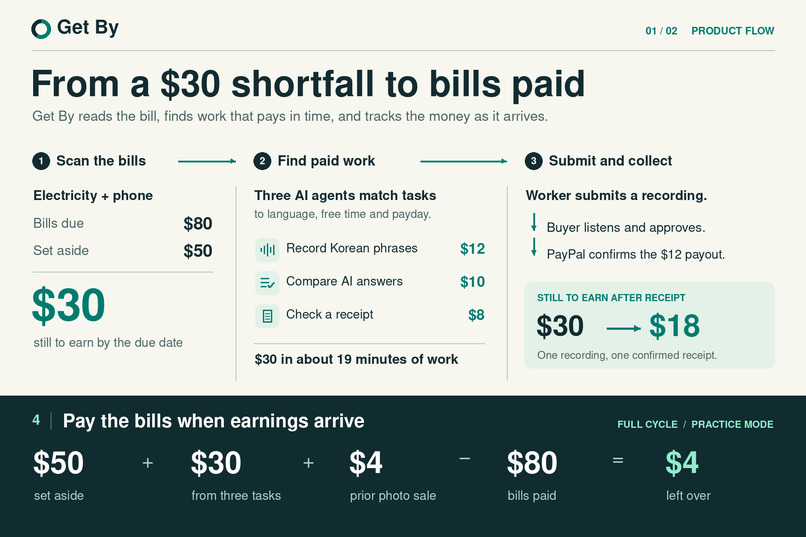
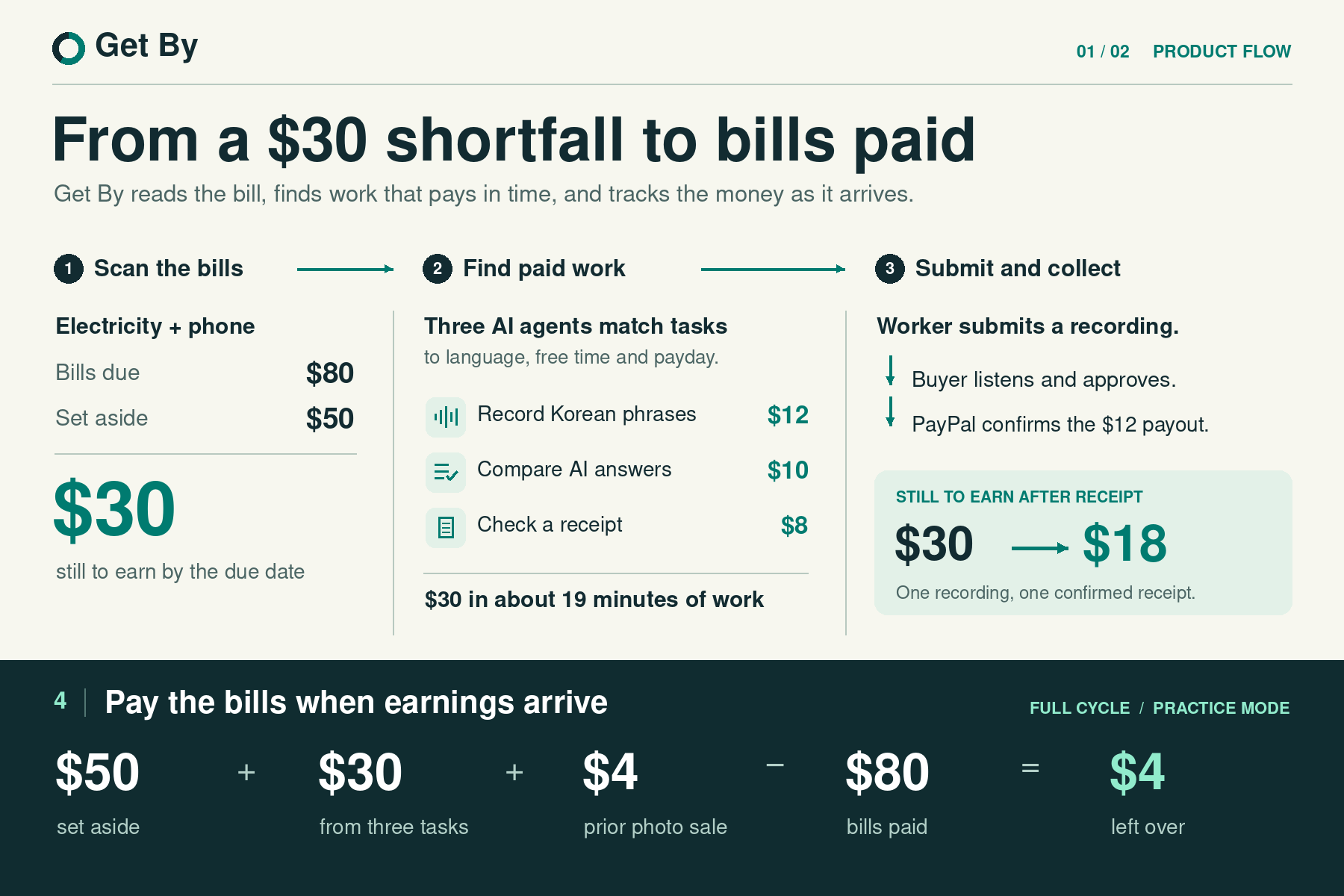
Product flow: Three AI agents find work to cover a $30 bill shortfall. A confirmed $12 PayPal payout brings it down to $18.
-
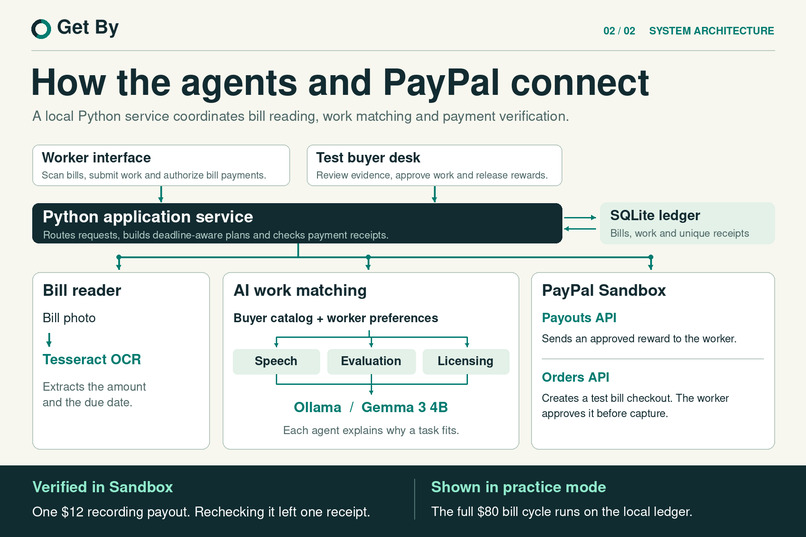
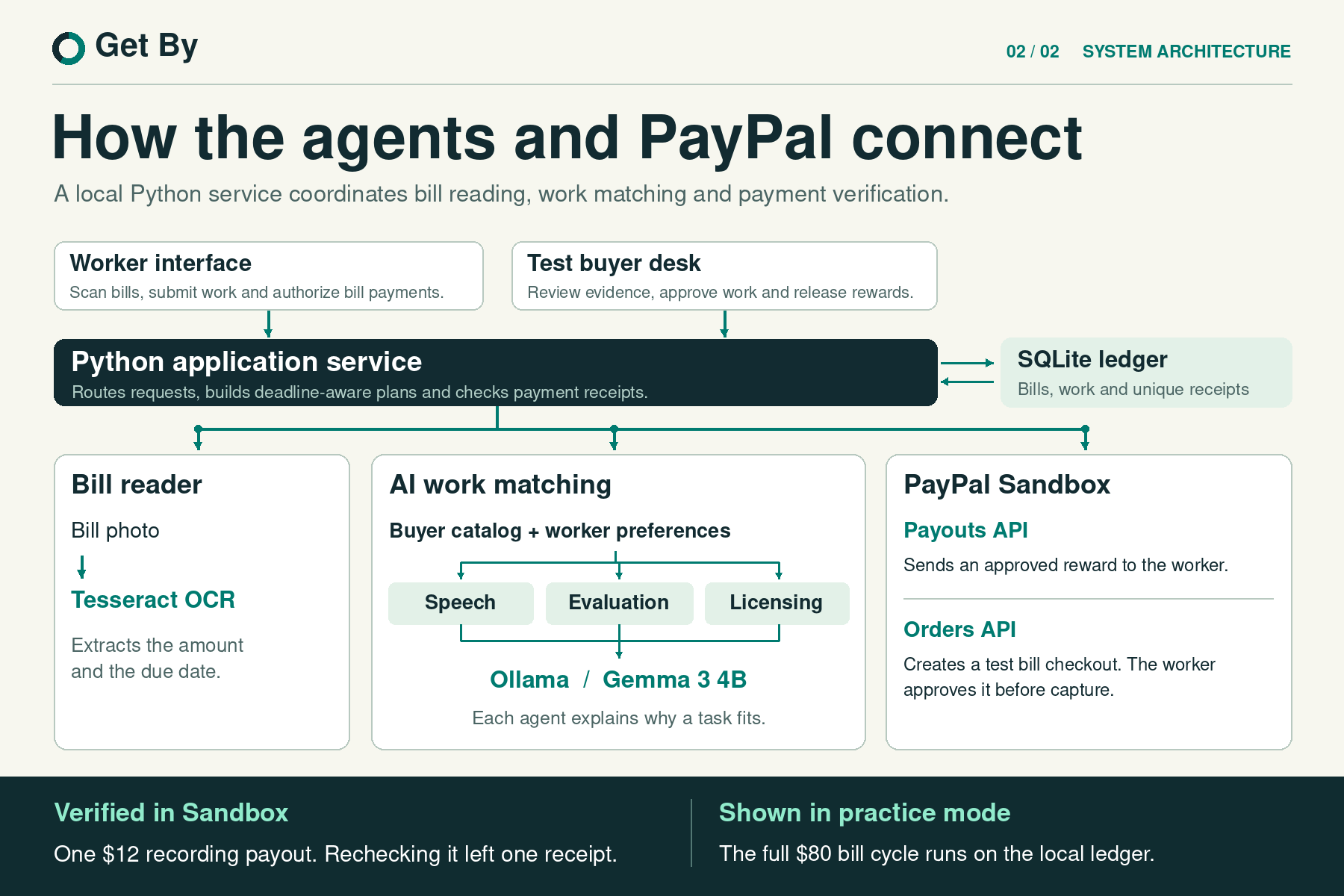
System architecture: Three agents use Gemma via Ollama. Python connects PayPal Payouts and Orders to the SQLite ledger.
-
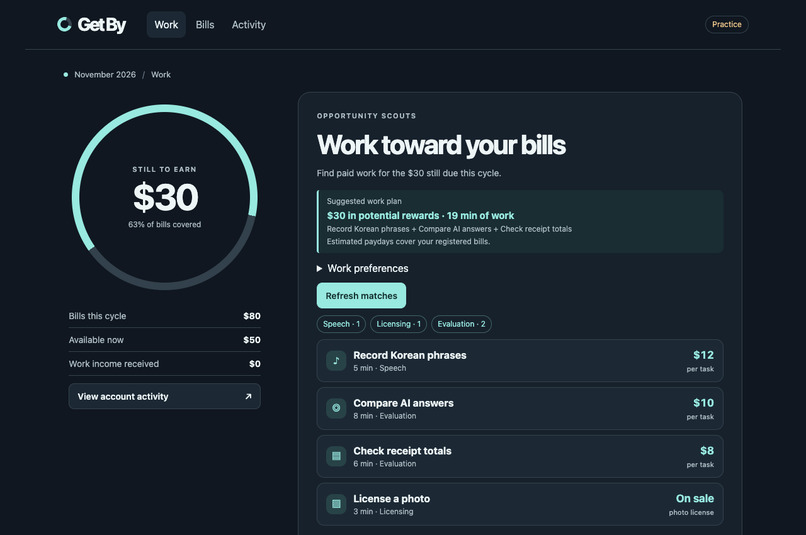
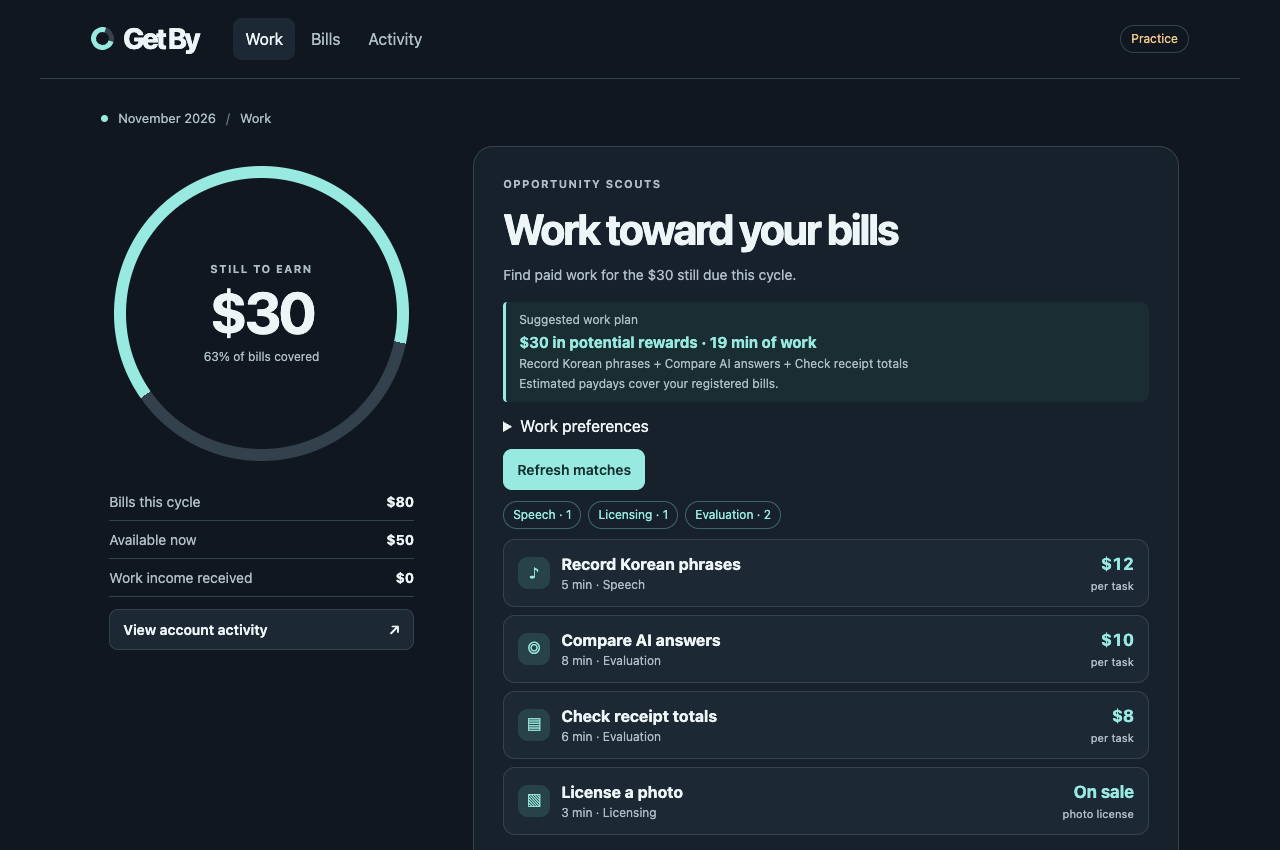
Before the work: $50 is available for $80 in bills. The AI agents suggest three tasks worth $30 in an estimated 19 minutes.
-
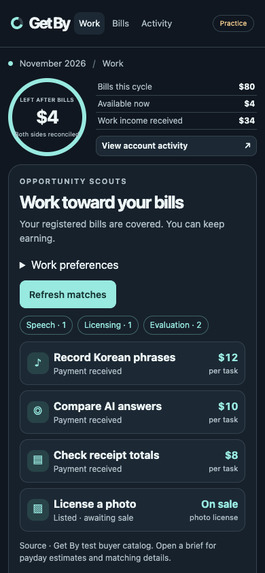
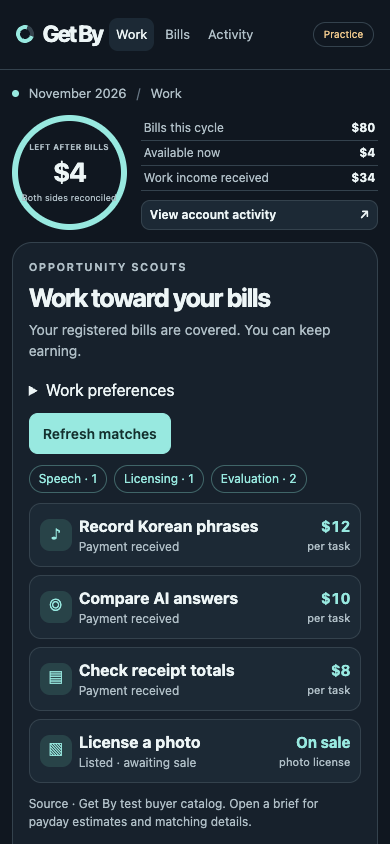
After the work: the practice ledger records $34 in earnings. Both bills are paid, with $4 left.
Inspiration
In the Federal Reserve’s 2025 survey, 28% of U.S. adults struggled to pay their bills in the month before the survey. That included 16% who fell short on at least one bill. Applied to the U.S. adult population, those figures represent roughly 76 million people who had difficulty paying, including about 43 million who fell short.
Imagine your electric bill is due Friday and you’re $30 short. You already know how much you owe. The question is: What work can I do, and will it pay me in time?
We built Get By to answer that question.
Source: Federal Reserve household survey · U.S. Census Bureau adult population estimates
What it does
Take a photo of a bill. Get By reads the amount and due date, calculates how much you still need, and uses AI agents to find paid tasks that fit your language, available time, and bill deadline.
In our demo, the user has $50 set aside for $80 in electric and phone bills. The agents find three tasks that cover the $30 gap in an estimated 19 minutes of work:
- $12 — Record a few Korean phrases.
- $10 — Compare two AI answers and explain which one is better.
- $8 — Check a receipt for accuracy.
The buyer can listen to the recording before approving it. Once PayPal confirms the $12 payout, the amount still needed drops from $30 to $18. When enough money has arrived, the user can authorize payment of the registered bills.
How we built it
- Reading the bill. Tesseract extracts the amount and due date from the photo.
- Finding the work. Three AI agents use Gemma through Ollama to review speech, evaluation, and licensing opportunities. Each explains why a task fits. Python checks the reward and expected payday against the bill deadline.
- Moving the money. Get By uses PayPal Payouts for task rewards and PayPal Orders for test bill payments. A SQLite ledger records each confirmed receipt and links it to the original task.
Challenges we ran into
The hardest part was deciding when to count a dollar as available. A buyer can approve a recording while the payout is still pending. Reducing the shortfall at approval would tell someone they could pay a bill before the money arrived.
Get By checks the recipient, amount, and payment status before updating the balance. If the connection drops, it looks up the original payout and records the receipt once.
Accomplishments we're proud of
We verified a $12 recording reward end to end in PayPal Sandbox. The test buyer approved the Korean recording, and PayPal confirmed payment to the worker’s test account. We checked the same payout again. The ledger still showed exactly one $12 receipt.
Our English demo shows the full bill cycle in practice mode. Starting with $50, the user earns $30 from three tasks and receives $4 from a photo listed the previous month. After paying $80 in bills, the user has $4 left.
What we learned
A five-minute task that pays next week cannot cover a bill due tomorrow. That changed how our agents select work. The expected payday matters as much as the reward and the time the task takes.
What's next for Get By
Today, the executable tasks come from our test buyer catalog. For our first live pilot, we want to pair a buyer who needs short language recordings with workers who have a bill coming due.
We’ll measure the result from the worker’s side: How much of the shortfall did they actually cover before the due date, and how much time did it take?