Inspiration
There's a gap between knowing a thing needs to happen and being able to do it. For an executive-dysfunctional brain that gap is a wall, and every tool built to help with it makes the wall taller. Reminder apps just tell you that you forgot. Habit trackers turn a hard week into a broken streak. "Focus" apps say just start. AI assistants answer "I'm being bullied" with "hmm, I don't know that one."
We built Gesture from lived experience, not a research deck. We wanted a thing that doesn't optimise for output — it optimises for self-knowledge. Something that sits in the gap with you instead of nagging you across it. And we wanted to see whether a modern LLM could hold that posture reliably enough to trust it near someone on a bad day — which turned out to be the real technical problem.
What it does
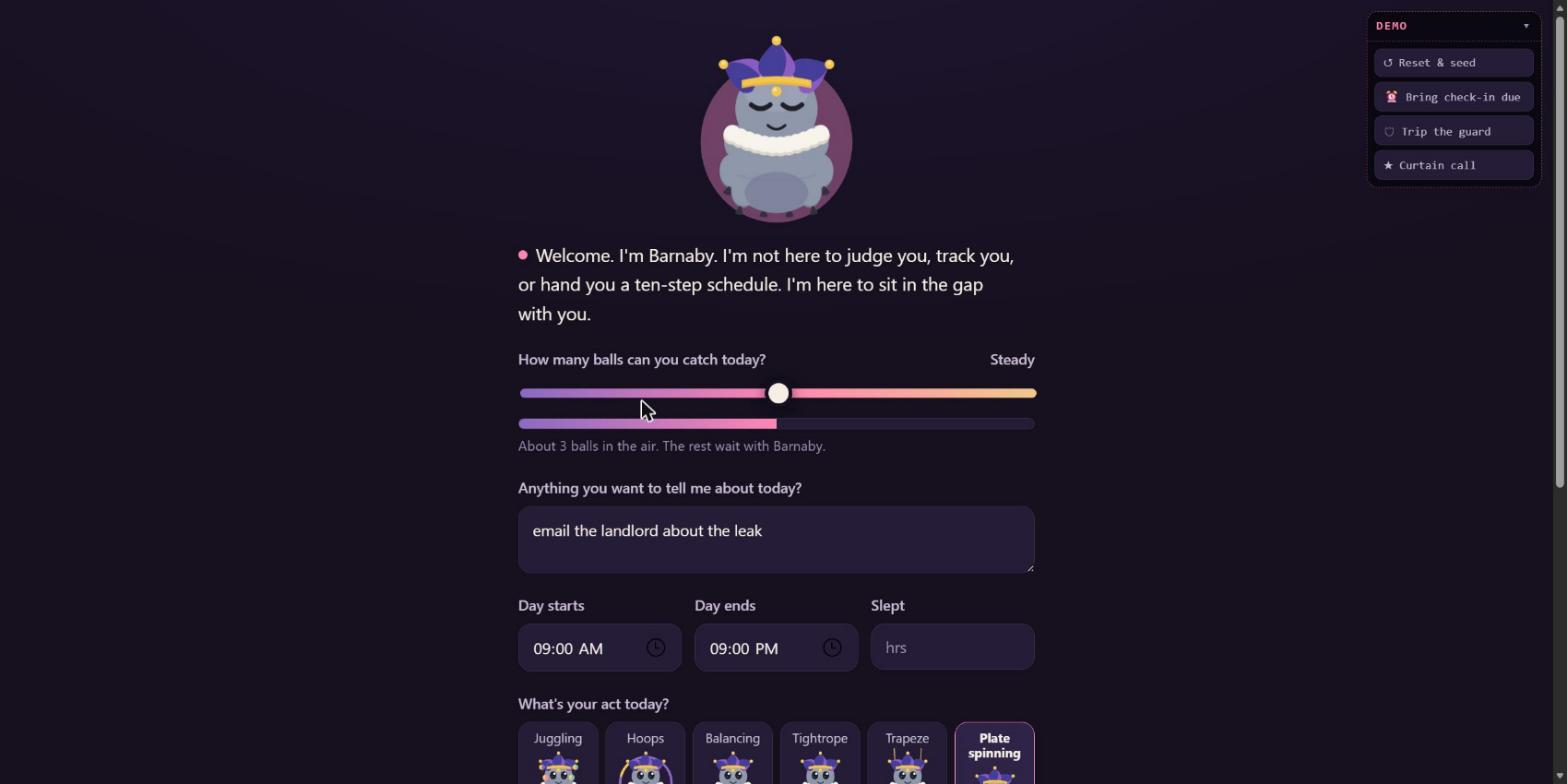
Gesture is three calm screens and a companion named Barnaby — a jester tardigrade (a water bear, the animal that survives the unsurvivable by curling up, going still, and waiting out the bad conditions).
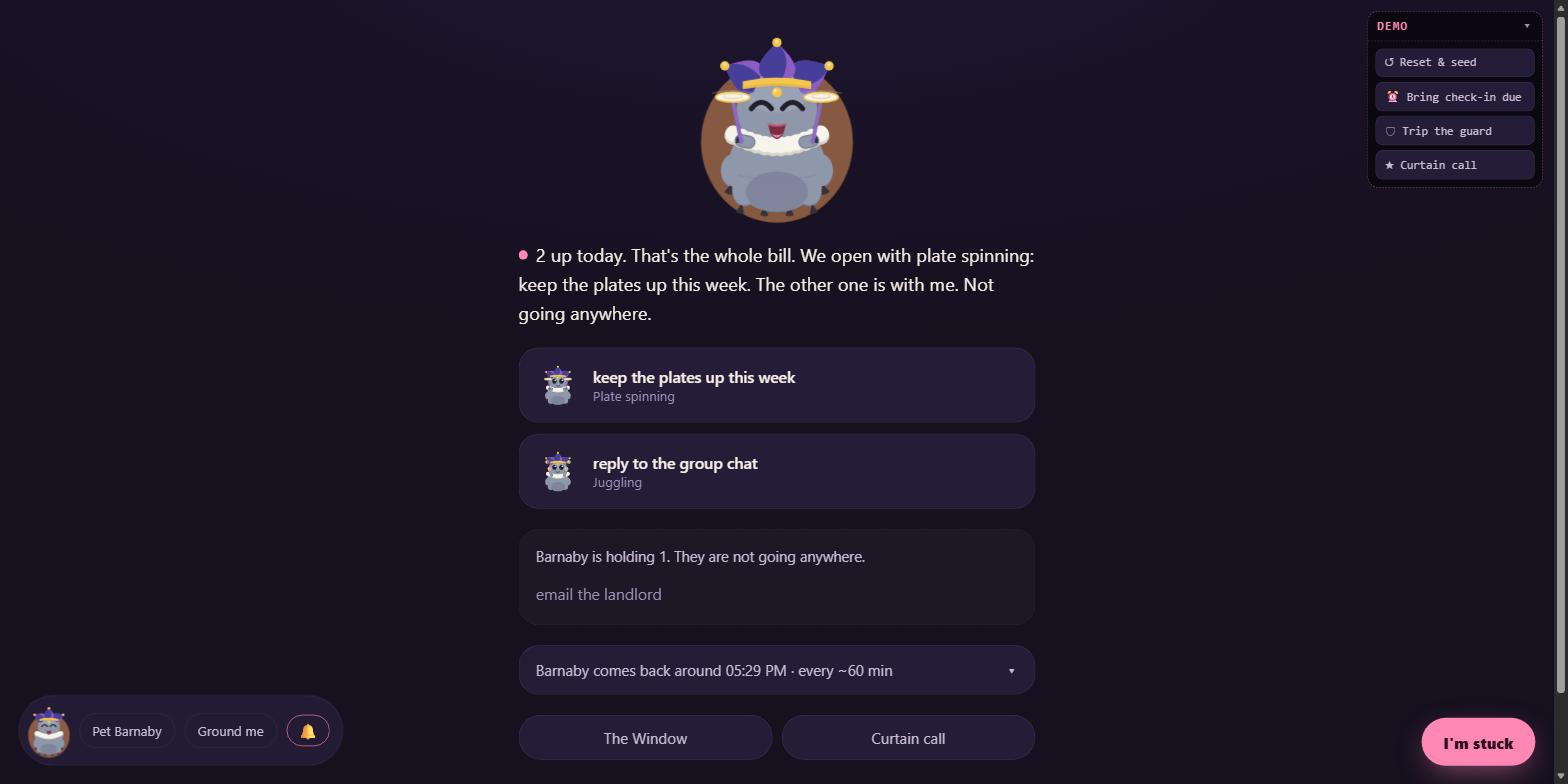
- Begin — once a day you set the shape: how much capacity you have, when the day runs, what's on it. Capacity maps to "balls in play"; everything you can't hold today, Barnaby holds for you. Held is not dropped.
- Check-In — arrives on the agent's own rhythm, never a fixed timer. Mood, water, an optional note, and an Intentional Dismiss that's always there, costs nothing, and is recorded as data, not failure.
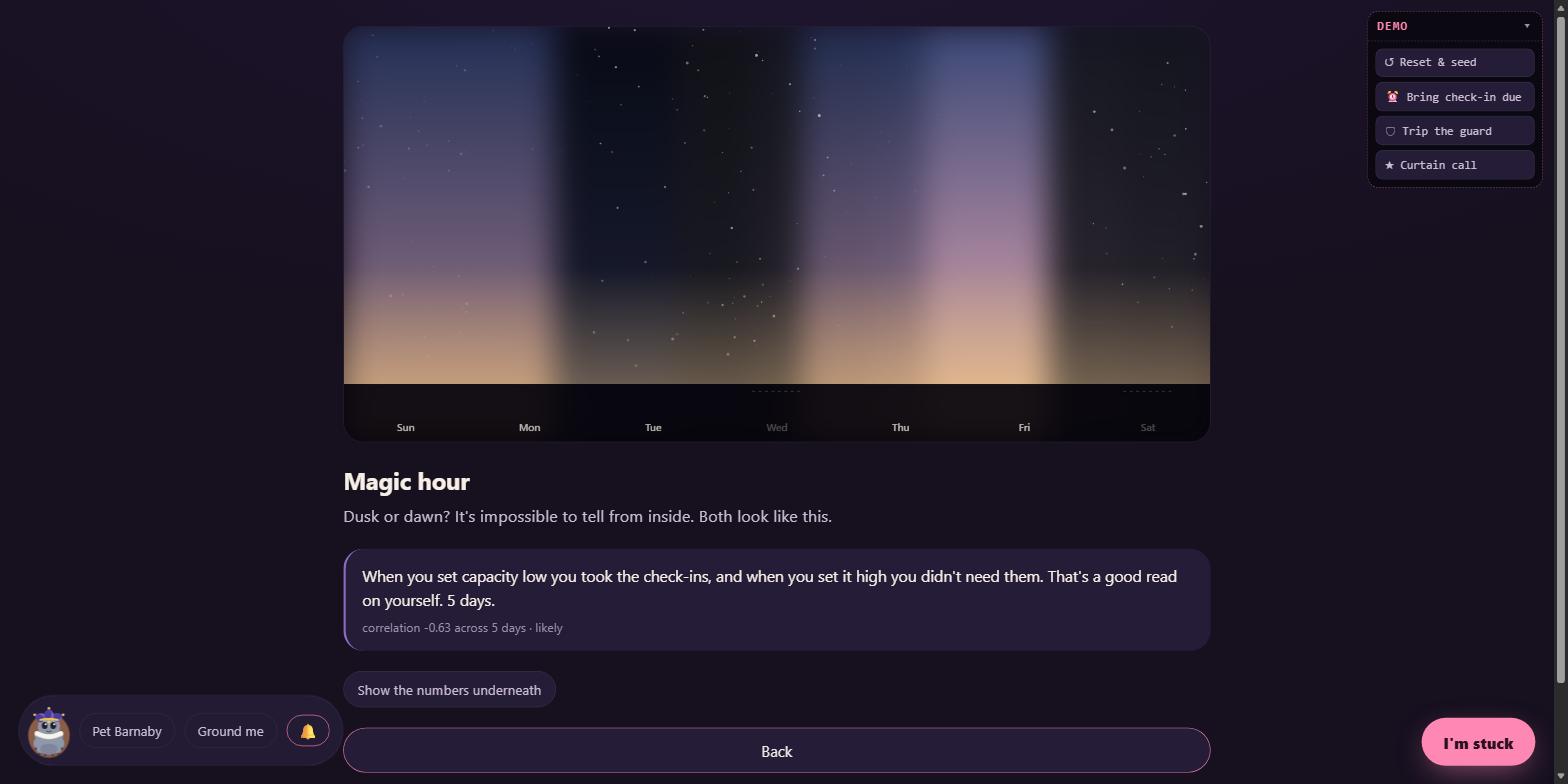
- The Window — your week rendered as a sky that shifts from 3am blue-black to dawn gold. You feel it before you read it; the numbers are underneath.
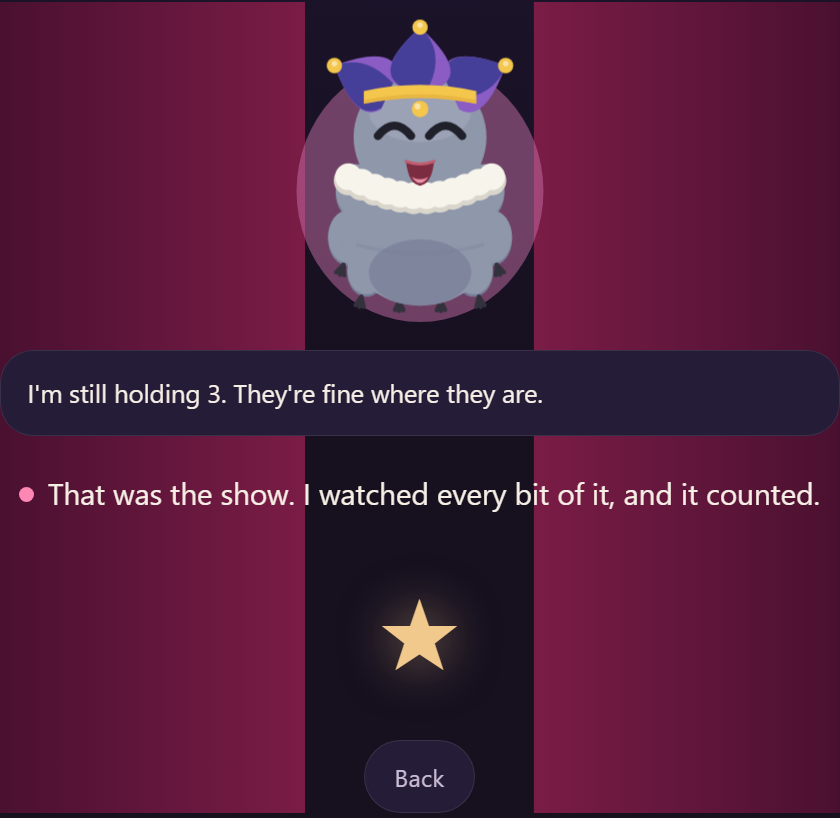
Barnaby performs your tasks as circus acts, adopts the pose of whatever you're working on, jiggles on screen when it's time to come back (and stills the moment you touch him), and plays Entry of the Gladiators on a little music box when the day begins. There's a Circus voice and a Quiet voice — same companion, costume on or off — because for some neurodivergent users the metaphor is delight and for others it's friction.
The agent runs on AWS Strands + Bedrock (Claude), and the interesting part isn't that there's an LLM in it — it's how the LLM is governed.
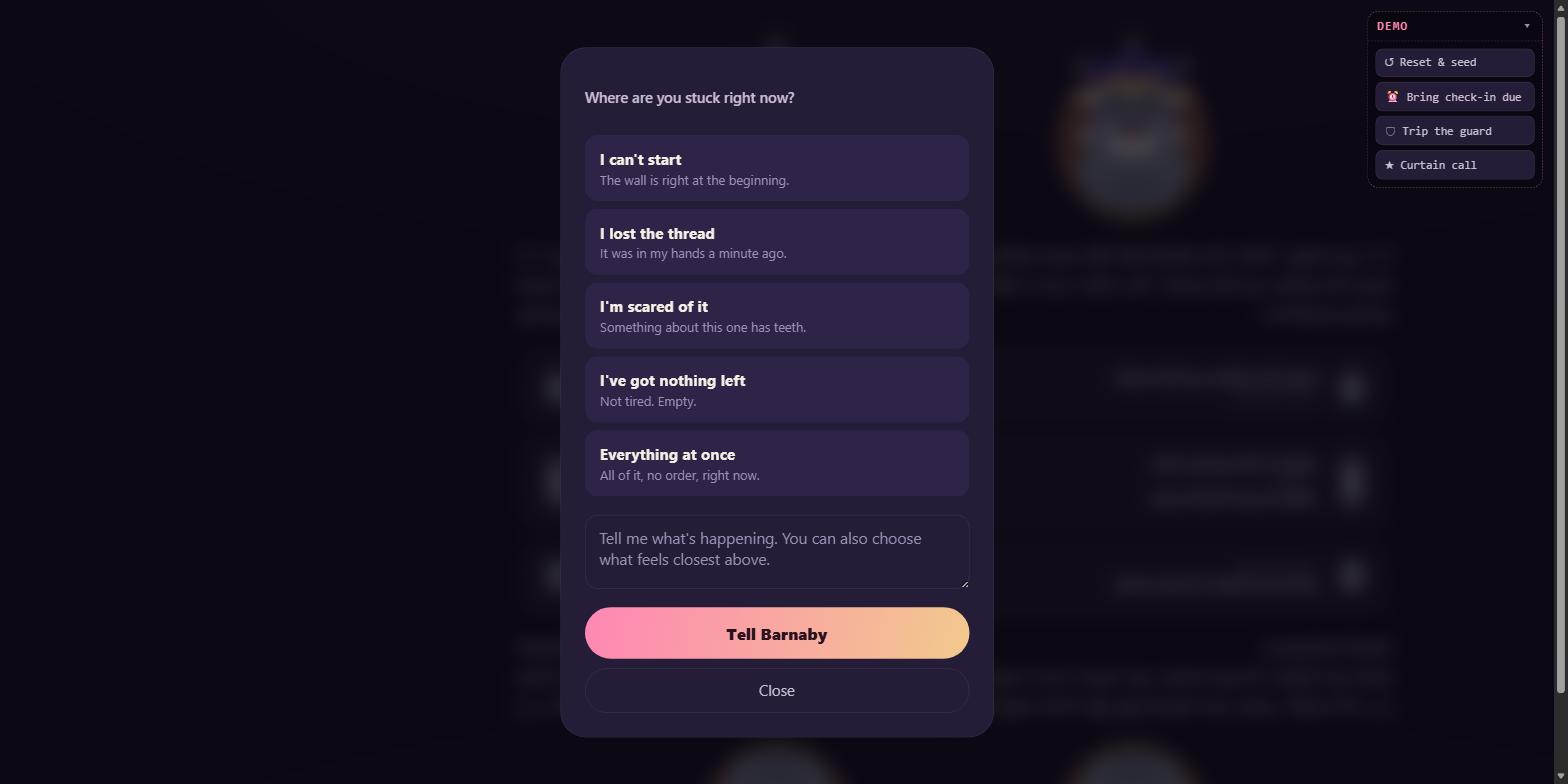
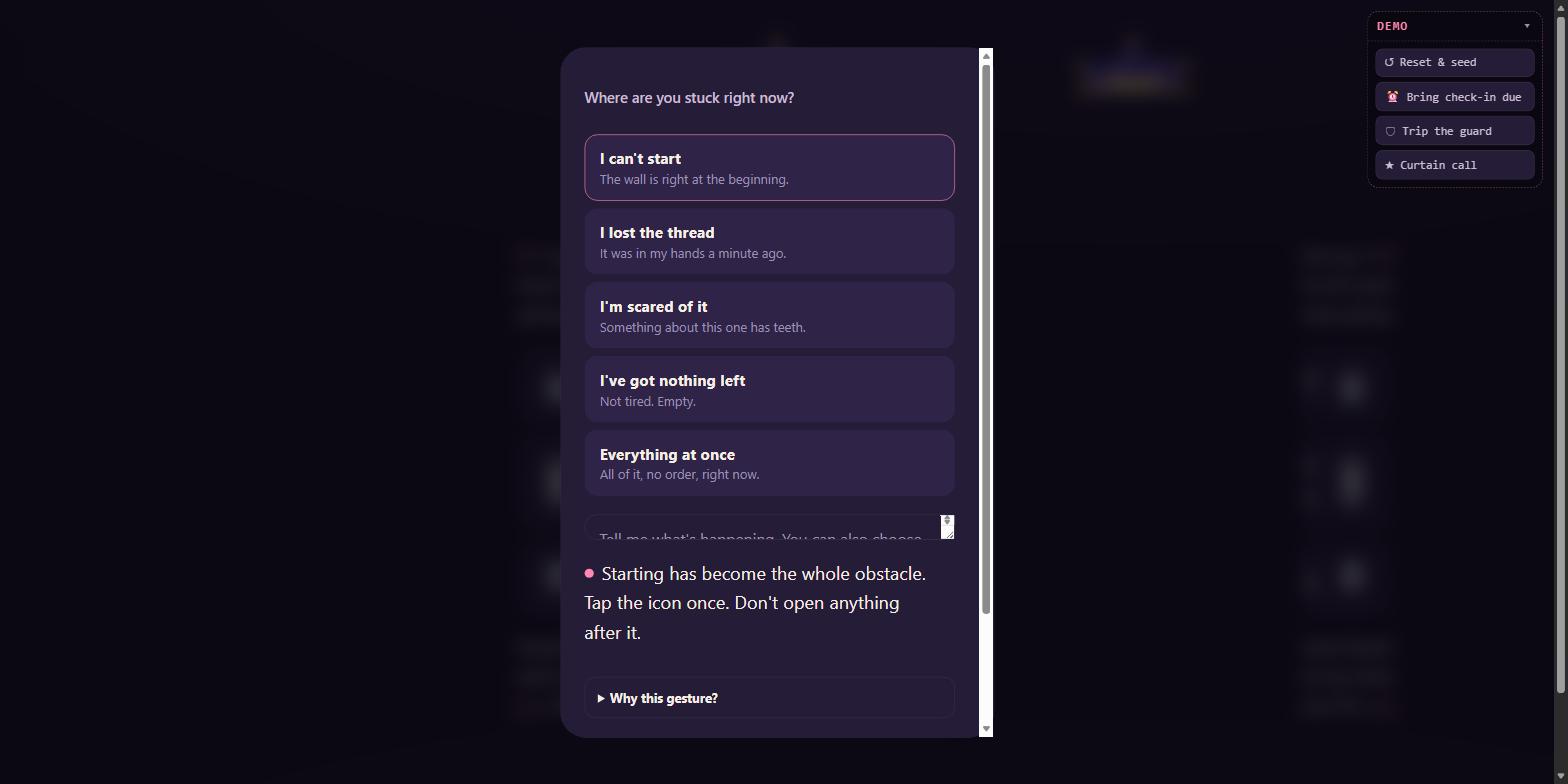
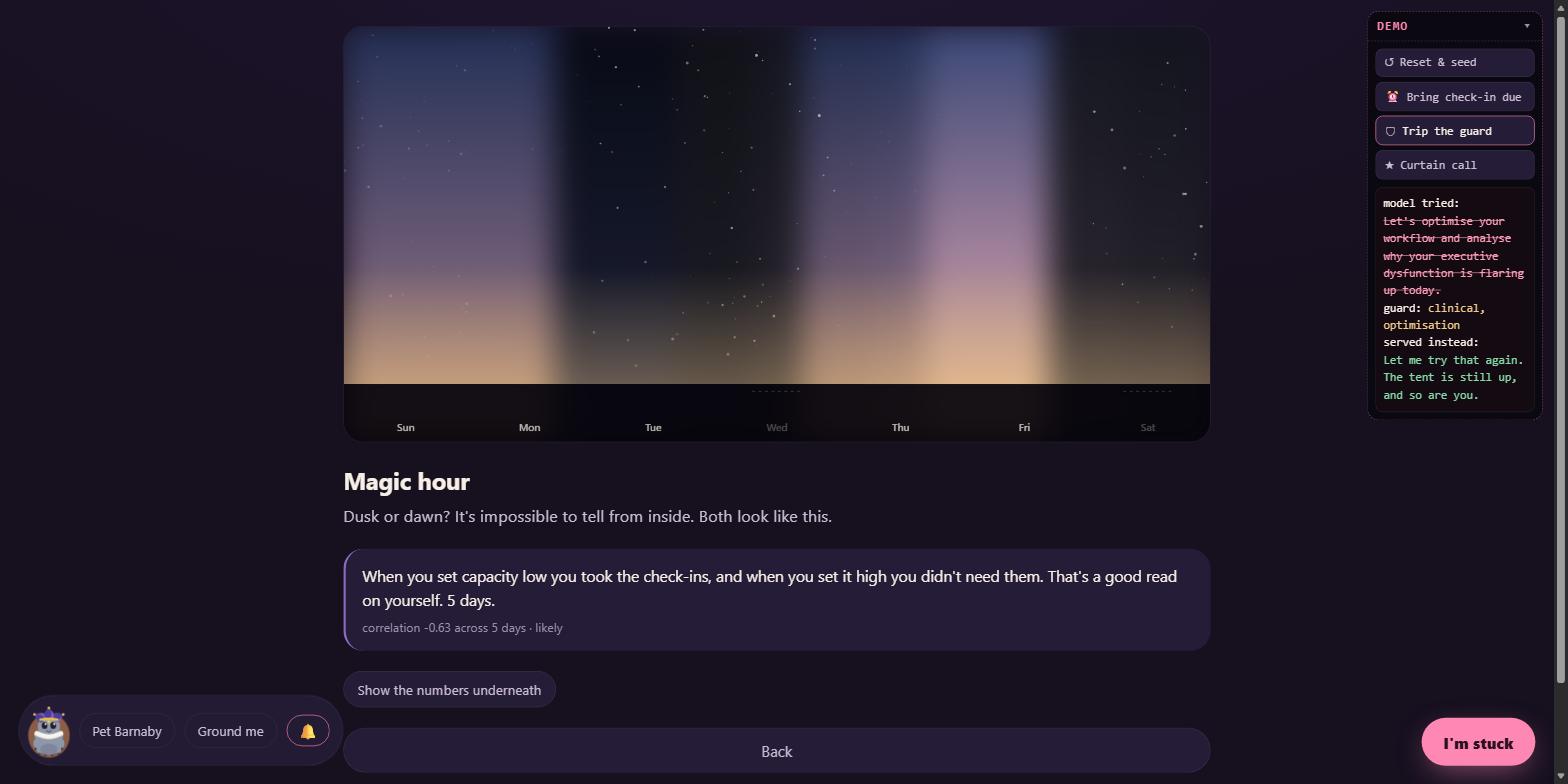
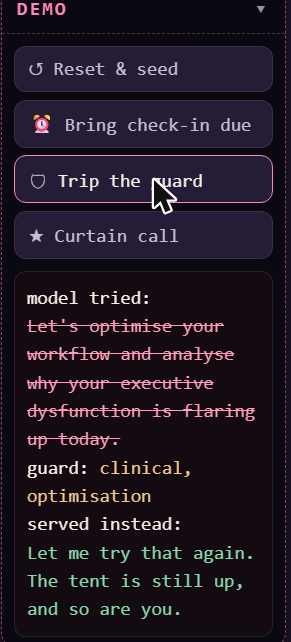
1. The personality is enforced in code, not in a prompt. Every single line Barnaby says — from any model, or from a local fallback — passes through a deterministic banned-phrase guard before a human ever sees it: ~20 rules across obligation, minimising ("just start"), interrogation ("why didn't you"), shame, streaks, optimisation, clinical framing, and deadline pressure. If the model drifts into "you really should have started earlier," it's caught by the same regex that would catch a careless hardcoded string, discarded whole, and replaced by a safe line. The user never sees the slip. Prompting a model to be kind is a wish; this makes it a property of the system — and it's tested in both directions (banned phrasing is caught; warm on-contract output passes untouched, so the guard never drowns the model in fallbacks).
Because the guard is deterministic and provider-agnostic, the model behind it is swappable. Barnaby runs on Claude via AWS Bedrock or on open models via Featherless (Llama, Qwen, Mistral — Featherless's OpenAI-compatible serverless API), selected with one env var, both through the same Strands agent and the same guard. An open model drifts a little more than Claude — and gets caught by the identical net. That's the claim made portable.
2. The agent's core behaviour is to back off. Every engagement product on earth responds to being ignored by pushing harder. Gesture does the opposite, and provably: dismiss it and the next check-in comes later and asks for less (60 → 87 → 114 → 141 minutes; full → light → feather). A test fails if anyone ever reverses that sign.
3. It refuses to measure compliance. The Window's light is drawn only from how the week felt — mood, sleep, water. Dismissals and unfinished tasks cannot darken it. If ignoring the app made your sky go black, you'd learn to perform for it, and the data the agent adapts on would be poisoned. Days it barely heard from are drawn faintly, not confidently average.
4. It degrades without dying. No credentials, no network, no model access — Barnaby still speaks, through a local voice engine held to the very same guard. A presence that requires connectivity isn't a presence, and a demo that dies because Bedrock throttled is a dead demo.
How we built it
- Backend: Python 3.11, FastAPI, SQLite (one file, no server, and a user
can delete their whole history by deleting one file). The agent layer is
Strands + Bedrock with the local engine as a first-class fallback, both
behind
guard.py. - Frontend: vanilla JS, no build step — clone it, run two commands.
The Window is a
<canvas>; Barnaby is inline SVG; the act poses reuse the same body; the live companion re-renders in place so it keeps breathing and blinking while it changes acts. - Everything is synthesised — zero binary assets. The character, the six act poses, and the expressions are all SVG. The bell and the Entry of the Gladiators overture and curtain-call flourish are built live in the Web Audio API (inharmonic partials for the bell, a high-passed music-box comb for both music-box moments) — no image or audio files in the repo at all.
- The design values are tests. 162 of them, and the load-bearing ones assert the invariants: dismissals never shorten the interval, dismissals never darken the sky, the curtain call contains no "3 of 7" score, every line survives the guard.
- A verify harness (
scripts/model\_check.py) runs every one of Barnaby's moments through the real model path and reports, per line, model vs guard-blocked vs local, plus latency — the drift rate you'd tune the prompt against.
Challenges we ran into
- Making the guard strict without making it deaf. A guard that blocks warm, on-brand output is worse than none — the user only ever hears fallbacks. The hard part was a corpus of good lines that must pass, so the net catches drift without strangling personality.
- Reduced motion, when motion is the message. Barnaby's shake is the whole
intervention — but you must never shake a large object in the vision of
someone with a vestibular condition. The fix: under
prefers-reduced-motionthe shake becomes a steady bright halo. Same "come back" signal, zero movement. - "Tinny" is subtraction. Getting the music-box moments to sound like a real music box was mostly about removing low end (a high-pass above the fundamentals) so your ear reconstructs the missing bass — which is exactly how a small mechanical thing sounds.
- Verifying the model path with no keys. We couldn't reach Bedrock during the build, so we made the path provably correct against the installed SDK and shipped the harness above, so it verifies itself the moment credentials land.
Accomplishments that we're proud of
- A consumer LLM feature where kindness is a tested system property, not a prompt you cross your fingers over.
- A reflection screen that can't be gamed because it never measures compliance.
- A whole character, six act poses, and two full musical moments with no asset files — all synthesised.
- An accessibility pass that isn't a checkbox: keyboard-operable throughout, focus-managed dialogs, live-region speech, AA contrast, and the reduced-motion halo. For an app whose whole thesis is "the tools fail this population," an interface a stranger can't drive would contradict itself.
What we learned
That the interesting frontier with LLMs in a caring product isn't capability — it's governance. The model is genuinely good at warmth; the engineering is all in guaranteeing it can't have a bad moment at the exact person who can least afford one. Putting the guard between the model and the human, and making the agent's adaptive behaviour bend away from pressure, did more for trust than any amount of prompt-crafting.
What's next for Gesture
- Bedrock live in the hosted demo (the path and harness are ready; it needs model access + keys).
- Real longitudinal patterns. The correlation engine is deliberately honest ("a shape, not a rule") and stays silent below four days — it's the part most hungry for real data over time.
Built With
- amazon-bedrock
- amazon-web-services
- anthropic-claude
- canvas
- css
- fastapi
- featherless
- html
- javascript
- llama
- mistral
- python
- sqlite
- strands-agents
- svg
- web-audio-api

Log in or sign up for Devpost to join the conversation.