-
-
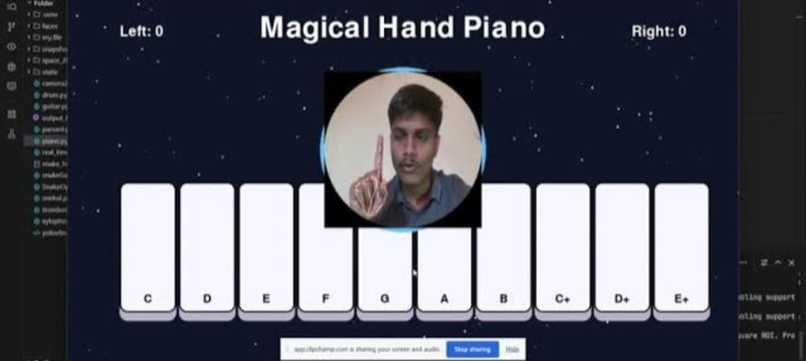
project look like
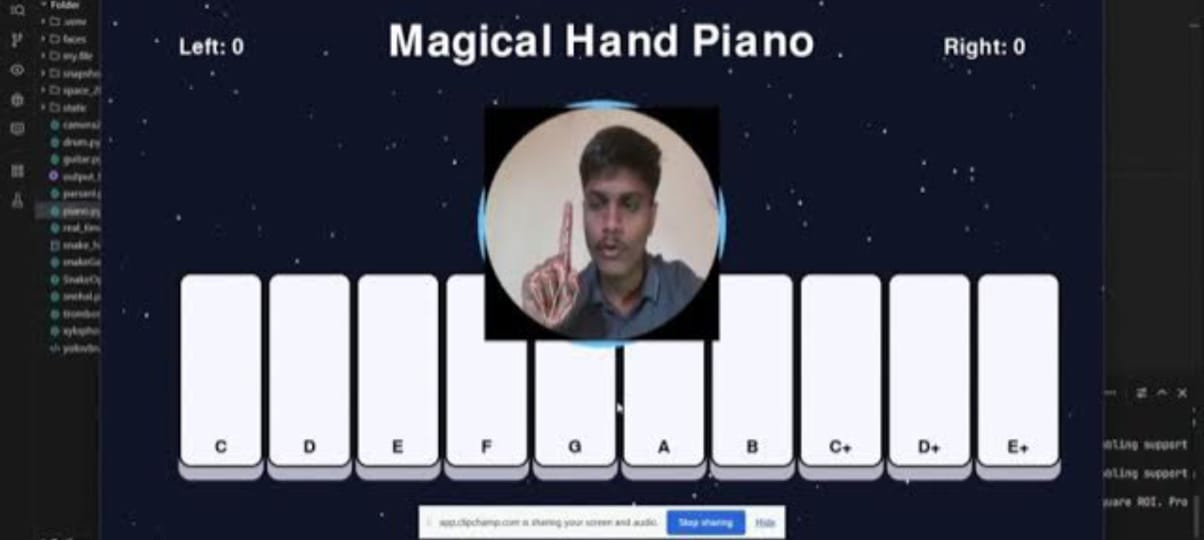
Inspiration
The inspiration for Gesture-Based-Musical-Instrument came from wanting to make music learning more accessible and enjoyable for students. Many schools lack enough instruments, so I wanted to build a tool where anyone could create music using just their hands. Combining AI, computer vision, and creativity motivated me to explore how gestures could become musical notes, making education more interactive and fun.
What it does
This project captures real-time hand movements through a camera, detects hand landmarks using MediaPipe, and converts specific gestures into musical sounds. When a user moves their fingers or changes the distance between them, the program maps these gestures to different pitches or tones. It acts like a virtual musical instrument that students can play in the air without touching anything.
How we built it
We built the system using Python, OpenCV for video processing, MediaPipe for accurate hand tracking, and audio libraries to generate sound. The camera captures each frame in real time, and the model identifies 21 hand landmarks to understand the user’s gestures. These gestures are then translated into corresponding musical notes, allowing the system to function like a virtual instrument. Visual feedback is displayed on the screen so students can clearly see how their hand movements are being interpreted, making the learning experience intuitive and interactive.
Challenges we ran into
Some major challenges included unstable hand detection in low lighting, delays between gesture movement and sound output, and difficulties in mapping gestures to accurate musical notes. Optimizing the frame rate, improving gesture thresholds, and testing in different environments required time and experimentation. Ensuring the system performed smoothly on different devices was also a challenge.
Accomplishments that we're proud of
We are proud that the project successfully turns simple hand gestures into real-time musical sounds, making it both educational and engaging. Creating an instrument that requires no physical hardware and works only with a camera feels like a meaningful achievement. We are also proud of improving gesture accuracy and building an accessible tool that can help students experience music in an innovative way.
What we learned
We learned how computer vision pipelines work, how to track hand landmarks, and how gesture-based interaction can be translated into audio output. The project taught us mathematical concepts behind gesture measurement, real-time processing, debugging, optimization, and user-friendly design. Overall, it strengthened our understanding of AI, algorithms, and creative problem-solving.
What's next for Gesture-Based-Musical-Instrument
Next, we plan to add more gesture options, support multiple instruments, improve sound accuracy, and create a user-friendly interface for classrooms. We also aim to build a web-based version so students can use the instrument anywhere without needing software installation. In the future, we hope to add learning modules so students can practice musical scales and rhythm using gesture-based interaction.

Log in or sign up for Devpost to join the conversation.