-
-
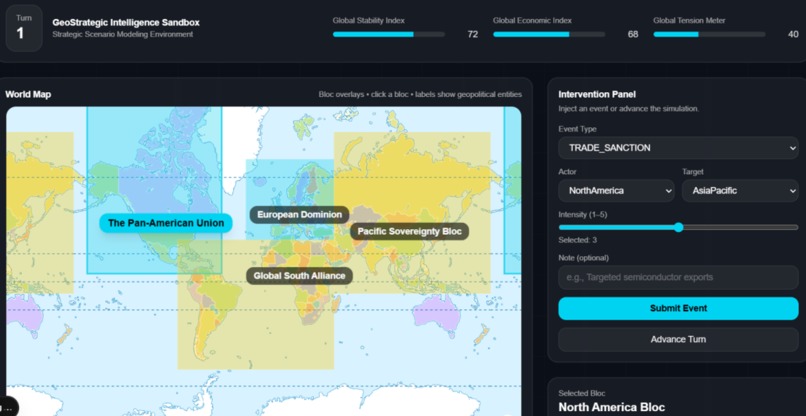
Dashboard
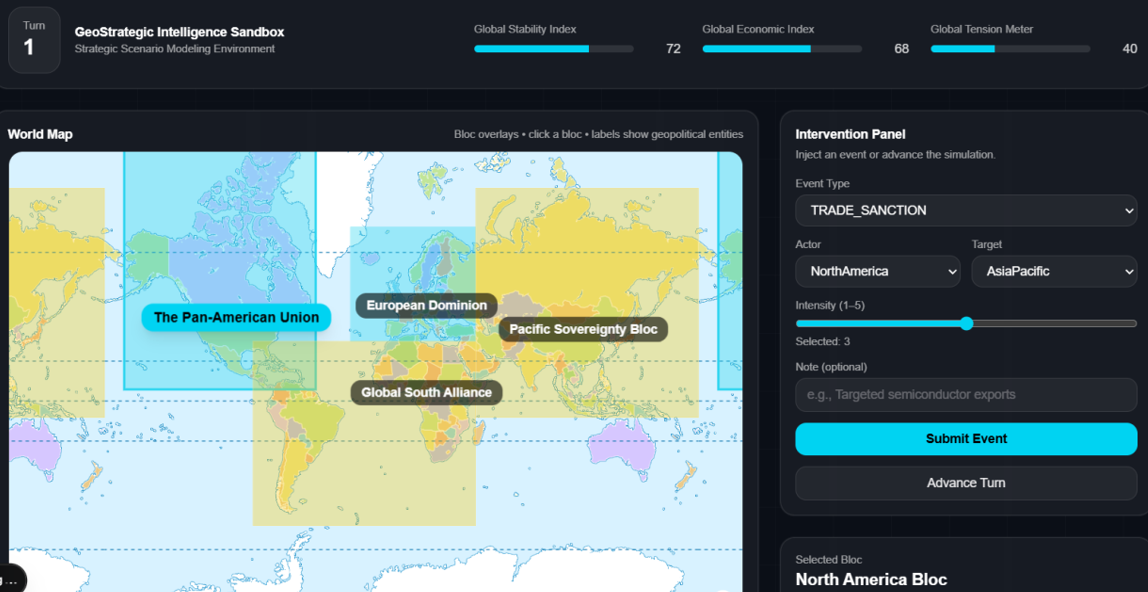
Inspiration
It is challenging to grasp the intricacies of global conflicts, alliances, and shifting economies. We aimed to create a system that provides a sense of the impact of geopolitical choices and features around the world. We aimed to create a tool that can be used as a sandbox to implement and evaluate policy changes, start and end wars, form alliances, and adjust economies with respect to a user-defined set of global variables.
What it does
GeoStrategic Intelligence Sandbox is a virtual world where users create worlds and interact with them by placing geopolitical actions and observing the reactions of countries to the actions over time. Users can place various wars, alliances, and economic events, and the world will evolve on a per-turn basis based on the degree of global stability, military expenditure, and international relations.
How we built it
GeoStrategic Intelligence Sandbox was developed with a Python backend based on FastAPI, which manages the geopolitical simulation engine, the state of the world, events, and decisions taken by AI agents acting as countries, with Amazon Nova Lite being used for the latter. The backend is hosted on Render, with the Next.js frontend being used to provide a interactive dashboard for the simulation, which can be run locally with npm run dev to show the map, blocs, and events.
Problems we encountered
A major challenge we experienced was completing the simulation in a realistic manner rather than in a random one. We had to implement the mechanisms to have the country attributes of stability, military spending, and relations change in a manner consistent to events and previous values. The entire stack and frontend and backend combination had to be done perfectly.
Achievements we are pleased with
A positive outcome we had was creating a working geopolitical sandbox which allowed users to create events and watch how the events impacted the world. The simulation engine successfully dealt with blocks, decisions and changes in the world for a specific number of turns.
Challenges we ran into
One of the biggest challenges was to make sure the simulation was developed as realistically as possible. This meant building systems that adjusted the parameters of the simulation (eg. stability, military spending, diplomatic relations between countries). Also, integrating the entire stack and configuring the front and back end services was a challenge.
Accomplishments that we’re proud of
We are pleased with the development of a prototype of a geopolitical sandbox in which users can create and modify events and observe how the global environment is impacted. The simulation engine monitors all the blocs, actions, and changes in the world for a defined number of turns.
What we learned
Building simulation systems, integrating AI decision-making systems with structured data, and developing fully operational advanced systems are the things the project showed us. Also, we learned to manage a complex world state and the relationships between different entities.
Future Developments for GeoStrategic Intelligence Sandbox
Moving forward, we want to add even more realism to our simulations by incorporating actual data from more countries, and creating more complex economic and diplomatic models along with more sophisticated AI decision-making models. Users will benefit from the integration of interactive visual data to understand the consequences of different geopolitical situations.
Built With
- fastapi
- next.js
- nova
- python
- render
- typescript

Log in or sign up for Devpost to join the conversation.