
Inspiration
The emotional feel of a place — whether peaceful, energetic, or chaotic — can impact mood, behavior, and well-being. We were inspired to explore how AI could interpret and map these feelings using visual and environmental cues, helping people make more mindful spatial choices.
What it does
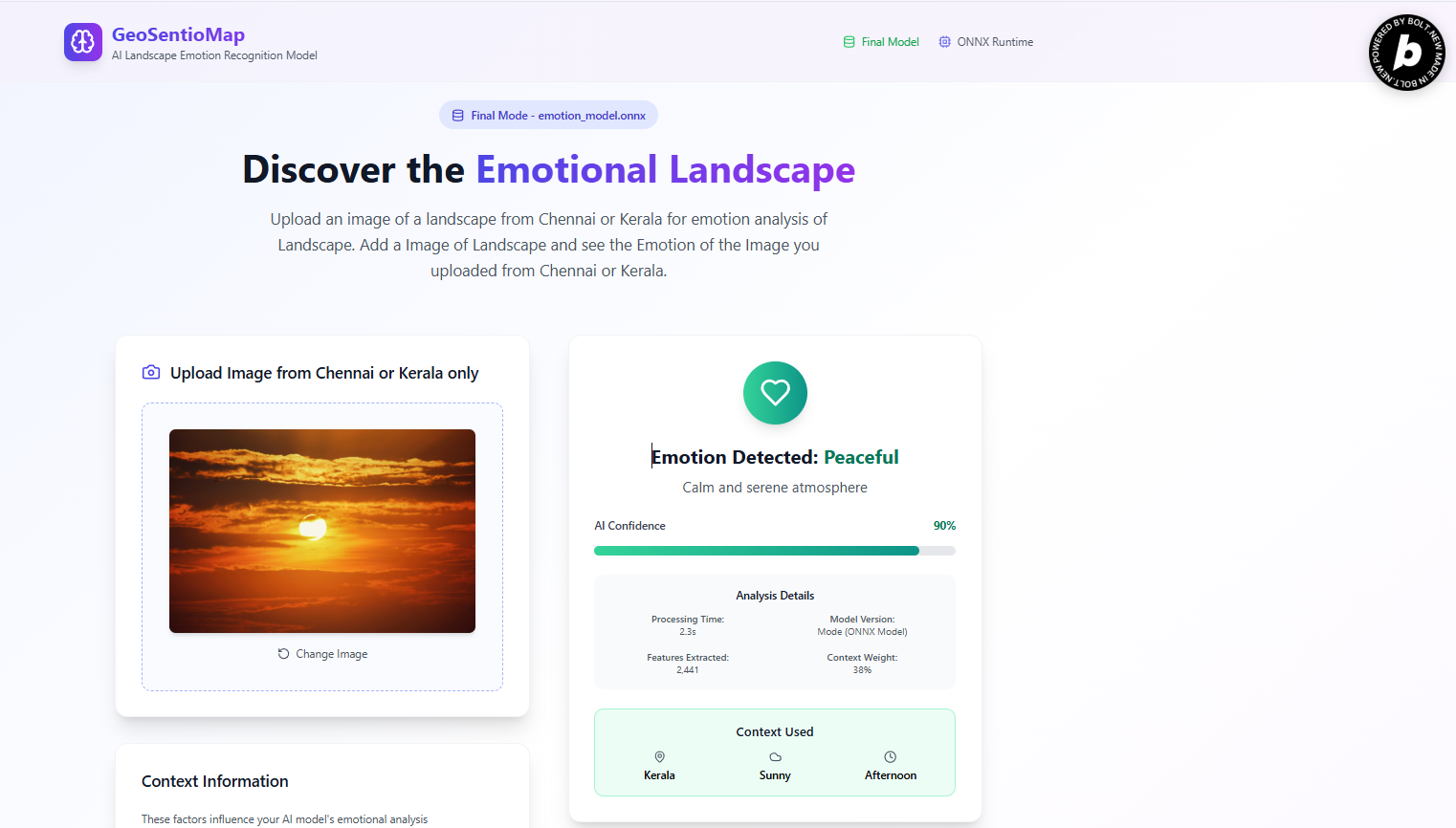
GeoSentioMap classifies public space images by emotional tone using both image features and contextual metadata (location, weather, time). It then visualizes these insights on an interactive map
How we built it
We collected copyright-free images of Kerala and Chennai from Pexels, annotated them with relevant metadata, and trained a multimodal neural network using ResNet18 and metadata fusion. The final model was deployed as a web app using with help from Bolt.new for a fast and interactive user experience.
Challenges we ran into
Working with a limited number of images while trying to maintain balance across emotion classes was a key challenge. Limited Bolt.new tokens, troubles a lot.
Accomplishments that we're proud of
We successfully built and deployed an AI model that combines image and context to predict emotional labels, all within limited resources and a support of Bolt.new. The project is user-friendly, practical, and innovative.
What we learned
We learned how to build a robust multimodal classifier, structure metadata effectively, and deploy deep learning models as interactive tools. We also gained experience in balancing real-world creativity with technical constraints.
What's next for GeoSentioMap: Context Aware Emotional Mapping Public Spaces
We plan to scale the model to include more cities, refine emotional categories, incorporate real-time weather APIs, and crowdsource feedback to improve accuracy and personalization.
Built With
- a-platform-offering-copyright-free-images
- and-basic-pytorch-layers.-image-transformations-and-handling-were-managed-through-pil-and-torchvision.transforms.-the-training-and-development-environment-was-powered-by-google-colab
- bolt.new
- combined-with-structured-metadata-inputs-processed-using-pandas
- google-colab
- hosted-on-streamlit-cloud.-the-model-leverages-a-pretrained-resnet18-architecture-from-torchvision.models-for-image-feature-extraction
- numpy
- pandas
- pexels
- pil
- python
- pytorch
- resnet18
- streamlit
- streamlit.cloud
- torchvision.transforms
- using-google-drive-for-dataset-and-model-storage.-all-images-were-sourced-from-pexels
- with-pytorch-serving-as-the-primary-deep-learning-framework-for-model-training-and-inference.-streamlit-was-used-to-build-and-deploy-the-interactive-web-application


Log in or sign up for Devpost to join the conversation.