-
-
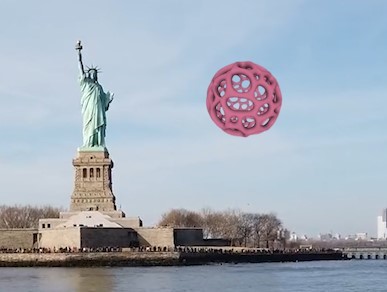
As time goes, whole world will be covered
-
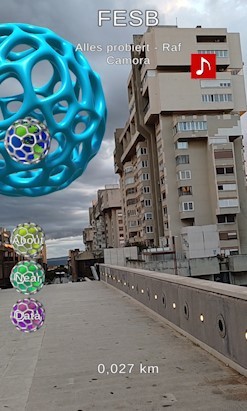
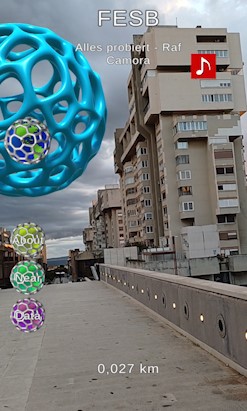
Near each attraction find cool AR ballon
-
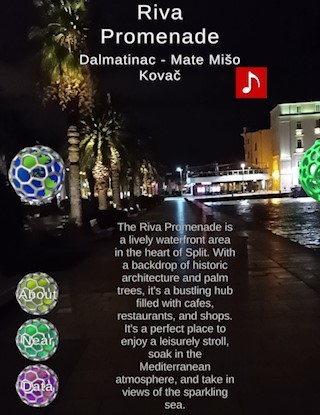
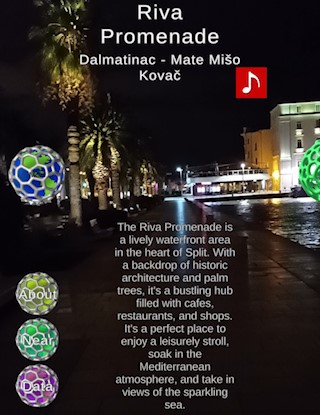
Using UI, you can access information about place
Inspiration
Everything started from my love for traveling and jamming to music. Picture strolling down Shibuya in Tokyo, Japan - imagine the iconic Tokyo Drift song playing in your mind or on your latest Instagram story.
Or in the heart of New York, surrounded by skyscrapers, feel the resonance of Jay-Z and Alicia Keys' "Empire State of Mind", especially if you're a tourist. Consider the image of Freddie Mercury and Barcelona, or the lively sounds of Italian „Tarantella” music filling the air in local villages around Naples. Have you heard about Raf Camora and West Wien? Or German rappers in Hamburg?
Sightseeing alone doesn't fully connect us to the places we visit; it's also about experiencing local food, meeting people, and, notably, immersing ourselves in the local music.
While France may be a well-known destination, its local music sometimes remains a hidden gem. Similarly, Croatia may be a familiar name, but to truly experience it, one must immerse oneself in the enchanting melodies of local Dalmatian music.
Designed for tourists, this app simplifies sightseeing. Near each attraction, find a balloon and tag linked to the location. With just a click or two, access valuable information about the area.
As you get closer, the music gets louder, immersing you in the local vibe. The app also provides a curated list of attractions within a 15 km radius, enabling you to explore them all in a day without relying on local guides. It displays distances and includes song links, allowing you to remember them and save them in your playlist as souvenirs from your beautiful journey.
How we built it
I've been using Unity and C# in my projects for a while, but this time, I took a leap into something new—Augmented Reality (AR). It was my first time working with AR, and it added a whole new dimension to my usual Unity and C# skills. Driven by my love for geography, I explored the capabilities of Geospatial AR Core and AR Foundation extensions. This journey not only broadened my technical skills but also sparked a fresh interest in combining virtual elements with real-world geography. I also harnessed the capabilities of Unity.Mathematics and applied my math know-how to calculate geographical distances, figuring out nearby attractions within the selected radius.
Challenges I ran into
One of the primary hurdles I faced was immersing myself in uncharted territory. With only a handful of projects existing on the entire internet and minimal tutorials available, I had to navigate through the new terrain relying solely on documentation. As a student with minimal free time, overcoming this challenge was a source of immense pride for me. Another significant obstacle arose when dealing with the inevitable issue of using copyrighted music. Acquiring the rights to play such music posed a considerable challenge. Despite consulting with musician friends and spending nights scouring for copyright-free alternatives, my journey led me to discover tracks on Spotify and Youtube as viable solutions.
Accomplishments that I am proud of
My pride stems not only from the technical achievements but fundamentally from the innovative idea that inspired it. The start of this app goes back to a creative vision—it aimed to go beyond the usual way we explore places on a map. The goal was to turn this exploration into an experience that involves more of our senses. The core idea was to show famous spots using colorful balloons and play music that fits the region. It's a unique and captivating way to connect with the digital world, making the whole exploration thing much more interesting.
What I learned
I took a deep dive into Unity, learning its core components and exploring extensions like Google AR Core and Cesium for augmented reality and Geospatial visualization. Understanding namespaces helped me write my code better and making projects more manageable. Exploring 3D geometry added a cool dimension to my designs. Exploring Google APIs and the Google Cloud Platform for the first time opened up a whole new dimension in my programming journey. Navigating these tools not only expanded my programming horizons but also deepened my understanding. Overall, this journey with Google and Unity taught me a lot, from the basics to advanced concepts.
What's next for GeoMusic Experience
I believe this can become a world-renowned application if we successfully engage with artists, copyright holders, or streaming platforms, so we can play each song, without copyright worries. (Now it is playing only copyright free song.) In case we can't achieve that, we'll develop API to enable background Spotify playback for Android phones. Speaking of Android, it's worth mentioning that we're actively working on an iOS version of the app. Finally, we plan to incorporate a feature that allows users (artists or passionate individuals) to add songs to specific locations, providing artists with a platform to promote their music. To manage this, we'll need to hire employees to oversee added songs, ensuring users don't add them multiple times or assign them to incorrect destinations.
Currently, our focus has been on incorporating locations exclusively in Split, Croatia. Ultimate goal is to provide a comprehensive and diverse range of locations, ensuring that every tourist, regardless of their chosen destination, can fully experience local culture. On the technical front, our initiative involves the development of a comprehensive database that will catalog these diverse locations. The intention is to establish a centralized repository, enabling us to store and manage this valuable information systematically, rather than relying on local storage solutions and list of attractions.
Built With
- ar
- ar-core
- blender
- c#
- cesium
- google-cloud
- unity


Log in or sign up for Devpost to join the conversation.