-
-
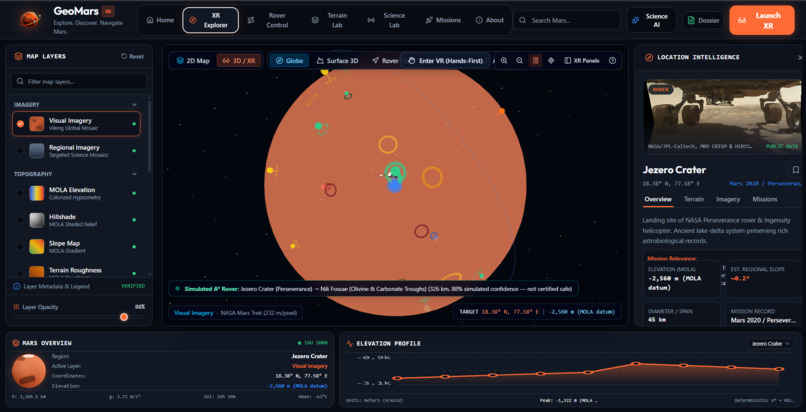
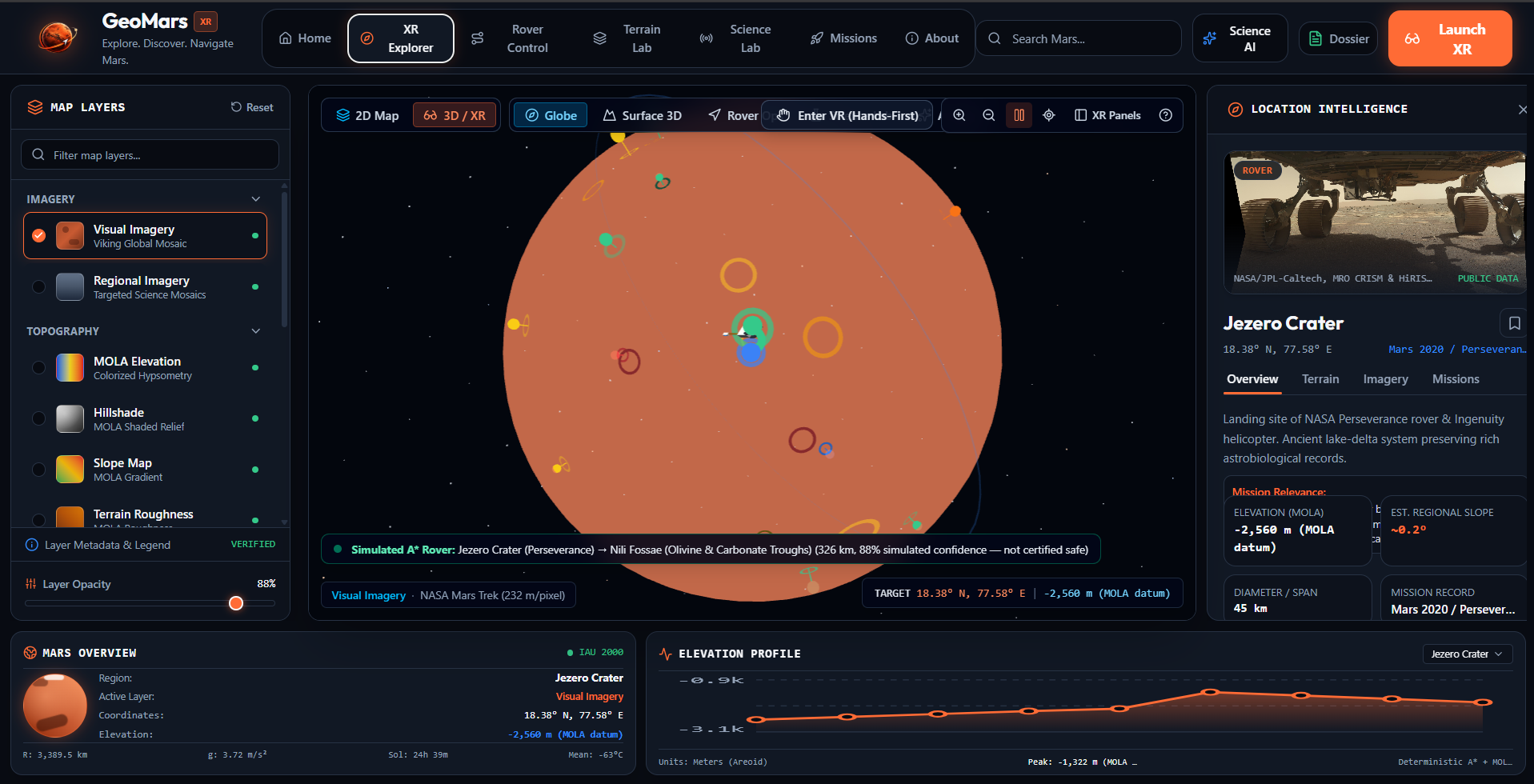
3D Dashboard
-
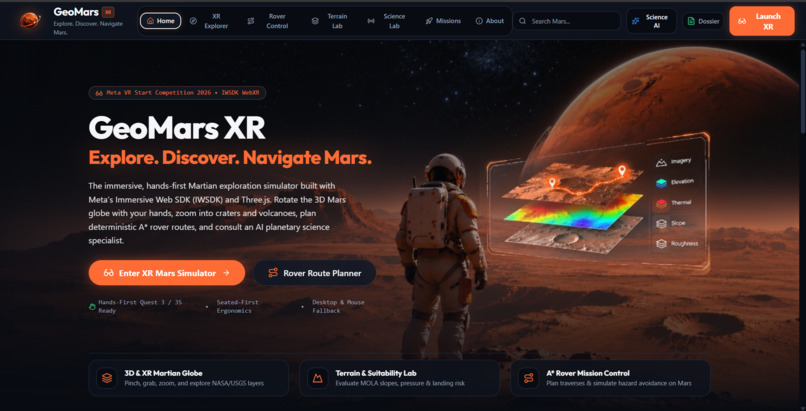
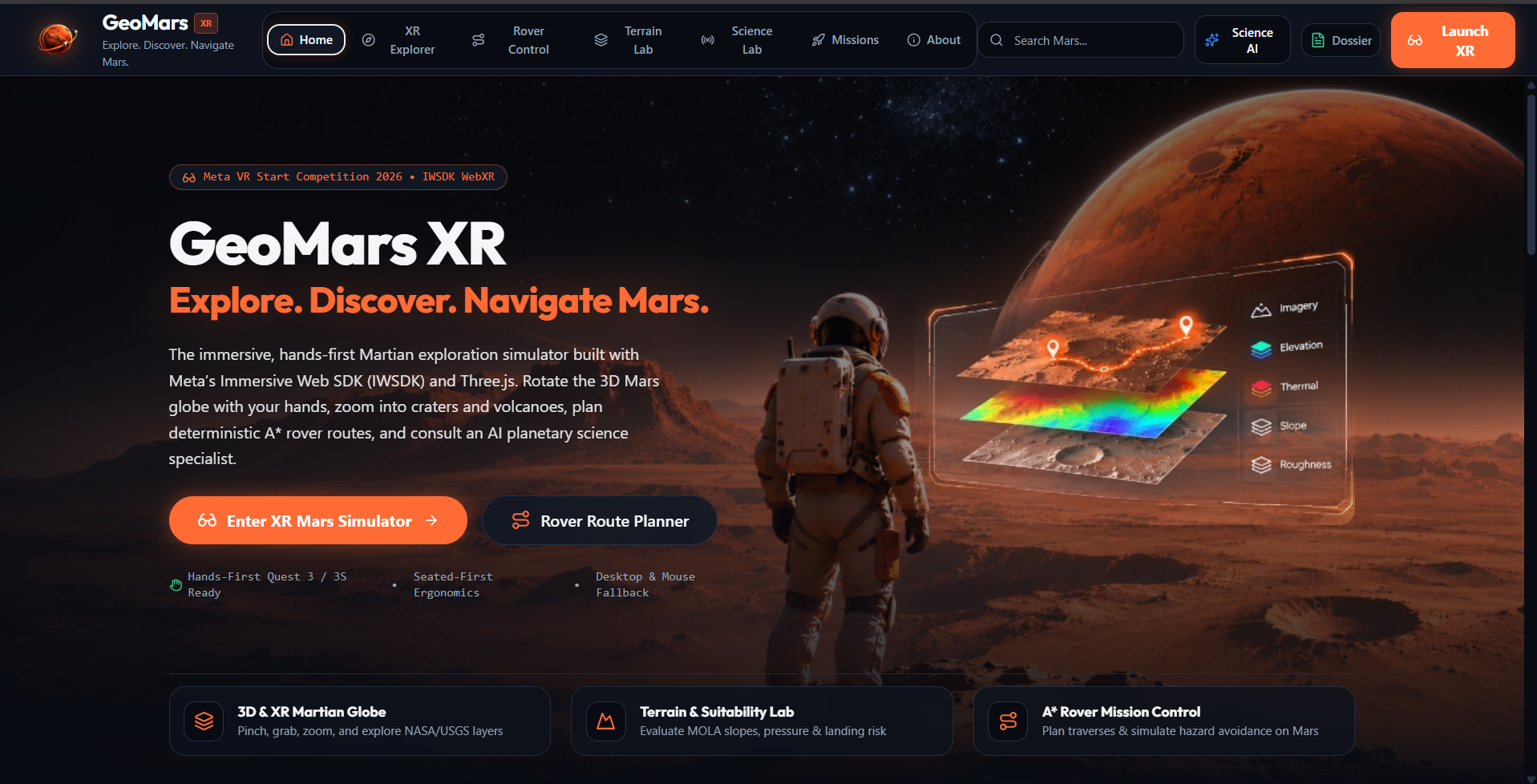
Home Page
🚀 Inspiration
Mars has always fascinated humanity. With ongoing missions by NASA and other space agencies, exploring the Red Planet is becoming increasingly important. However, understanding Martian geography and planetary science through traditional maps and images can be limiting.
We wanted to make Mars exploration more interactive, immersive and accessible. This inspired us to transform GeoMars into GeoMars XR, an immersive planetary exploration experience.
🌎 What It Does
GeoMars XR brings the Red Planet into an interactive 3D environment where users can:
- Explore Mars through an immersive 3D globe.
- Discover famous locations such as Olympus Mons, Jezero Crater and Valles Marineris.
- Explore Martian geographical features and scientific information.
- Plan intelligent rover exploration routes using A* pathfinding.
- Identify simulated terrain hazards and explore potential mission paths.
- Interact with the environment using natural hand gestures.
- Learn about Mars through an AI-powered science assistant.
Our goal is to make planetary exploration feel like an interactive mission rather than simply viewing a map.
🛠️ How We Built It
GeoMars XR builds upon our existing GeoMars project using modern web technologies.
Our technology stack includes:
- React – User interface and application architecture.
- TypeScript – Type-safe application development.
- Three.js – 3D planetary visualization.
- OpenLayers – Geographic mapping capabilities.
- Vite – Development and build tooling.
- WebXR / IWSDK – Immersive VR capabilities and spatial interactions.
- A* Algorithm – Intelligent rover route planning.
- AI integration – Interactive planetary science assistance.
We are evolving the existing web-based planetary exploration system into an immersive, hands-first experience designed for Meta Quest devices.
🧩 Challenges We Faced
One of our biggest challenges was connecting traditional geographical mapping with immersive 3D planetary visualization.
We also focused on making complex scientific information understandable, designing intuitive interactions, optimizing 3D performance and adapting existing functionality for VR environments.
Integrating hand-based interactions while maintaining accessibility across different devices is another important engineering challenge.
📚 What We Learned
Through GeoMars XR, we explored immersive web technologies, 3D planetary visualization, spatial interaction design, intelligent pathfinding and the possibilities of combining AI with scientific education.
We learned that immersive technology can transform how people understand and interact with complex scientific environments.
🔭 What's Next
Our vision is to make GeoMars XR a platform for interactive planetary exploration, scientific education and future space mission simulations.
**Explore Mars. Discover the Unknown. Experience Beyond Earth
