-
-
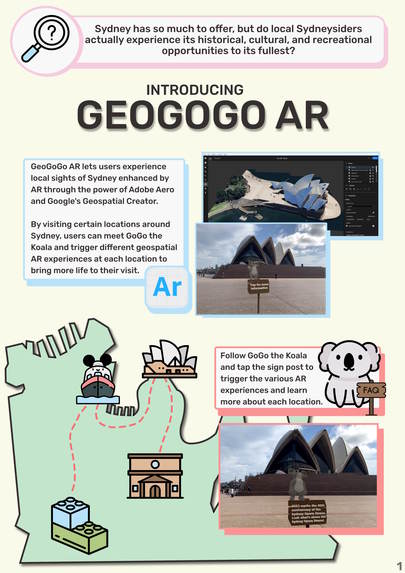
GeoGoGo AR Write Up Page 1
-
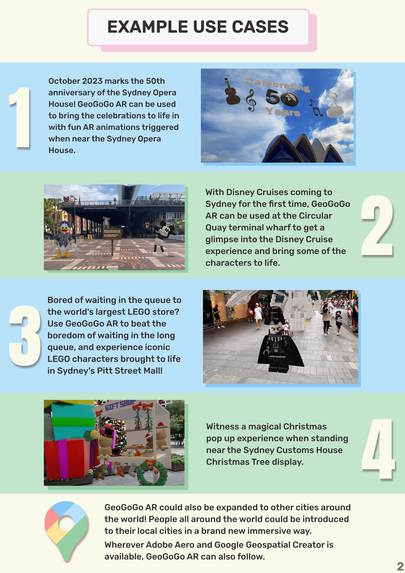
GeoGoGo AR Write Up Page 2
-
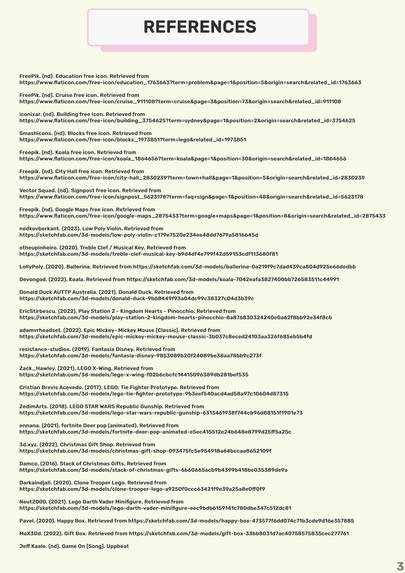
GeoGoGo AR References
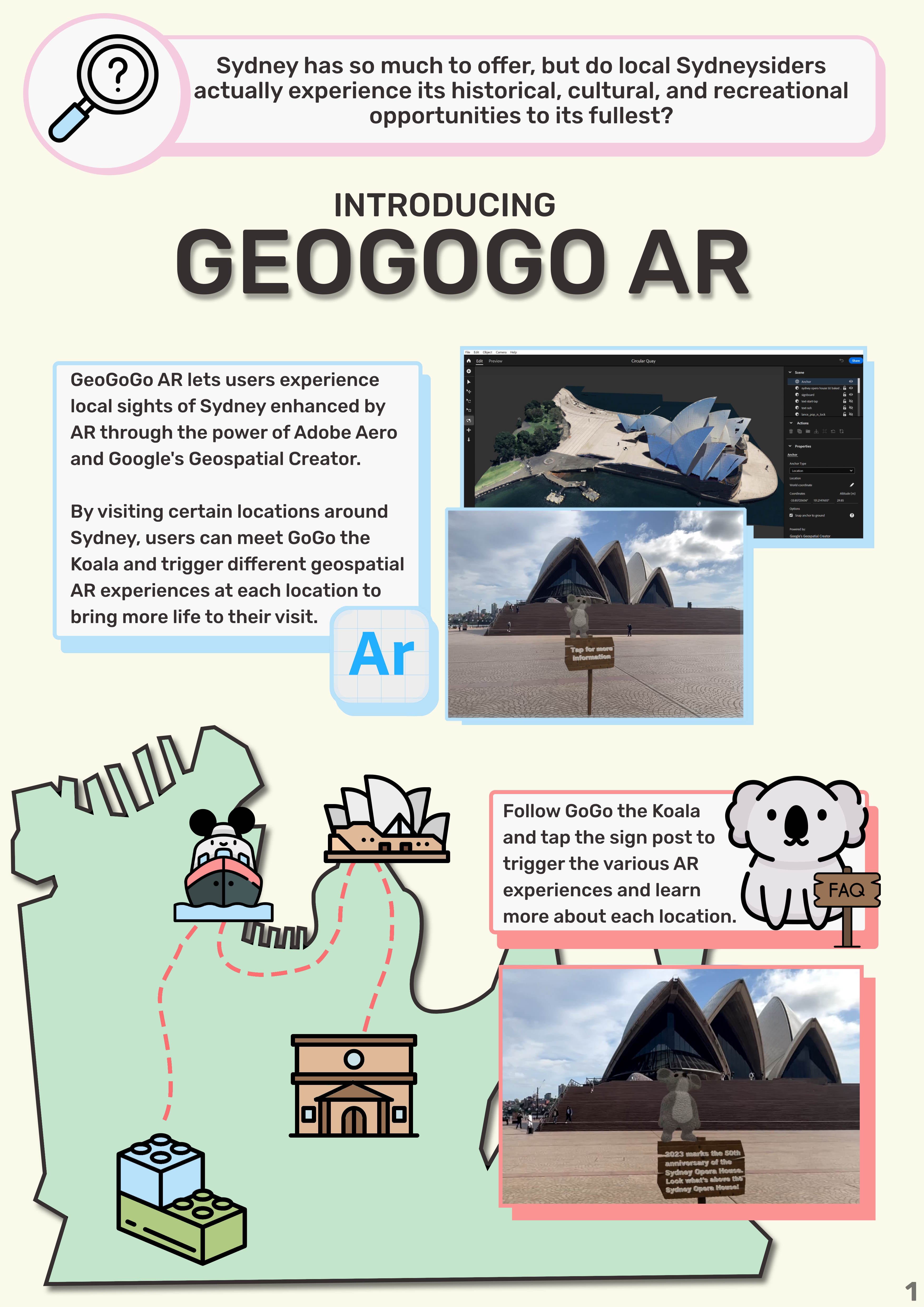

Inspiration
The idea of GeoGoGo AR initially started from a back of a napkin idea of potentially incorporating AR into the Sydney Opera House's 50th anniversary celebrations, as the timing conveniently matched up with Google's Immersive Geospatial Challenge. Despite a lot of branding and content being released to celebrate the cultural landmark, not many people were aware of this occasion and not much was being done in the virtual space. So we took it as a springboard to think even further of how could we incorporate the world of AR to local events around Sydney to both inform people of these events in the first place, and make the occasions more interactive and fun.
What Is GeoGoGo AR
GeoGoGo AR offers users the ability to experience local cultural, historical and recreational activities spread around Sydney in a new dimension, the virtual dimension. By visiting certain locations around Sydney, their experience is enhanced through the power of Adobe Aero and Google's Geospatial Creator by triggering unique animated experiences only available when they are within specific area in Sydney. Additional informational context is also provided alongside the virtual experiences so to let people know of what is happening at the event or provide any cultural context. By offering unique experiences only seen at certain spots, everyone will be encouraged to go out to visit these locations physically and get to know of events or areas they may not have known before.
How We Built It
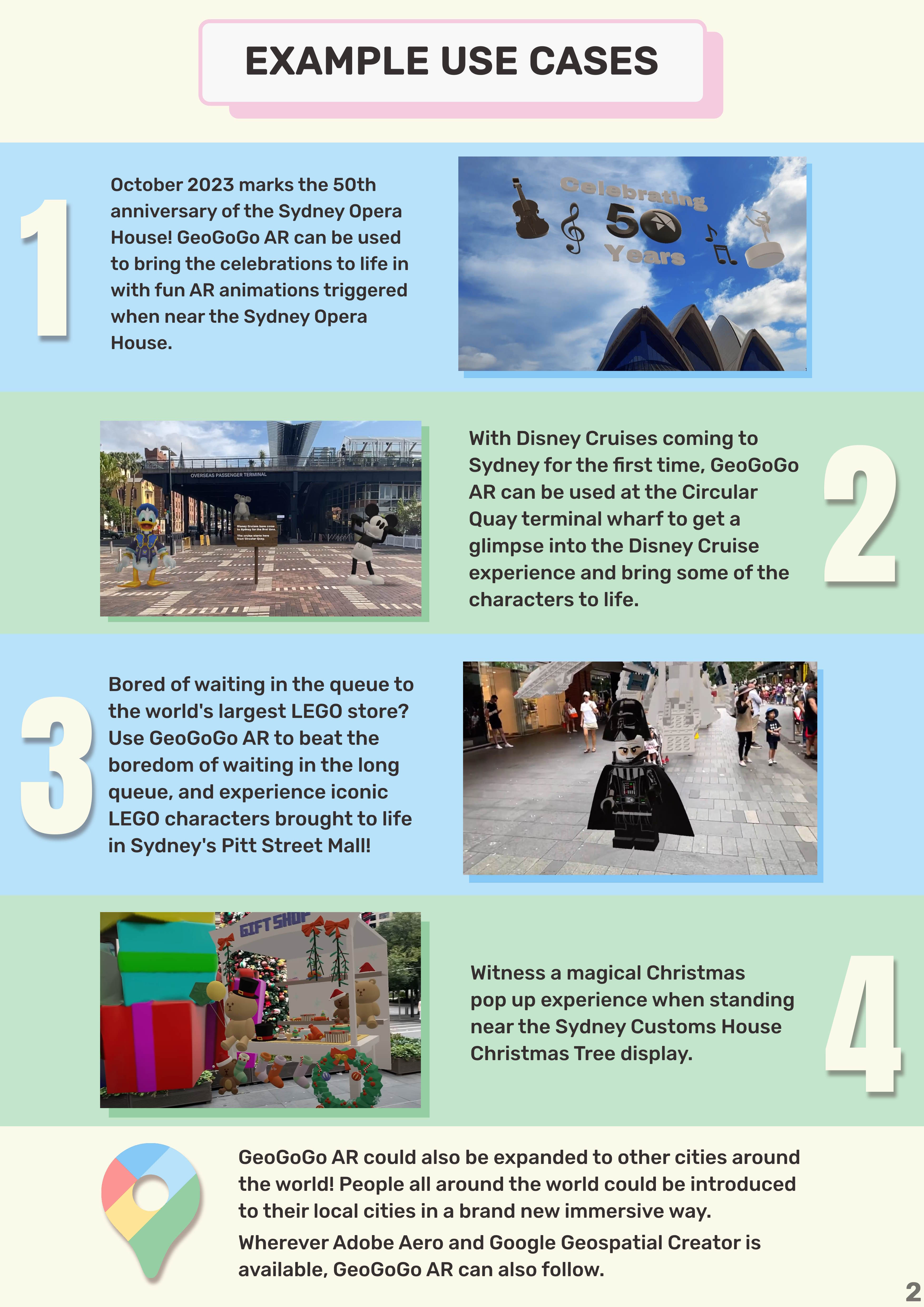
To showcase the concept of GeoGoGo AR, a few demo experiences were built at a few key sites around Sydney using animated 3D characters and sound. Experiences appeared when they entered the specified location, and the animation was triggered by user interaction, by tapping the animation. A combination of freely available 3D models and custom built 3D models were utilised, with both custom animations and freely available animations added to the models to give the experience life and character. These animated models were then imported into Adobe Aero with behaviour triggers and sounds configured for some added interaction, and location anchors were used to specify where in Sydney these experiences would trigger.
Challenges We Ran Into
We faced a few hurdles of getting the AR experiences to work well in some of these locations. During the prototyping and initial testing phases we used our personal backyard as a trial run to see how well the experiences would look in real life, but soon realised there were new difficulties we hadn't yet considered of triggering the experiences at the actual locations themselves, especially in crowded public areas. This was due to a combination of: the location scanning not always consistently recognising the location we were in, unstable network connections, and the animated experience we built not necessarily being appropriate in size for crowded areas. So this required multiple rounds or iteration and testing to get to a more presentable result. Additionally one of the largest challenges we faced was not being able to test with Android as Adobe Aero is not yet available in Australia, thus we were restricted to testing with an iPad as our only iOS device.
Accomplishments We're Proud Of
One accomplishment we achieved was how we were able to expand and iterate from our initial concept to come up with multiple different use cases, as we went through rounds of brainstorming and discussions to see how we could expand into different ideas. However one of the main accomplishments we achieved was simply the fact that we were able to deliver a final submission in terms of a demo product, video, and concept design poster in the short time frame we had. Truthfully, we were only made aware of this geospatial challenge in the last week of October, thus only giving us a few weeks to produce a submission in time for the final deadline. So the fact that we were able to produce a submission consisting of multiple working prototypes, a concept video and a concept design poster to demonstrate various use cases in half of the given timeframe was something we are proud of.
What We Learned
While building GeoGoGo AR we realised that AR experiences built for private testing will not always be reflected the same way in public locations. 3D assets may not appear as well when in crowded areas, and that it is important to consider the users' experience of how they will witness the AR scene in areas with high foot traffic, thus we had to often re-evaluate the composition of the AR scene. Additionally that testing these experiences is more laborious and time consuming than one might think.
What's Next For GeoGoGo AR
GeoGoGo AR as a concept is not limited to just Sydney, but can be expanded to all cities all around the world so long as Adobe Aero and Google Geospatial Creator is available. But for now in regards to wider deployments in Australia, realistically it would be wise to wait for Adobe Aero to also be available on Google Play Store so to reach an even wider audience.
Built With
- adobe
- aero
- creator
- geospatial


Log in or sign up for Devpost to join the conversation.