Rankify: Uncovering the Interpretability of AI Search Rankings
The Curiosity
In an era where AI assistants are becoming our go-to research companions, I found myself asking a question: What websites actually rank when AI models search the web? While everyone obsesses over Google SEO, there's an entirely new domain emerging - one where AI models like Perplexity decide which sources to cite and trust.
This curiosity led me down a rabbit hole. If businesses are pouring resources into traditional SEO without understanding their visibility in AI-powered search results, they could be missing the future of online discovery. That's when the idea for Fluxio was born - a tool to help businesses understand and improve their "LLM Visibility Score" in this brave new world of AI search.
The Learning Journey Building Rankify was tough with the features we had in mind - everything was new to us.
In a matter of 2 weeks we figured out -
API orchestration at scale - Learning to coordinate multiple API callsand manage data flows between different services System architecture design - Creating a robust backend that could process URLs, scrape content, analyze competitors, and generate meaningful insights Data visualization strategies - Figuring out how to present complex competitive analysis data in a way that business owners could actually understand and act upon Real-time processing pipelines - Building systems that could handle the unpredictable nature of web scraping and API responses The most eye-opening learning was understanding how AI models actually "think" about sources and citations. It's not just about keywords anymore - it's about authority, context, and relevance in ways that traditional SEO tools never measured.
Building the Beast Rankify's architecture emerged through pure necessity and countless iterations:
The Frontend Foundation We built a clean Next.js interface that makes the complex simple. Users just enter a URL, and behind that innocent input field lies a sophisticated analysis engine.
The Intelligence Layer The real magic happens in the backend orchestration:
Content ingestion that scrapes and analyzes submitted URLs Competitor discovery using Perplexity's intelligence to identify industry rivals Citation analysis that tracks which websites get mentioned across dozens of AI-generated responses Score calculation that translates raw citation data into actionable insights Data Persistence Strategy Every analysis gets saved as structured Markdown files under parsed, creating a growing knowledge base of website analyses and competitive landscapes.
The Challenges That Almost Broke Me Challenge #1: The Competitor Identification Puzzle How do you programmatically identify competitors for any business? I couldn't rely on users to know their competition, and generic business directories were too broad. The breakthrough came when I realized Perplexity could solve this - by asking it industry-specific questions and analyzing which websites it naturally cited together.
Challenge #2: Maximizing Perplexity API Citations Perplexity's citation system became both my greatest asset and biggest challenge. I had to reverse-engineer the optimal way to: Generate relevant queries that would trigger citations for specific industries Extract and deduplicate citation data across multiple API calls Weight citations based on context and relevance to create meaningful scores
Challenge #3: Creating an LLM Visibility Score That Actually Matters This was the main feature of the project. How do you distill complex citation patterns into a single score that business owners would trust and understand? After testing various algorithms, I settled on a weighted approach that considers a softmax over Citation frequency across diverse queries
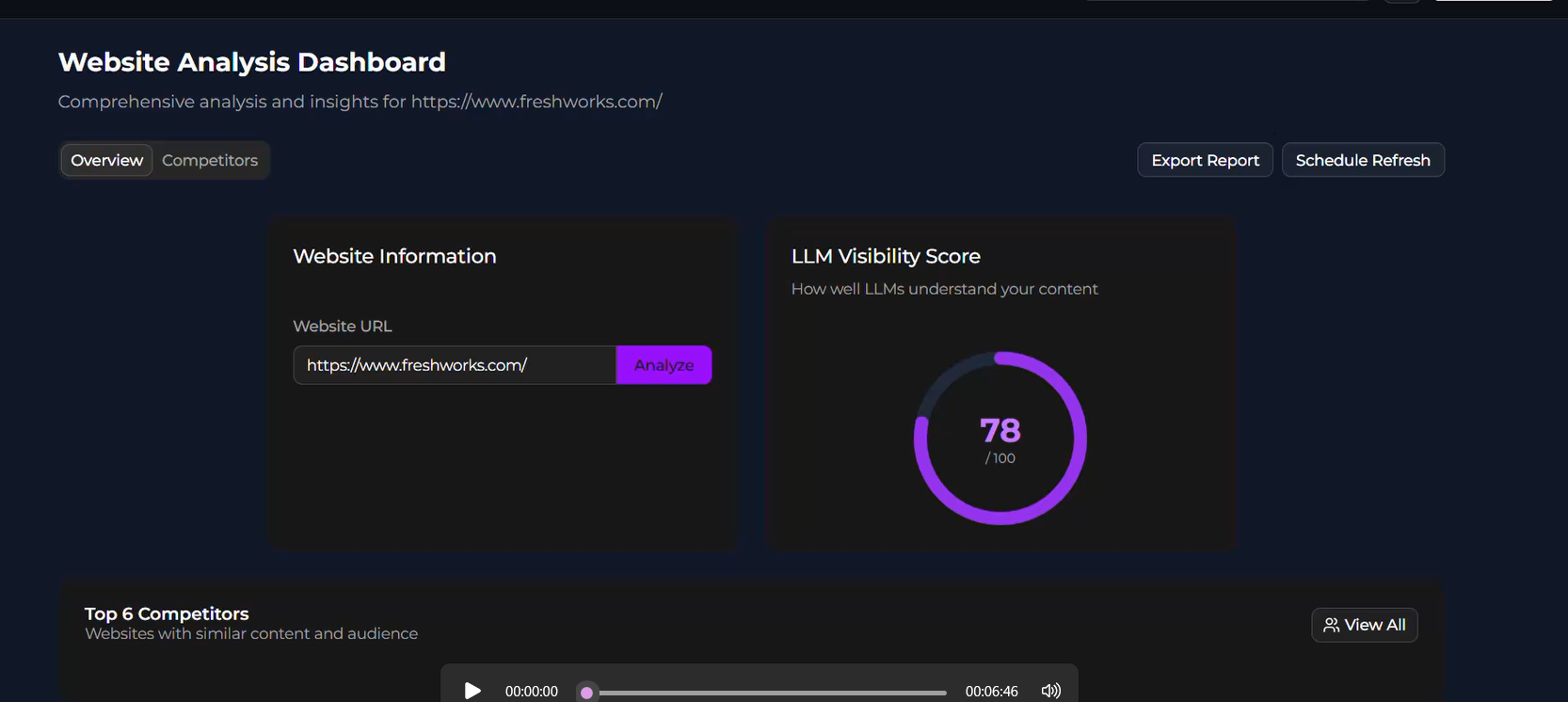
The Result Fluxio emerged as a comprehensive dashboard that transforms a simple URL submission into deep competitive intelligence. It reveals not just where your business stands in the AI search landscape, but provides concrete recommendations for improvement.
The project taught me that the future of search visibility isn't just about optimizing for algorithms - it's about becoming the kind of authoritative source that AI models naturally want to cite and recommend. In building Fluxio , I didn't just create a tool; I mapped out what SEO would look like in 2025.
The real victory? Taking a complex, technical challenge and turning it into something that any business owner can understand and act upon. Because in the end, the best technology is the kind that feels effortless to use, even when there's incredible complexity working behind the scenes.
Built With
- firecrawl
- nextjs
- perplexity
- react
- sonar
- typescript

Log in or sign up for Devpost to join the conversation.