Inspiration
Search is changing from SEO to GEO. Instead of clicking through a list of links, users now ask AI systems directly and receive one synthesized answer. That creates a new visibility problem for brands: if an LLM does not mention you, you effectively disappear from the buyer's consideration set. We built GEO Agent to help brands understand whether they are being recommended by AI, which competitors are showing up instead, and what they should do next to improve their presence.
What it does
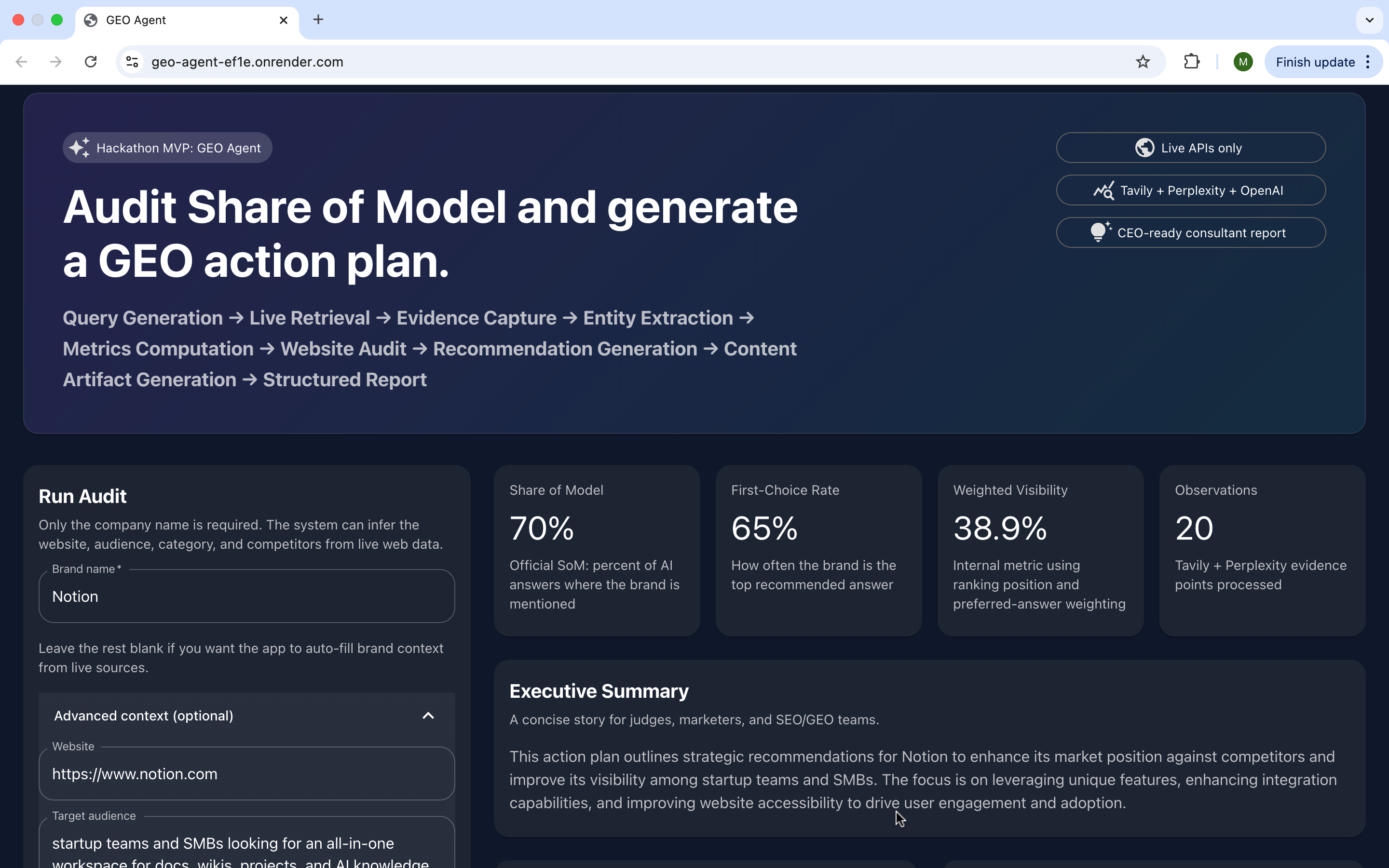
GEO Agent is a live AI visibility auditor for brands. A user can enter a company name, and the system will infer the brand context, generate category-level high-intent queries, query live external tools, extract mentions and competitors, compute Share of Model, and produce a consultant-style report. The report includes visibility metrics, competitor comparisons, evidence citations, website audit findings, prioritized recommendations, and generated content artifacts such as FAQ drafts, wiki-style summaries, and comparison outlines.
How we built it
We built GEO Agent as a full-stack app with a React + MUI frontend and a FastAPI backend. The backend orchestrates a multi-step workflow: brand context resolution, query generation, live retrieval through Tavily and Perplexity, evidence capture, structured entity extraction with OpenAI, metric computation, website audit, recommendation generation, and content artifact generation. The frontend presents the output as a clean executive dashboard. We also configured the project for single-service deployment so the frontend and backend can be served from one public URL.
Challenges we ran into
One challenge was defining Share of Model in a way that was both faithful to the hackathon prompt and still analytically useful. We initially experimented with more complex visibility scoring, then aligned the main SoM metric with the official prompt definition while preserving richer supporting metrics like first-choice rate and weighted visibility. Another challenge was reducing bias in the query generation step, since branded prompts can artificially inflate visibility. We solved this by generating category-level, brand-agnostic queries. We also had to handle deployment complexity, so we simplified the architecture into a single public service for easier demoing.
Accomplishments that we're proud of
We are proud that the product uses live data end to end instead of canned responses or static datasets. The system can infer brand context from just a company name, run a multi-step audit, and return a polished, evidence-backed report. We are also proud of the balance between technical depth and usability: the app is agentic under the hood, but the output is simple enough for a non-technical founder, marketer, or executive to understand quickly.
What we learned
We learned that GEO is not just traditional SEO with a new label. Visibility in AI answers depends on how retrievable, structured, and recommendation-ready a brand’s digital presence is. We also learned that metrics alone are not enough; users need evidence, competitor context, and actionable next steps. On the engineering side, we learned how important it is to design for live-data reliability, transparent reasoning, and deployment simplicity under hackathon time pressure.
What's next for GEO Agent
Next, we want to turn GEO Agent into an ongoing monitoring platform instead of a one-time audit. That includes tracking Share of Model over time, detecting misinformation, monitoring emerging competitors, and surfacing visibility changes across different AI systems. We also want to deepen the recommendation layer with stronger website crawling, structured-data analysis, and more targeted content generation so teams can move directly from diagnosis to execution.

Log in or sign up for Devpost to join the conversation.