-
-
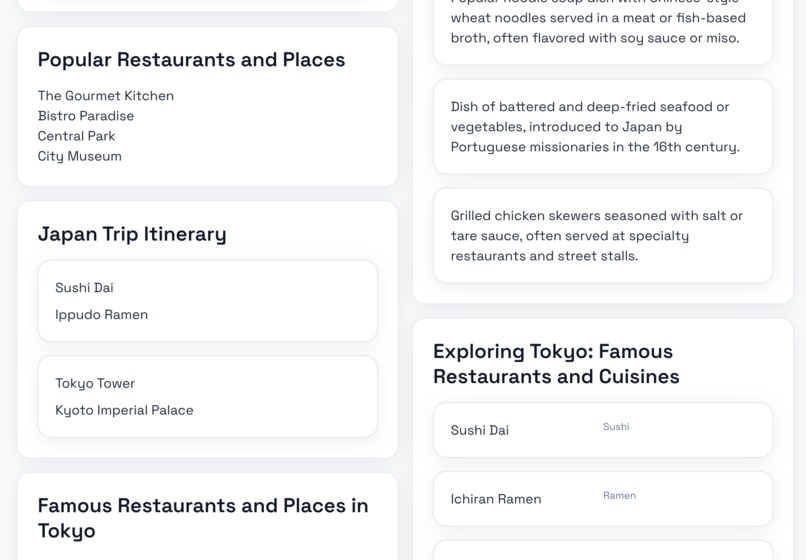
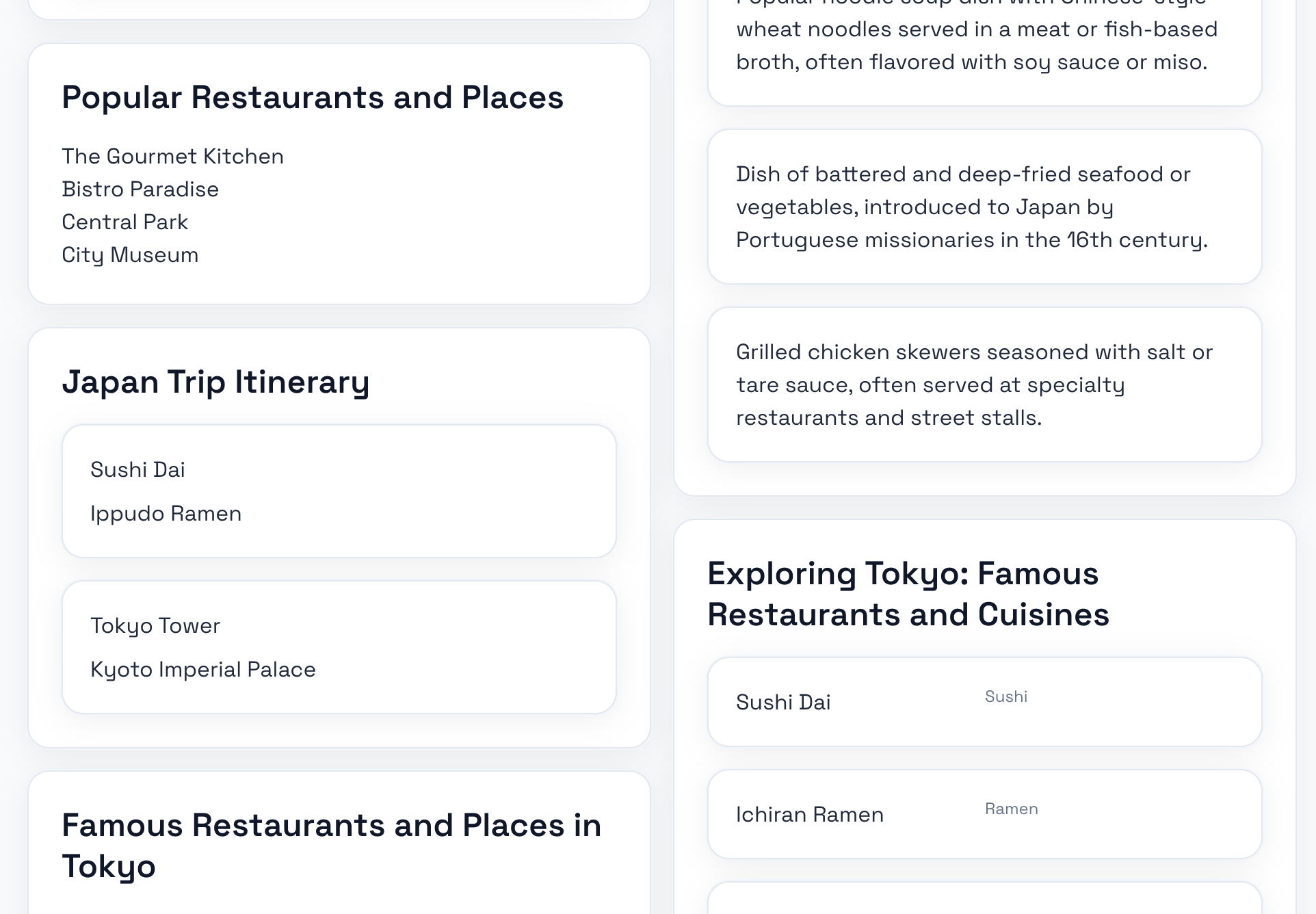
UI Components Generated during discussion of trip to japan
-
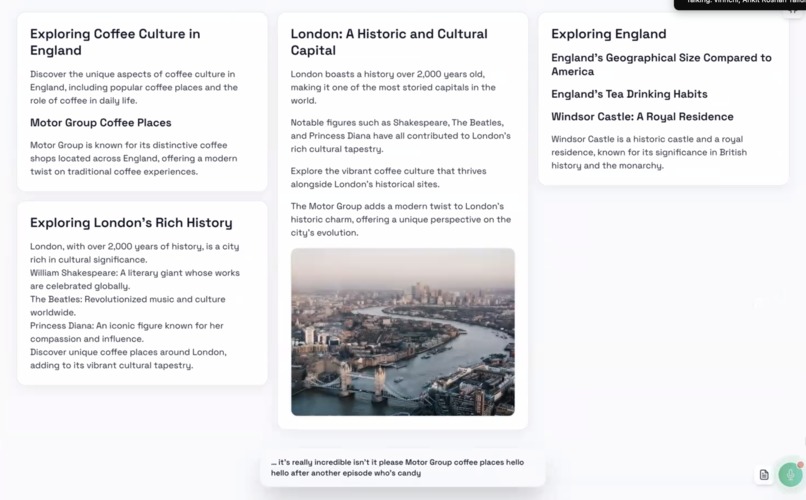
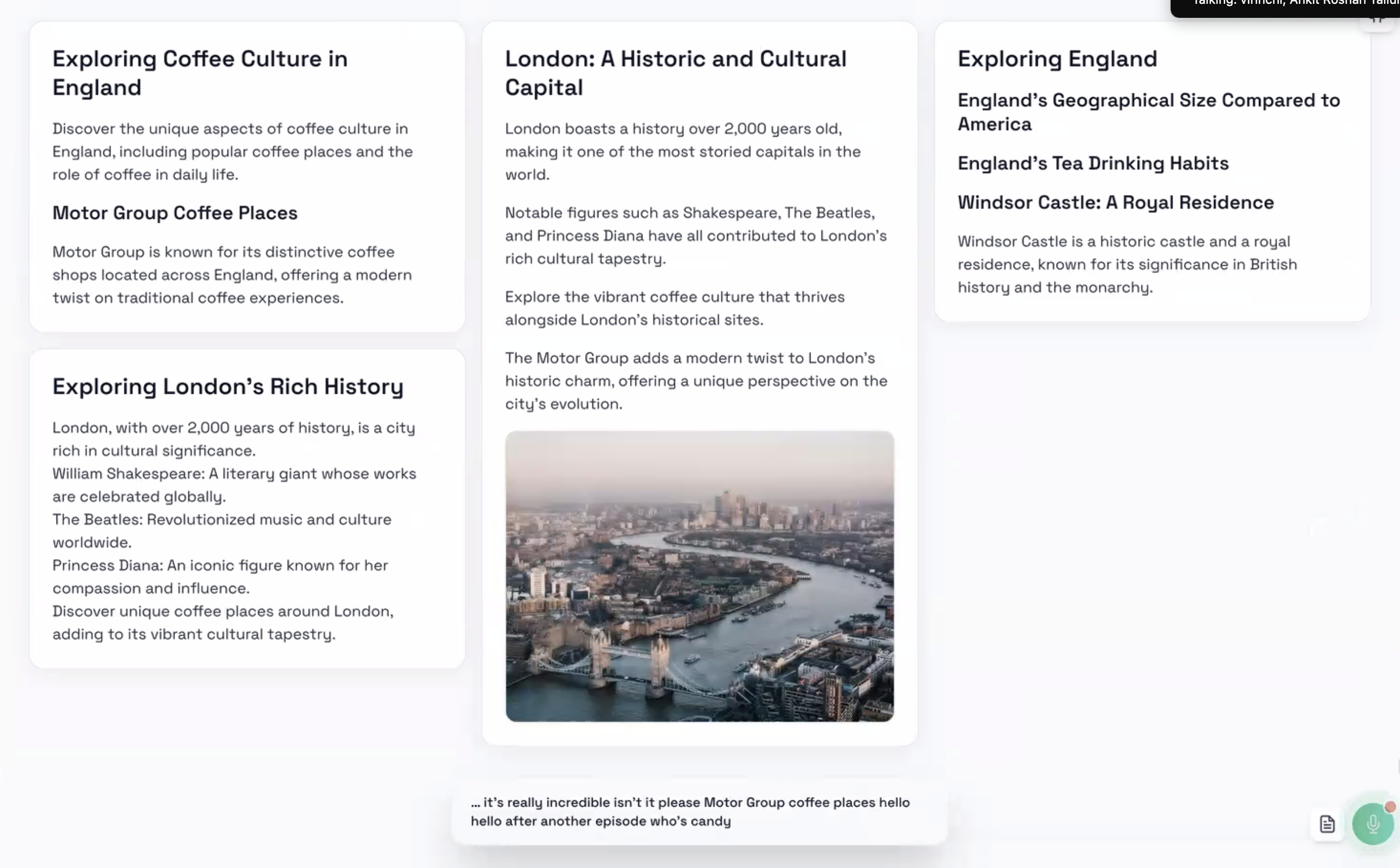
Full View of UI Components Generated (covnersation regarding Tea)
Inspiration
The inspiration for this project came from a simple but persistent problem we've all experienced: groups talk a lot, yet often leave with different understandings. In classrooms, meetings, healthcare discussions, and community spaces, conversations are rich—but alignment is fragile. Notes are taken after the fact, decisions are remembered differently, and important context gets lost in the moment it matters most.
We wanted to explore a different question: What if the system didn't document conversations after they happened, but instead helped people think better together while they were happening?
This led us to the idea of treating the UI not as a static canvas, but as a living mirror of collective thought—one that listens with consent, understands context, and adapts in real time to support shared understanding.
What it does
GenUI is a conversation intelligence platform that turns live conversations into shared understanding. With explicit consent, the product listens to a conversation, interprets its evolving context, and dynamically generates a read-only, adaptive UI that reflects what the group is discussing. As ideas emerge, diverge, or converge, the UI changes to match the cognitive state of the group—whether that's exploration, clarification, or decision-making.
Core Capabilities:
- Captures speech input with explicit user consent through a floating microphone button
- Processes conversations in real time using LLM intelligence (OpenAI GPT-4o) to extract meaning, context, and structure
- Generates dynamic, read-only UI surfaces using the proprietary GenUI schema—a structured, declarative format for information visualization
- Visualizes group thinking by displaying insights, summaries, and patterns derived from live conversation
- Maintains session-based context to build understanding progressively as conversations evolve
Examples of what the UI can surface include:
- Emerging topics and key ideas
- Points of agreement and disagreement
- Open questions and unresolved threads
- Decision summaries and next steps
The core principle is simple: don't interrupt the conversation—augment it.
GenUI is built for consent-first interaction: every participant controls their microphone, and the system treats conversation data with respect and privacy in mind.
How we built it
GenUI is a full-stack application combining modern web technologies with AI intelligence, organized into three distinct layers:
Conversation Layer:
- Processes conversational input only with explicit user consent
- Uses Web Speech API for real-time speech capture and transcription
- Maintains session-based context with persistent event storage
Understanding Layer:
- Extracts high-level semantic signals such as topics, alignment, uncertainty, and decision intent—without diagnosing, judging, or steering the conversation
- Integrates OpenAI GPT-4o for intelligent conversation analysis and UI generation
- Implements prompt compression and token optimization for real-time responsiveness
UI Layer (GenUI):
- Renders a declarative, read-only interface using a custom schema
- The UI is fully data-driven and adapts based on the evolving conversation state, ensuring separation between logic, data, and presentation
- Uses React + TypeScript for type-safe, component-based rendering
Technical Stack:
Frontend:
- React + TypeScript for type-safe, component-based UI
- Vite as the build tool for fast development and optimized production builds
- Tailwind CSS for responsive, utility-first styling
- Web Speech API for real-time speech capture and transcription
- React Router for session-based navigation and state management
Backend:
- FastAPI for a high-performance, modern Python API
- OpenAI GPT-4o integration for intelligent conversation analysis and UI generation
- SQLAlchemy for session and event persistence
- GenUI Schema system for structured, read-only UI generation with declarative component definitions
Shared Assets:
- genui-schema package: A TypeScript library defining the GenUI schema, providing type safety across frontend and backend
- WebSocket-ready architecture for real-time updates and progressive conversation processing
We intentionally constrained the UI to be non-interactive. This design choice keeps the focus on human dialogue while allowing the system to support clarity and alignment in the background.
Challenges we ran into
One of the biggest challenges was knowing what not to build. We had to resist turning the system into a chatbot or an active participant, and ensure the product supports human thinking rather than replacing it. Designing a UI that adapts meaningfully—without becoming distracting or overwhelming—required careful abstraction.
Technical Challenges:
- Real-time LLM responsiveness: Balancing token optimization and prompt compression to keep LLM response times low while maintaining context fidelity
- UI schema consistency: Designing a schema flexible enough for diverse conversation visualizations while strict enough to ensure reliable rendering across different information types
- State management at scale: Handling incremental speech input, progressive LLM responses, and multi-surface UI updates without introducing race conditions
- Speech accuracy and consent: Integrating the Web Speech API responsibly, ensuring users maintain clear control over when and what is captured
- Multi-surface coordination: Managing interactions between multiple UI surfaces that update asynchronously based on different LLM insights
- Performance optimization: Compressing user prompts and reducing token consumption without sacrificing semantic understanding
Another challenge was trust and consent. Listening to conversations, even for helpful purposes, demands transparency and clear boundaries. We learned that consent-first design isn't just an ethical choice—it also improves user comfort and adoption.
Finally, translating messy, real-time conversations into clean, structured representations forced us to think deeply about how humans actually reason together—not just how systems process language.
Accomplishments that we're proud of
- Built a production-grade LLM integration with OpenAI, including intelligent prompt compression via TokenC and robust error handling
- Designed the GenUI Schema: A declarative, read-only UI specification that enables AI-driven UI generation without traditional imperative component logic
- Implemented consent-first UX: A clean, intuitive microphone interface that empowers users to control what data is captured
- Created a responsive, real-time experience: Multi-surface UI updates driven by LLM intelligence, with progressive conversation processing
- Established strong type safety: Shared TypeScript schema definitions across frontend and backend ensure consistency and reduce runtime errors
- Built a scalable session model: Session-based architecture with persistent event storage enables long-running conversations and historical analysis
- Optimized for clarity and scannability: Intentional UI density, hierarchy, and structure to make complex conversation insights immediately actionable
What we learned
- Shared understanding is not automatic—it needs support. Groups talk a lot but often leave with different understandings without proper augmentation.
- The most powerful role for AI in groups is often reflective, not directive. AI works best when it mirrors and supports human thinking rather than steering it.
- Constraints (like read-only UI and strict schemas) can unlock better design by forcing clarity. Limiting interactivity keeps focus on human dialogue.
- LLMs need careful prompting: System prompts, context management, and compression strategies directly impact both quality and latency
- UI generation is a solved problem with the right constraints: By limiting to read-only, data-bound visualizations, we enable AI-driven UI without hallucination or unsafety risks
- Consent and control are foundational: Users trust systems more when they have explicit, moment-to-moment control over data capture
- Data binding via JSON Pointers is powerful: Decoupling UI structure from data enables flexible, reusable component designs
- Session-based architecture scales: Incremental event processing allows us to handle long conversations without overwhelming memory or latency
- Type safety across boundaries matters: Sharing TypeScript types between frontend and backend dramatically reduces integration bugs
What's next for GenUI
This project is an early step toward tools that help people align, reason, and decide together—in education, healthcare navigation, teams, and communities. We believe the future of collaboration isn't about more features, but about better shared mental models.
Future Roadmap:
- Multi-participant support: Extend session management to handle group conversations with identified speakers and per-participant insights
- Enhanced analytics: Add timeline views, sentiment analysis, and decision-tracking features
- Export and sharing: Enable teams to export conversation insights in multiple formats (PDF, HTML, JSON) and share analysis across the organization
- Custom LLM models: Support for switching between different LLM providers and fine-tuned models for domain-specific conversation analysis
- Offline and hybrid modes: Extend the platform to work with audio files, recorded meetings, and hybrid sync scenarios
- AI-driven action items: Automatically extract, track, and assign action items derived from conversation context
- Privacy-first deployment: Deploy self-hosted versions for enterprise customers with strict data residency requirements
- Integration with productivity tools: Connect with Slack, Microsoft Teams, Notion, and other platforms to embed GenUI insights into existing workflows
That's the future we're building toward.

Log in or sign up for Devpost to join the conversation.