-
-
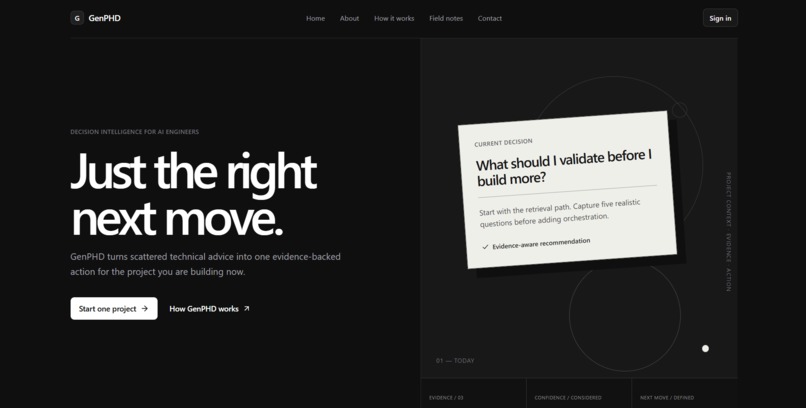
Clear next moves for AI engineers.
-
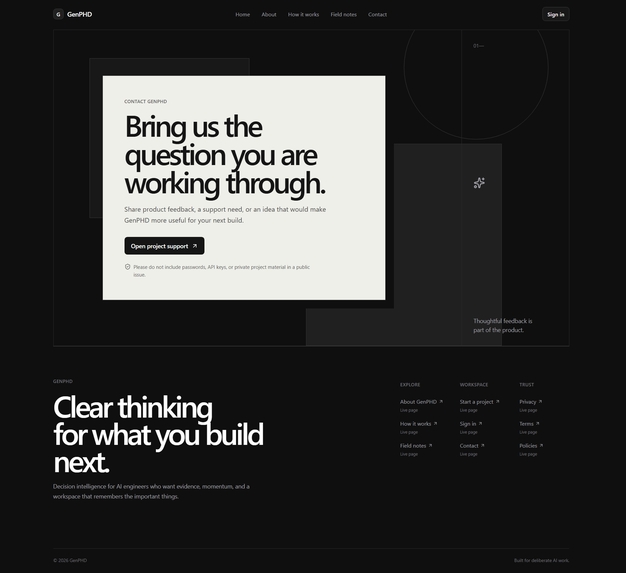
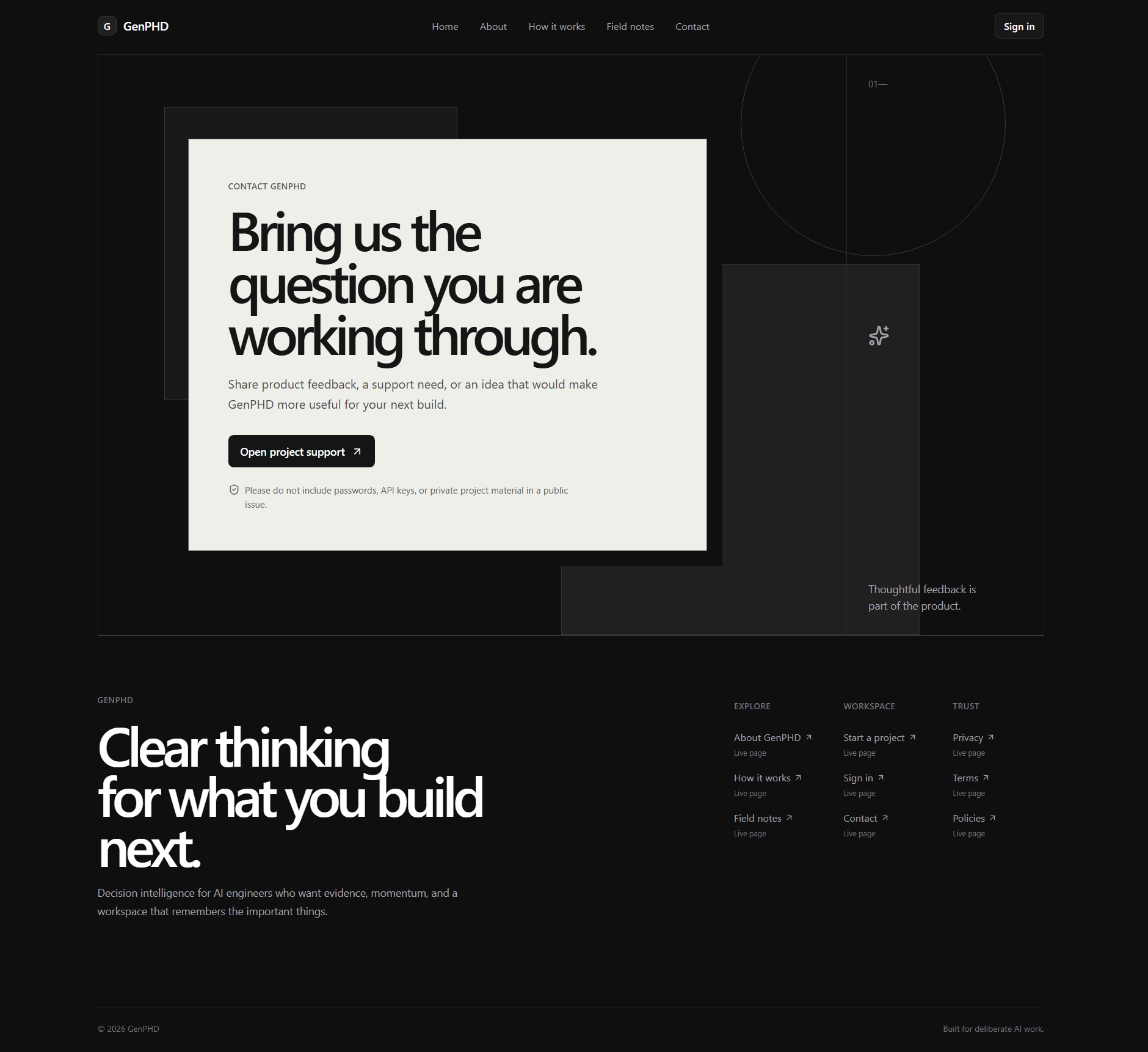
Get in touch with the GenPHD team for product questions, feedback, collaboration, or support.
-
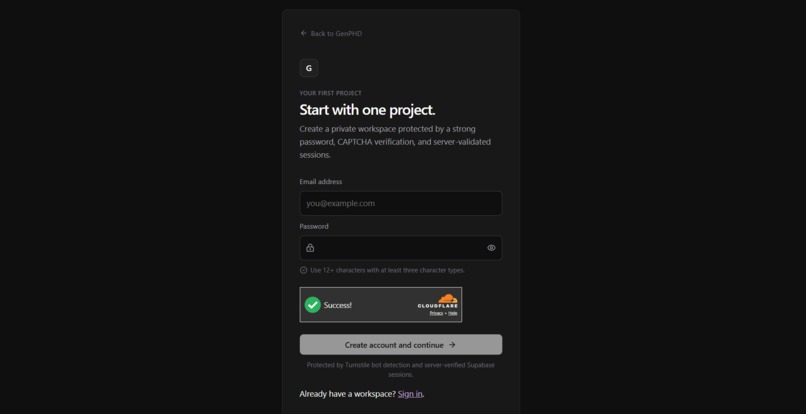
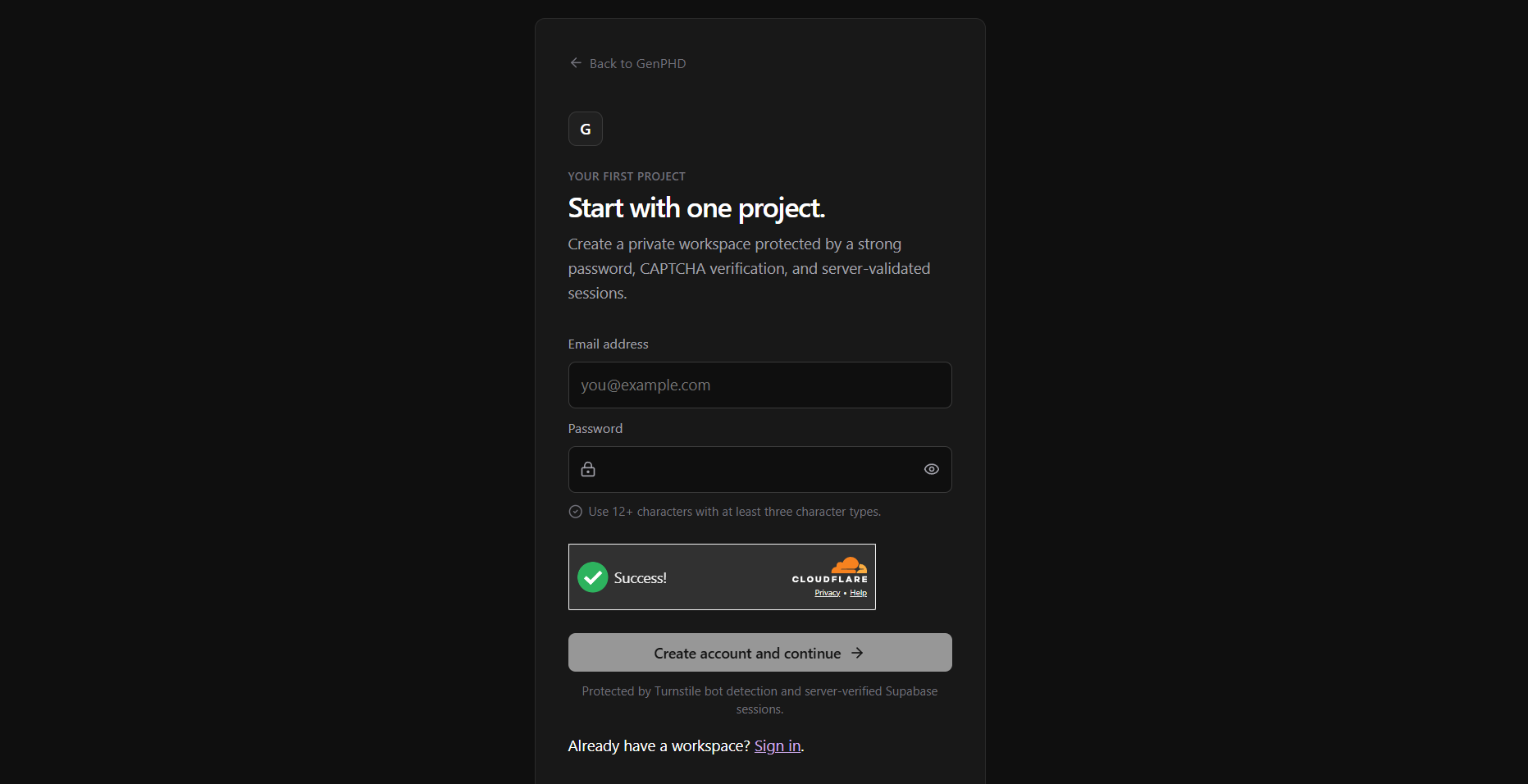
Sign in to access your private GenPHD workspace, protected by Supabase authentication and Cloudflare Turnstile.
-
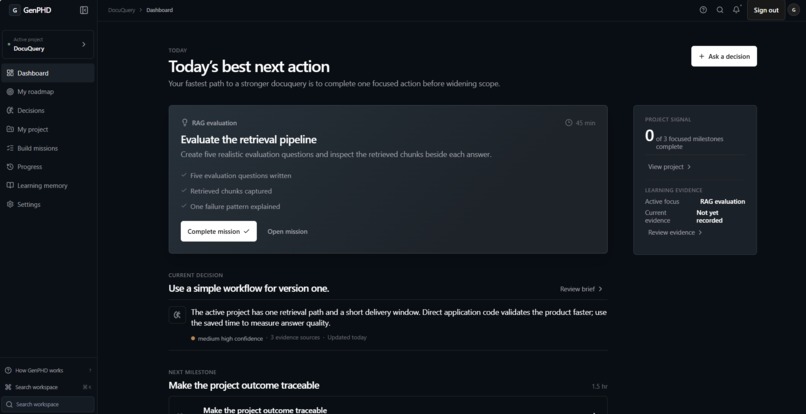
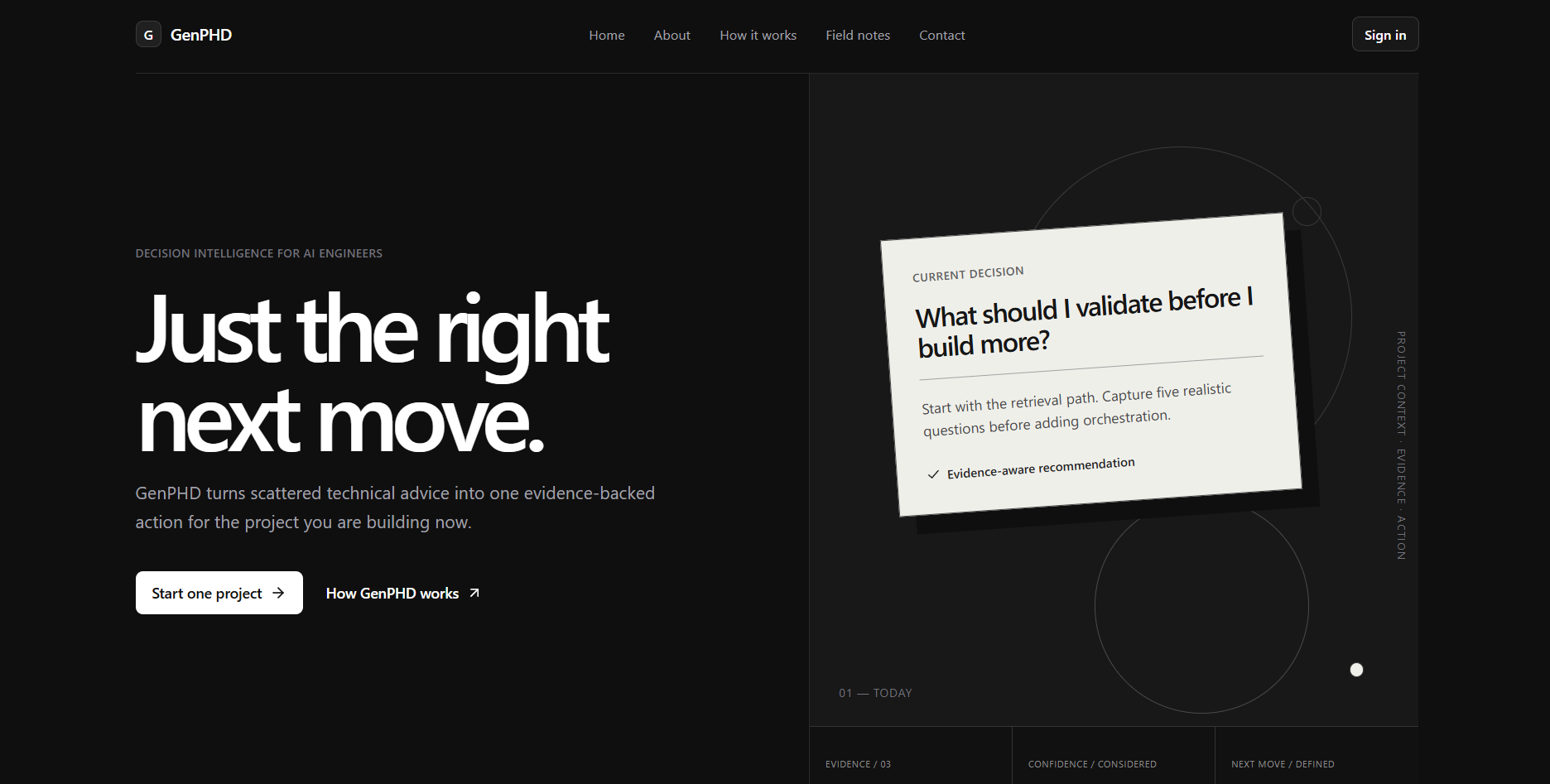
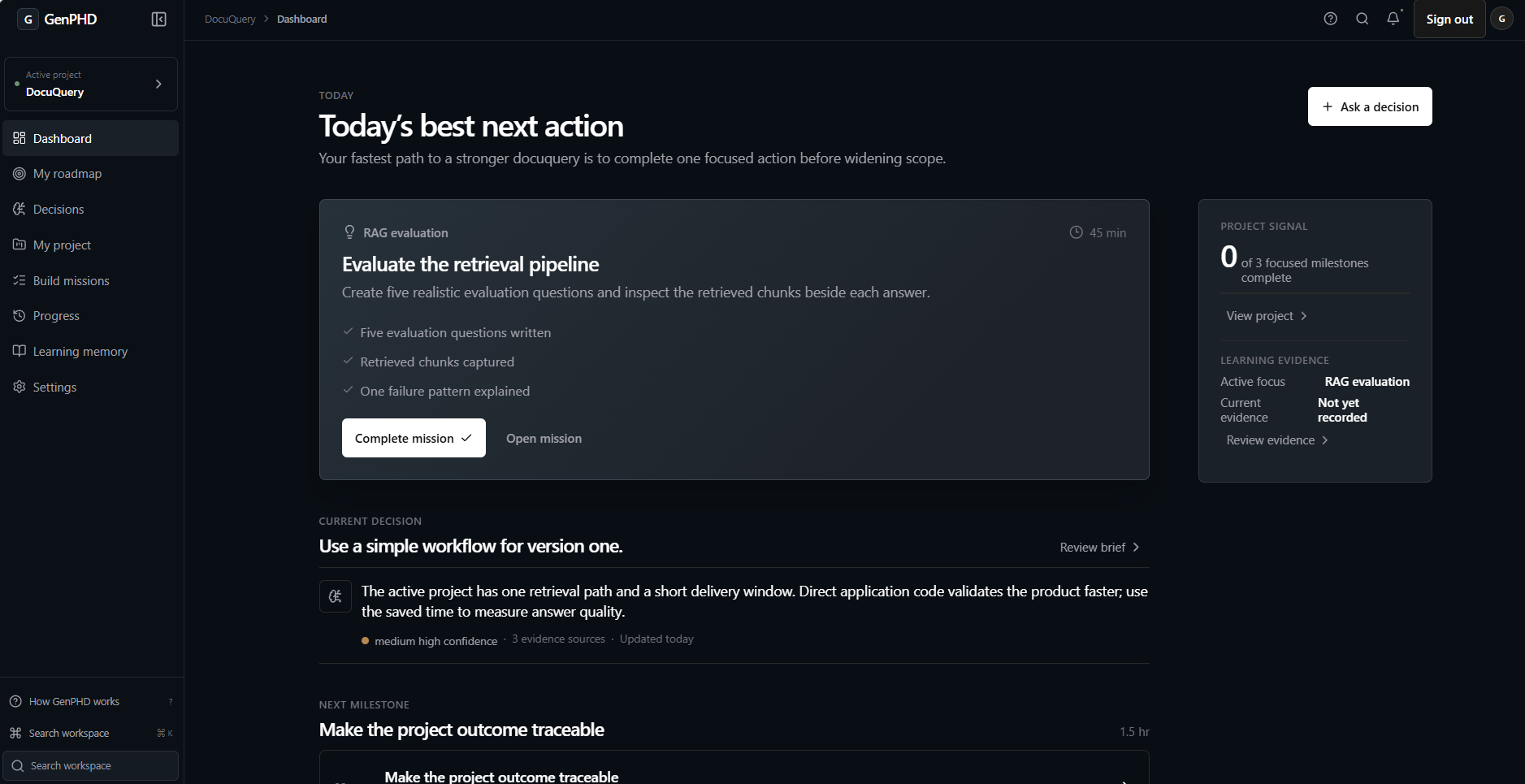
See your active project, understand what matters most today, and take the next evidence-backed step toward a stronger AI product.
-
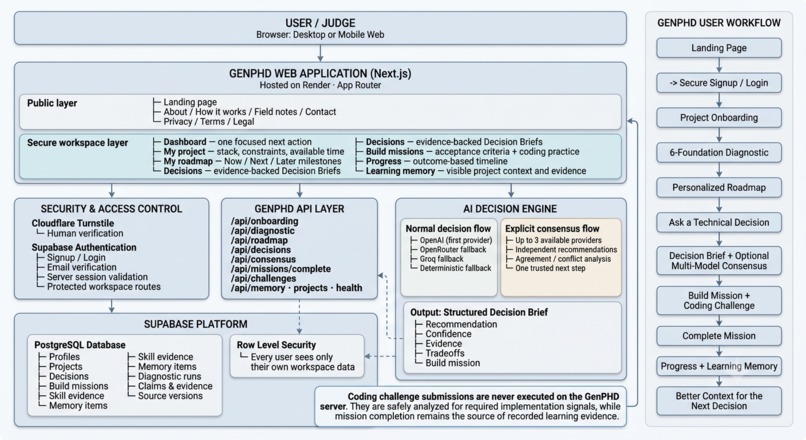
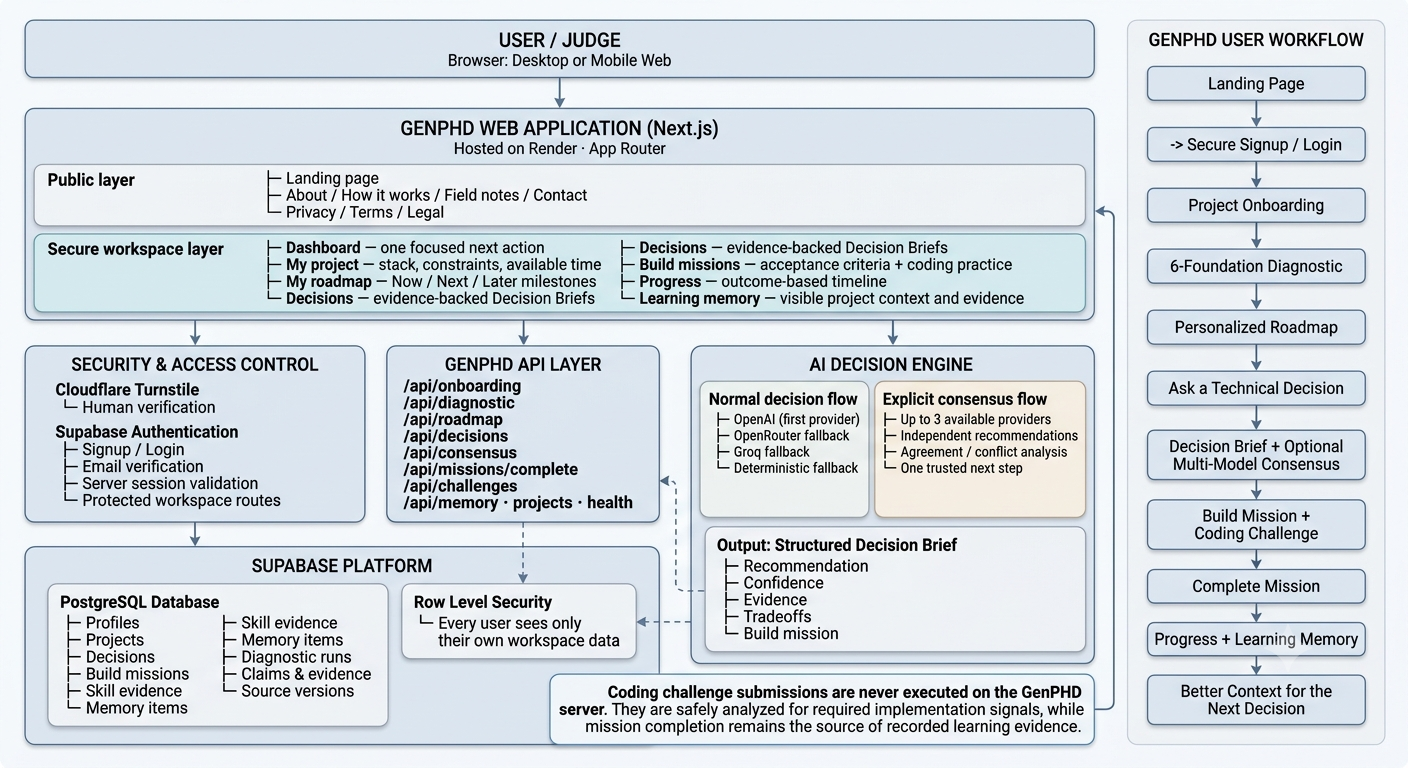
architecture diagram
-
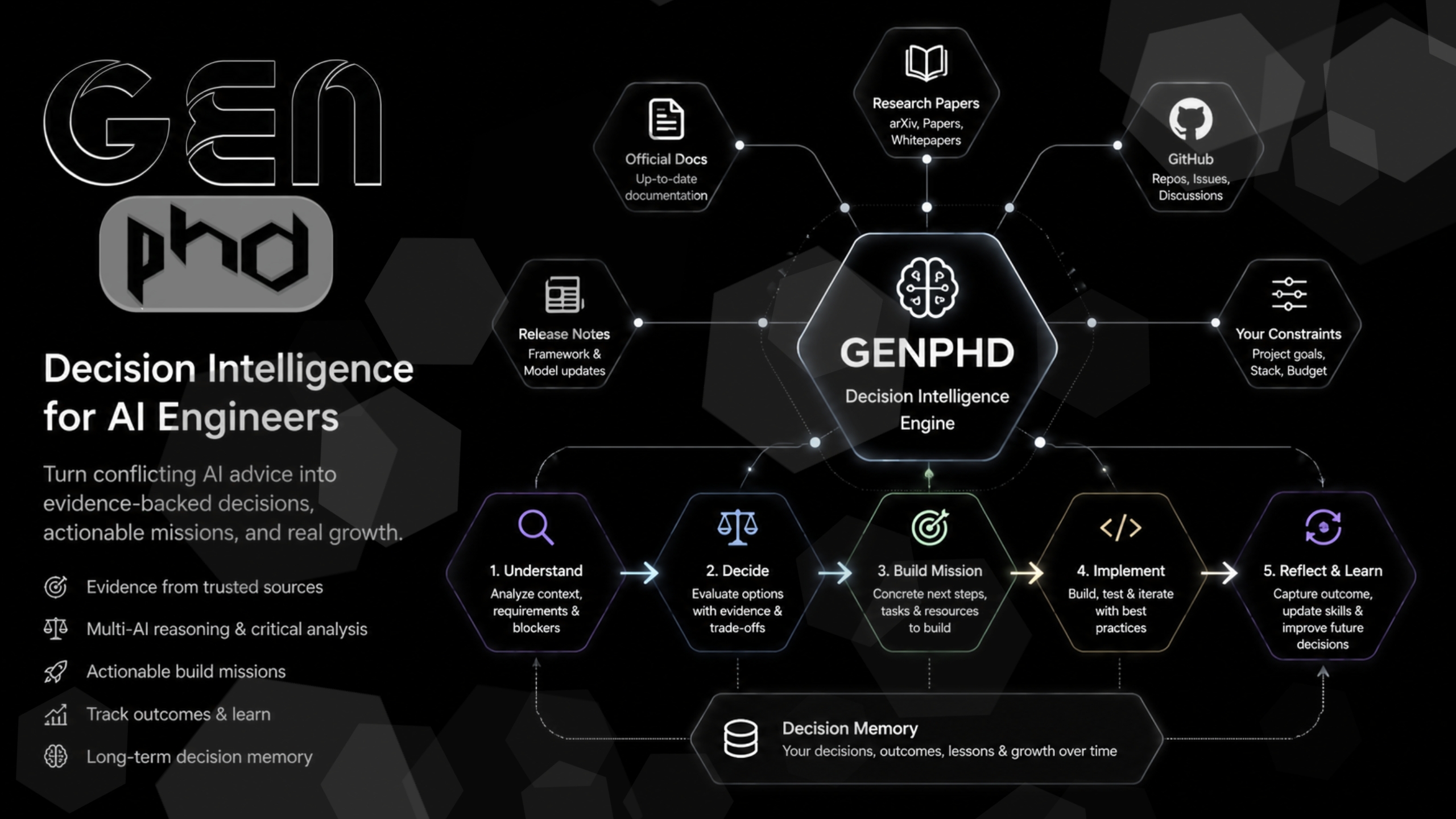
logo
Inspiration
Every AI engineer has lost hours asking the same question in five different tabs — ChatGPT says use agents, a tutorial says use a framework, the docs say something else entirely. The problem was never a lack of answers. It was a lack of a system that remembers your project, weighs evidence over opinion, and turns a decision into an actual next step. That's why we built GenPHD — the decision intelligence layer for AI engineers.
What it does
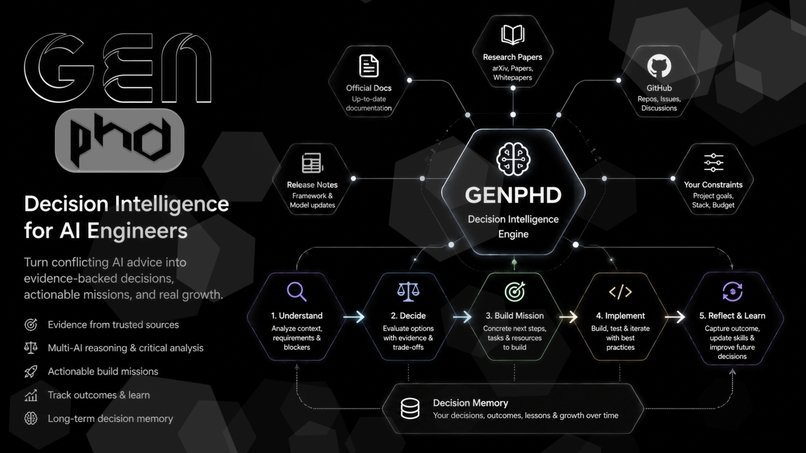
GenPHD turns conflicting AI advice into an evidence-backed next build action, then learns from what happens when you act on it.
The core loop:
- You describe your goal, active project, stack, time budget, and current blocker.
- GenPHD builds a concise roadmap with your next three milestones.
- When you're stuck, you ask a real decision question — e.g. "Should I use LangGraph for this two-day RAG project?"
- GenPHD returns a Decision Brief: source-backed evidence, tradeoffs, a recommendation, an explicit confidence level, a counterfactual ("choose the alternative if…"), and one next action.
- That action becomes a Build Mission with a target outcome and acceptance criteria.
- Once you complete it, GenPHD records the outcome, updates your skill evidence, and adjusts your roadmap.
It is not a generic chatbot, a course platform, or a multi-agent dashboard. It's a closed decision loop — evidence in, action out, learning compounding over time.
How we built it
- Frontend/App: Next.js (App Router, TypeScript strict mode), Tailwind CSS, shadcn/ui, Lucide icons
- Backend: Supabase (PostgreSQL, Auth, Row Level Security, Storage), typed server routes, Zod schema validation at every boundary
- AI workflow: OpenAI as the primary reasoning layer, orchestrated as a controlled pipeline — Context Builder → Evidence Retriever → Parallel Deliberation → Claim Adjudicator → Action Composer → Reflection Evaluator — not an unconstrained autonomous agent
- Architecture: Deliberate modular monolith for the MVP; services split only when there's a measured reason (e.g. sandboxed code evaluation)
- Design system: A monochrome, restraint-first UI (Apple-level calm, Linear-level density discipline) — no gradients, no gamification, one primary action per screen
- Source grounding: Curated, versioned source corpus with visible URLs and dates, tiered by trust (official docs > maintainer repos > practitioner articles > unsourced social content)
Challenges we ran into
- Designing a Decision Brief structure that's genuinely useful rather than "AI says X" — we had to force every recommendation to expose uncertainty and a counterfactual, not just a confident-sounding answer.
- Resisting the urge to build a flashy multi-agent dashboard. The real value was in a disciplined, inspectable workflow, not agent theatre.
- Keeping memory transparent and user-controlled (visible, editable, deletable) while still making the roadmap feel adaptive and smart.
- Scoping the MVP tightly — cutting gamification, social feeds, and admin dashboards that would have diluted the core loop.
Accomplishments that we're proud of
- A working end-to-end loop: onboarding → Decision Brief → Build Mission → reflection → updated roadmap.
- A Decision Brief that always shows its evidence, its confidence, and what would change the recommendation — instead of presenting model output as ground truth.
- A design system that stays calm and legible under real product complexity, with zero dashboard clutter.
What we learned
Model consensus isn't trust — evidence quality, recency, and fit to the user's actual constraints are what make a recommendation defensible. Building a product around a loop (decide → act → reflect → improve) creates far more lasting value than another single-turn chat interface.
What's next for GenPHD
- Repository-aware evidence retrieval tied directly to a user's codebase
- Secure sandboxed code evaluation for Build Missions
- Source freshness alerts when a past decision's evidence changes
- Shared/team decision records for bootcamps and engineering teams
- Portfolio-ready, source-backed skill evidence
Built With
- nextjs
- openai
- postgresql
- supabase
- tailwindcss
- typescript
- zod


Log in or sign up for Devpost to join the conversation.