-
Genome House
Inspiration
GenomeHouse was conceived to address a critical gap in the bioinformatics ecosystem: the lack of an integrated, efficient toolkit for handling complex genomic data. Existing solutions often focus on isolated tasks, leading to fragmentation and inefficiencies in research workflows. Recognizing the need for a unified platform, GenomeHouse was designed to streamline bioinformatics processes, enabling researchers and developers to work more effectively with genomic data.
What it does
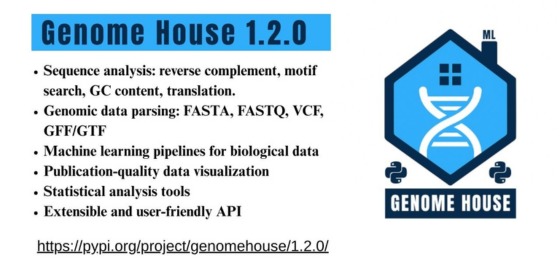
GenomeHouse is a modular Python toolkit that simplifies and accelerates bioinformatics workflows. Key functionalities include:
Sequence Analysis: Reverse complement, motif search, GC content calculation, and translation.
Genomic Data Parsing: Support for standard formats such as FASTA, FASTQ, VCF, and GFF/GTF.
Machine Learning Pipelines: Pre-configured pipelines optimized for biological data analysis.
Visualization: Publication-quality plots and interactive genomic visualizations.
Statistical Analysis: Built-in methods for rigorous analysis and interpretation of genomic datasets.
This comprehensive suite empowers researchers and professionals to conduct sophisticated analyses with efficiency and accuracy.
How It Was Built
GenomeHouse was developed using Python, leveraging robust libraries such as NumPy and Pandas for data manipulation, Matplotlib for visualization, and scikit-learn for machine learning. Its modular architecture allows users to import only the components they require, optimizing performance and usability. The design emphasizes scalability, reproducibility, and adaptability to diverse bioinformatics workflows.
Challenges Encountered
Key challenges included:
Integration of Diverse Tools: Ensuring compatibility across multiple functionalities without compromising usability.
Performance Optimization: Efficient processing of large genomic datasets required advanced algorithm design and memory management.
User Accessibility: Developing a toolkit suitable for both expert bioinformaticians and professionals new to computational workflows.
Comprehensive Documentation: Delivering clear, thorough guidance to maximize the toolkit’s utility for diverse users.
Accomplishments
Unified Platform: Successfully created a single, cohesive toolkit integrating multiple bioinformatics workflows.
Professional Adoption: GenomeHouse is actively used by researchers and developers in real-world projects.
Community Contributions: Engagement with the global bioinformatics community has driven enhancements and collaborative development.
Continuous Innovation: Ongoing updates ensure that the toolkit remains relevant and cutting-edge.
Key Learnings
Developing GenomeHouse provided critical insights into:
Interdisciplinary Expertise: Strengthened understanding of both computational methodologies and biological principles. Professional Software Development: Advanced skills in modular design, version control, and collaborative project management.
User-Centric Design: Importance of creating intuitive, accessible tools for diverse professional users.
Problem-Solving and Resilience: Overcoming technical and conceptual challenges reinforced strategic thinking and adaptability.
Future Roadmap
The next phase of GenomeHouse focuses on:
Advanced Machine Learning: Incorporating predictive modeling and AI-driven analytics for genomic datasets.
Interactive Visualization: Developing dynamic, interactive tools for exploring complex genomic information.
Cloud Integration: Enabling scalable analysis for large-scale datasets in cloud environments.
Enhanced Community Collaboration: Encouraging contributions to expand functionality and improve usability.
Professional Training Resources: Delivering comprehensive tutorials and courses to support adoption in research and industry.

Log in or sign up for Devpost to join the conversation.