-
-
logo
-
Inspiration
I was frustrated with how boring history classes can be - just memorizing dates and facts from textbooks. I kept wondering, "What would it actually feel like to talk with Albert Einstein?" That curiosity about having real conversations with my intellectual heroes sparked this whole project. I wanted to experience what it would be like to ask Einstein about relativity or get life advice from the greatest minds in history.
What it does
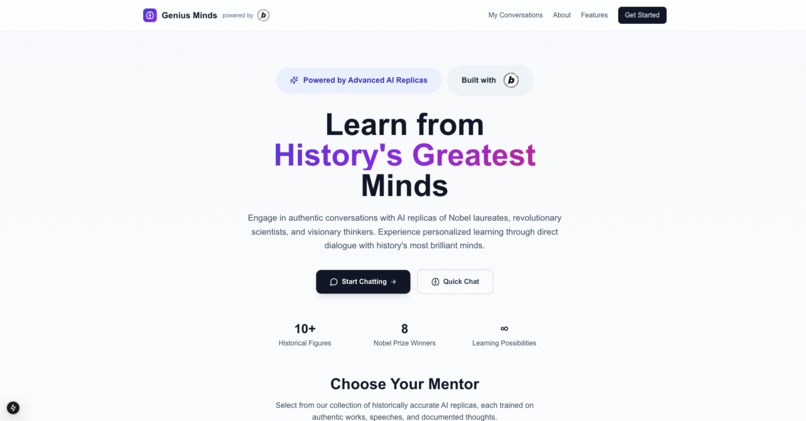
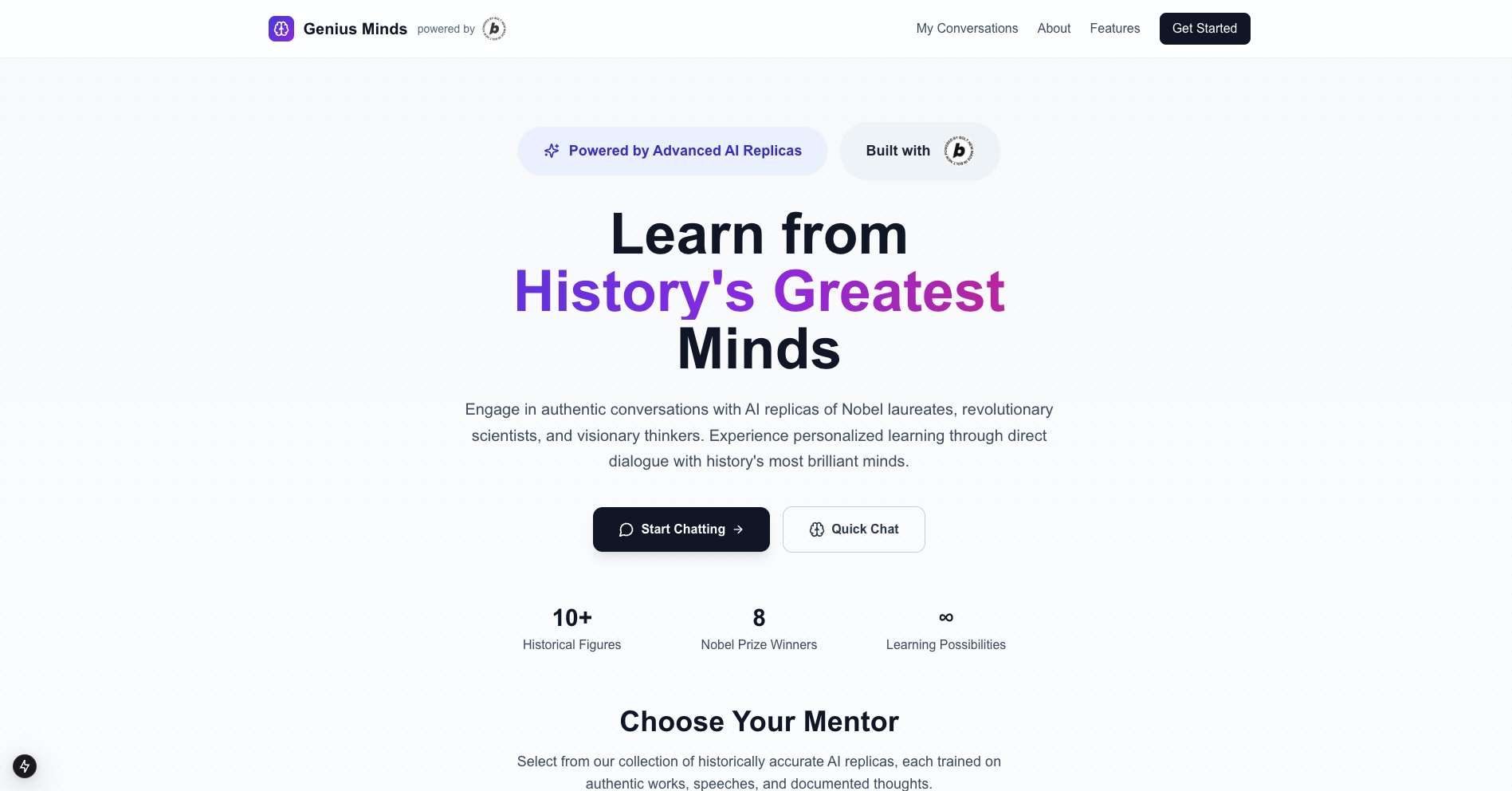
Genius Minds lets you chat with 10 famous historical figures like they're your personal tutors. You can ask Einstein to explain physics, get writing advice from Maya Angelou, or even set up group discussions where multiple geniuses debate topics together. For voice conversations, I've implemented Einstein, Feynman, and Nelson Mandela using ElevenLabs' conversational AI - the rest are available through text chat powered by OpenAI's latest gpt-4.1-nano model. You can also generate professional PDF study notes from your conversations with custom categories and analysis.
How I built it
I used Next.js 15 with TypeScript because I wanted something modern and reliable. The core AI conversations are powered by OpenAI's gpt-4.1-nano model, which I integrated through secure server-side API routes to maintain proper authentication. The trickiest part was creating authentic character personalities - I crafted detailed system prompts for each historical figure and integrated ElevenLabs for both text-to-speech and conversational AI agents for voice interactions. I spent a lot of time making the chat interface feel natural, like WhatsApp, with real timestamps and smooth animations using Framer Motion. For the PDF generation, I integrated html2pdf.js to create professional documents with logos and custom formatting.
Challenges I ran into
Getting multiple AI characters to respond simultaneously in group chats was a nightmare at first - I had to figure out how to manage multiple OpenAI API calls without everything breaking. Creating distinct personalities for each historical figure using gpt-4.1-nano took extensive prompt engineering and testing. The voice integration with ElevenLabs for Einstein, Feynman, and Mandela was particularly challenging, especially getting the conversational AI agents to work smoothly with proper audio queuing to prevent overlapping responses. I probably rewrote the PDF export feature three times before getting professional-looking documents with proper styling and branding.
Accomplishments that I'm proud of
I successfully created authentic conversations with 10 different historical personalities using OpenAI's gpt-4.1-nano model that feel genuinely real and distinct. The group chat feature where you can watch Einstein and Hawking discuss black holes is honestly magical. Getting voice conversations working smoothly with three characters using ElevenLabs' conversational AI, complete with proper audio queuing and real-time microphone input, was a major technical achievement. Creating a PDF generator that produces study notes with custom analysis categories - not just generic summaries - feels like a real breakthrough in educational technology.
What I learned
AI integration with OpenAI's latest models is way more complex than I expected, especially when trying to maintain distinct personalities across text and voice using different systems. I learned a ton about optimizing OpenAI API calls, proper environment variable management in Next.js, and discovered that good UX is just as important as the AI technology itself. Working with ElevenLabs taught me about voice synthesis, conversational AI agents, and audio streaming challenges. The dual-API approach (OpenAI + Cerebras) taught me about combining different AI services effectively. Also, students really do want to learn when you make it interactive and fun.
What's next for Genius Minds
I want to add voice conversations for all 10 characters, not just Einstein, Feynman, and Mandela. Expanding to more historical figures is obvious, but I'm also excited about VR experiences where you could sit in da Vinci's workshop or attend Socrates' philosophy sessions. I want to explore OpenAI's newer models as they release and potentially integrate vision capabilities for document analysis. Mobile apps, enhanced PDF generation with more export formats, and learning analytics to track engagement are on the roadmap too.
Built With
- elevenlabs
- nextjs
- python


Log in or sign up for Devpost to join the conversation.