-
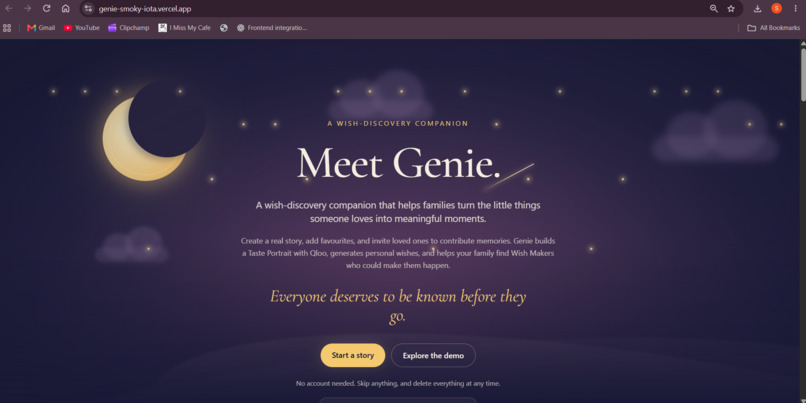
Homepage — Meet Genie hero | Meet Genie, an AI companion turning personal memories into meaningful wishes. |
-
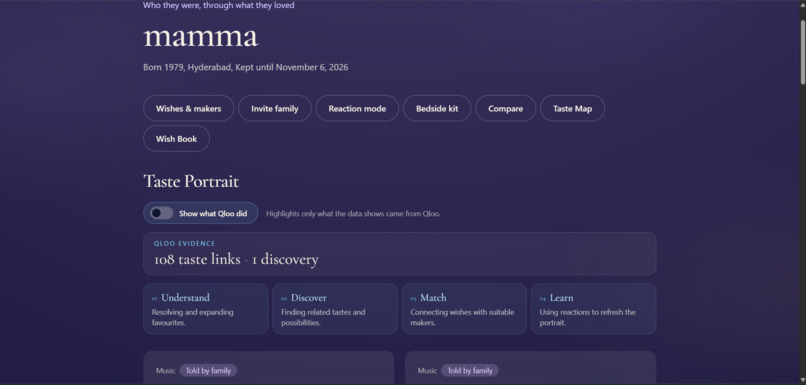
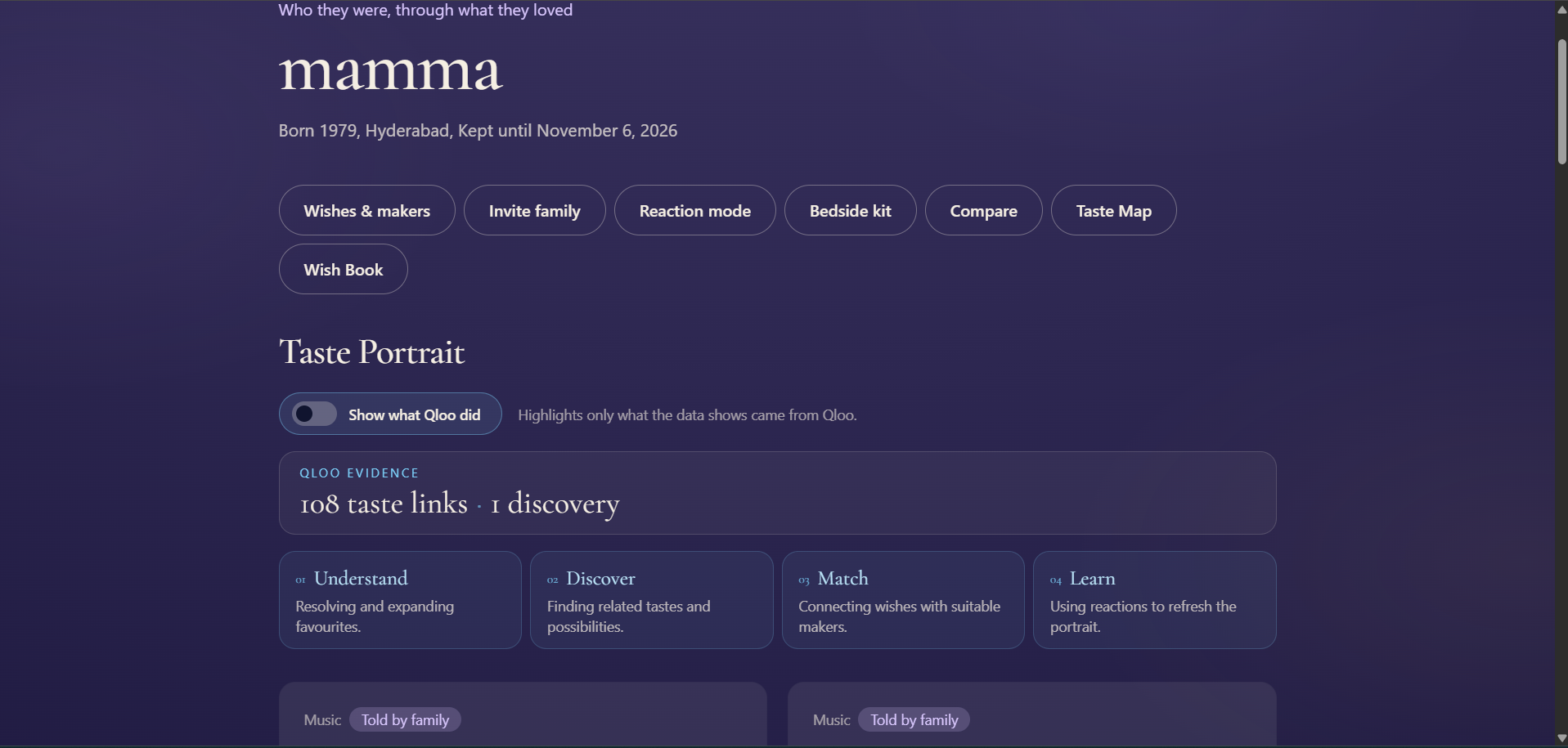
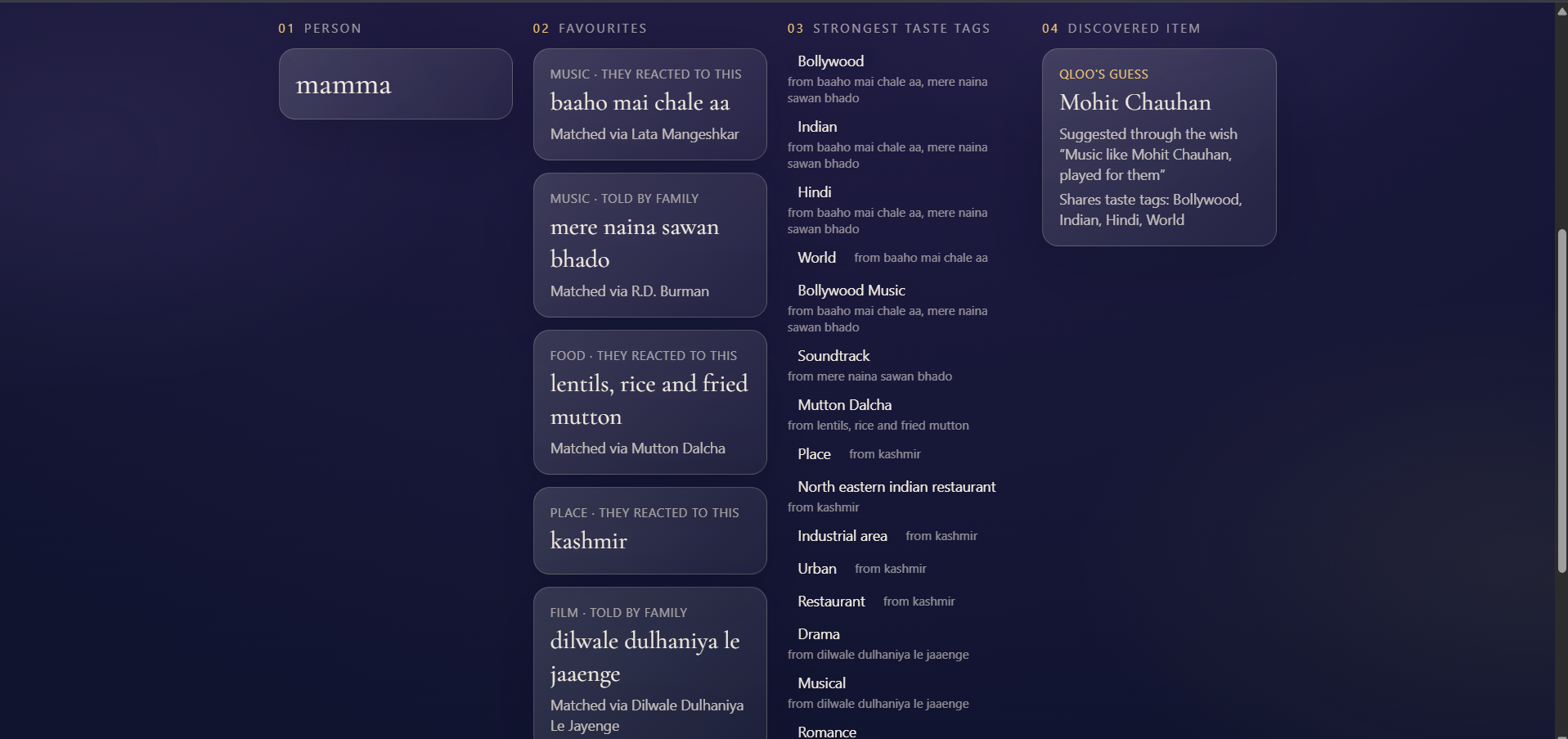
Full Person Dashboard | One place to explore a person's Taste Portrait, wishes and complete story. |
-
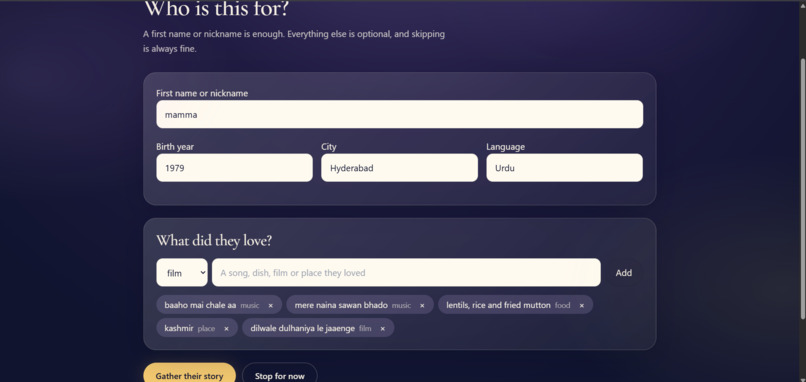
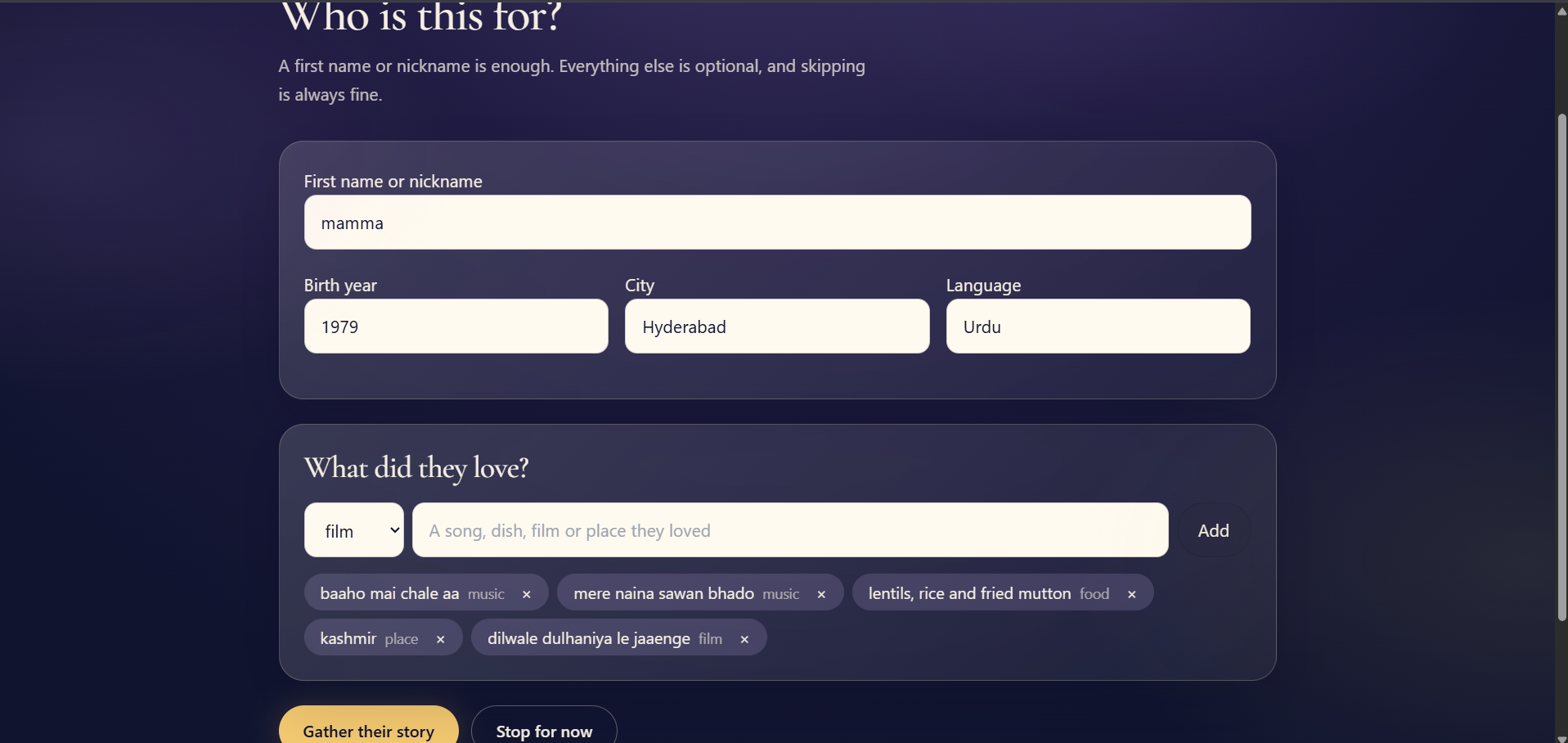
Create Your Own Story | Start a personal story with a name, optional details and favourite things. |
-
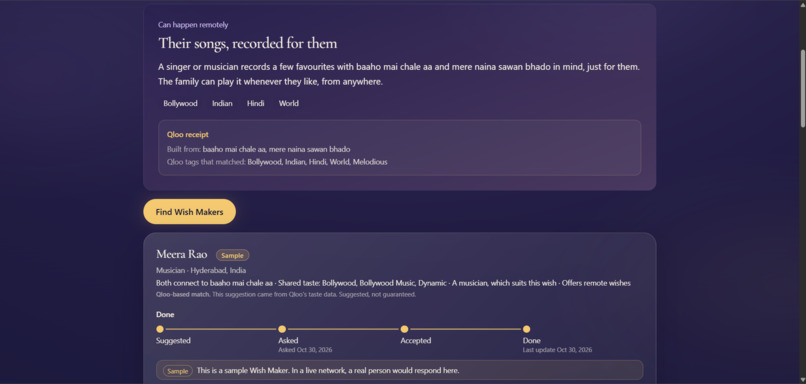
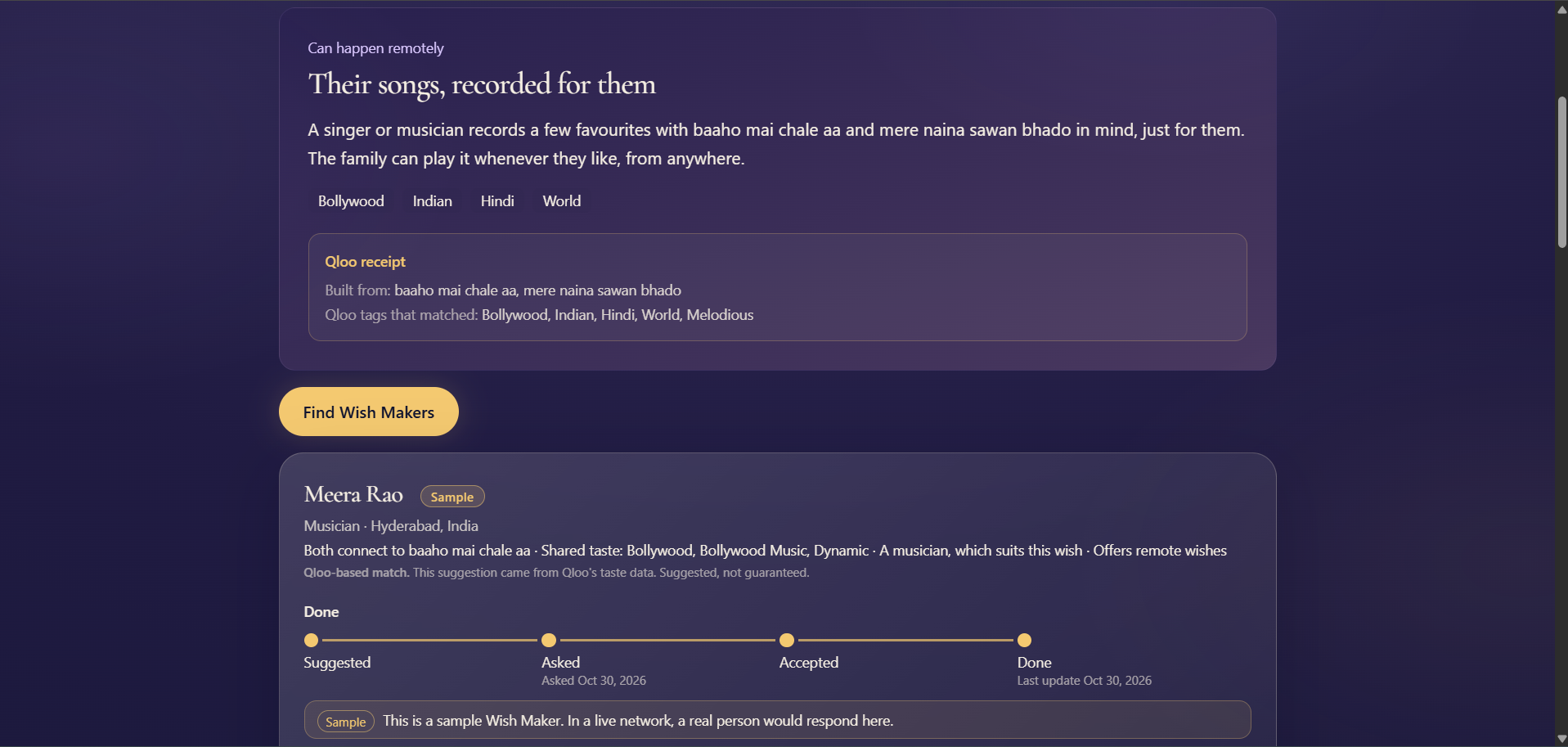
Wish Maker Match | Genie connects a meaningful wish with potential people who can help fulfil it. |
-
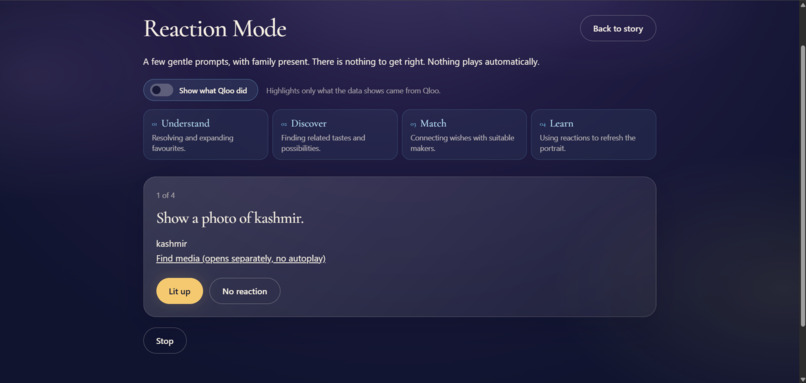
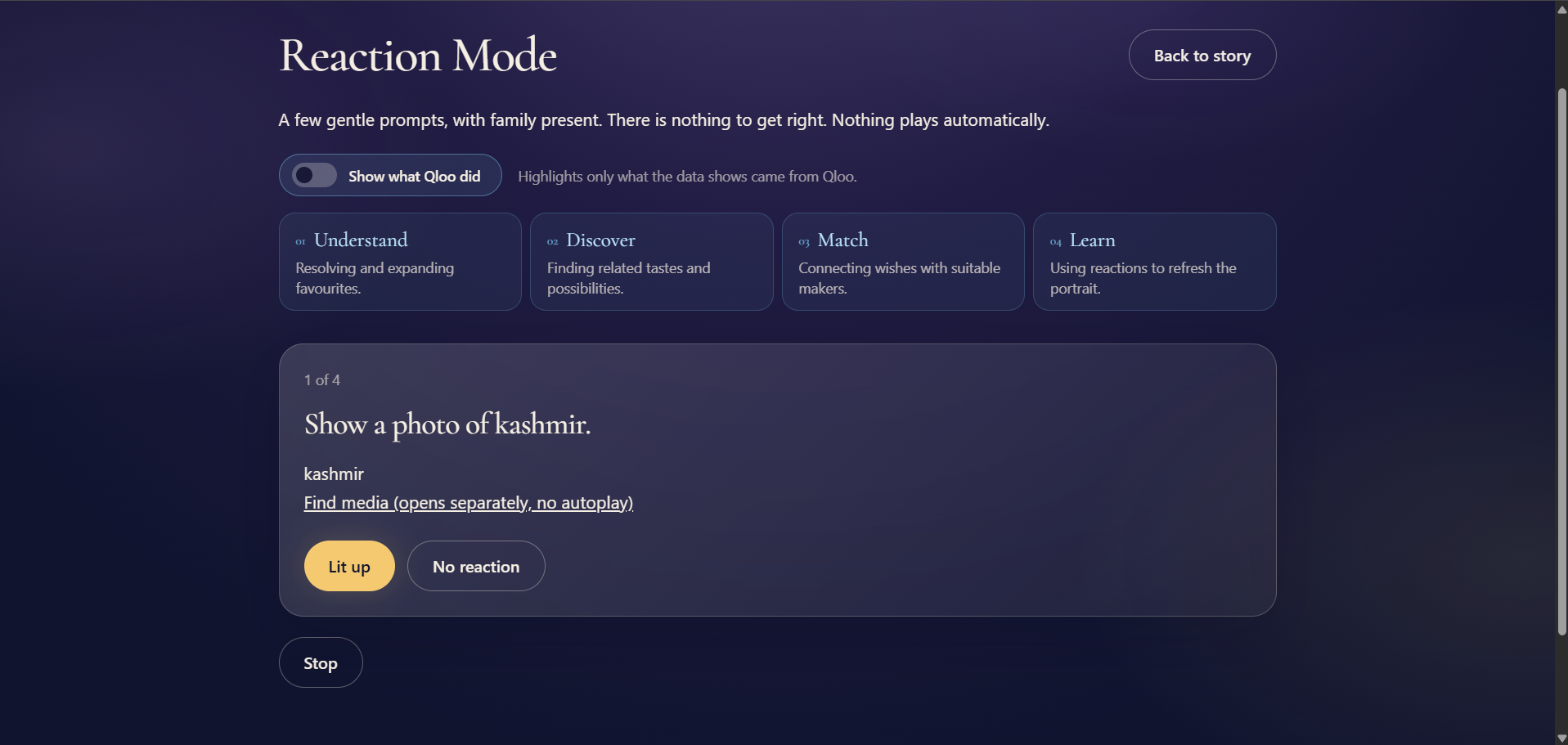
Reaction Mode | Gentle reaction prompts help Genie refine its understanding with family involvement. |
-
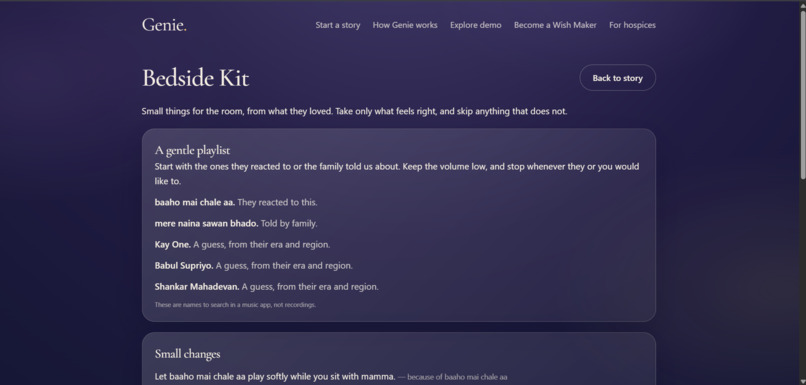
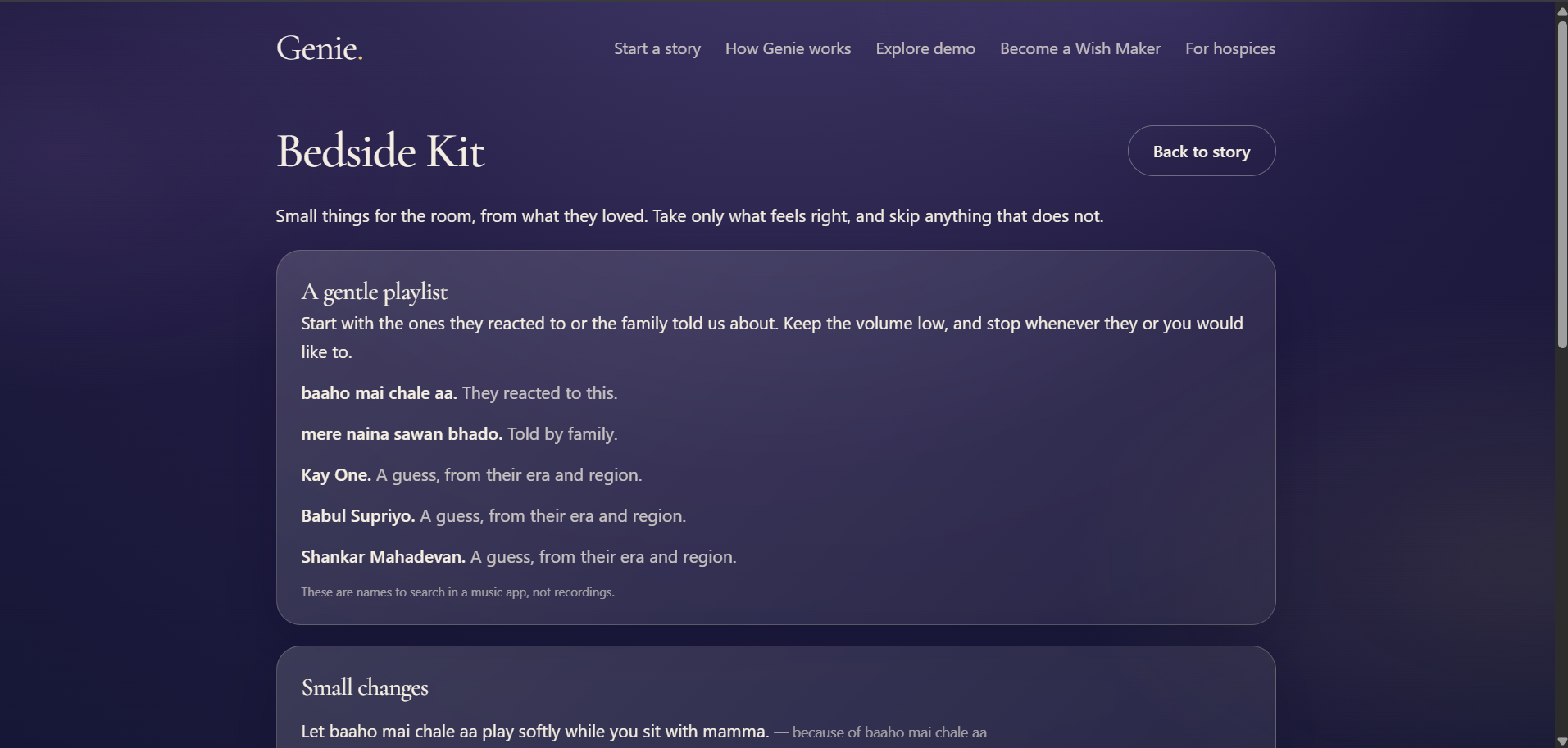
Bedside Kit | Turn personal preferences into comforting music, visitor and everyday-care suggestions. |
-
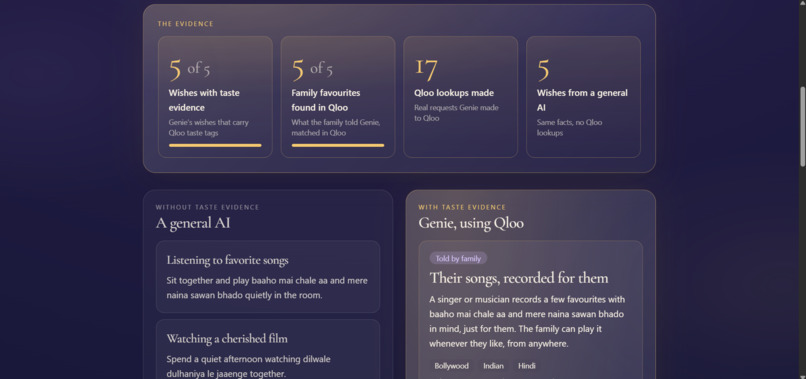
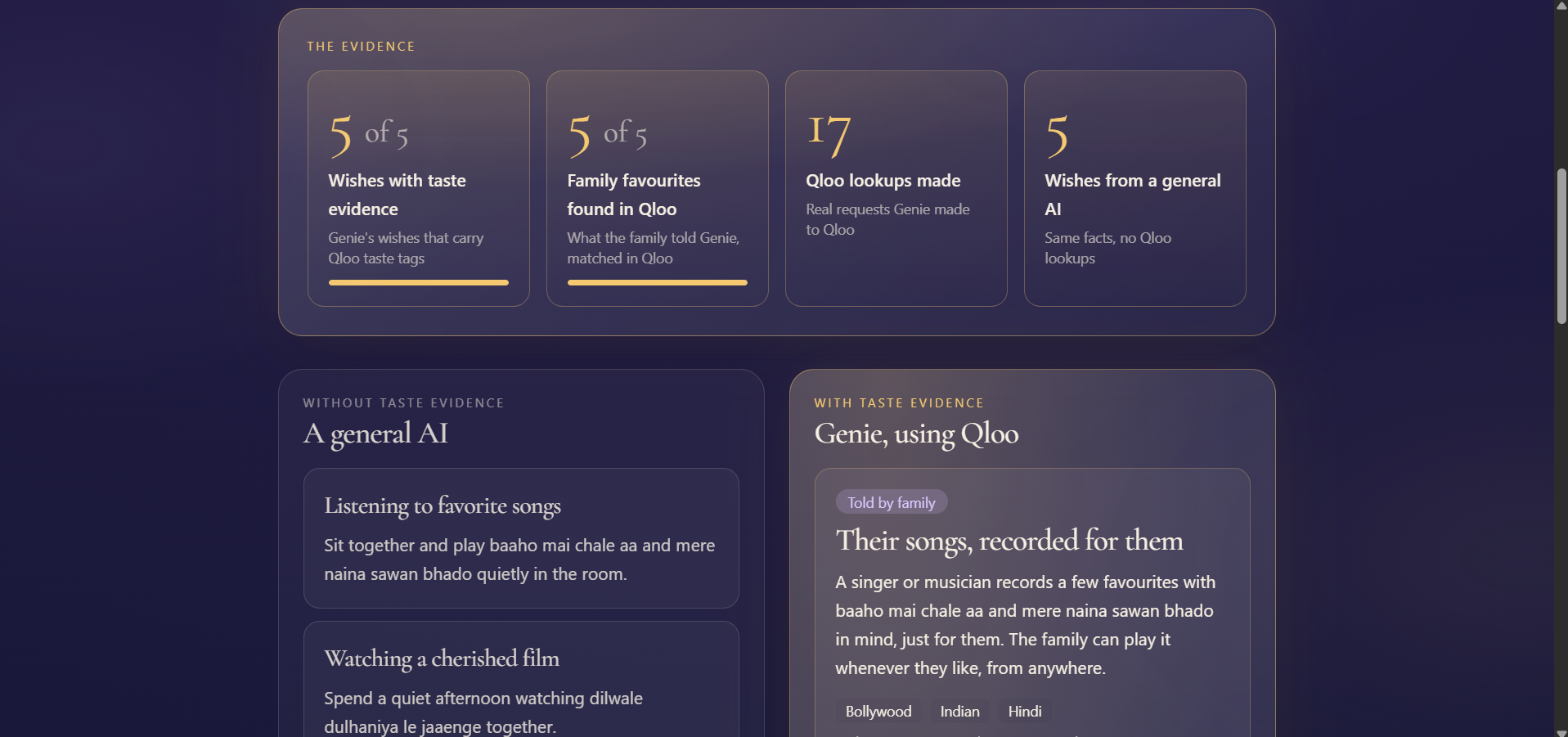
Compare | See how Qloo-grounded Genie differs from general AI given the same family facts. |
-
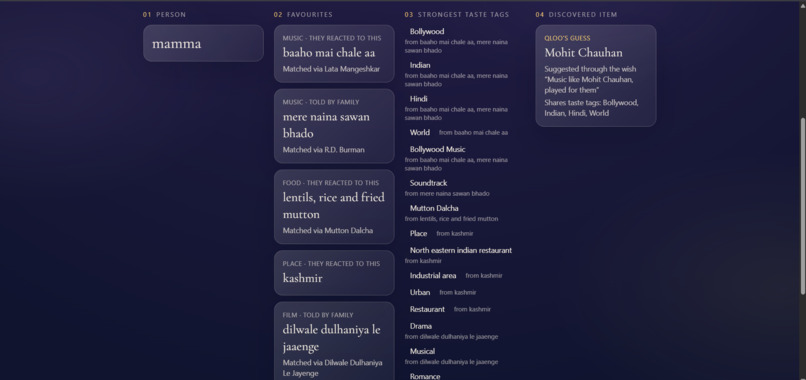
Taste Map | Trace the connections between family memories, Qloo taste evidence and new discoveries. |
-
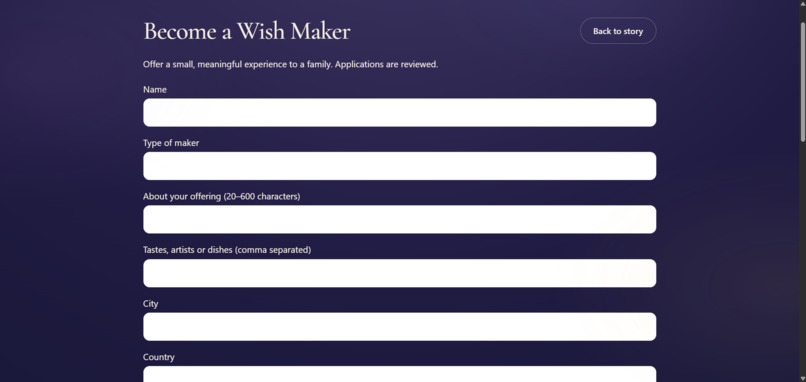
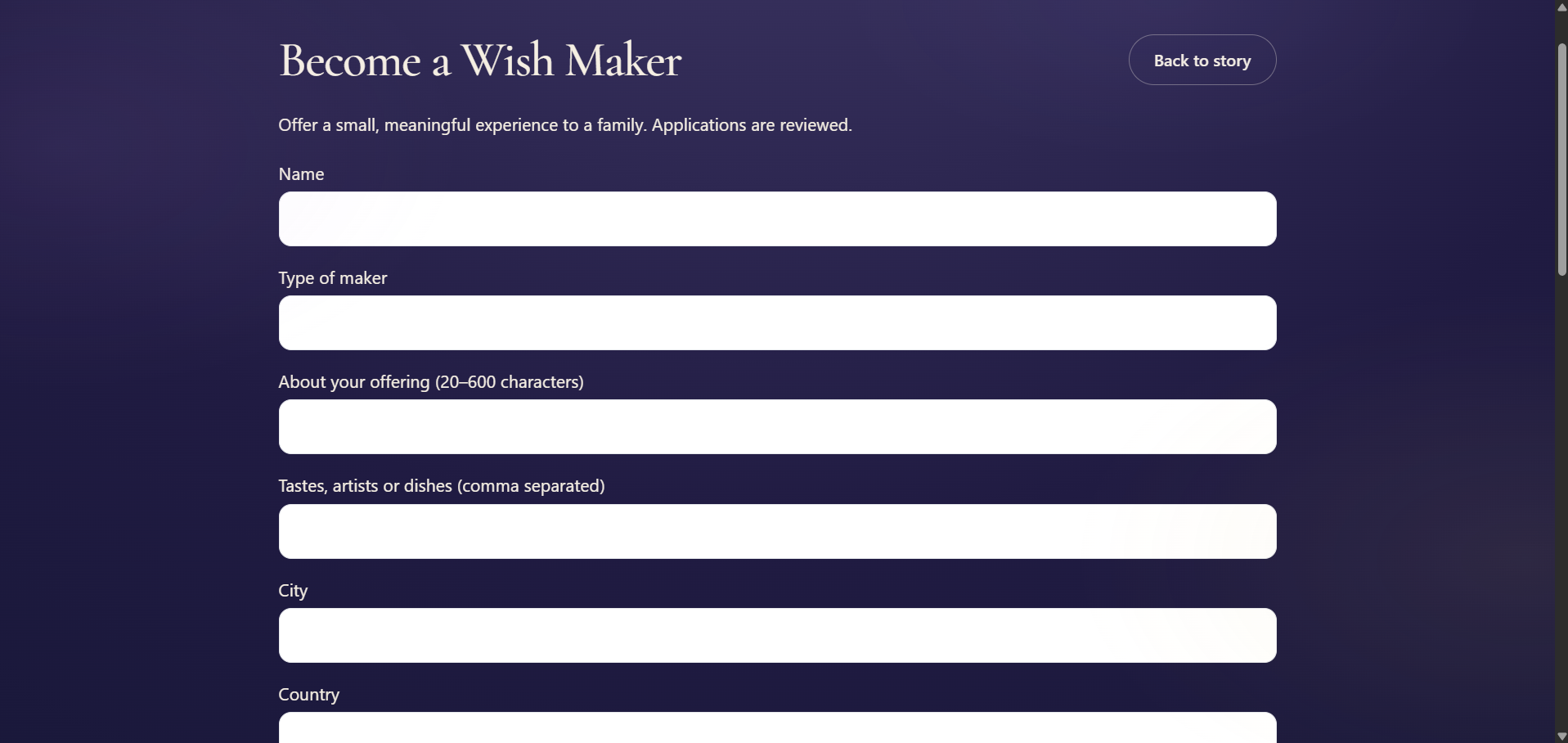
Become a Wish Maker — Application | People can apply to offer small, meaningful experiences aligned with their interests. |
-
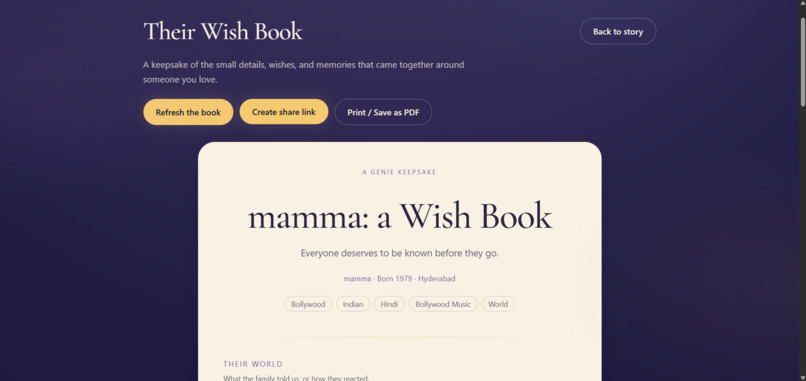
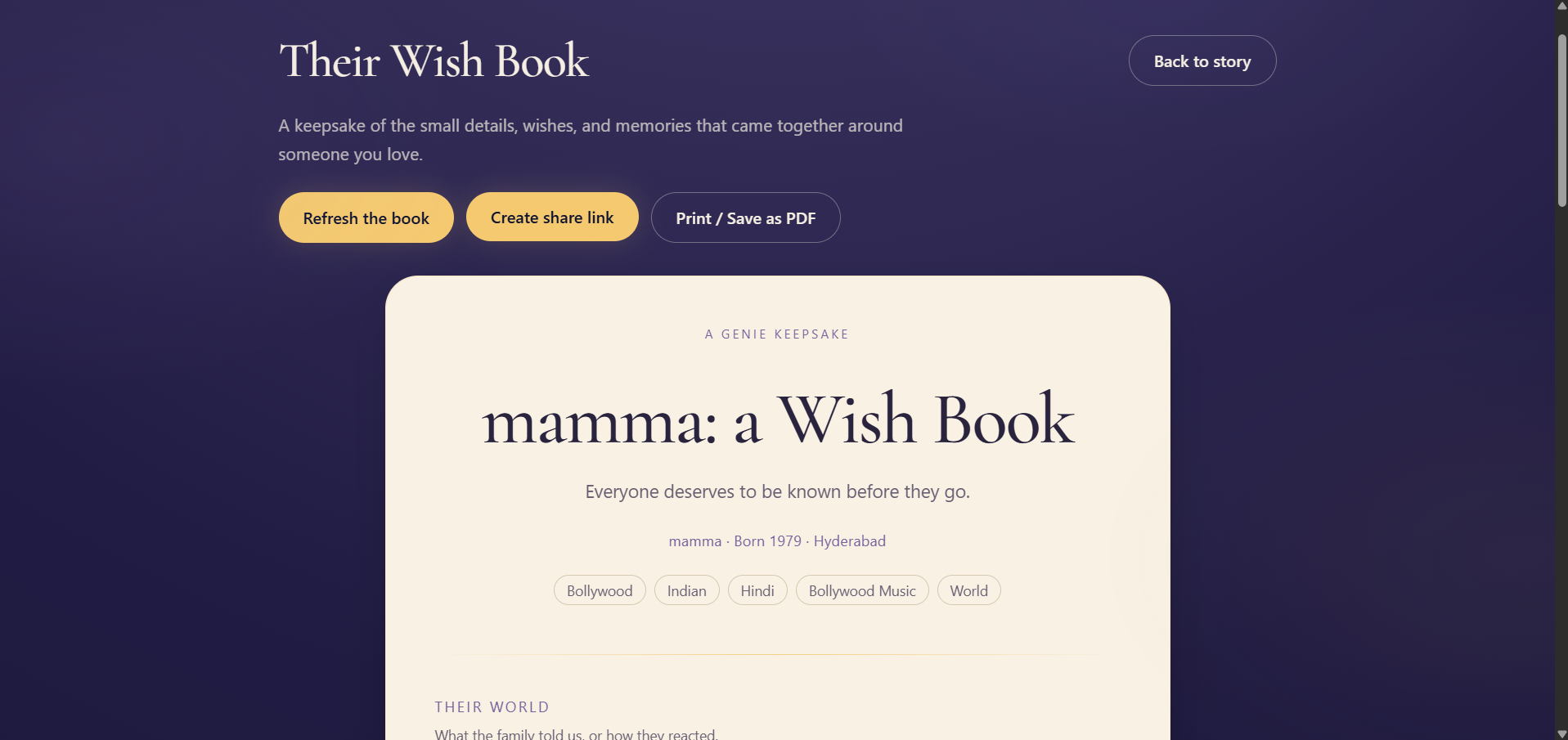
Full Wish Book / Print View | Preserve a personalised collection of memories and wishes in a shareable keepsake. |
-
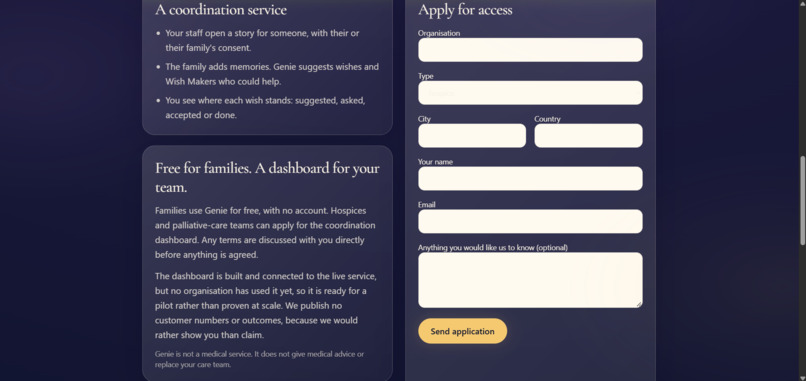
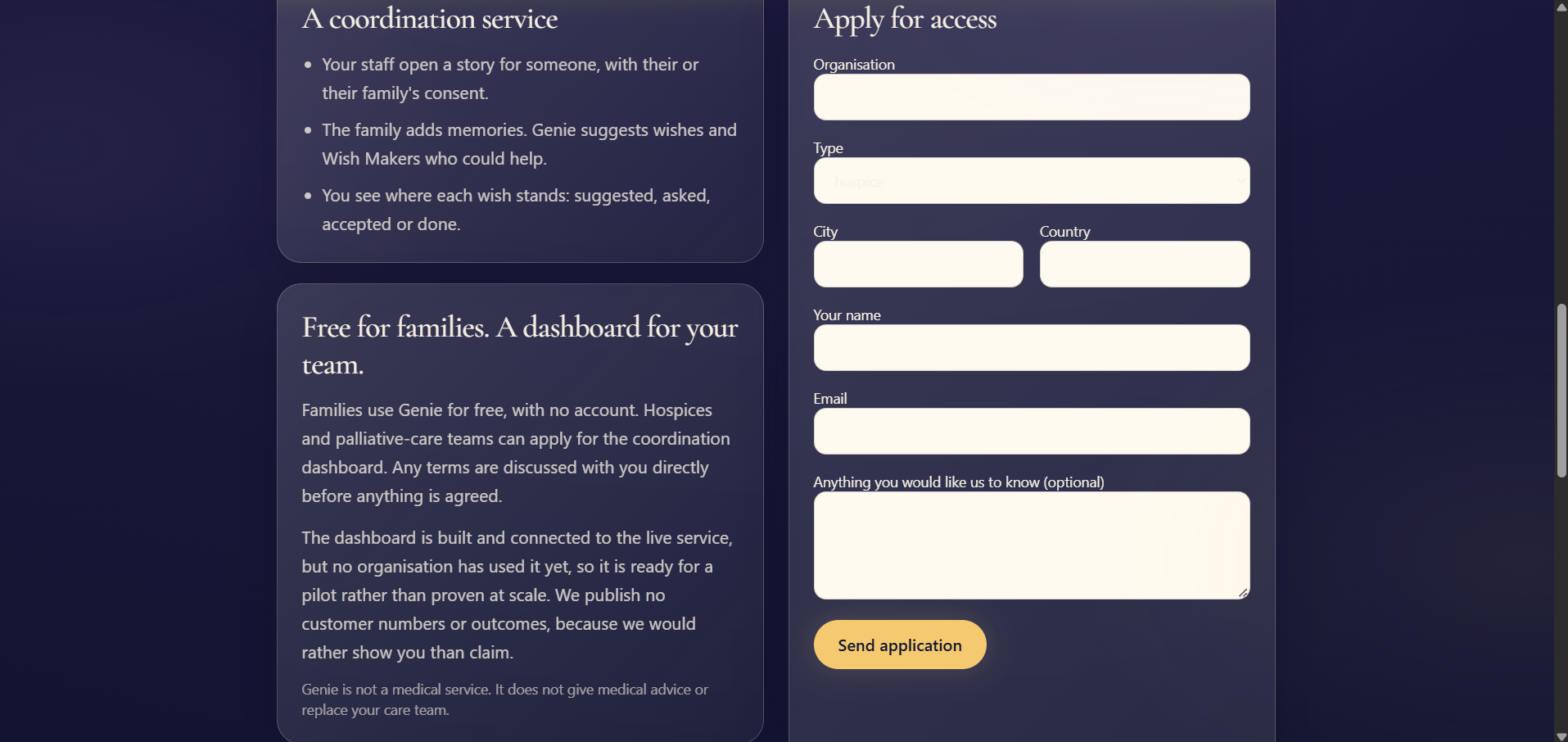
For Hospices — Information & Application | Care organisations can apply to coordinate meaningful experiences for families. |
-
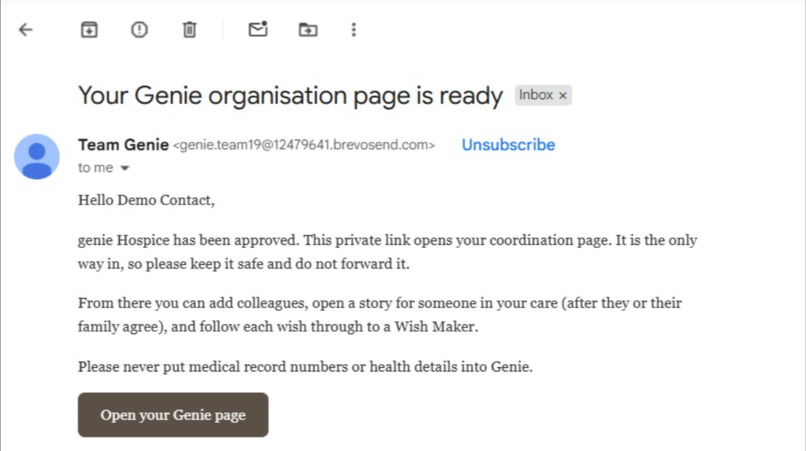
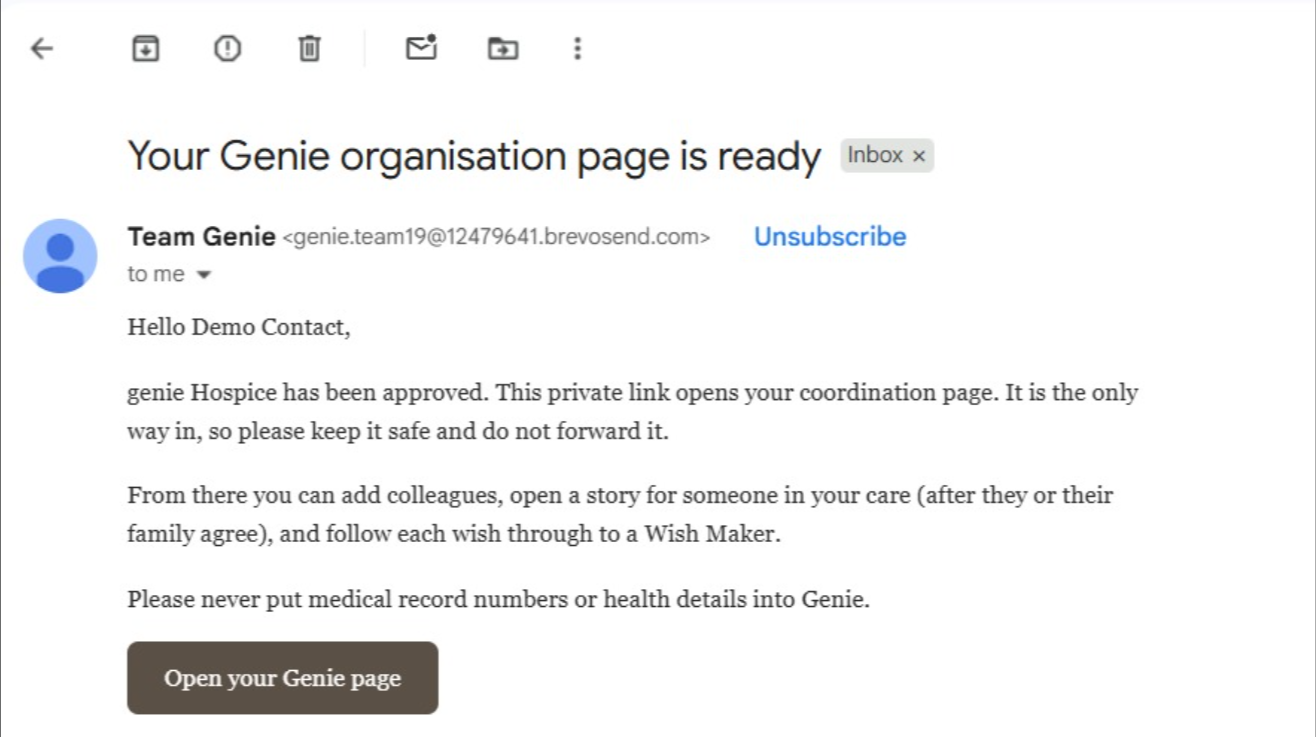
Approved hospices get a private coordination page
-
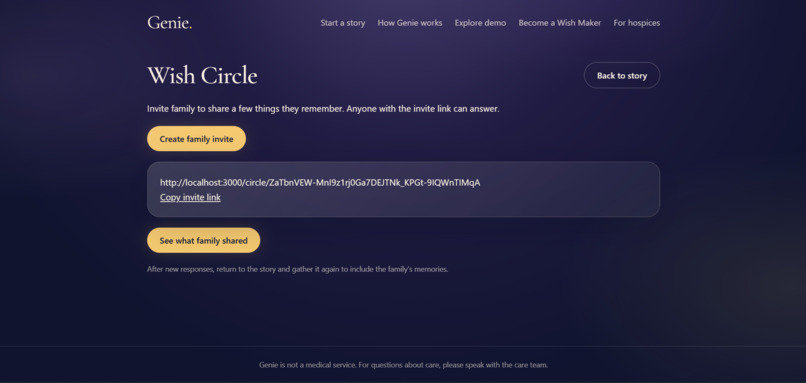
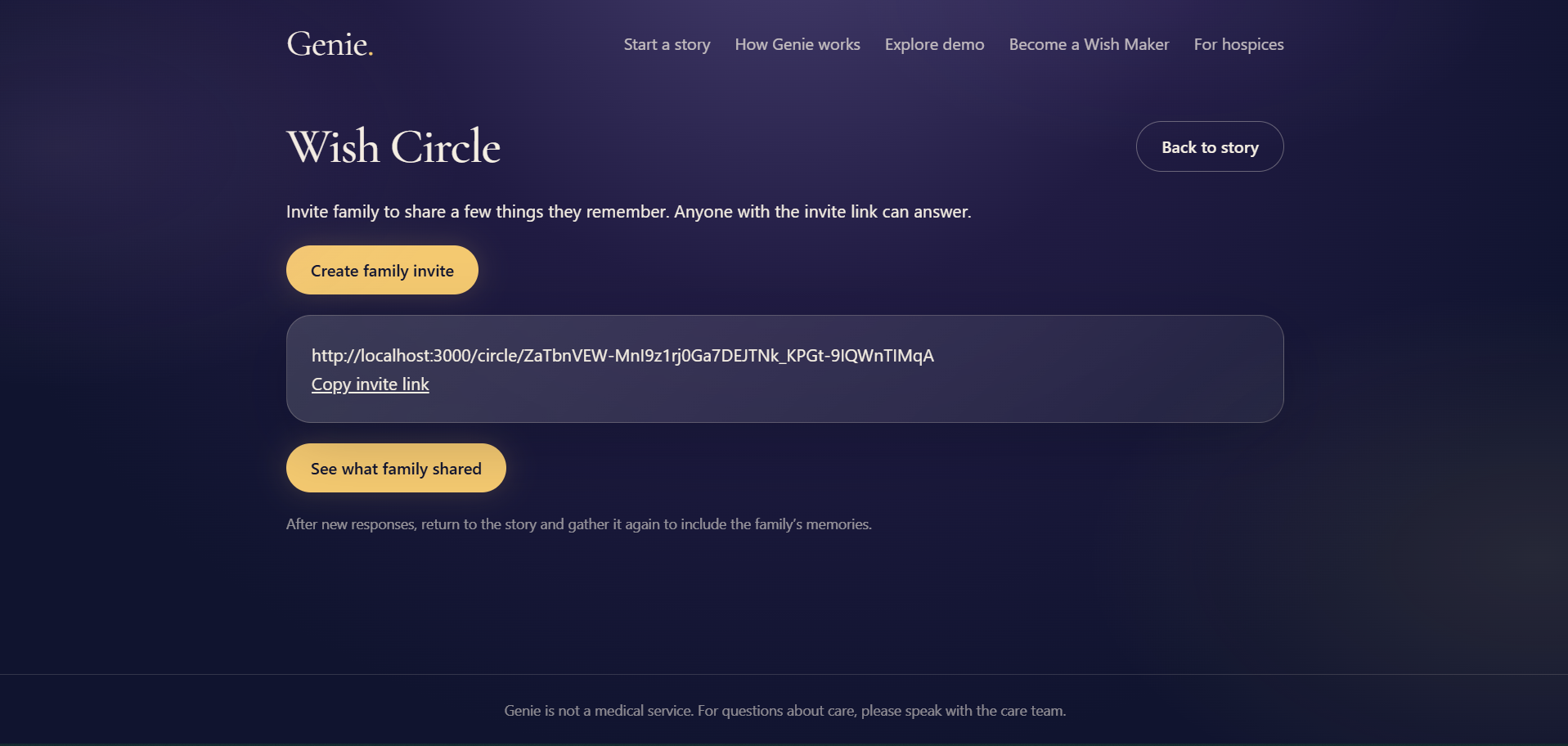
Wish Circle — Family Invite | Invite loved ones to contribute the memories that make a story more complete. |
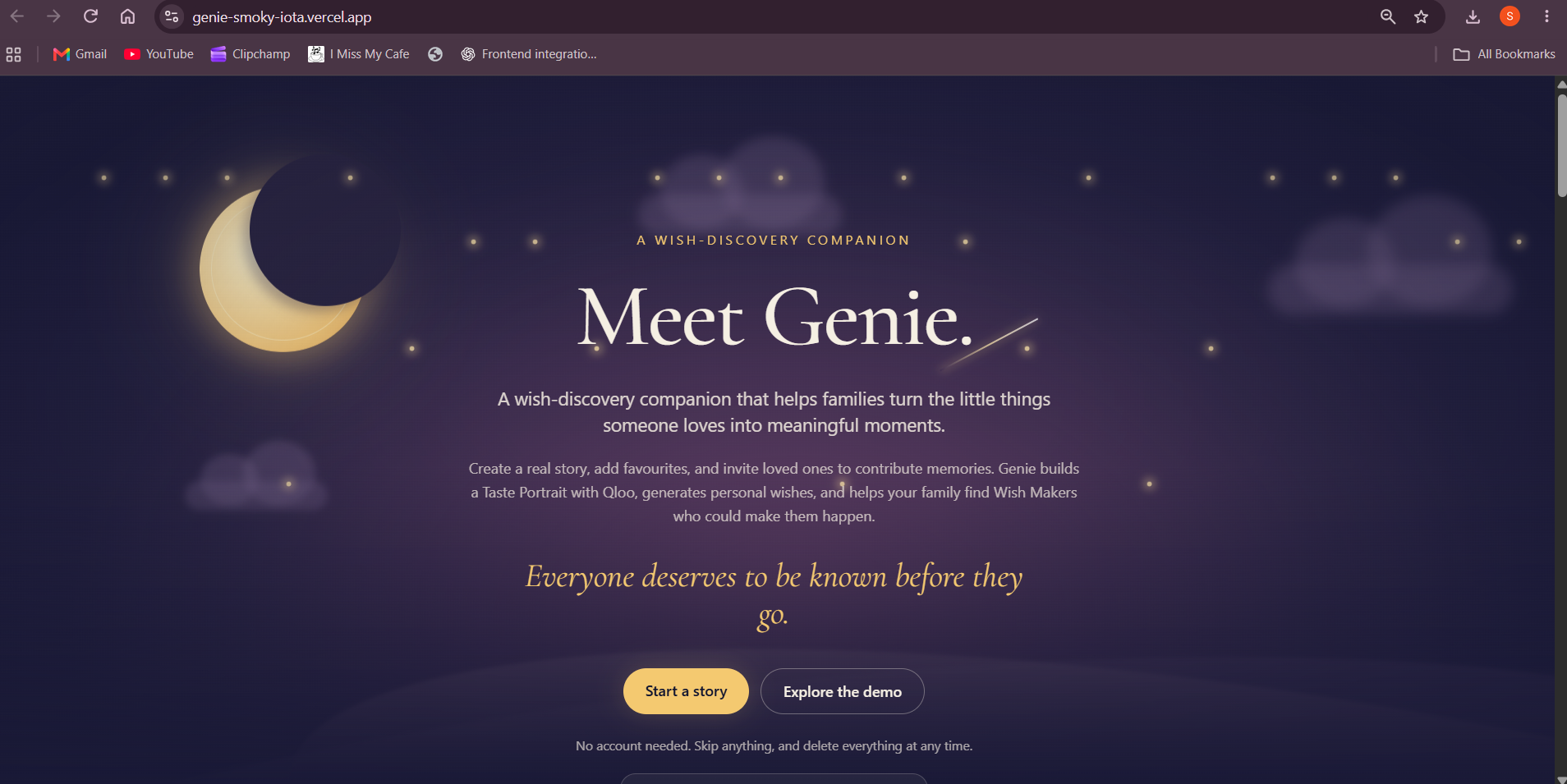
Genie — Everyone deserves to be known before they go.
Inspiration
What if someone's final wish wasn't something grand?
What if it was hearing a song from their childhood one more time, tasting a familiar home-cooked meal, receiving a message from someone who shares their passion, or experiencing a small piece of a place they once called home?
When someone approaches the end of life, conversations naturally become centred on care, logistics, and what needs to be done. But there is an entire person behind those conversations: their music, food, favourite places, stories, memories, and the little things that made them light up.
Families often hold fragments of these memories. One relative remembers a favourite singer. Another remembers a childhood dish. Someone else recalls a place the person always wanted to revisit.
Turning those scattered memories into meaningful moments, especially when someone can no longer communicate easily, is much harder.
We built Genie around one belief:
Everyone deserves to be known before they go.
We didn't want to create another AI tool that simply generates a bucket list. We wanted to build a system that could understand what made someone them, discover meaningful possibilities their family might never have considered, and help connect those wishes with people who could bring them to life.
A final wish does not always require something extraordinary. Sometimes, the right person, the right memory, and the right moment are enough.
Qloo's Taste Intelligence gave us the foundation to connect those dots.
What it does
Genie is a Qloo-powered agentic platform designed to help families, hospice organisations, and Wish Makers discover, coordinate, and work towards fulfilling meaningful last wishes.
It transforms personal favourites and family memories into a Taste Portrait, generates personalised wishes, identifies potential Wish Maker matches, and provides the infrastructure to coordinate the journey.
Genie isn't limited to suggesting what someone might enjoy. It is designed to help those suggestions become real experiences.
1. Start with the person, not their condition
A family begins with a few details and favourites: a song, an artist, a dish, a film, a meaningful place, or a personal memory.
No medical information is required. The experience centres on who the person is and what they love.
2. Bring their memories together through the Wish Circle
Family members and friends can contribute memories using private, consent-based links without creating accounts.
Each contribution adds another piece to the person's story, allowing Genie to build a richer understanding than any single family member could provide.
3. Build a Qloo-powered Taste Portrait
Genie uses Qloo to resolve favourites into taste entities and tags, identify meaningful connections, and build a personalised portrait.
It also preserves the distinction between what the family actually shared, what the person reacted to, and what Genie inferred.
We never want an AI-generated guess to be presented as someone's confirmed memory.
4. Discover meaningful last wishes
Using Qloo's taste relationships and explainability, Genie generates three to five personalised wishes grounded in the person's interests.
These can range from simple bedside moments to experiences that require someone else's involvement.
For example, a childhood music preference might inspire a personal recording or live performance. A remembered dish might become a recipe recreated by a cook. A meaningful location might inspire a story, photograph collection, or message from someone connected to that place.
Genie can also surface related discoveries the family may not have considered, clearly identifying them as suggestions rather than established favourites.
The goal is not to produce the longest wish list. It is to identify moments that could genuinely matter while there is still time.
5. Find potential Wish Makers
This is where Genie moves beyond a conventional recommendation engine.
Its matching system connects wishes with relevant types of contributors, such as musicians, cooks, artists, storytellers, and other potential Wish Makers, using shared Qloo taste entities and tags.
The matching experience and underlying workflows are implemented. Our current demonstration uses clearly labelled fictional Wish Makers because real-world fulfilment requires verified participants, consent, availability, and human oversight.
The platform is designed to support real Wish Maker connections once those partnerships are established.
6. Coordinate through the hospice dashboard
We have already developed a dedicated organisation-facing layer rather than leaving hospice integration as a future concept.
It includes an organisation portal with role-based access, application and approval workflows, consent confirmation, opaque case identifiers, case management, expiry extensions, deletion controls, and audit logging.
This creates a structured pathway for hospice organisations to participate in the experience and oversee the people and wishes associated with their organisation.
What remains is real-world onboarding and validation with hospice partners, not building the dashboard from scratch.
7. Preserve the journey in a Wish Book
Genie compiles the person's Taste Portrait, contributed memories, and wishes into a personal keepsake that families can print or optionally share.
Sharing can be revoked, and the platform includes privacy and retention controls.
Additional experiences
- Reaction Mode: Helps Genie learn from simple responses, such as when something makes a person light up, including situations where verbal communication is difficult.
- Bedside Kit: Offers gentle, comfort-focused suggestions involving music, surroundings, and visitors—not medical advice.
- Watch Genie Learn: Makes the agent's steps and Qloo calls visible rather than hiding the process behind a single AI response.
- Genie vs. General AI: Uses the same input facts to demonstrate what Qloo's taste intelligence contributes to personalisation.
- Hospice and organisation portal: An implemented coordination layer for organisation access, case management, permissions, and oversight.
- Fictional guided demos: Allow judges to explore the complete experience without exposing anyone's real private memories.
Genie is not a medical service, and it cannot promise that every wish will be fulfilled. It is a platform built to make discovering, organising, and pursuing deeply personal last wishes more achievable.
How we built it
We built Genie as a full-stack platform connecting three major components: the family-facing experience, the Qloo-powered agent, and the backend infrastructure supporting privacy and organisation workflows.
Frontend — Next.js, React, TypeScript, and Vercel
We designed a warm, accessible interface around the entire journey, from the first family memory to the final Wish Book.
The frontend includes onboarding, Wish Circle contributions, Taste Portraits, wish discovery, Wish Maker matching, agent transparency, Reaction Mode, guided fictional demonstrations, and the hospice-facing experience.
We wanted the interface to feel personal and reassuring rather than clinical or transactional.
Backend — Python, FastAPI, Supabase PostgreSQL, and Render
Our backend connects the experience to the agent and manages people, memories, contributions, portraits, wishes, matching, sharing, retention, and deletion.
We also implemented the organisation layer, including role-based permissions, organisation applications and approvals, consent confirmation, opaque case keys, case management, expiry extensions, deletion, and audit logs.
This was an important architectural decision: if Genie is intended to support real last wishes, it needs more than a beautiful family-facing interface. It needs the infrastructure through which organisations can responsibly participate.
Agent and taste intelligence — Python, Qloo API, and optional LLM integration
Qloo is the reasoning foundation of Genie, not an API added to an otherwise generic chatbot.
Our agent uses Qloo in five connected ways:
- Resolve: Interpret personal favourites as Qloo entities or taste tags.
- Expand: Build a richer Taste Portrait using associated taste information.
- Discover: Find related interests through Qloo Insights and explainability data.
- Match: Connect wishes with potential Wish Makers through relevant entities and tags.
- Learn: Use positive reactions to explore further possibilities.
The agent follows a visible workflow: collect, resolve, expand, fill gaps where appropriate, build the portrait, discover, and generate wishes.
We implemented a six-level resolution and fallback system to handle exact matches, alternate spellings, parent entities, incomplete portraits, unknown inputs, and API failures.
For example, if Qloo recognises an artist but not an individual song, Genie explicitly explains that the connection was made via the artist. It doesn't invent a direct match.
An optional LLM helps interpret free-text input and supports the general-AI comparison. The core experience can function without it, while reviewed templates keep wish generation controlled and appropriate.
For reliability, we added private caching, timeouts, retries, and a circuit breaker. Qloo response data is stored privately rather than committed to the public repository.
Privacy also shaped the implementation: minimal personal information, consent-based contributions, private links, configurable expiry, revocable sharing, and deletion of linked personal records.
Challenges we ran into
1. Turning incomplete memories into meaningful results
Families don't remember things in perfectly structured API inputs.
Someone might enter a song without its artist, spell a name differently, mention a regional dish, or remember only a fragment of a childhood favourite.
We found that different input types required different resolution strategies. Songs may need to resolve through artists, while dishes can be better represented through taste tags.
Instead of silently dropping unfamiliar memories, we built and tested a fallback ladder that preserves as much useful context as possible while explaining how each connection was made.
2. Discovering wishes without inventing someone's identity
Qloo can reveal interesting relationships between tastes, but a recommendation is not the same as a confirmed personal memory.
That distinction matters enormously when the purpose is to create meaningful moments for someone approaching the end of life.
We made provenance part of the product. Genie separates family-provided facts, personal reactions, and AI-inferred possibilities.
A discovered wish is presented as a possibility worth exploring, never as something the person definitely wanted.
3. Moving from recommendation to potential fulfilment
Generating wishes was only part of the problem.
We also had to consider what happens afterwards: Who might help? How could an organisation participate? Who should have access to a person's information? How can consent, permissions, and deletion be handled responsibly?
That challenge led us to develop the Wish Maker matching flow and the organisation-facing hospice portal.
The remaining challenge is operational rather than simply technical: establishing real hospice partnerships, verifying Wish Makers, and validating how the platform works with actual people and organisations.
We deliberately use fictional sample participants in our demonstration rather than presenting unverified matches as real commitments.
4. Getting the tone right
Genie operates in a sensitive setting. A suggestion can be technically relevant and still feel emotionally inappropriate.
We filtered heavy or clinical themes and tested an AI-based wish rewriter. Only 79% of its rewrites passed our safety checks, so we made reviewed templates the default instead.
We learned that restraint, clarity, and dignity matter more than making every output sound elaborate.
5. Handling external-service failures
Live APIs introduce latency, rate limits, timeouts, and provider failures.
We added private caching, retries, timeouts, and a circuit breaker so Genie can degrade gracefully rather than expose raw errors or interrupt the entire journey.
6. Testing beyond ideal demo inputs
End-to-end testing revealed issues that isolated tests had missed: a thin portrait that failed to request a follow-up, a film-only portrait that produced too few wishes, and inferred interests being described as confirmed favourites.
We fixed these issues and reran the documented fictional-person journeys.
Accomplishments that we're proud of
Our biggest accomplishment is building Genie as an end-to-end platform for meaningful last-wish discovery and coordination, rather than stopping at an AI recommendation demo.
We're particularly proud of:
- Qloo at the core: Taste resolution, expansion, discovery, Wish Maker matching, and reaction-driven learning are connected through a single agentic workflow.
- A developed hospice dashboard: We implemented the organisation-facing portal, role-based access, application and approval flow, consent confirmation, case management, expiry controls, deletion, and audit logging.
- A Wish Maker matching experience: The system can identify relevant potential contributors using taste-based connections. Fictional sample makers demonstrate the flow until real participants are onboarded.
- An end-to-end family journey: From the first memory and Wish Circle contributions to a personalised Taste Portrait, wishes, potential matches, and a printable Wish Book.
- Transparent reasoning: Genie exposes agent steps, source labels, Qloo call logs, and the reasoning behind discovered suggestions.
- 40/40 tested coverage inputs resolved through our resolution ladder, including regional and multilingual favourites, with direct and fallback matches distinguished.
- 12/12 fictional people completed our documented local end-to-end judge test with zero failed checks, covering varied languages, regions, and incomplete inputs.
- 43/43 odd-input checks passed, including difficult and malformed inputs.
- 213 offline engine checks and 8 cache-store checks, alongside 162 passing frontend tests.
- Privacy-conscious architecture: Minimal personal information, contributor consent, private links, revocable sharing, and personal-record deletion controls.
- Two fictional guided demo journeys that let judges explore Genie without using real families' private information.
We're also proud that we developed the organisational infrastructure before securing external partners.
That means our next milestone is not merely to imagine a hospice integration. It is to demonstrate the existing platform to real organisations, gather their feedback, and establish the human partnerships needed to make actual wish fulfilment possible.
The question guiding Genie has always been:
What would make this particular person feel remembered?
And we wanted to build something capable of helping families act on the answer.
What we learned
Building Genie taught us that personalisation is not simply producing more recommendations. It is understanding context, recognising uncertainty, and making connections that feel specific to a human being.
We learned to use Qloo's taste graph as the reasoning foundation of an agentic workflow rather than treating an API response as the finished product.
We also learned that explainability matters as much as intelligence. A family should understand why Genie suggested something, what information informed it, and whether it came from a known memory or an inferred connection.
Another major lesson was that a meaningful recommendation needs a pathway to action.
A beautifully written wish is only the beginning. Helping fulfil it requires people, permissions, coordination, availability, and trust. That realisation shaped our decision to build both the Wish Maker matching system and the hospice organisation layer during the hackathon itself.
Most importantly, we learned that responsible AI design changes technical decisions. Honesty labels, privacy controls, graceful fallbacks, and carefully reviewed language were not finishing touches. They shaped Genie from the beginning.
What's next for Genie
Genie's next step is real-world connection, not starting its core product development from scratch.
We have already built the family-facing journey, Qloo-powered agent, Wish Maker matching experience, Wish Book, and hospice organisation dashboard.
The missing piece is establishing the real partnerships that can bring the platform into use.
Our immediate priorities are:
1. Onboard real hospice organisations.
We want to approach hospice organisations, demonstrate our existing portal, and invite them to evaluate Genie through a supervised pilot.
The organisation dashboard, access roles, application and approval flow, consent confirmation, case management, and oversight features are already implemented. Partner feedback will help us adapt these workflows to actual organisational requirements.
2. Connect verified Wish Makers.
Our current matching flow uses clearly labelled fictional participants. We want to establish a real, human-reviewed network of musicians, cooks, artists, storytellers, volunteers, and other contributors who can help families pursue personal wishes.
We plan to begin with practical, remote-first experiences such as recorded songs, recreated recipes, letters, personal messages, and stories before exploring more complex fulfilment requests.
3. Help coordinate real last-wish journeys.
With willing hospice partners and verified Wish Makers, Genie can move from demonstrating potential matches to supporting actual coordination between families, organisations, and contributors.
Real fulfilment would remain subject to consent, availability, human review, safeguarding, and each organisation's procedures. We don't want to promise that every wish can come true; we want to make more meaningful wishes possible.
4. Continue improving the experience.
We also plan to strengthen multilingual support, test Reaction Mode with appropriate users, improve accessibility, and evaluate how Qloo-powered discoveries compare with general AI suggestions.
Our long-term vision is for Genie to become a bridge between memories and meaningful action: a platform where families can preserve what someone loved, discover wishes they might never have thought of, and connect with people who can help create those moments.
We have built the technical foundation. Now we want to connect it with the real people and organisations who can give it purpose.
Because a lifetime is more than a list of facts. It is everything someone loved.
Built With
- agentic-ai
- ai-agents
- api
- css
- explainable-ai
- fastapi
- google-gemini
- insights
- javascript
- llm
- natural-language-processing
- next.js
- postgresql
- python
- qloo
- react
- recommendation-systems
- render
- rest-api
- supabase
- tailwind
- taste-intelligence
- typescript
- vercel
- vitest

Log in or sign up for Devpost to join the conversation.