-
-
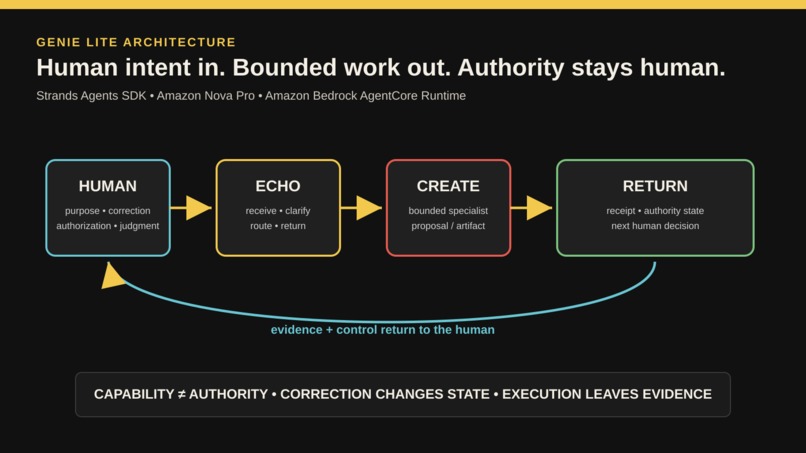
Genie Lite Architecture
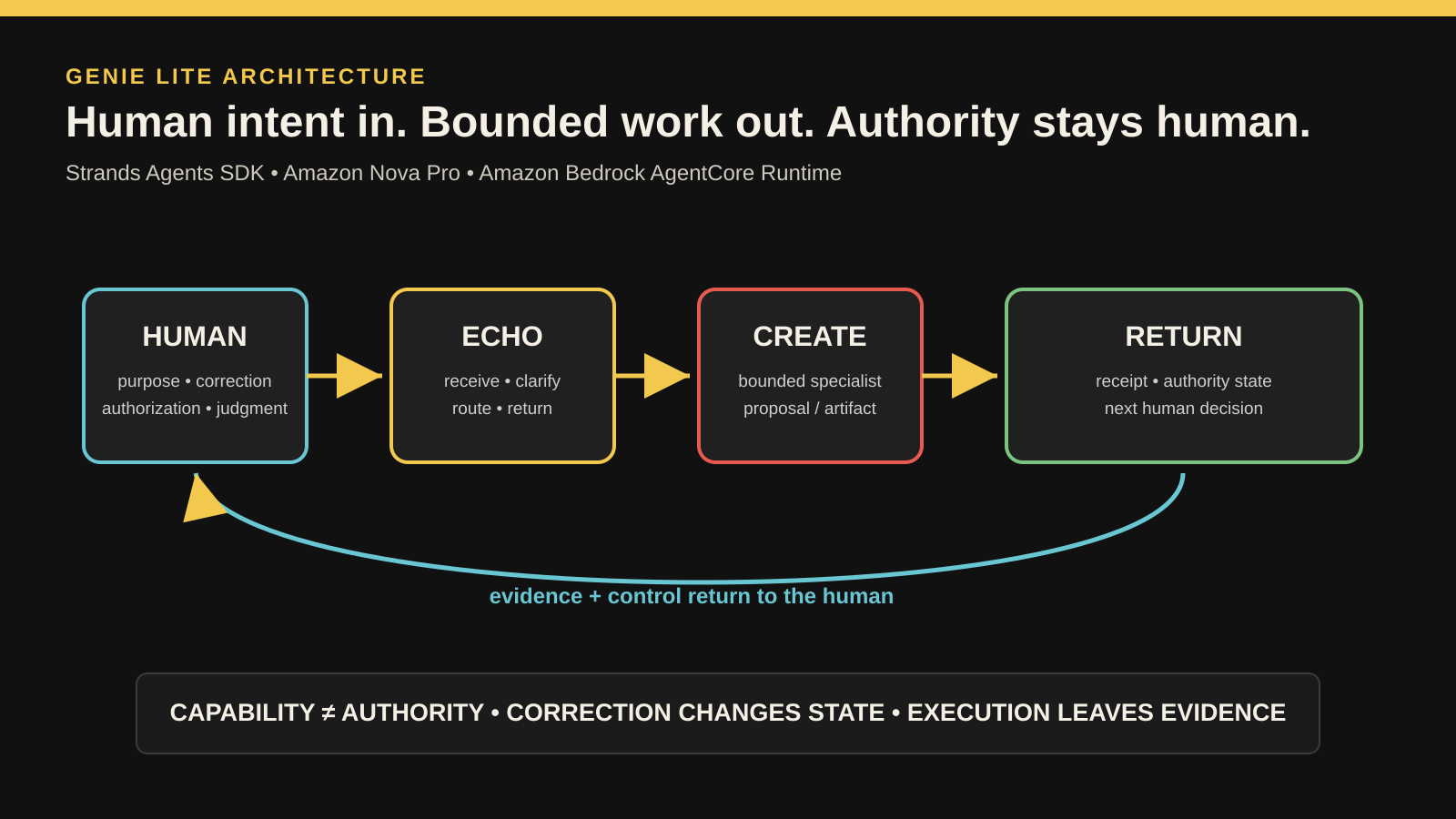
Devpost Submission Draft — Genie Lite
Track
Professional Agents
Tagline
Human-led specialist routing with explicit authority, correction, recovery, and receipts.
One-line summary
Genie Lite is a Strands-based professional agent that carries human intent into specialist work without silently transferring human authority.
The problem
As professionals use AI for more than one-shot answers, the coordination burden grows fast. A person has to remember what they asked for, which capability did the work, whether a correction actually changed the work, what is safe to resume after interruption, and what the system has or has not actually proved.
Most agent experiences optimize for capability. Genie Lite focuses on inspectability under delegation.
Who it is for
Professionals, makers, creators, and small teams using AI across multi-step or specialist work where correction, handoff, recovery, and human authority matter.
What Genie Lite does
A human speaks to Echo, the conversational bridge. Echo carries the request to CREATE, one bounded specialist. CREATE returns specialist work through Echo. If the human corrects the direction, the next specialist brief and result must materially change. Receipts expose the route, return, authority state, and claim limits.
The contest seam is:
HUMAN → ECHO → CREATE → ECHO → HUMAN
Recovery restores useful state, but stale consequential authority does not silently resume.
Why it matters
The human should be able to carry less operational complexity without surrendering the decisions that matter.
Genie Lite makes four distinctions visible:
Conversation does not equal authority.
Routing does not equal execution.
Execution does not equal verification.
Recovery does not equal permission to resume.
Built with
- Strands Agents
- Amazon Bedrock AgentCore
- Amazon Nova Pro (
amazon.nova-pro-v1:0) - Python
- AgentCore CodeZip deployment
Technical implementation
Genie Lite uses a Strands/AgentCore runtime with one visible specialist route. The implementation includes explicit state, authority, correction, recovery, and receipt behavior rather than burying those boundaries in the system prompt.
The project is deployed to Amazon Bedrock AgentCore in us-east-1; AgentCore reports the runtime as deployed and READY. A post-deploy diff reports no infrastructure drift.
What is proved
- six deterministic credit-free tests pass
- Echo→CREATE routing is visible
- correction changes the next specialist brief/artifact
- receipts expose route, return, authority state, and limits
- stale consequential authority expires after interruption/recovery
- AgentCore configuration validates
- public repository is receiver-readable
- AgentCore deployment completed successfully
- runtime reports deployed /
READY - post-deploy diff reports no differences
Current live-provider limitation
The first deployed Amazon Nova Pro invocation reached the runtime but returned a provider daily-token ThrottlingException.
We preserved that as an inspectable limitation instead of changing models, regions, or architecture to manufacture a green result. If the quota clears before submission close, the deployed normal/correction trace will be added as an evidence upgrade.
Until then, we do not claim a successful deployed model conversation.
What we do not claim
Genie Lite is not presented as production-ready, managed long-term memory, a generalized AI companion, or managed durable recovery. It does not automatically continue human authority after interruption.
What we learned
A useful human-led agent system needs more than capability. It needs boundaries that survive correction, handoff, and interruption.
The most important design lesson was:
The human can carry less complexity without giving the system more authority.
Repository
https://github.com/finious/genie-lite
Judge path
https://github.com/finious/genie-lite/blob/main/docs/JUDGE_START_HERE.md
Built With
- agentcore-codezip
- amazon-bedrock-agentcore
- amazon-nova-pro
- python
- strands-agents