Inspiration
We’ve all been there—starting at a massive codebase, feeling lost and unsure where to begin. As students, interns, and contributors, we were inspired to build GENIE to fix that. We wanted to create an AI-powered mentor that helps developers explore, understand, and contribute to any GitHub repository with confidence. GENIE was born out of our own frustrations and a desire to make onboarding and collaboration easier, faster, and more intelligent.
What it does
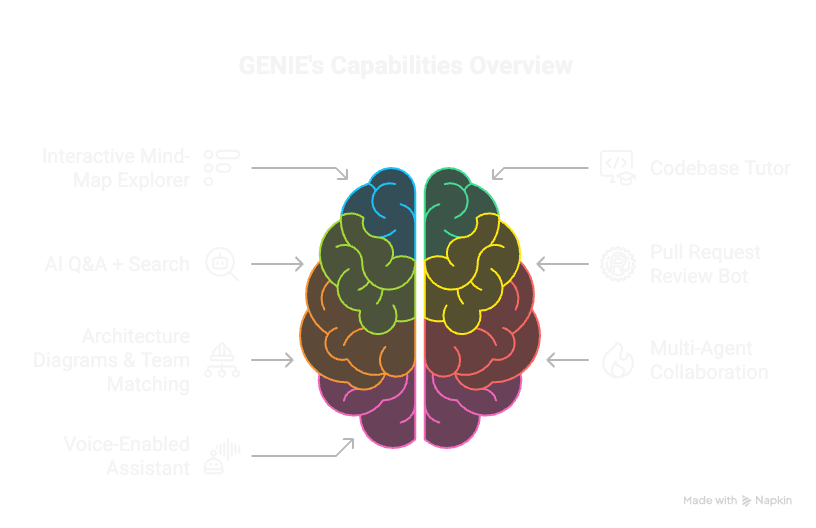
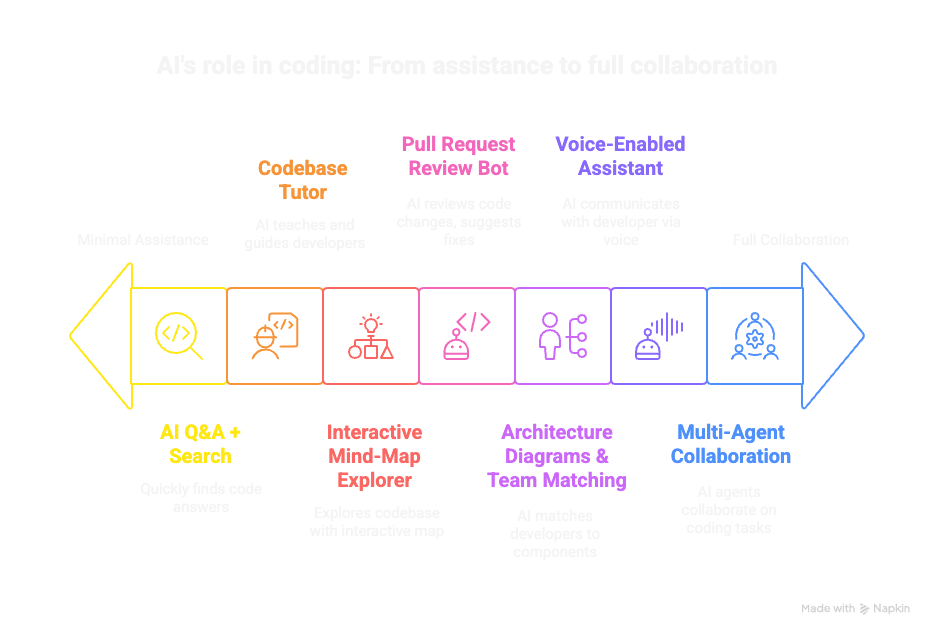
GENIE is a multi-agent AI system designed to assist developers in every stage of codebase interaction:
- Interactive Mind-Map Explorer: Auto-generates visual, clickable maps of the code structure.
- Codebase Tutor: Breaks down code into digestible modules with personalized learning paths.
- RAG-Powered Search & Q&A: Natural language search across code, docs, and issues with cited answers.
- AI-Assisted Pull Request Reviews: Summarizes, critiques, and suggests improvements for PRs.
- Auto-Generated Architecture Diagrams: Generates UML/Mermaid visuals from code and PR diffs.
- Skill-Based Matching: Recommends contribution points based on commit history and developer profile.
- Multi-Turn Chat & Voice Agents: Conversational codebase navigation with memory and intent tracking.
How we built it
We combined several powerful tools and frameworks to bring GENIE to life:
- Frontend: Built with NextJS, TailwindCSS, Shadcn and React bits for UI, animation and visual maps.
- Backend: Node.js, Express, uploadthing for user image upload, NeonDB + ORM Postgresql for user tracking, and Python for orchestrating agent workflows and static analysis.
- LLMs & RAG: Integrated OpenAI/Gemini models via LangChain for contextual understanding and retrieval-based answers.
- Visualization: Used D3.js and Mermaid.js to render mind maps, sequence diagrams, and architecture flows.
- APIs & Integration: GitHub API, Slack, Jira, Notion for bi-directional sync and live interaction.
Challenges we ran into
- Keeping multi-turn conversations context-aware without losing accuracy
- Extracting meaningful structure from untyped or loosely-coupled codebases
- Rate-limiting issues when accessing external APIs (GitHub, Slack)
- Designing UX that’s both powerful and beginner-friendly
- Coordinating multiple AI agents with distinct responsibilities in real time
Accomplishments that we're proud of
- Building a working prototype that visualizes a repo as an interactive mind map
- Creating voice-enabled chat agents that understand code context
- Generating real-time PR summaries and architecture diagrams
- Designing an onboarding experience that mimics a personalized tutor
- Seamless integration with GitHub, Slack, and Jira for team collaboration
What we learned
- The power of Retrieval-Augmented Generation (RAG) to enhance code comprehension
- How to design modular AI agent systems for real-world workflows
- The importance of UI/UX in developer tools
- Advanced GitHub API usage and static code parsing
- Best practices for LLM integration with privacy and performance in mind
What's next for GENIE (GitHub Enhanced Neural Intelligence Explorer)
- Deploying GENIE as a VS Code extension and GitHub App
- Adding real-time pair programming suggestions with AI copilots
- Training fine-tuned LLMs on specific company codebases for internal use
- Integrating compliance scanning and IP-safe private LLM deployment
- Expanding to support GitLab, Bitbucket, and enterprise systems
GENIE is just getting started. We believe this agent-driven future will redefine how developers learn, collaborate, and ship better software.
Built With
- authjs
- d3.js
- docker
- express.js
- faiss
- geminiprovision
- github
- javascript
- jira
- langchainmemory
- mermaid.js
- nextjs
- node.js
- notion
- oauth
- postgresql
- python
- react
- reactbit
- shadcn
- slack
- tailwindcss
- typescript
- uploadthing
- vercel
- whisper


Log in or sign up for Devpost to join the conversation.