AuditAgent_Network
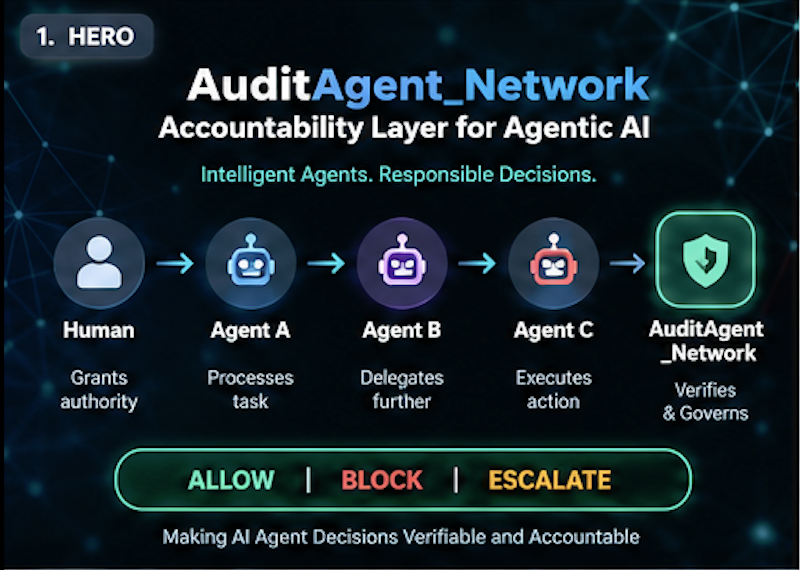
Making AI Agent Decisions Verifiable and Accountable
🚨 The Problem
AI agents are increasingly able to delegate tasks, call tools, collaborate with other agents, and make consequential decisions.
But when a task passes through multiple autonomous agents, accountability can disappear.
Consider:
Human → Agent A → Agent B → Agent C → High-Impact Action
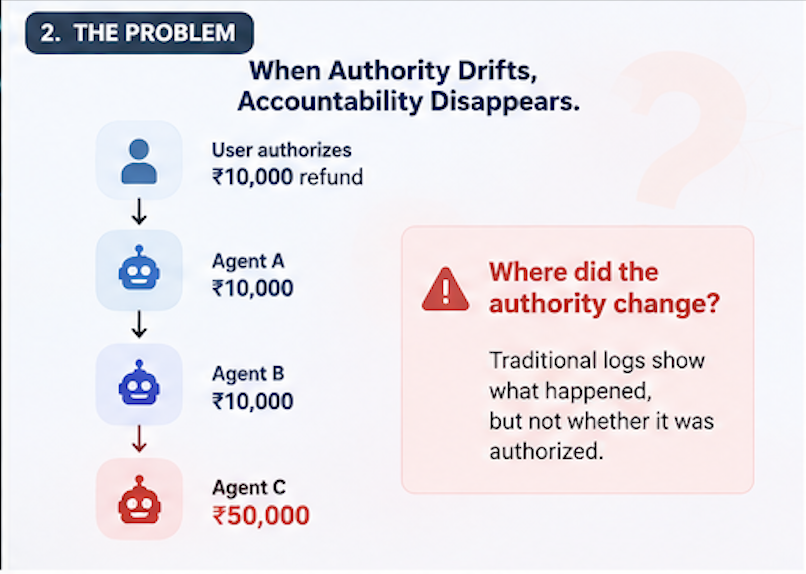
A user may authorize Agent A to perform an action within a specific limit. Agent A delegates to Agent B, which delegates to Agent C. During this process, the downstream agent may exercise more authority than was originally granted.
For example:
User authorizes: ₹10,000 refund

Agent A → ₹10,000
Agent B → ₹10,000
Agent C → ₹50,000

🚨 Where did the authority change?
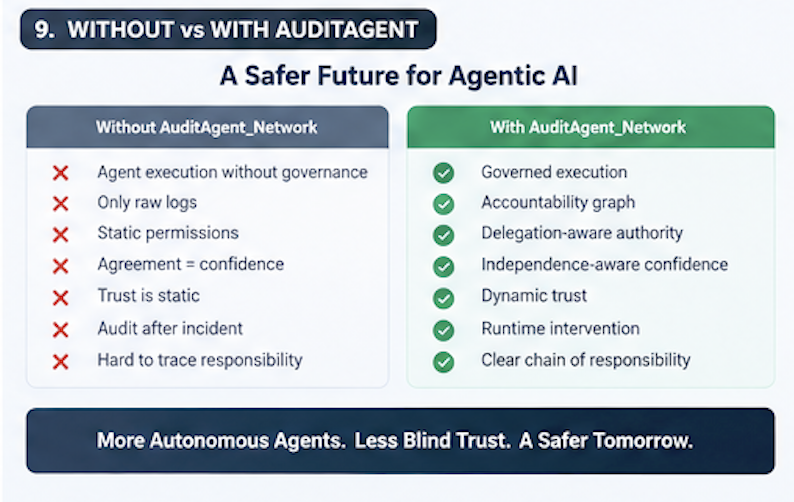
Traditional logs can show what happened, but they don't necessarily answer:
- Who authorized the action?
- What authority was delegated?
- Did authority expand during delegation?
- Which agent became responsible?
- Was the audit actually independent?
- Should the action be allowed?
This is the accountability gap in delegated Agentic AI.
💡 Our Solution
AuditAgent_Network is a runtime AI accountability and governance layer for multi-agent systems.
We are not building another agent orchestration framework.
Instead, we focus on a missing layer around agent execution:
Can we continuously prove that every downstream agent is acting within its delegated authority?
The system observes the delegation chain, evaluates authority, policy, evidence and risk, and produces a runtime decision:
ALLOW → BLOCK → ESCALATE
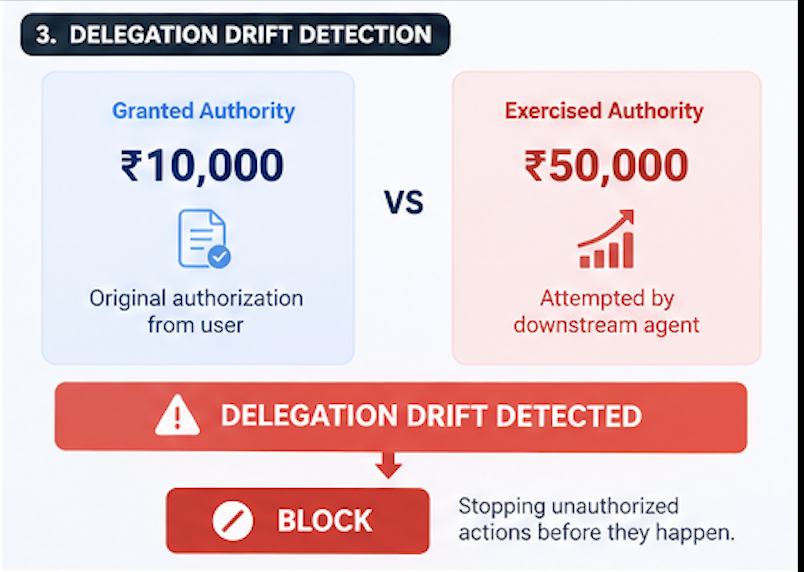
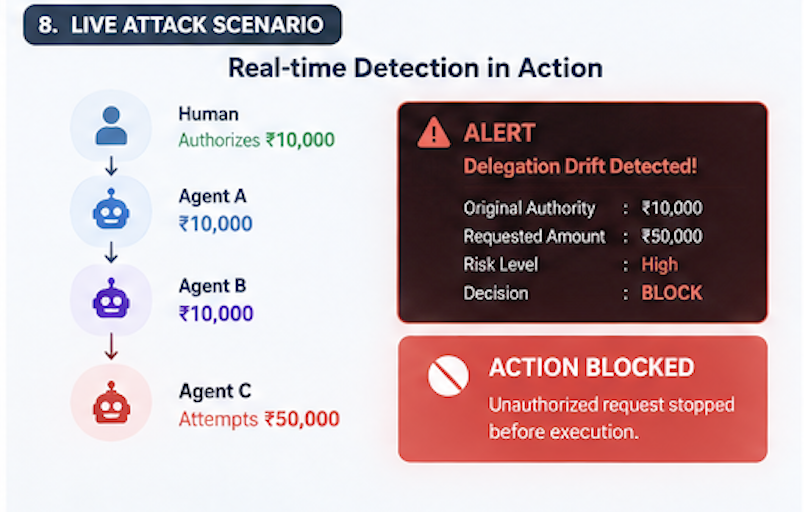
Our flagship capability is Delegation Drift Detection.
If an agent attempts to exercise authority beyond what it inherited from the original authorization, AuditAgent_Network detects the drift and can block the action before execution.
🔥 What Makes Us Different?
Frameworks such as LangGraph help developers build and orchestrate agent workflows.
We use a different perspective:
LangGraph can represent the workflow. AuditAgent_Network represents accountability around that workflow.
A workflow answers:
"Which agent executes next?"
Our accountability layer asks:
"Was that agent authorized to perform this action?"
Our system adds four key mechanisms:
1. Delegation Drift Detection
Continuously compares:
Granted Authority vs. Exercised Authority
Example:
Original Authority:  ₹10,000
Observed Authority: ₹50,000

       ↓

🚨 DRIFT DETECTED

       ↓

BLOCK
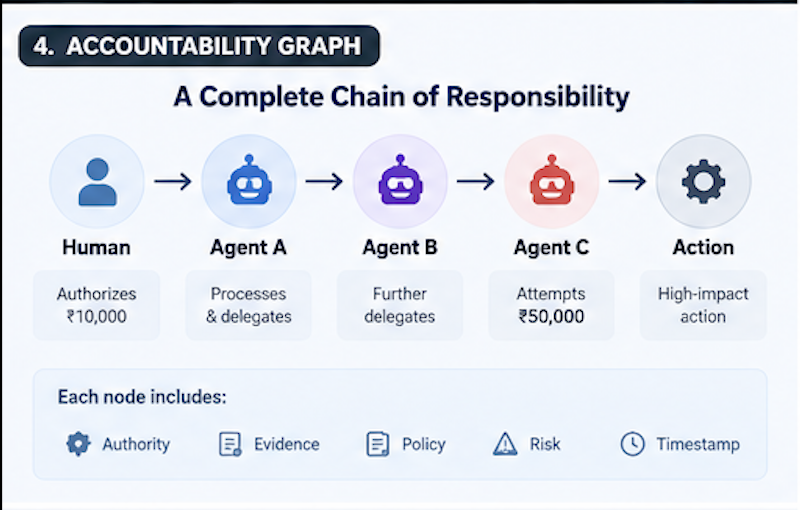
2. Accountability Graph
We create a traceable chain:
Human → Agent A → Agent B → Agent C → Action
along with authority, evidence, policy and risk information.
This allows a decision to be reconstructed as an accountability chain rather than merely as disconnected logs.
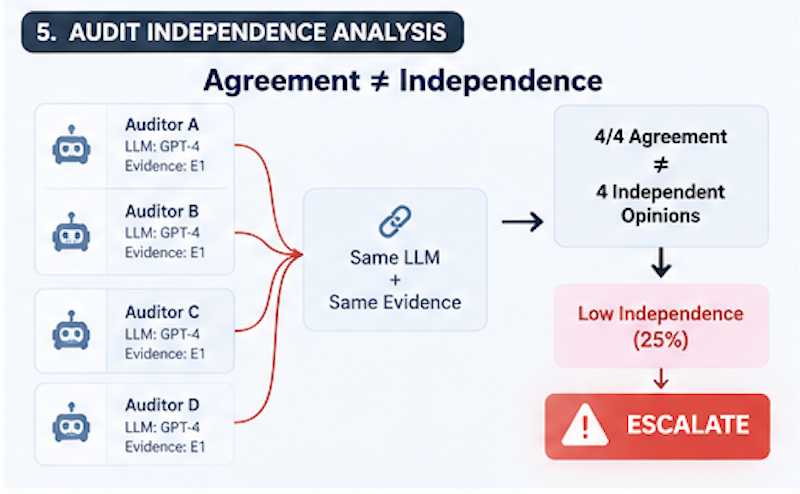
3. Audit Independence Analysis
Multiple auditors agreeing does not automatically mean independent verification.
If four auditors depend on the same LLM and evidence:
Auditor A ─┐
Auditor B ─┤
Auditor C ─┼→ Same LLM + Same Evidence
Auditor D ─┘

4/4 Agreement
       ≠
4 Independent Opinions
AuditAgent_Network analyzes this correlation and can escalate decisions when apparent consensus lacks sufficient independence.
4. Dynamic Agent Trust
Agent trust is not treated as permanently static.
Historical behavior and audit outcomes can influence future trust and delegation decisions.
🏗️ How We Built It
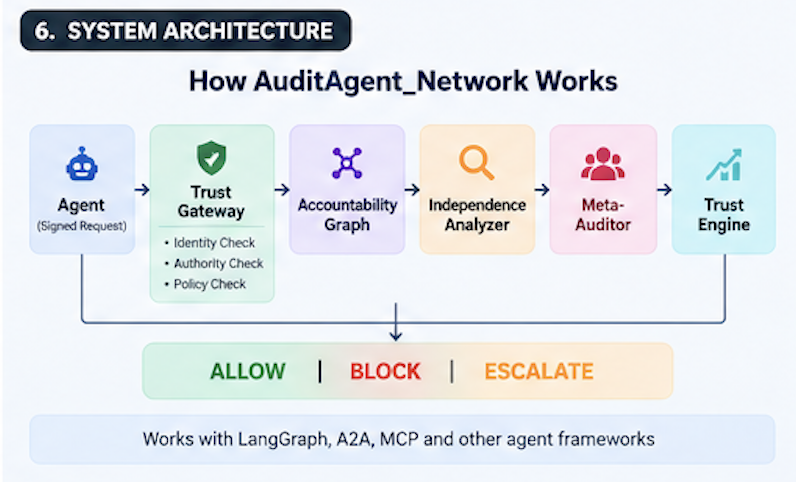
Our runtime pipeline is:
Agent
  ↓
Signed Delegation Request
  ↓
Trust Gateway
  ├── Identity Check
  ├── Authority Check
  └── Policy Check
  ↓
Accountability Graph
  ↓
Independence Analyzer
  ↓
Meta-Auditor
  ↓
Trust Engine
  ↓
ALLOW / BLOCK / ESCALATE
The architecture is designed to work alongside agent interoperability and orchestration technologies such as A2A, MCP and LangGraph, rather than replacing them.
🛠️ Built With
- Python
- FastAPI
- LangGraph
- Custom AI Agents
- A2A
- MCP
- NetworkX / Neo4j
- PostgreSQL
- Configurable LLM APIs
- React
🧪 Our Hackathon Demonstration
Our core demonstration uses a high-impact action delegated through multiple agents.
Normal execution
Human
 ↓
Agent A — ₹10,000
 ↓
Agent B — ₹10,000
 ↓
Agent C — ₹10,000
 ↓
✅ ALLOW
Delegation drift
Human
 ↓
Agent A — ₹10,000
 ↓
Agent B — ₹10,000
 ↓
Agent C — attempts ₹50,000
 ↓
🚨 DRIFT DETECTED
 ↓
❌ BLOCK
The system then records the accountability chain and updates the downstream agent's trust state.
🧠 What We Learned
The biggest lesson from building AuditAgent_Network was that Agentic AI reliability is not only a model intelligence problem.
An autonomous system can produce a technically valid decision while still violating the authority granted to it.
We therefore explored accountability as a combination of:
Identity + Authorization + Evidence + Policy + Risk + Independent Verification + Trust
We also learned that interoperability and accountability are different problems.
A2A and MCP can help agents communicate and access tools. Our contribution focuses on maintaining accountability as authority and decisions propagate through those agents.
🚧 Challenges
The hardest part was determining how to maintain a reliable chain of responsibility across multiple autonomous agents.
We needed to distinguish between:
- original authority,
- inherited authority,
- exercised authority,
- evidence used for decisions,
- policy constraints,
- auditor independence,
- and historical agent behavior.
Another challenge was balancing autonomy with safety.
Instead of requiring humans to approve every action, our design allows normal low-risk actions to proceed automatically while high-risk actions can be escalated for human approval.
🌍 Impact
AuditAgent_Network is designed for environments where autonomous AI can make consequential decisions.
Potential applications include:
- Financial approvals
- Refund and payment workflows
- Enterprise automation
- Security operations
- Compliance
- Insurance
- Procurement
- High-impact AI decision systems
For enterprises, our goal is:
Connect more autonomous agents without blindly trusting every downstream agent.
For security teams:
Detect unauthorized or risky actions before execution.
For auditors:
Move from raw logs to structured accountability graphs.
For regulated organizations:
Generate machine-readable governance evidence for consequential AI decisions.
🚀 What's Next?
We want to take AuditAgent_Network from a controlled prototype toward a production-ready governance layer for real-world Agentic AI systems.
Future work includes:
- stronger agent identity,
- cryptographically verifiable delegation,
- richer policy enforcement,
- scalable accountability graphs,
- improved independence measurement,
- continuous trust calibration,
- and enterprise integrations.
🏆 Our Core Idea
We are not trying to replace LangGraph, A2A, MCP, or existing agent frameworks.
We are addressing a different problem.
Existing systems help agents communicate and execute.
AuditAgent_Network helps make delegated execution accountable.
Our goal is to make autonomous AI decisions not only intelligent, but also:
Authorized. Traceable. Auditable. Verifiable. Accountable.
Built With
- a2a
- agentic
- enterprise
- fastapi
- governance
- langgraph
- llm
- mcp
- multi-agent
- neo4j
- networkx
- postgresql
- python
- react
- safety
- systems

Log in or sign up for Devpost to join the conversation.