-
-
the project is added in the zip file
Inspiration
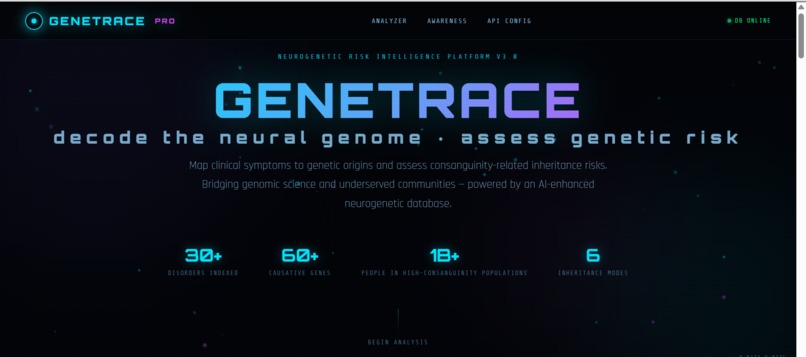
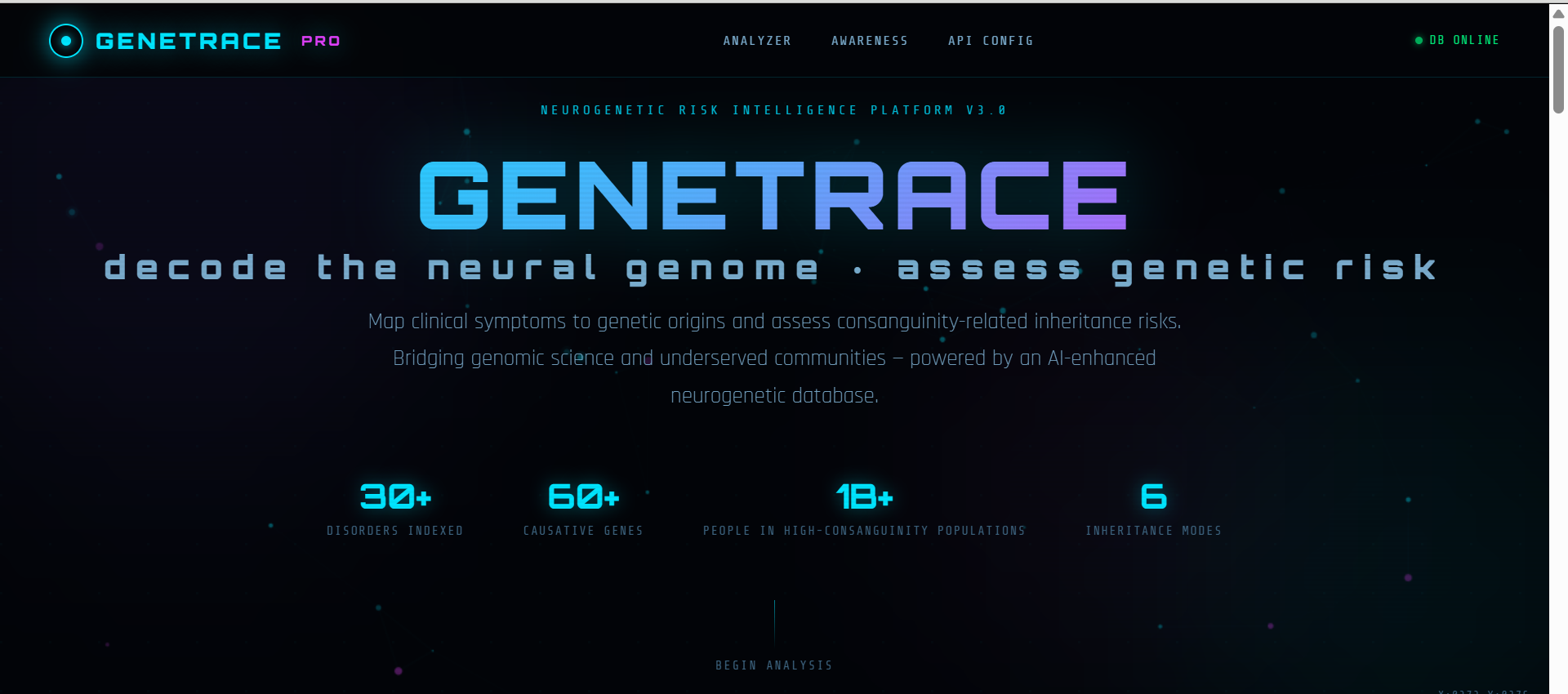
GeneTrace Pro is an AI-powered neurogenetic risk intelligence platform that helps families and clinicians identify rare neurological genetic diseases from symptom inputs. It cross-references a curated database of 20+ rare neurogenetic disorders using a weighted symptom-matching algorithm, then uses Claude AI to generate plain-language explanations for non-specialist users. The platform includes a dedicated Consanguinity Risk Module — a first-of-its-kind feature for populations where consanguineous marriages are common (South Asia, MENA, Turkey). It calculates autosomal recessive risk multipliers based on degree of relatedness, visually compares population-level risk, and generates a prioritized clinical action plan. GeneTrace Pro runs entirely in the browser as a single HTML file — no backend, no installation, no internet required after loading. Every analysis can be downloaded as a printable clinical repor Tech Stack • HTML5, CSS3, Vanilla JavaScript (zero-dependency front-end) • Anthropic Claude API (claude-sonnet-4-20250514) — plain-language AI synthesis • Custom weighted symptom-matching algorithm • Canvas API for live neural network background animation • OMIM, Orphanet, and NIH GTR as disease data references
What it does
- User enters neurological symptoms via free text or quick-tap tags
- Optional consanguinity module: toggle on, select degree of relatedness
- Weighted algorithm scores symptom overlap across 20+ disease profiles
- Results display matched diseases with genes, inheritance, OMIM links, and match confidence
- Claude AI generates a compassionate plain-language explanation for families
- Consanguinity panel shows risk multipliers, comparison bars, and recommended next steps
- Printable clinical report generated on demand
How we built it
The disease database was manually curated from OMIM and Orphanet, with weighted symptom importance vectors assigned per condition. The matching algorithm computes weighted intersection scores and applies a threshold for high/moderate/low confidence. The consanguinity module uses established population genetics coefficients (F values) to calculate risk multipliers. The Claude AI integration uses a structured prompt system that passes matched disease data and family history to generate contextually appropriate explanations.
Challenges we ran into
• Calibrating symptom weights to avoid false positives while maintaining recall for rare conditions • Designing a consanguinity risk UI that is clinically accurate but not alarming to non-specialist users • Making the AI output useful for families in low-resource settings — language had to be warm, non-technical, and actionable
Accomplishments that we're proud of
• First browser-based tool combining neurogenetic symptom mapping with consanguinity risk assessment • Covers 20+ rare diseases including the full NCL/Batten family, lysosomal storage disorders, mitochondrial conditions, and motor neuron diseases • Zero backend — fully offline capable after initial load • Built for real global need: populations with highest consanguinity rates also have lowest access to genetic counseling
What we learned
• The clinical depth required for rare disease AI: symptom patterns, inheritance modes, and molecular genetics must all be accurate • Plain-language generation with AI requires careful prompt design to avoid both alarming and under-informing families • Consanguinity is a public health topic rarely addressed in digital health tools, despite affecting over a billion people
What's next for GeneTrace_Pro
• Expand disease database to 50+ conditions across all rare disease categories • Add pedigree visualization tool for family history mapping • Multi-language support (Urdu, Arabic, Turkish, French) • Integrate with WHO genetic counseling referral directories • Partner with hospital genetics departments in South Asia and MENA for clinical validation
Built With
- and
- css3
- nih
- orphanet
- tech-stack-?-html5
- vanilla-javascript-(zero-dependency-front-end)-?-anthropic-claude-api-(claude-sonnet-4-20250514)-?-plain-language-ai-synthesis-?-custom-weighted-symptom-matching-algorithm-?-canvas-api-for-live-neural-network-background-animation-?-omim


Log in or sign up for Devpost to join the conversation.