-
-
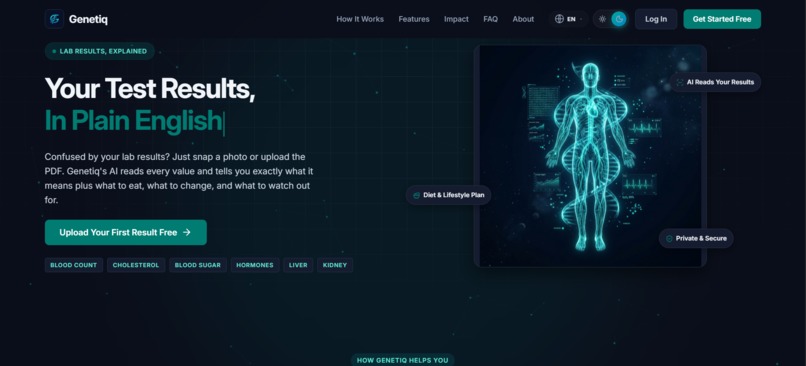
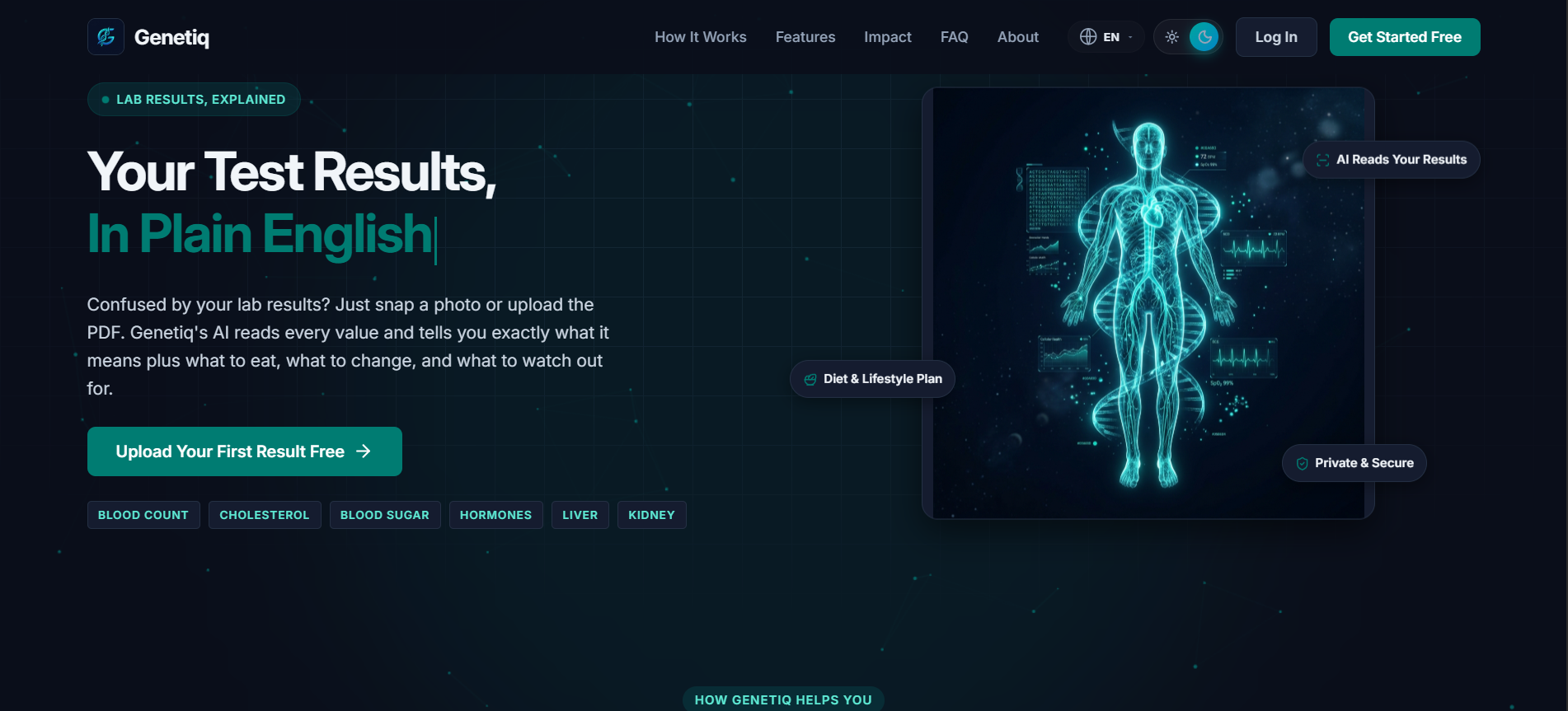
Landing Page
-
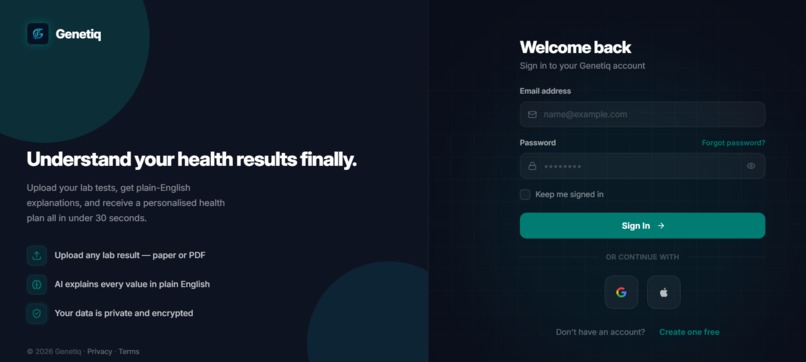
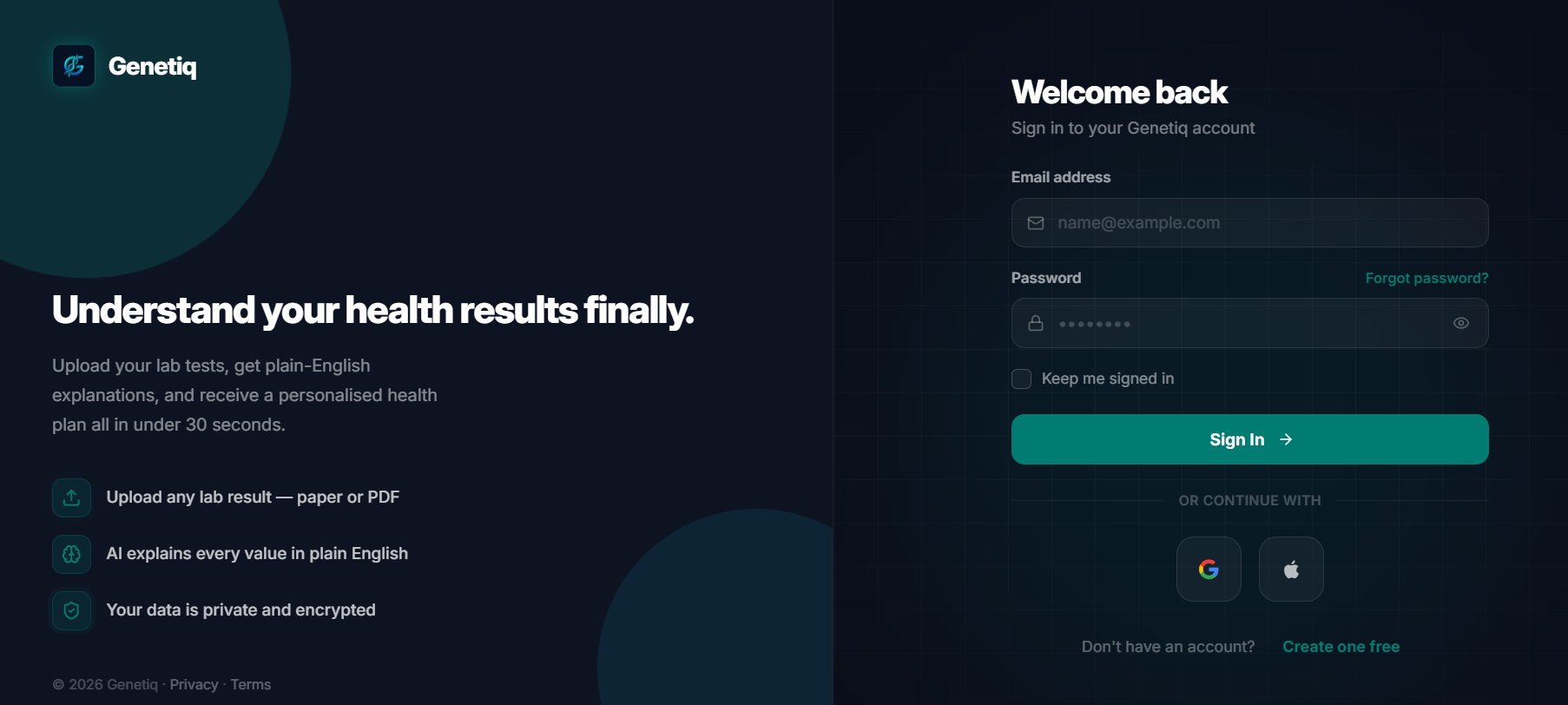
Login Page
-
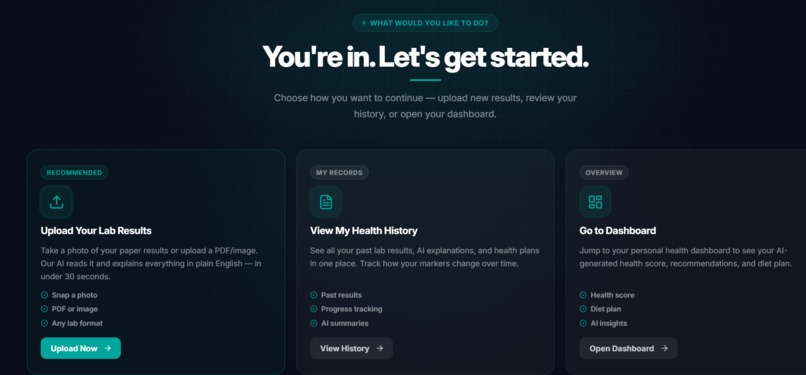
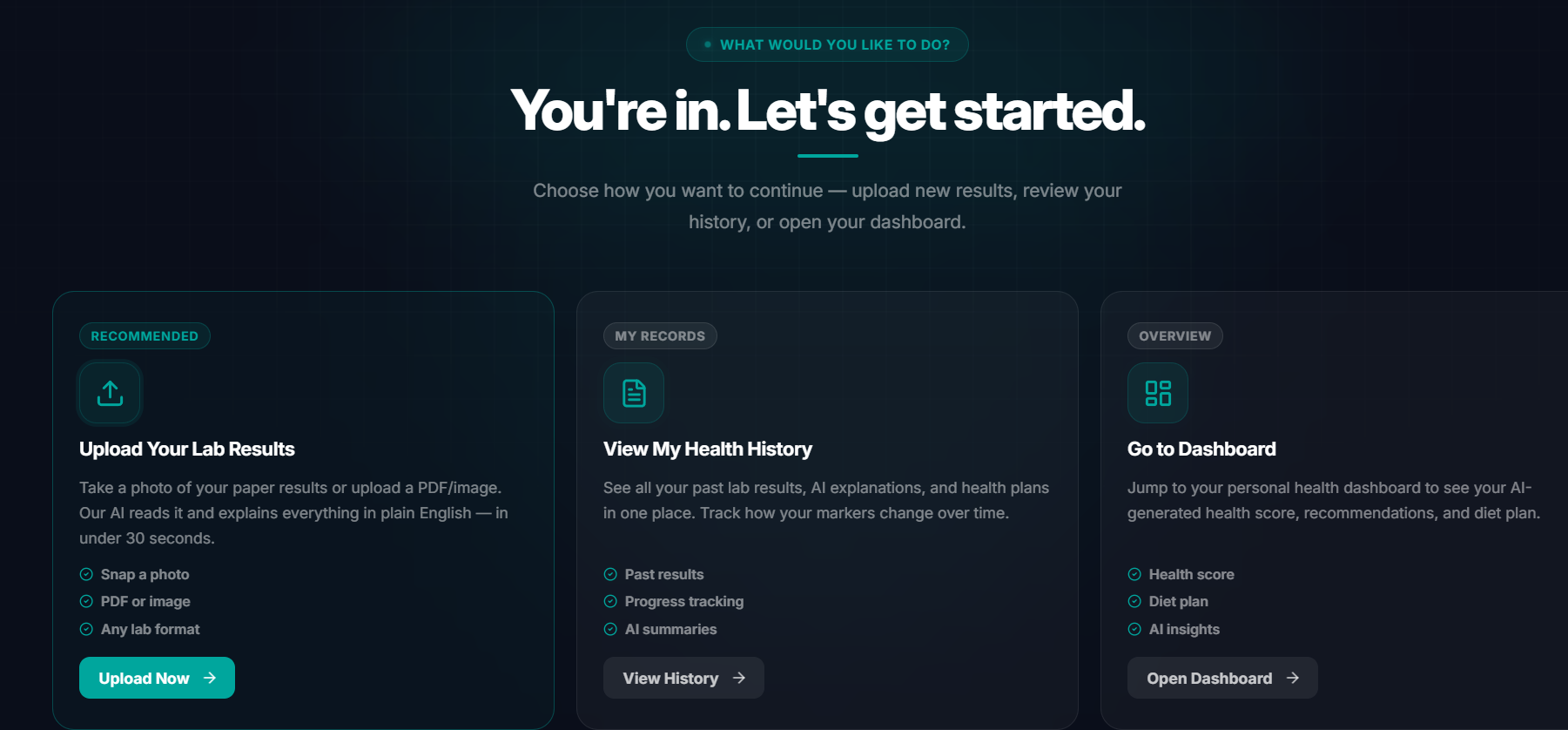
Upload file Page
-
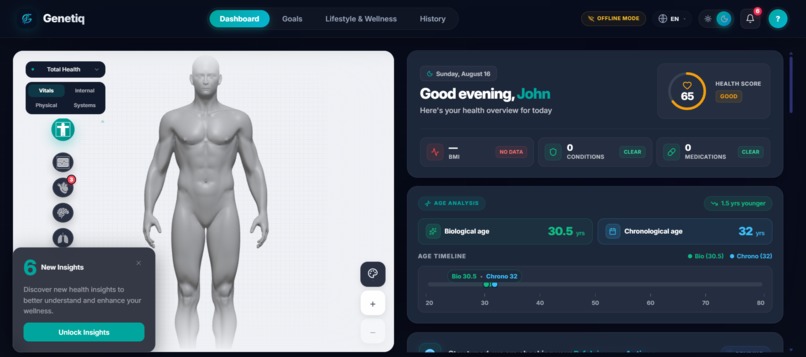
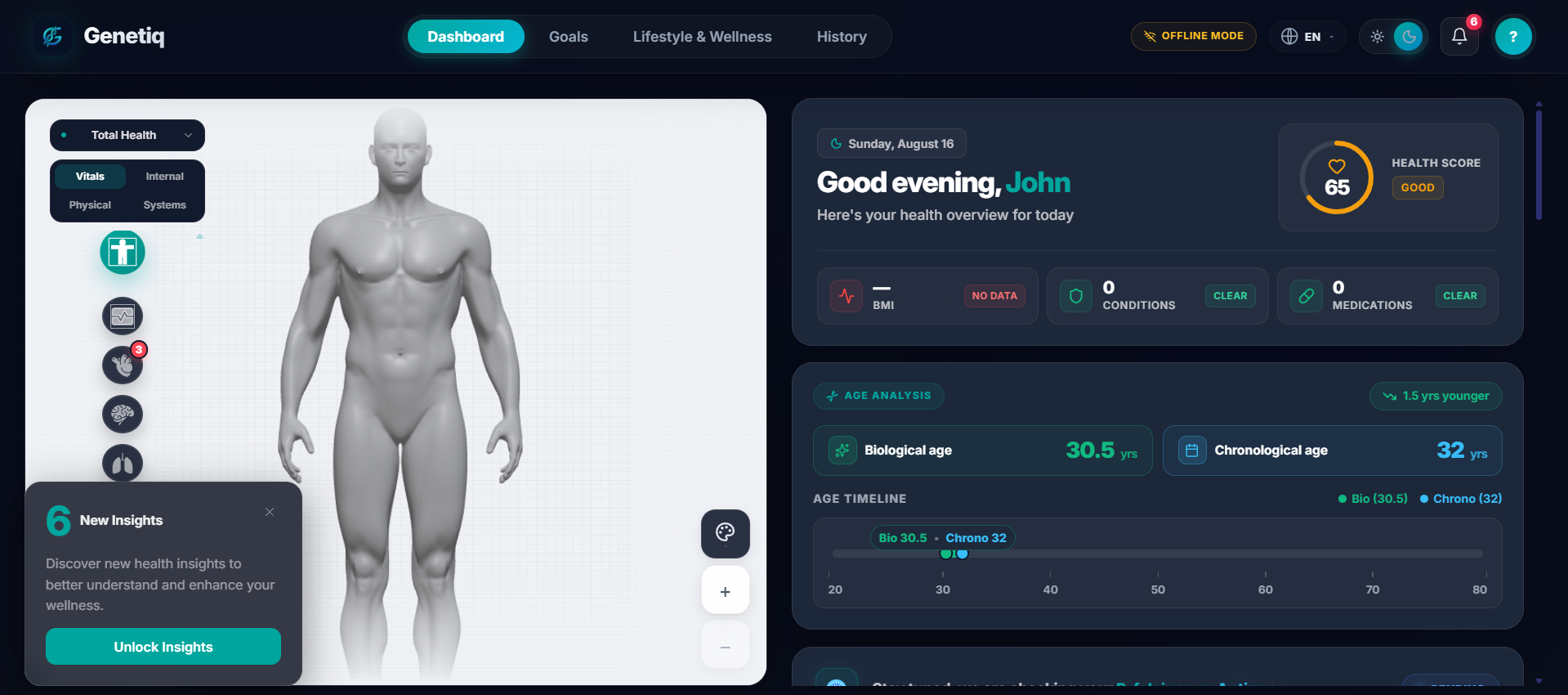
Dashboard Page
Inspiration
In Ghana, the healthcare system is facing a severe infrastructural bottleneck. As developers, we watched family members and people in our communities receive complex medical lab results filled with dense jargon. Because they didn't understand the terminology, they would wait days sometimes weeks just to get a five-minute consultation with a specialist who would simply translate the document into everyday language.
What it does
Genetiq is a multi-lingual AI health platform that acts as a patient’s "3D digital twin." It allows users to either chat with an AI symptom checker or directly upload raw medical lab results. The platform parses the unstructured data, translates the clinical jargon into a 6th-grade reading level, and translates those insights into 4 widely spoken local languages (including Twi, Ga, Ewe and Fante).
To ensure total accessibility, Genetiq reads the results aloud using native text-to-speech. Simultaneously, it maps the data onto an interactive 3D human anatomical model, highlighting the exact organ affected. If the AI determines the patient needs professional care, an integrated telehealth scheduler allows them to instantly book a phone or video consultation.
How we built it
We are a team of intermediate developers who love pushing our boundaries, so we built Genetiq using a modern, full-stack architecture:
Frontend: We used React , styled with Tailwind CSS, to build a fast, responsive web application that works on low-bandwidth connections.
AI Backend & Data Parsing: We integrated powerful gemini LLM APIs to handle the complex reasoning required to extract biomarkers from unstructured text and map them to plain language.
3D Visualization: We utilized React Three Fiber (Three.js) to render lightweight .glb 3D human anatomy models directly in the browser, achieving smooth 60fps performance without requiring heavy graphics hardware.
Audio & Translation: We incorporated Text-to-Speech (TTS) models to generate natural-sounding local dialect audio.
Challenges we ran into
We ran into several major technical hurdles during development:
Unstructured Data: Medical PDFs are notoriously messy. Building a reliable pipeline to parse OCR data into clean JSON that the LLM could actually understand took significant prompt engineering and trial-and-error.
WebGL Performance: Getting a 3D human body to render smoothly on an average mobile browser was tough. We had to aggressively optimize our .glb models, reduce polygon counts, and manage lighting effectively in Three.js so the app wouldn't crash older phones.
Medical Nuance in Local Languages: Translating complex terms like "hepatic steatosis" into local dialects like Twi without losing medical accuracy was incredibly challenging and required careful calibration of our translation prompts.
Accomplishments that we're proud of
Cracking the 3D WebGL Performance: We had very little experience with React Three Fiber before this project. Figuring out how to load a complex .glb human anatomy model, optimize the polygons, and get it to render smoothly at 60fps on a standard mobile browser without crashing was a massive technical win for us.
The Multi-Lingual Audio Pipeline: Getting an LLM to simplify medical jargon is one thing, but chaining that output into a multi-lingual translation pipeline and hooking it up to native Text-to-Speech APIs for dialects like Twi and Hausa was complex. Seeing it successfully read a translated diagnosis aloud for the first time felt like a breakthrough for accessibility.
Taming Messy Unstructured Data: Real-world medical PDFs are incredibly messy. We are extremely proud of the prompt engineering and backend pipeline we built to handle OCR data, forcing the AI to return clean, reliable JSON biomarkers without hallucinating or losing medical context.
Shipping a Complete Ecosystem: We didn't just build a single feature; we connected an AI symptom checker, a PDF data parser, an interactive 3D visualizer, and a telehealth booking system into one seamless UI. Going from a blank repository to a fully functional ecosystem under severe time constraints proved to us how capable we are as a full-stack team.
What we learned
Our biggest takeaway was that building for healthcare requires profound empathy. We learned that the most advanced AI is useless if the user cannot read the output. Integrating multi-lingual audio transformed our project from a "cool tech demo" into an inclusive tool that respects the reality of regional literacy rates. On the technical side, we massively leveled up our skills in bridging AI data outputs with dynamic front-end state management and 3D rendering.
What's next for Genetiq
Zero-Knowledge Privacy: We plan to transition our data processing to run entirely on-device, ensuring patient PDFs are never sent to external servers.
IoT Hardware Integration: We aim to connect Genetiq to low-cost biometric sensors to pull live vitals, allowing the 3D twin to update dynamically based on real-time hardware data.
Built With
- node.js
- react
- tailwing
- three.js
- typescript

Log in or sign up for Devpost to join the conversation.