-
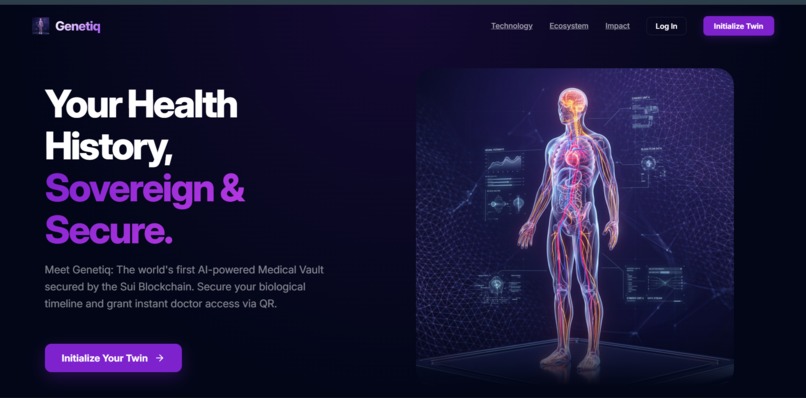
Landing Page
-
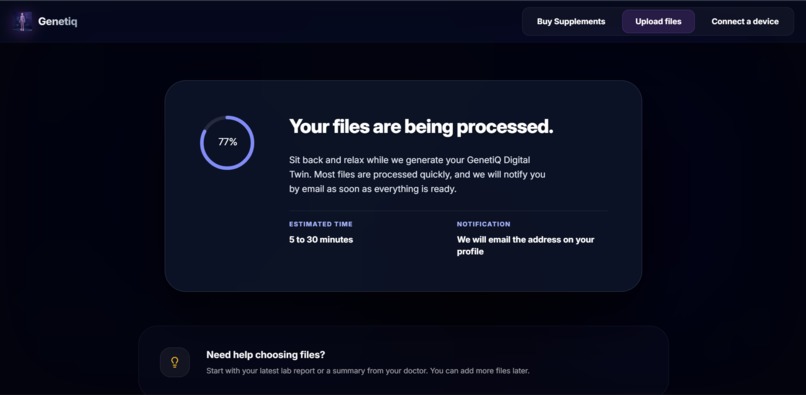
Upload file page
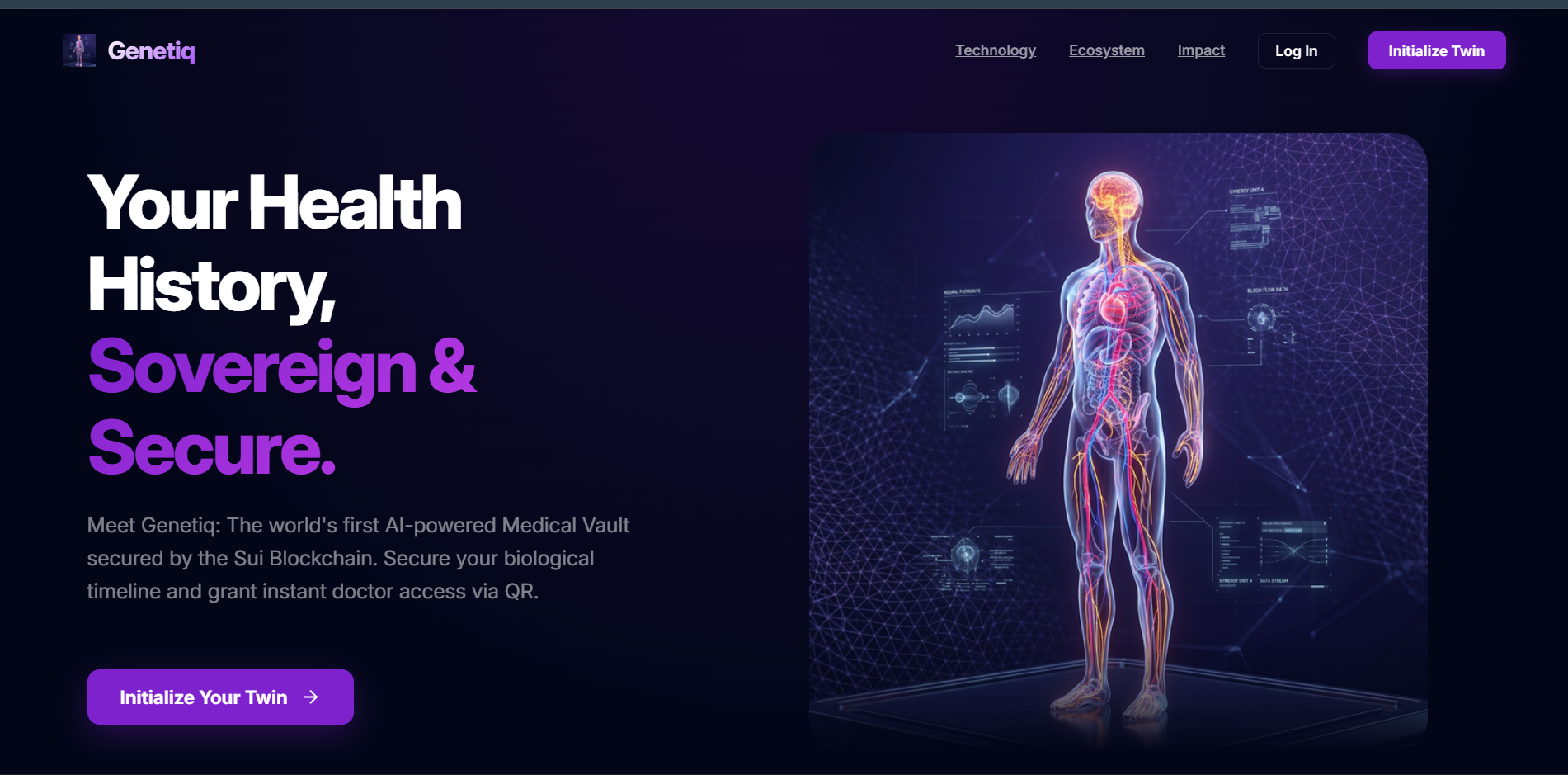
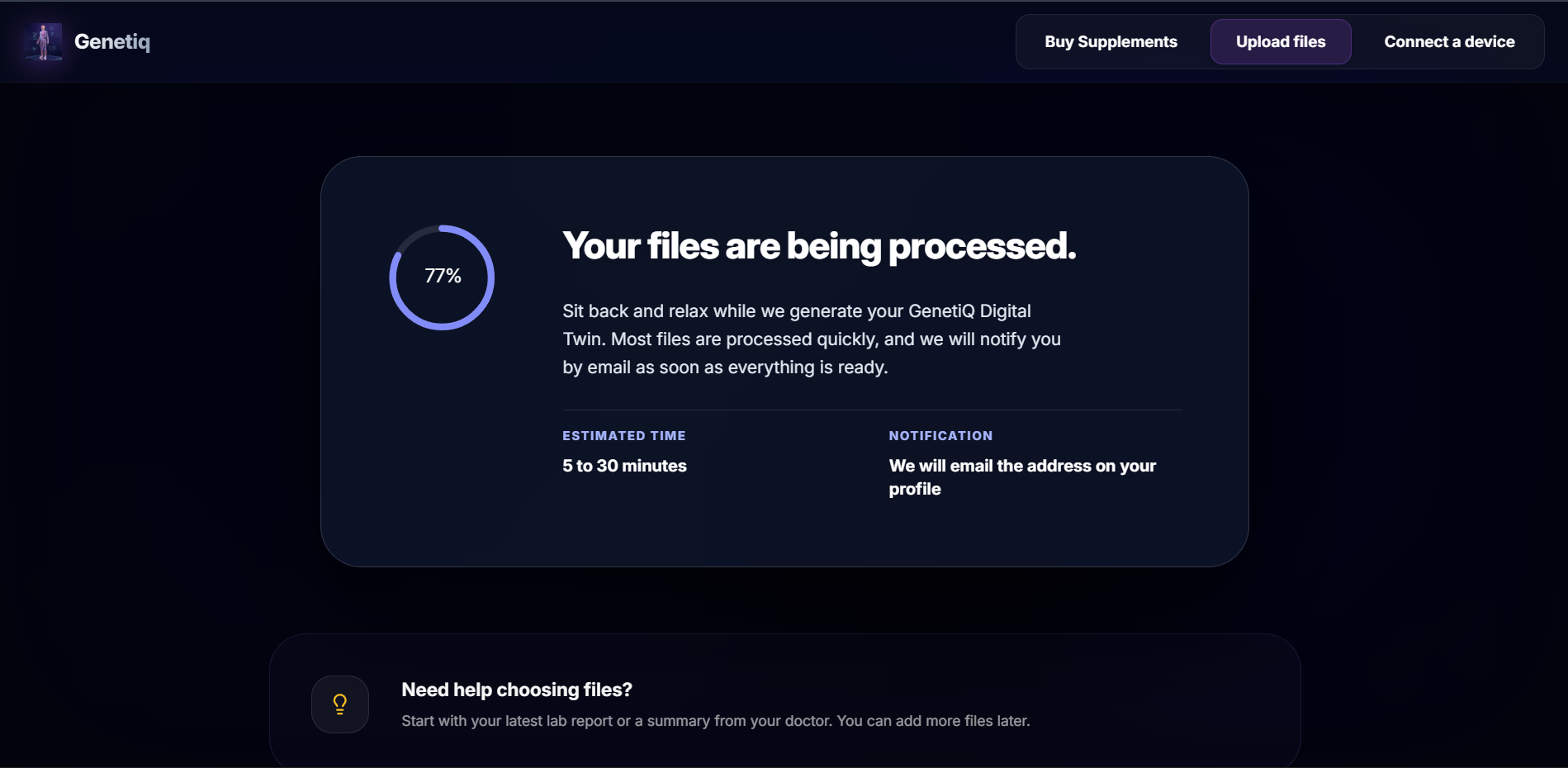
🧬 Genetiq: The Sovereign Digital Health Twin💡 The inspiration for Genetiq was born from a frustrating reality in modern healthcare: our medical data is everywhere, yet it belongs to no one. We have heart rate data on our watches, DNA results in our emails, and blood tests on paper at clinics like Korle-Bu. This fragmentation creates a "Black Box" where patients cannot visualize how their lifestyle affects their biology.I wanted to build a "Digital Twin" that wasn't just a cool 3D model, but a Sovereign Health Vault. My goal was to move from passive "Patient Records" to an active, visual, and private representation of the human body, secured by the Sui Blockchain.🏗️ How I Built the ProjectBuilding a "Living" Digital Twin required a sophisticated, multi-layered tech stack:Visualization Engine: I utilized React Three Fiber and Three.js to render a responsive 3D human model. I implemented "System Mapping" logic so that clinical data (like a high heart rate) could trigger visual "Glow" effects on specific anatomical regions.Intelligence Layer: I integrated an AI Triage Engine to process natural language symptoms. It correlates these inputs with uploaded lab results to provide a clinical risk assessment.The Trust Layer (Web3): I leveraged the Sui Network and zkLogin to ensure users could access their vault using familiar social logins while maintaining decentralized security. Every medical event is hashed and anchored to the blockchain as a unique Sui Object.Offline-First Architecture: To handle low-connectivity environments, I used IndexedDB to cache critical vitals locally, ensuring the "Digital Twin" is accessible even without a signal.🧠 What I LearnedThis project pushed me to master Sui’s object-centric model. I learned that medical records are best represented as "Owned Objects" on-chain, where permissions can be delegated rather than just shared.I also delved into the mathematics of health optimization. For example, to calculate a user's Biological Age ($A_{bio}$) based on biomarkers, I explored the use of weighted linear combinations:$$A_{bio} = \alpha + \sum_{i=1}^{n} \beta_i \cdot x_i + \epsilon$$Where:$x_i$ represents specific biomarkers (e.g., Glycated Hemoglobin, C-reactive protein).$\beta_i$ is the weight assigned to each biomarker's impact on aging.$\epsilon$ is the error term for individual genetic variance.🚩 Challenges I Faced3D Performance & UX: Rendering a high-fidelity 3D model while maintaining a smooth Glassmorphic UI on mobile devices was difficult. I had to optimize the mesh geometry and use efficient post-processing for the "Glow" effects to avoid dropping frames.Data Interoperability: Normalizing data from different sources (Apple Health vs. Manual Lab Uploads) required a custom-built "Data Ingestion" pipeline to ensure the AI received clean, structured information.Web3 Friction: Making blockchain "invisible" was a major hurdle. zkLogin was the breakthrough, allowing for a seamless transition from a standard Google login to a secure, on-chain session.🎯 ConclusionGenetiq proves that healthcare can be intuitive, visual, and private. By merging the visual power of 3D with the cryptographic security of Sui, we have created a platform where the patient is finally the true owner of their biological future.
Built With
- move
- react
- scss
- sui
- three.js
- typescript


Log in or sign up for Devpost to join the conversation.