-
-
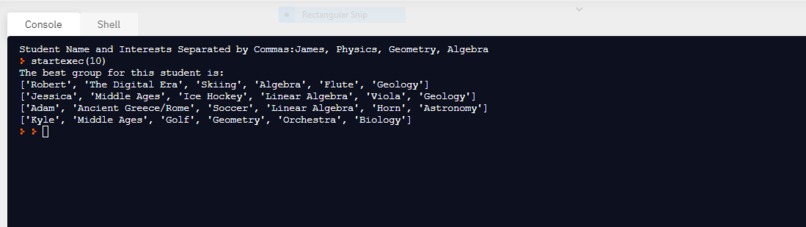
The results and how it is displayed.
Inspiration
When we went into our hackathon groups, we were expecting to have a not so great ones. This depressing mindset is a major problem in groupwork and academic success. This inspired us to create a software that matches people with similar interests together so people can feel more comfortable in their groups, and improve group dynamic.
What it does
Our program takes a person with interests, and groups them into a group which has similar interests with the person, and also similar interests with each other.
How we built it
In a key determining factor for our compatibility test, we identified that shared interests between group will better the work dynamic and flow, and make it easier for groups to work together. Therefore, we created several categories regarding academic and extracurricular life. Then, by determining the interests we created a compatibility function which checks whether a group is compatible or not by checking how many similar categories they had. The function also gave “bonus points” to those that had the exact same interests. It is great to have both of these functions, but there needs to be a base function that feeds a large amount of groups into these functions, and also improve the functions over time. We decided to use a genetic algorithm to both feed the compatibility functions a large amount of groups and to improve the group’s compatibility over time. The main determinant for how “fit” a function was to survive, was the size of the compatibility score. Those that had the greatest compatibility score were the most fit, and therefore the most compatible.
Challenges we ran into
We ran into many challenges on the rough road to success. One of them was creating a program that generates people in a classroom to test the program. This part of the code was bug-ridden and hard to make judging that there were so many interests. Another challenge was to create the genetic algorithm by itself. Though most of our group were comfortable with knowing what a genetic algorithm did, only one of us had written a program using it before, and it was a much more simpler problem than we had now. This was a huge leap for us.



Log in or sign up for Devpost to join the conversation.